Just before dark on the day after Christmas 1944, elements of Lieutenant General George S. Patton, Jr.’s 4th Armored Division, attacking from the south, succeeded in making contact with the beleaguered Americans at Bastogne. The encircled 101st Airborne Division had occupied that critically vital Belgian town for several days, categorically refusing German demands for surrender.
The dramatic linkup of the two forces broke the siege of Bastogne and was one of the great turning points in the Battle of the Bulge. This legendary event has often been described in histories of World War II, but there is a fascinating subplot to the story that is little-known.
It took the 4th Armored Division five days of bitter, costly fighting to break the ring of German units encircling the 101st, but only six days before the linkup, elements of that same division had actually been in Bastogne on the day it was being encircled. In fact, during that earlier movement into the town, those forces had come within one kilometer of the same spot to which they would return six days later, after heavy fighting. How could this have happened?
To understand this enigma, we must go back to December 8, 1944, the day the 4th Armored Division was pulled back from heavy fighting after reaching the Maginot Line, at a point a little more than nine miles from the German border. It was time for refitting and rest so that the division would be better prepared to cross the border and continue its assault to the east. The move to the rest area was not only welcome and richly deserved but necessary. The men of the division were exhausted after incessant fighting during the heavy, record-breaking November rains. The weather, the enemy and the gummy mud combined to make conditions deplorable and had taken a serious toll on the men and their tracked vehicles. Such extended breaks in the fighting were rare, and spirits were high.
At the time, I was serving with Combat Command B (CCB) of the 4th Armored Division, commanded by Brig. Gen. Holmes E. Dager, and its 8th Tank Battalion, which I commanded as a young major. During the division’s rest period my command post was in Domnon-les-Dieuze, a tiny, wet, muddy and depressing French village about 40 miles northeast of Nancy. Almost immediately, the town became littered with tank parts and equipment of all types. Not knowing how long we would be there, the men wasted no time in tackling their tasks.
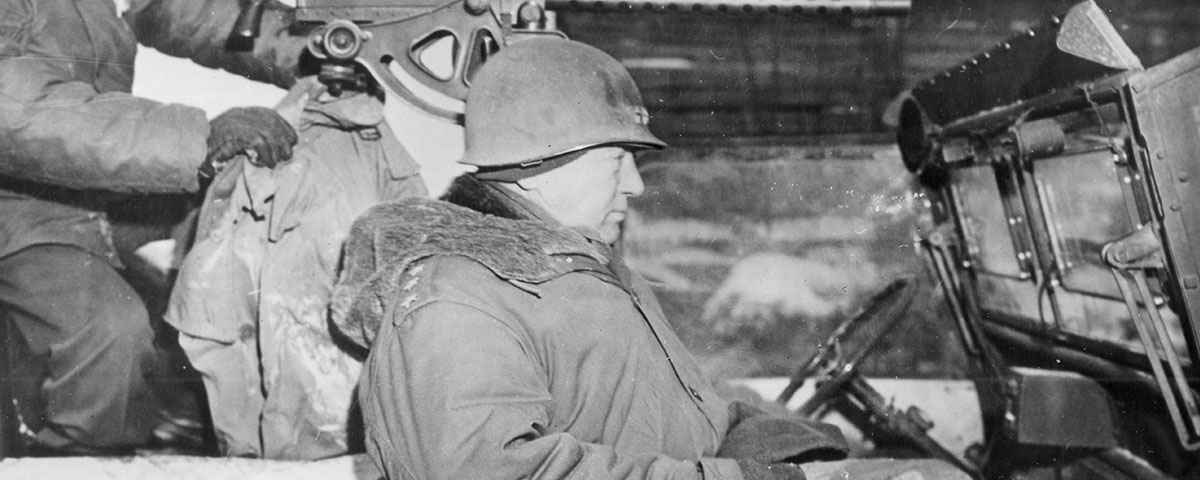
On the fourth day the troops were excited and energized by the visit of the Third Army commander, General Patton, who swooped in for a quick stop. He arrived at high speed in his jeep, with a wide, crooked grin and all his stars blazing. He was jolly, animated and interested in how we were doing. After jumping out of his jeep, he worked his way along the entire length of the small town. He stopped at every vehicle, talked with every cluster of soldiers and had something to say to each–a question, a word of encouragement or appreciation, a compliment, a wisecrack, a good-natured dig. He was a master at this kind of rapprochement. His visits were brief, and he kept moving. But in 30 minutes or so, he had worked his magic–he had “touched” virtually every man in that battalion.
We soon learned that the 8th Tank Battalion was the only battalion in the division that he visited. Although the troops had no inkling of the momentous events that lay just ahead, Patton was apparently aware that an attack might be in the offing. After visiting the three other divisions of the XII Corps that day, he wrote in his diary that he had decided to put the 6th Armored Division and the 26th Infantry Division into the III Corps because “if the enemy attacks the VIII Corps of the First Army, as is probable, I can use the III Corps to help.”
December 18 is a day I will always remember as the most confusing day of the entire war. Early that morning I was told to attend a meeting at division headquarters, but before I left for the meeting it was called off. The previous day I had been told that a move was imminent and to have my troops ready to move on short notice.
At 10:45 a.m. on the 18th, CCB was placed on a one-hour alert. I continued with my preparations for the move the next day to the east, as well as the subsequent attack into Germany, by sending billeting parties forward to obtain billets for the battalion to occupy at the end of the march to the border.
At 5 p.m. the one-hour alert was canceled. Shortly afterward, I also received word the move to the east the next day was off. I recalled my billeting parties. With no order for the next day, the men settled in for the night after the evening meal.
Then, suddenly, at 11 p.m. the 8th was ordered by CCB to be prepared to move at once. That directive was quickly followed up with instructions to cross the initial point, or IP (as yet to be designated), at 12:50 a.m. and then move in a totally different direction–north! We would be moving to the III Corps zone (wherever that was) to assist in stopping a strong German counterattack in that sector.
The radical change in mission, the confusion that had preceded it, the lack of information, the uncertainty, the hasty departure in the pitch-dark and the highly unusual timing of the move–50 minutes after midnight–all combined to indicate we were involved in something serious. A cloud of apprehension hovered over the entire battalion.
As ordered, the 8th Tank Battalion crossed the IP at 12:50 a.m. on December 19. We had no information about the situation up ahead or about the enemy. CCB’s orders were to move to an area in the vicinity of Longwy, France, many miles to the north. The 4th Armored Division, previously attached to the XII Corps, was now assigned to the III Corps.
Combat Command B, with its 8th Tank Battalion out front, led the advance of the division. Combat Command A (CCA) would be the next to move out, nine hours behind CCB and along the same route. Thus, the 8th led the odyssey north into the cold, black night, reinforced with the halftracks of the 10th Armored Infantry Battalion. At the head of the 8th was my tank, making it the lead element of the Third Army in its advance to the north.
Amazingly, the combat command had but one map, and that was with General Dager. During our rapid movements across France that summer and autumn, we occasionally had to rely on Michelin road maps for direction. But to be completely without maps was a new experience.
Once the column was on the road, we rolled mile after mile into the unknown. I was guided and directed by General Dager in a variety of ways. He radioed instructions from his jeep, his staff relayed radio messages, he sometimes rode alongside to shout directions at me in my turret, and at tricky intersections he dismounted and pointed the way.
The hours and miles passed, and Longwy loomed closer. The end was in sight. But then our spirits were dashed. As we reached Longwy, we were waved on, and we rolled through the city without slackening our pace. Our tank guns were still pointed to the north, and now, for the first time in the war, we were in Belgium. We passed through Arlon and changed direction to the northwest, still with no reduction of speed.
We began our journey in darkness and were to end it in darkness, as night came upon us again. A difficult situation became considerably more difficult, since we now had to travel under blackout conditions, and our progress would be greatly slowed. On top of that we had absolutely no idea of what lay ahead, and we were expecting to be fired on by the enemy at any moment.
Neufchâteau, another milestone, came and went as we continued to roll, still without enemy contact. Again we changed direction slightly, this time moving to the northeast. Now we were on the Neufchâteau-Bastogne road, headed toward Bastogne, another unfamiliar town.
As we neared the town of Vaux-les-Rosières, we were at last told to stop for the night. Combat Command B moved into that location, which was west of the road. I selected a spot about two kilometers east of the road for our bivouac area (I would later learn that it was near a town named Nives). By the time we settled in, it was 11 p.m.
Except for brief halts, and one longer one to refuel, we had been on the move unceasingly for more than 22 hours–half of one night, all day and half of another night under blackout conditions. Remarkably, we had traveled 161 miles over roads that were sometimes bad–without maps and without confusion. The fact that we arrived was a tribute to both our men and vehicles and spoke volumes for the work we had accomplished during the recent rest period. Most important, there had been no enemy contact.
That night none of us realized that we were the vanguard of what would later be called the greatest mass movement of men in the shortest period of time in the history of warfare. Patton’s troops had been poised to attack the Saar to the east. Forced to abandon that plan, he ordered the major part of his Third Army to make a gigantic 90-degree wheeling movement and then drive north at full speed. Involved in the spectacular maneuver were thousands of men and vehicles operating in damnable weather, often over icy roads.
Once we reached the bivouac area, there was still no rest for many of us. Many of the men were exhausted, but as soon as we reached our position we sent forward some strong patrols of light tanks and armored infantry to detect any enemy movement from the north.
Early the next morning, December 20, I was, figuratively speaking, hit by a thunderbolt. General Dager called me on his radio and, without any preliminaries, ordered me to send a task force into Bastogne. I was stunned. I protested vehemently, reminding him that the situation up ahead was unclear, terribly confused, and that this was no time for a piecemeal commitment of my forces. To my great surprise, Dager agreed with me. He said that he had just made the same arguments in a tug of war with Maj. Gen. Troy H. Middleton of the VIII Corps. Middleton had ordered him to take all of CCB into Bastogne, and he had hotly resisted, insisting that Middleton wait until General Hugh Gaffey arrived with the rest of the 4th Armored Division. Middleton finally agreed not to commit the entire combat command, but only after Dager conceded that he would send a task force instead.
As ordered, I formed the task force. It consisted of A Company, 8th Tank Battalion; C Company, 10th Armored Infantry Battalion; and C Battery, 22nd Armored Field Artillery Battalion. I placed in command of the task force Captain Bert P. Ezell, my battalion executive officer. His force would henceforth be known as “Task Force Ezell.” Ezell’s mission was to report to Brig. Gen. Anthony C. McAuliffe, commander of the 101st Airborne Division, learn about the situation in Bastogne, receive instructions and render support if so ordered.
The task force moved northeast on the Neufchâteau-Bastogne road and reached Bastogne without seeing any enemy troops. Upon entering the city, Ezell was told to report for instructions–not to McAuliffe, but to Colonel William Roberts, commander of Combat Command B of the 10th Armored Division.
Shortly after Ezell radioed me that he was in Bastogne and had made contact with our troops, I was astonished to receive an order from divisional headquarters to recall the task force to Nives at once. I immediately called Ezell, whose radio operator told me that he was out talking to a colonel. I shouted, “Get him!” I reached him not a moment too soon, for at that very instant Ezell had been receiving instructions for deployment from Colonel Roberts. When I told him to return, Ezell was dumbfounded. As was to be expected, he had a difficult time convincing Roberts that he had to leave with his force just after arriving in Bastogne. A short time later, just after noon, a delighted and vastly relieved task force was on the road again.
Seven hours after it set out for Bastogne, Ezell’s task force returned to our bivouac area with many more vehicles than it had when it pulled out. The men were beside themselves, chatting and shouting excitedly. They had seen some strange sights–so strange that they had a difficult time explaining it all to the rest of us.
As the task force moved away from Bastogne, they had encountered an American 2 1/2-ton truck in a ditch on the right side of the road. The truck was barely damaged and its driver was still sitting behind the wheel. But the top of his head had been blown off above the eyes, apparently by an armor-piercing round.
Moving a little farther down the road beyond the ditched truck, the troops noticed tank tracks running across the asphalt pavement. They were much wider tracks than could be made by American tanks and must have been made by German Panther or Tiger tanks.
The task force then came upon another strange sight–about two battalions of U.S. artillery stopped along the road. The equipment seemed to be in good shape, but there was no sign of any troops. Some of the vehicles were still idling. It was not clear whether the artillery units had been attacked and their positions overrun, or if they had been spooked by the sight of German tanks crossing the road just to the north of them and had abandoned their guns and vehicles. Given the evidence they had seen so far, it appeared that a strong German force had moved rapidly west and cut across the Neufchâteau-Bastogne road while Ezell was moving toward Bastogne. Perhaps the lead German elements had been moving so rapidly that following forces had not yet caught up with the vanguard. Ezell’s units had apparently managed to slip through a gap in the enemy echelons driving west. The task force hauled back as much of the abandoned artillery equipment as they could handle and encountered no resistance on the way back to the bivouac area.
As December 20 passed, events continued to move swiftly. At 2 p.m., CCB was reassigned to III Corps with the rest of the division. The 8th Tank Battalion was ordered to retrace its steps of the previous night and move southwest to Neufchâteau, then southeast to Léglise. We arrived in the vicinity of Léglise after dark on the 20th. Shortly after, I was surprised to learn that the rest of the division had remained in the vicinity of Arlon, and none of its units had made any attempt to close up on CCB. Only later did we learn why CCB had gone where it did and when it did.
On the 21st, I received my orders from General Dager at CCB headquarters for the attack that would take place the following day. I was also informed that during the previous night and early that morning very strong German forces had driven west and flanked the city of Bastogne on the north and south. The two forces had met west of the city and completely encircled Bastogne. Trapped in the city was the 101st Airborne Division, to which were attached elements of the 9th and 10th Armored divisions.
This was shocking news, but Task Force Ezell had provided ample clues that the Germans had been on the move the previous day. What really was disturbing was the realization that the encirclement had been taking place while Ezell’s group had been in Bastogne, and it had continued with unabated fury after the 8th Tank Battalion and CCB had left the area.
I could not help but think about what could have happened. If he had not been recalled by divisional headquarters, Ezell and his men might have been trapped in Bastogne along with Colonel Roberts’ combat command of the 10th Armored. And what if General Dager had not won the day in his tussle with General Middleton? All the 4th Armored’s CCB–if we had moved into Bastogne as General Middleton had originally ordered–might well be stuck in the besieged city.
We moved out of Léglise at 4:30 the next morning–the 22nd–so as to arrive at the IP at 6. The 8th Tank Battalion and the rest of CCB were part of the 4th Armored Division’s attacking force, coordinated with the 80th and 26th Infantry divisions of III Corps. The 4th Armored was on the left flank.
We began our slow, difficult return to Bastogne. The following day, at Chaumont, the 8th Tank Battalion was on the receiving end of one of the most powerful tank-led counterattacks of the war, temporarily slowing its advance to Bastogne and inflicting heavy casualties. Ironically, the battle at Chaumont was fought just four kilometers east of the quiet bivouac area we had occupied at Nives just three days earlier.
It took five days of bitter fighting to relieve the 101st in Bastogne, but by December 28 the area had been cleared of the enemy, and all of our positions had been consolidated. When Captain Ezell walked into the 8th Tank Battalion command post in Assenois, he was just one kilometer southeast of where his task force had been eight days earlier as it rolled into Bastogne.
Those of us who participated in this confusing operation, as well as historians who have analyzed the Battle of the Bulge in the years following World War II, could not help but note the ironies and incongruities surrounding the battle.
A number of questions have been raised about our mission:
*Why did CCB, whose original destination was the vicinity of Longwy, continue on alone until it reached a position in VIII Corps sector, only nine kilometers from Bastogne?
*Why did General Middleton of VIII Corps seem to exert “ownership” of CCB?
*Why did the rest of the 4th Armored Division not close up behind CCB instead of leaving CCB near Bastogne while the rest of the division assembled well to the rear, in the Arlon area?
*If General Dager had not protested dividing his command, what might have happened to CCB if it had rolled into Bastogne as ordered, on the day when the enemy was very much on the move?
*After moving into Bastogne, why was Task Force Ezell immediately and summarily recalled, especially considering that General Middleton had argued strongly for its presence there?
*After the elements of Task Force Ezell had returned to their parent units, why was all of CCB relieved from assignment to VIII Corps and withdrawn–back to the rear–less than a day after arriving in the forward position?
*Should commanders at higher levels have exploited Task Force Ezell’s rapid progress to Bastogne once they knew the unit had entered the town without a fight and returned? And should General Middleton have been allowed to hold onto CCB and use it to try to keep the NeufchâteauBastogne highway open, possibly preventing the encirclement of Bastogne?
*Once CCB had moved into its bivouac at Vaux-les-Rosières, should the rest of the 4th Armored Division have capitalized on the situation, moving up to attack from the bivouac location only a short distance from Bastogne rather than consolidating for the attack farther south and then fighting its way north along the difficult forest axis from Arlon to the encircled city?
Among those who have answered “Yes” to the last two questions is Charles B. MacDonald, who stated in his book A Time for Trumpets: “If Middleton had been allowed to hold CCB and with it keep open the Neufchâteau/Bastogne highway, Bastogne probably never would have been surrounded. Even if the Germans had cut the Neufchâteau/Bastogne highway, the Fourth Armored Division might have capitalized on the location of CCB and attacked from Vaux-les-Rosières instead of from Arlon. Which would have spared many officers and men of the Fourth Armored Division a great deal of misery and, in some cases, death.” The following additional information about the events leading up to the Battle of Bastogne provides answers to some of these nagging questions.
On December 18, Lt. Gen. Omar N. Bradley, commander of all U.S. ground forces, called off Patton’s planned offensive into the Saar. Without hesitation, Patton told Bradley that he would concentrate the 4th Armored Division in the vicinity of Longwy, pull the 80th Infantry Division out of the line and get the 26th Infantry Division moving within 24 hours. Much later that same day he issued the order that got CCB moving just after midnight.
General Patton met with his staff at 8 the next morning, December 19, as CCB was already well on its way to Longwy. His plan, he told his staff, was to strike due north and hit the underbelly of the German penetration where it would hurt. During the next hour, Patton and his staff planned, in outline, three distinct operations. Arrangements were made for a simple code to indicate, via a brief telephone call, which operation would be implemented.
Later that same day, Patton met at Verdun with Supreme Allied Commander General Dwight D. Eisenhower and a distinguished gathering of senior commanders that some have called perhaps the most historically significant conference of the 1944-45 campaign. All agreed that there should be a counterattack at the earliest possible moment. Patton told the group that he could be ready to attack with three divisions of the III Corps on December 22. A stronger force, he said, would take several more days to assemble and would forfeit surprise. The group was astonished at his rapid response to the situation and was more than satisfied with his proposal. It should be emphasized that at this meeting Patton pledged a three-division counterattack with the entire 4th Armored Division as the key division in the corps. He was completely unaware that CCB was then on its way toward Bastogne.
Given the situation, it is absolutely inconceivable that CCB should have been sent on its merry way all the way to the outskirts of Bastogne and told to report to the VIII Corps. It turned out that General Bradley was responsible for that trip. Whatever the rationale for its mission may have been, the motivation for this decision is difficult to comprehend.
In his memoir War As I Knew It, General Patton wrote, “The next morning I arrived at Bradley’s headquarters in Luxembourg and found that he had, without notifying me, detached Combat Command ‘B’ [General Dager] of the 4th Armored Division from Arlon to a position southwest of Bastogne. Since the Combat Command had not been engaged, I withdrew it to Arlon [not Arlon but Léglise].”
Historian Martin Blumenson, in the second volume of The Patton Papers, quotes from General Patton’s diary entry of the same day, December 20: “In the morning I drove to Luxembourg, arriving at 0900. Bradley had halted the 80th Division at Luxembourg and had also engaged one combat command of the 4th Armored Division in the vicinity east of Bastogne [not east but southeast] without letting me know, but I said nothing.”
General Patton then drove to Arlon, to the headquarters of General Middleton’s troubled VIII Corps to get a firsthand picture of the situation in the Bulge. When he arrived, he found Maj. Gen. Hugh J. Gaffey of the 4th Armored Division, Maj. Gen. Willard S. Paul of the 26th Infantry Division, and Maj. Gen. John Milliken of the III Corps already there. There is considerable speculation and some difference of opinion about what actually took place during their meeting. However, subsequent events lead easily to certain assumptions.
General Middleton still must have been anxious to send CCB into Bastogne behind Task Force Ezell and surely requested permission to do so. Elements of his corps were already scattered, and his armor was especially fragmented. Middleton wanted to avoid more of the same. General Gaffey must have wanted his combat command returned. With a major attack coming up in just two days, he needed his division at full strength, and it would have been severely handicapped without CCB. General Milliken also knew that the key to his III Corps three-division attack was having the 4th Armored at full strength. He surely must have supported Gaffey’s argument to have his CCB returned.
As events later developed, CCB shouldered an extremely heavy share of the 4th Armored’s fight at Bastogne. The combat command acted as the powerful left flank, not only of the division, but also of the III Corps all the way to the encircled city. In retrospect, General Dager’s resistance to committing CCB to Bastogne earlier surely saved the unit. If he had not protested, CCB probably would have been in Bastogne before Patton was aware that it had been given away by Bradley.
It was fortunate that Task Force Ezell returned unscathed from its fruitless mission. The loss of a tank company, an armored infantry company and an artillery battery would have considerably weakened CCB.
At the Verdun meeting, General Patton had committed himself to a coordinated attack with three full divisions. He knew that the situation in the Bulge at that moment was confused. That was not the time to reinforce a failing situation and risk having elements of the 4th Armored committed prematurely. Patton’s decision was revealed when Task Force Ezell was ordered out of Bastogne shortly after noon and CCB was directed to move to the rear, which it began to do by midafternoon.
Patton chose as his ultimate course of action a well-planned, well-coordinated, orderly attack toward a known, specific objective. He jumped off from ground that was firmly in his hands. His planning and execution were sound and professional. Undeterred by the panic around him, he kept his eye on the ball.
Patton’s counteroffensive not only broke the ring enclosing Bastogne but also destroyed a portion of the German penetrating force, eliminating hundreds of enemy vehicles and thousands of troops. Because of his rapidly organized and well-executed counterattack, he was able to snatch the momentum from the Germans and seize the initiative. He had done what he had promised his commanders he would do.
In the eyes of historians, the experience of Task Force Ezell is an extremely minor episode in the war in Europe. It did not have any significant impact on any campaign. But finding the answers to some of the more puzzling aspects of Ezell’s mission helps to enrich our understanding of the Battle of the Bulge. It clarifies how the counterattack was planned and provides some fascinating sidelights on the men who made the decisions and brought about the dramatic linkup at Bastogne. No one who learns about Ezell’s trip to the city during its encirclement can help but be struck by the story’s ironies and might-have-beens. Although I was a participant in much that happened, I still find it a strange and fascinating tale. In sharing my own experience and research, my goal has been to shed a little light on an obscure, yet telling, incident that had formerly been shrouded by the fog of war.
Brigadier General Albin F. Irzyk is the author of He Rode Up Front for Patton. Further reading: A Time For Trumpets, by Charles B. McDonald; and Battle: The Story of the Bulge, by John Toland.