Of all the African powers, only the ancient kingdom of Ethiopia remained completely free from European domination by the end of the 19th century. This was no accident of history; Ethiopia secured its sovereignty by inflicting a decisive and humiliating defeat upon the Italian invaders at Adowa (or Adwa) on March 1, 1896. The battle at Adowa was, at the time, the greatest defeat inflicted upon a European army by an African army since the time of Hannibal, and its consequences were felt well into the 20th century. As an example of colonial warfare on an epic scale, it cannot be surpassed. As an example of the twin follies of arrogance and underestimation of one’s enemies, it should never be forgotten.
Ethiopia has existed as a political entity since biblical times. The ancient Greeks gave the name ‘burnt face’ to the peoples who inhabited the little known regions south of Egypt, and it is from the Greek that the name Ethiopia is derived. Bisected by the great Rift Valley that runs the length of the African continent, Ethiopia encompasses fertile mountainous highlands of moderate climate and unbearably hot lowlands that fall below sea level in some places.
Christianity came to the Ethiopians in the 4th century AD and was adopted with a fanatical passion. A rich, sophisticated and thriving culture developed among the Ethiopians, producing among its many treasures beautiful illuminated Bibles in the ancient language of Geez, the only written language native to Africa. The advent and aggressive spread of Islam, however, drove the Ethiopians deeper into their isolated mountainous highlands, and there they remained for the next 1,200 years.
In 1868 the outside world encroached upon the mountain kingdom in the form of 5,000 British and Indian troops sent to chastise the negus, or emperor, Tewodros II for his detention of a number of European envoys and missionaries. On April 13, ‘Mad King Theodore,’ as the British press soon dubbed the ill-fated negus, ended the affair by shooting himself, after being abandoned by his own nobles and decisively defeated at Magdala by the superior weaponry of the British. The British then departed, leaving behind a power vacuum that led to a four-year struggle for power among the feudal nobility.
The eventual victory went to Kassai, the ras, or lord, of Tigre, who had used his gift of surplus British rifles and ammunition to good effect. Negus Yohannes IV, as he proclaimed himself, next had to contend with growing pressures from a variety of external sources. During the 1870s, Ethiopia repelled repeated attacks from the Egyptian armies of Ismael Pasha, whose dreams of empire had led him to occupy the Red Sea port of Massawa, thus blocking Ethiopia’s only significant access to the outside world. Yohannes’ armies inflicted terrible defeats upon the Egyptians, most notably at Gura on March 7-9, 1876, when 20,000 well-equipped Egyptians, led by European and American mercenaries, were routed.
In 1885, another foreign power occupied Massawa. Italy had been trading along the Red Sea coast for some time, but under the government of Prime Minister Francesco Crispi, Italian ambitions turned toward the acquisition of a colonial empire like those of Britain and France. With the consent of the British government, with whom Crispi had fostered friendly relations, Italy garrisoned Massawa. The Ethiopians found this foreign occupation intolerable, and Yohannes encouraged his Tigrean subjects to harass any Italian forces attempting to move out from Massawa into Eritrea.
The Italians steadily expanded into the hinterland of Eritrea after occupying Massawa, leading to a number of clashes, some of which verged upon the comic. During a fight at Sabarguma in March 1885, the appearance of balloons released by the Italians was enough to panic the attacking force of Ethiopians. In another incident, electric spotlights so terrified a Tigrean force attacking at night that the men froze, petrified, then fled, while the Italians laughed at their foes. Matters took a more serious turn, however, on January 26, 1887, when a column of 550 Italians, moving to relieve the garrison at Saati, was trapped in a narrow valley and overrun, leaving 430 dead and 82 wounded. That incident was decried in Italy as ‘The Dogali Massacre.’
While fending off Italian incursions, Yohannes also had to deal with his African neighbors. The rise of the Mahdi Mohammed Ahmed in Sudan led to conflict between the Mahdist and Ethiopian forces. On March 12, 1889, they clashed at Gallabat in southern Sudan, both sides invoking their own God to grant them victory. In a battle more reminiscent of the medieval Crusades than the later part of the 19th century, Yohannes was killed and his army fled. Within months, Ras Menelik of Shoa, Yohannes’ great rival, was proclaimed negus.
Crowned as Menelik II (the first Menelik had been the son of King Solomon of Israel and the queen of Sheba), Sahle Miriam, Ras Menelik of Shoa, was intelligent, shrewd and ruthless, all virtues which had helped him to prosper in the cutthroat world of Ethiopia’s feudal politics. As a young man, Menelik had been held hostage by Tewodros, and during his captivity he had absorbed a good deal of Tewodros’ fascination with the technology of the outside world. He had also seen with his own eyes the effects of disunity upon the empire and the rout of the negus’ armies by the British. Menelik realized that Ethiopia’s continued sovereignty would rely upon national unity and military strength. Since the most dangerous enemies would more than likely be European, Menelik decided that the procurement of modern weaponry was essential.
With funds from the sale of ivory, gold, silver, musk and slaves as well as from taxes, the negus embarked upon a major effort to import modern rifles and artillery via the French-controlled port of Djibouti, along with whatever he could cajole out of the Italians in Massawa. Over the next few years, tens of thousands of magazine-loading rifles, millions of rounds of ammunition and dozens of modern rifled artillery guns were brought by caravan on a tortuous route from the coastal lowlands to Menelik’s new capital at Addis Ababa. By the mid-1890s, Menelik was able to field an army in which the majority of his warriors were armed with the best weapons that Europe and the United States could offer.
The Italians had been cultivating friendship with Menelik for years by supplying him with rifles. When he came to the throne, their support seemed to have payed off–surely, Rome reasoned, this new negus would compliantly surrender sovereignty to his former sponsors. On May 2, 1889, Menelik signed the Treaty of Wichale (or Uccialli), in which he ceded to the Italians part of Yohannes’ native province of Tigre and some of the adjacent highlands.
In a Machiavellian subterfuge, the Italian government touted the Treaty of Wichale as legal proof that Menelik had ceded sovereignty to Rome. The trick was eminently simple, the kind that had been played on native rulers by European traders and settlers for centuries. As far as Rome was concerned, Menelik was little more than an unsophisticated barbarian.
Article XVII of the treaty, concerning Ethiopia’s diplomatic representation outside of Africa, had been presented for signing as two documents, one written in Italian and one written in Amharic. The Italian version of Article XVII stated, ‘The Emperor consents to use the Italian government for all the business he does with all the other Powers or Governments.’ Article XVII of the Amharic version read somewhat differently: ‘The Emperor has the option to communicate with the help of the Italian government for all matters that he wants with the kings of Europe.’ Needless to say, the Italian negotiators failed to inform the Ethiopian court of the none-too-subtle differences between the two versions of the treaty.
Menelik, however, was at heart a nationalist, and subservience to any power was anathema to him. When he discovered the subterfuge in the treaty, Menelik rejected it. Despite a belated attempt by the Italians to buy him off with a gift of 2 million cartridges, he continued to characterize the Italians as cheats. The European powers remained deaf to his complaints, however, and all but Turkey, Russia and France accepted the Italian version of affairs.
The Italians then began to cultivate Yohannes’ eldest son, Ras Mangasha, as Menelik’s rival to the throne and made moves to assist Mangasha in establishing a base of support in Tigre. But Tigre had been devastated by famine and war, and the promised Italian aid failed to appear. Mangasha made his peace with Menelik in June 1894, and later in the year many other lords followed Mangasha’s lead. Menelik’s power grew until he truly became negusa nagast, the ‘king of kings’–the first such Ethiopian leader in centuries.
Menelik now felt that the time had come to confront the Italians directly. ‘God, in his bounty, has struck down my enemies and enlarged my empire and preserved me to this day,’ he declared. ‘I have reigned by the grace of God….Enemies have come who would ruin our country and change our religion. They have passed beyond the sea which God gave us as our frontier….These enemies have advanced, burrowing into the country like moles. With God’s help I will get rid of them.’
Rome, however, was unimpressed. The Italian governor of Eritrea, General Oreste Baratieri, moved quickly to crush a premature uprising in Tigre and pursued Mangasha’s army across the Ethiopian frontier, capturing Adigrat, Adowa and Makalle. Returning to Italy, Baratieri was hailed as a hero and received an ovation from the national parliament. He subsequently secured a substantial increase in the financial subsidy paid by Rome to its colony in Eritrea. Inspired by Crispi’s description of the Ethiopians as ‘barbarians whose material progress and spiritual salvation cried out for the high ministry of Roman civilization,’ Baratieri promised to bring Menelik back in a cage.
While Baratieri was basking in the adulation of the Italian government and people, Menelik had summoned his feudal host to gather at Addis Ababa. When the army had assembled, 196,000 men–more than half armed with modern rifles–were available to the negus, including 34,000 absolutely loyal Shoan royal troops.
Against that army, Baratieri could bring a force of 25,000 men–a well-equipped but mixed bag of Eritrean askari (native troops), European conscripts and elite bersaglieri and alpini. Baratieri knew nothing of the disparity in numbers until December 7, 1895, when a force of 1,300 askari, under the command of Major Pietro Toselli, was annihilated by some 30,000 Ethiopians in a narrow pass on the mountain of Amba Alagi. Shortly after that, another horde of Ethiopian warriors besieged Makalle.
Originally one of Giuseppe Garibaldi’s ‘Thousand Redshirts’ who invaded Sicily in 1860, Baratieri had enough experience in warfare to realize that a dangerous situation was developing. He withdrew his forces to Adigrat and dug in, resolved to watch and wait. Unable to be relieved, the 1,200-man Italian garrison at Makalle endured a 45-day siege until Menelik allowed the garrison safe conduct and offered to negotiate with Rome. Outraged by the perceived insult to the honor of the army and nation, the Crispi government ignored the negus’ entreaties and dispatched reinforcements to Massawa. It also allocated a further 20 million lire to pursue the war against Menelik.
In Adigrat, Baratieri still waited. As he saw it, the Ethiopians were little more than an undisciplined horde of savages who were no match for the rifles and artillery he could deploy against them. That would be especially so if the Ethiopians could be lured into an assault upon the strong defensive positions he had constructed. The enemy did not oblige him, however. Instead, Menelik’s army occupied Adowa in a move that threatened to outflank Adigrat. The Italians dug a fresh line of defenses at Sauria and posted 20,000 troops and 56 guns there to block any Ethiopian advance from Adowa. Still, Menelik did not come. The waiting game continued through February 1896.
Supplies in both camps began to run short. Menelik had planned his war well and ordered that gibbir, or ‘the king’s feeding of his men,’ depots be established along his route of march. The negus had provided for his army so well that after two months in the field his soldiers had still not touched their sinq, the Ethiopian soldier’s campaign ration, consisting of two weeks’ worth of grain, dried meat and other foods. Yet even Menelik had not anticipated the long months of indecisive activity, and the food supplies for his army were rapidly running out. In late February, the negus reluctantly conceded that if the Italians remained behind their fortifications, he would be obliged to break up his army and retreat.
Matters were not much better on the Italian side. Hampered by a lack of transport animals and the poor tracks leading up from Massawa, Baratieri’s men had been reduced to half rations, but even that expedient would not allow them to remain at Sauria past March 2. The stalemate continued until February 25, when Crispi, desperate to secure a military victory for domestic political reasons, cabled a message to Baratieri that came close to accusing the general of cowardice and incompetence. Shaken by the telegram, Baratieri called together the commanders of his four brigades and sought their advice. To a man, they counseled attack. Baratieri was at first reluctant, but was eventually persuaded to go on the offensive. The Italian army prepared to advance from its lines at Sauria on the evening of February 29 (1896 being leap year).
Meanwhile, Menelik had seen his proud host dwindling daily as his warriors, ravaged by disease and hunger, slipped away to search for food or return to their homes in the distant mountains to the east. With resignation, the negus decided that he must order the great camp to break up. Thus it was with surprise bordering on disbelief that he received at his tent a frantic rider who brought news that the ferangi, or foreigners, were advancing in strength to attack the camp and were even now engaged in fighting with the negus’ army. Menelik, dressed in the white robes of a common soldier and accompanied by Taitu, his empress, and a procession of richly accoutered priests, spent a moment in prayer. While he did so, the warrior host of Ethiopia roused itself and surged toward the sound of battle.
Baratieri knew that the Ethiopians outnumbered his force–even though he still grossly underestimated their real numbers–so he still sought to goad the negus’ army into attacking on his terms. He planned to advance his force, which consisted of 17,700 men and 56 guns, under cover of darkness. By dawn on March 1, Baratieri expected that his troops would be dug in on the high ground overlooking the Ethiopian camp at Adowa. Menelik would be obliged to either attack the Italians frontally–in which case his army would be destroyed–or retreat. In concept it was a sound plan, but unfortunately for Baratieri and his men, it began to go wrong almost from the start.
Baratieri planned for each of his four brigades to advance along separate routes and arrive at their objectives before dawn. At 2:30 a.m., the general advance commenced, but it was not long before difficulties occurred. As each of the brigades began to move, the Italians soon found themselves struggling through precipitous passes, across barren hills and around the steep ravines, gorges and treacherous crevasses that cut up the country so badly that one Italian officer described it as ‘a stormy sea moved by the anger of God.’ It hardly helped matters that the only maps the Italians possessed were little more than ambiguous sketches and proved to be of little use. Parts of the 4,000-man askari brigade of Brig. Gen. Matteo Albertone, which formed the left wing of the advance, soon became confused in the darkness and blundered into the path of Brig. Gen. Arimondi’s brigade of European troops, who formed the center of the advance. Arimondi’s troops halted, and the confused formations were not finally untangled until 4 a.m.
As the center of Baratieri’s advance came to a halt, the majority of Albertone’s brigade and the right flank brigade of Brig. Gen. Vittorio Dabormida–completely unaware of the confusion in their rear–continued to advance. Albertone soon reached what he thought to be the hill of Kidane Meret, the objective of his advance. The general had just halted when the Ethiopian guide attached to his headquarters informed him that Kidane Meret actually lay another 4 1/2 miles to his front. Not knowing that Arimondi’s brigade was still languishing behind him, Albertone assumed that his colleague’s men were now out to his right front somewhere, their left flank uncovered and drawing farther away. Without further delay, Albertone ordered his brigade forward. By 6 a.m. the askari had covered about 2 1/2 miles when they encountered the Ethiopians.
Baratieri, who had been advancing with Brig. Gen. Ellena’s reserve brigade, began to receive reports of some type of action developing to the left of his army and of increasing contacts to Arimondi’s front. Lingering darkness and heavy morning mists obscured much of what was happening, but it was obvious that Albertone was being heavily engaged. At 7:45 a.m. Baratieri issued orders to Dabormida to swing his brigade to the left and move to support the army’s center. For some reason, Dabormida’s brigade moved toward the right flank–directly away from where it was supposed to go–and a gap of about two miles opened between it and the rest of the army. Dabormida’s movement could not have occurred at a worse time for the Italians, for as the gap opened, Ras Makonnen of Harrar and 30,000 warriors arrived and lunged forward into the opening.
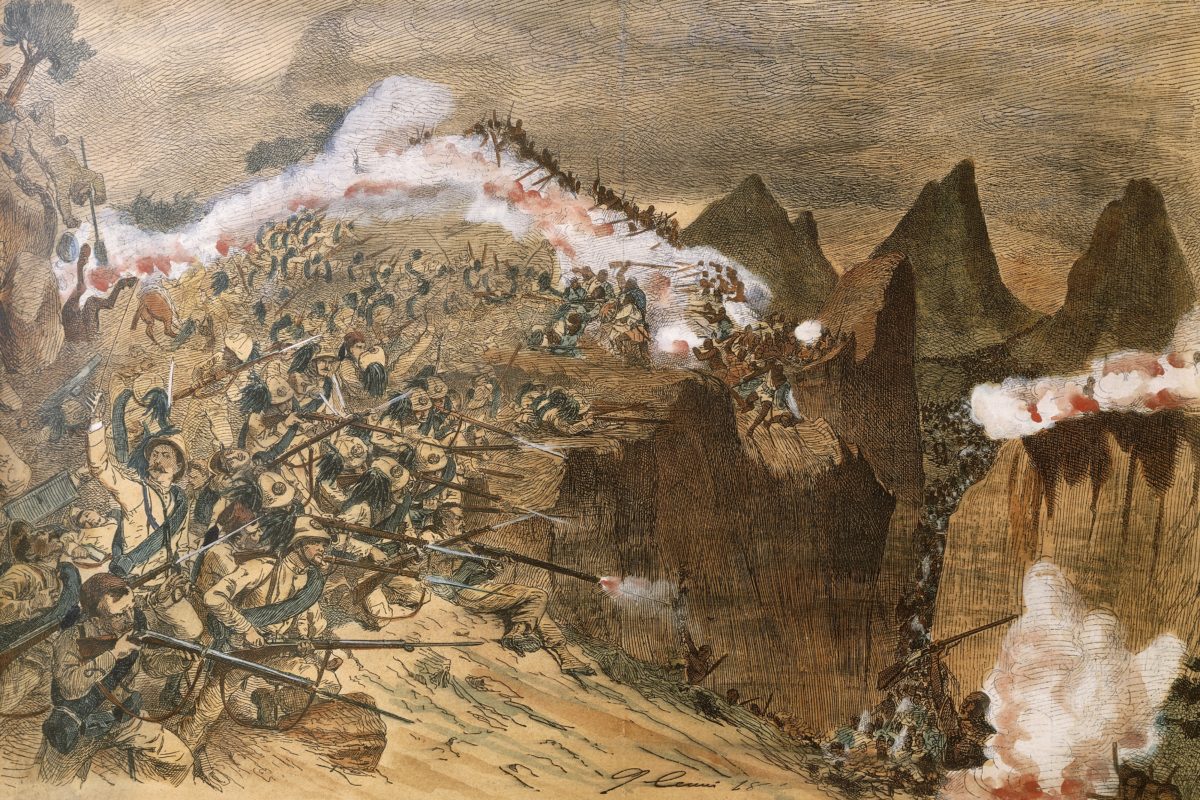
From the crests of hills and ridges and from out of the narrow passes, Menelik’s warriors came on in waves, a sea of green, orange and red standards, copper and gold crucifixes, burnished metal helmets, dyed-cloth headdresses and lion’s-mane-adorned shields. Menelik’s force consisted of 82,000 rifle- and sword-armed infantry, 20,000 spearmen and 8,000 cavalry–the fierce Oromo horsemen roaring their war cry ‘Ebalgume! Ebalgume!’ (Reap! Reap!). In addition, 40 quick-firing mountain guns were set up on the slopes of Kidane Meret. Although the Ethiopian gunners had been schooled in the use of their weapons by Russian adventurers, they were in no way expert in their use. Even so, the shells they sent forth added to the discomfiture of their enemies. Ras Tekla-Haymanot commanded the right wing, Ras Alula the left. Ras Mangasha and Ras Makonnen jointly commanded the center. Menelik, with 25,000 royal troops and the best of the cavalry, and Empress Taitu, with 3,000 infantry and 600 cavalry, remained in reserve.
Well-armed as they were, the Ethiopian army was still the product of a medieval society, and once the enemy was sighted all discipline was forgotten. To European eyes, their attacks resembled ‘a flood of men following a giddy course.’ Impassioned by patriotic zeal and a great deal of religious fervor, the Ethiopian warriors came on, in the words of one Italian officer who had survived the fight at Dogali in 1887, ‘like madmen.’ Traditional tactics revolved around exploiting the enemy’s flank and enveloping him when the opportunity arose. The isolated Italian brigades presented excellent targets for just such tactics.
By 8:15 the morning mists had dissipated, exposing a panorama of hills and valleys swarming with Ethiopians and rapidly becoming enshrouded in clouds of black powder smoke.
Italian firepower held the warriors at bay; Fitaurari (general) Gagjehu tried to break the stalemate by throwing aside his rifle and shield and leading his men with only a stick–only to be shot down. Losing men and momentum, Menelik was about to order retreat, but Empress Taitu and Ras Maneasha persuaded him to commit the 25,000 men of his imperial guard to a final assault on Kidane Meret. Those last reserves proved to be decisive.
At about 8:30, Albertone’s brigade, having fought well for more than two hours but receiving no reply to his plea for reinforcements, began to break up. Most of his officers were already dead, having fallen to Tekla-Haymanot’s gojam cavalry. Albertone was taken prisoner. Then the askari, assailed on all sides by what seemed to be limitless numbers of ferocious enemies, gave up the struggle. Those who could fled toward the positions held by Arimondi’s brigade around Mount Bellah, about two miles to the rear.
Arimondi’s artillery held its fire until the askari could reach safety. It was only at the last minute that Arimondi’s soldiers realized that Ethiopians were mixed in among the askari. Too late to fire, the gunners and infantrymen of the central brigade soon found themselves at close quarters with hordes of sword- and rifle-wielding foes. Assailed from the front and both flanks, Arimondi’s men fought back with a courage born of desperation and took a heavy toll on their attackers.
At 9:15, Baratieri galloped up from his position with the reserve brigade to see the situation for himself. He still had no idea of Dabormida’s actual location and assumed that the general and his brigade were still complying with the orders he had issued earlier to move to support Arimondi. Meanwhile, growing numbers of Ethiopians charged Arimondi’s brigade in waves, the frontmost warriors armed with rifles while those behind brandished traditional swords and spears. The Italians fired with deadly effect, mowing down hundreds of warriors, but they could not break the Ethiopian attacks. By about 10 o’clock, the high ground on the spur of Mount Bellah had fallen to hordes of Shoan warriors, and the situation for Arimondi’s brigade was becoming critical. Two companies of bersaglieri failed to drive the Shoans off Mount Bellah, and at about 10:15, Lt. Col. Galliano’s 3rd Native Battalion, holding part of the left of the brigade’s line, gave way. Caught amid a sea of screaming enemy warriors and subjected to a storm of shot and occasional shell, the Italians continued to resist for about an hour and a half. Then, with their position becoming more precarious with each passing minute, Baratieri ordered a retreat. Arimondi and Galliano were among the thousands who did not survive.
Withdrawal in the face of a relentless enemy is a dangerous maneuver, requiring steady nerves, discipline and, above all, good tactical leadership. In the debacle that followed Baratieri’s order to retire, none of those virtues were obvious. Within minutes the central brigade had dissolved into a rabble that fled back toward Sauria, abandoning its wounded, artillery and most weapons. Shouting ‘Viva l’Italia,’ Baratieri managed to rally a few alpini and bersaglieri behind the protection of a walled enclosure, but he could do nothing to stem the panic. By just after midday, Menelik’s warriors had completely destroyed two of the three Italian brigades that had advanced against him.
When General Baratieri had proposed retreating as one option open to his army at the officers’ council on February 28, Dabormida had cried, ‘Retire? Never!’ In the hours that followed the destruction of Albertone’s and Arimondi’s brigades, Dabormida would suffer the bitter consequences of his ill-considered bravado.
About two miles to the northwest of Mount Bellah lay the valley of Mariam Shavitu, about 800 yards wide and two miles long. Since about 10 a.m., Dabromida’s brigade had been in the valley, engaged in a firefight with increasing numbers of Ethiopians. By 2 p.m., as the slopes above Miriam Sahvitu seethed with Ethiopians, he began to wonder what had happened to the rest of the army. There had been no word from Baratieri since earlier that morning, and Dabormida paced about, openly commenting on what seemed to be the disappearance of headquarters. As the enemy numbers grew and the pressure on his brigade intensified, Dabormida decided to withdraw along a track leading to the north from Miriam Shavitu. In contrast to the rout at Mount Bellah, Dabormida’s soldiers conducted a well-ordered withdrawal. Fighting from behind rocks and boulders and from trenches they had dug that morning, Dabormida’s soldiers contested every yard of the Ethiopian’s advance. The gunners defended their pieces to the end, falling beneath the hacking swords and stabbing spears of the Ethiopians, and the infantry rear guards stood their ground until annihilated.
It was a battle with no quarter. Since time immemorial, the Ethiopian armies had fought war with the object of utterly destroying their enemies. The Oromo horsemen of Ras Mikail swept in and through the ranks of Italians, slashing and stabbing at the soldiers, while wave after wave of foot warriors rushed forward. Dabormida, wounded and by then no doubt realizing the disaster that had befallen his command, dragged himself to a small village and asked a local woman for a drink of water. No record exists of where and how the general met his death, but months later his remains were found lying among those of thousands of his soldiers scattered along the valley.
The Battle of Adowa cost the lives of 289 Italian officers, 2,918 European soldiers and about 2,000 askari. A further 954 European troops were missing, while 470 Italians and 958 askari were wounded. Some 700 Italians and 1,800 askari fell into the hands of the Ethiopian troops. About 70 Italians and 230 askari were tortured to death before Menelik discovered it and put a stop to it. After enduring a terrible forced march back to Addis Ababa through the cold and rain of the highlands, the rest of the captives were held for several months until the Europeans were released in exchange for payment of a 10 million lire ‘reparation’ by the Italian government.
Some 800 Tigrean askari prisoners did not fare so well; they were subjected to the traditional punishment for disloyalty by having their right hands and left feet amputated. In addition to the human losses, Baratieri’s army lost 11,000 rifles and all of its 56 guns and had to endure attacks by the Tigrean peasantry as it retreated.
For Baratieri, who only months earlier had been lauded by the Italian government, his military career was over. Even before Adowa, the government secretly had decided to relieve him of command and dispatched his replacement. The political consequences of the defeat were even greater. After news of the debacle reached Rome, angry crowds filled the streets of most Italian cities. Humiliated by the utter collapse of his colonial policy, Prime Minister Crispi and his cabinet resigned.
An estimated 7,000 warriors died at Adowa, and 10,000 were wounded. Ethiopia had never before had to pay such a price for victory, and for a while a note of war weariness echoed through the ranks of Menelik’s host. Yet it had been a victory, and a great one at that. Eritrea was Menelik’s for the taking, and he ordered his army to mass on the border of the Italian colony. But he did not give the order to invade.
Historians have long debated why the negus did not exploit his advantage over the Italians at that time–indeed, his nobles were urging him to do so. The thought of further grievous losses, the claimed lack of cavalry horses or the inhospitable wilderness through which his army would have to march to reach the Italians were all factors that may have stayed his hand. Menelik also knew that soon many of his feudal warriors would wish to return to their homes for the annual plowing and sowing of their crops.
The actual motivation may have been more subtle, however. Menelik recognized Italy’s craving for a colonial empire, and Eritrea was the young nation’s most valuable colonial possession. Its loss would compel the Italians to reply with all their resources. Such a war would be one that Menelik could not hope to win. Whatever lay behind his decision, Menelik made two simple demands of the new government in Rome–the abolition of the Treaty of Wichale and the unconditional recognition of Ethiopia’s independence. He was, in effect, asking for a return to the status quo of 1889.
Within months of the Battle of Adowa, European nations rushed to establish diplomatic representation with the negus. Menelik accepted all comers, including the envoys from Rome, balancing in the Byzantine manner of Ethiopian politics each of the suitors against one another. To the French, he secretly offered support for their claims to the upper Nile in return for part of French Somaliland. To the British, he offered assistance against the Mahdists in the Sudan, receiving an agreement to waive duty on goods imported through British Somaliland as his reward. To the Mahdists, he offered a commercial pact.
On October 26, 1896, Rome signed the Treaty of Addis Ababa, sensibly accepting Menelik’s liberal terms to end the war. Thus secure, the negus launched a campaign of conquest against the Kaffa and Galla peoples who lived to the south and, after crushing them, added the looted wealth of those lands to the royal treasury.
Throughout the world, the news of Adowa created a surge of racial pride among people of African descent. In places as diverse as Haiti, the Gold Coast, South Africa and the United States, black people hailed Menelik’s victory, and Ethiopia became a place of pilgrimage for black intellectuals and religious leaders.
Four decades later, as Benito Mussolini’s legions overran Ethiopia, fascist propaganda justified the aggression as an opportunity to erase the lingering humiliation of Italy’s defeat at Menelik’s hands. The rout of General Baratieri’s army did indeed have far-reaching consequences.
Adowa saved Ethiopia from Italian colonization and raised its status from that of an isolated nation whose institutions, heritage and people where held in contempt to that of an equal partner in the world community of nations. March 1 is a national day of celebration in Ethiopia, and the events of 1896 are remembered with pride.
Greg Blake teaches history in Darwin, Australia. Further reading: The Campaign of Adowa and the Rise of Menelik, by Sir George F.H. Berkeley; The Life and Times of Menelik II: Ethiopia 18441913, by Harold G. Marcus; Conquest and Resistance to Colonialism in Africa, by G. Maddox; and One House: The Battle of Adwa 1896–100 Years, edited by Pamela S. Brown and Fassil Yirgu.
For more great articles be sure to subscribe to Military History magazine today!