A large crowd gathered outside the walls of the Walnut Street Prison that fronted on what is now Independence Square in Philadelphia at dawn on January 9, 1793. The occasion was not a hanging but a balloon launching, which, if successful, would be the first aerial voyage in the history of the new United States of America and the New World.
Jean Pierre Blanchard, noted French aeronaut, had advertised in Dunlap’s American Daily Advertiser for several weeks that he would make a hydrogen-filled gas balloon ascension on that day “at 10 in the morning precisely, weather permitting.” He had sold tickets at $5 each, and when not enough seats were reserved, Blanchard offered $2 seats in a special section behind the others. The tickets would admit the bearers inside the prison yard to view his departure. The excitement he generated was so great that almost the entire population of the capital city had turned out, in addition to a large number of visitors from the surrounding countryside.
A number of people wanted to go with him, but Blanchard was not about to share this “first” with anyone. He also discouraged those who wanted to follow him on horseback. In a notice in the Federal Gazette, he noted, “If the day is calm, there will be full time to reach the prison court…as…I will ascend perpendicularly; but if the wind blows, permit me, gentlemen, to advise you not to attempt to keep up with me, especially in a country so intersected with rivers, and so covered with woods.”
Two field artillery pieces positioned at Potter’s Field had been firing every quarter hour since 6 that morning, to remind the citizens of the great event. A brass band played soul-stirring martial music inside the prison yard as the famous Frenchman busied himself around the slowly expanding, varnished yellow silk bag. Dressed in bright-blue knee breeches, matching waistcoat and a hat with white feathers, the short, slender aeronaut looked like a Shakespearean actor readying himself for his role in a great drama.
The handsome, flamboyant Frenchman was confident that he was going to have his name inscribed in the history books of this new nation, just as he had done in Europe. The name Blanchard had completely dominated the aeronautical scene in the decade after Pilatre de Rozier’s epic untethered free flight in a hot-air balloon on November 21, 1783.
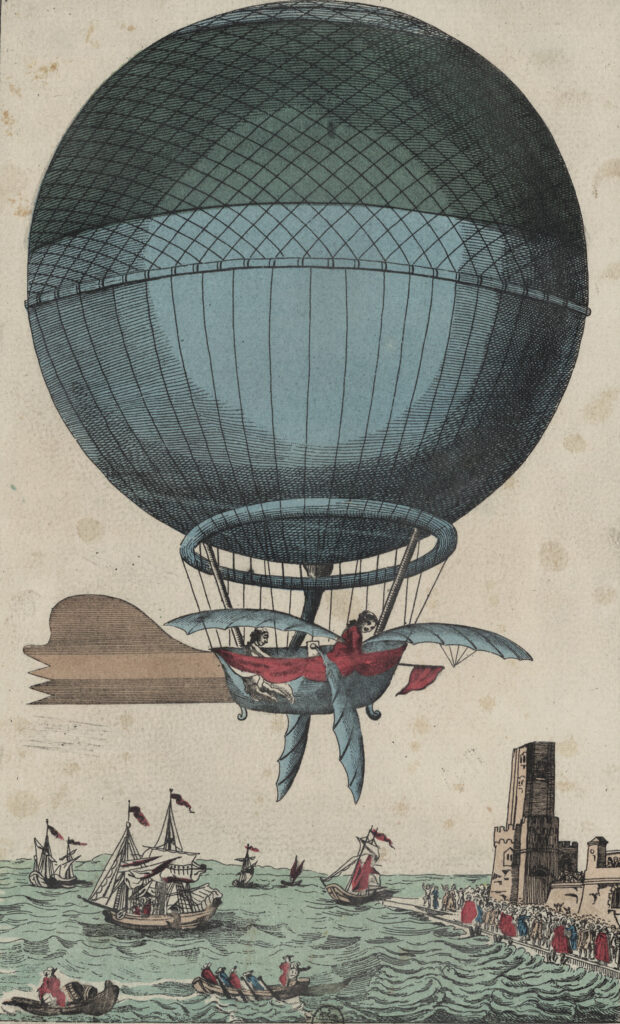
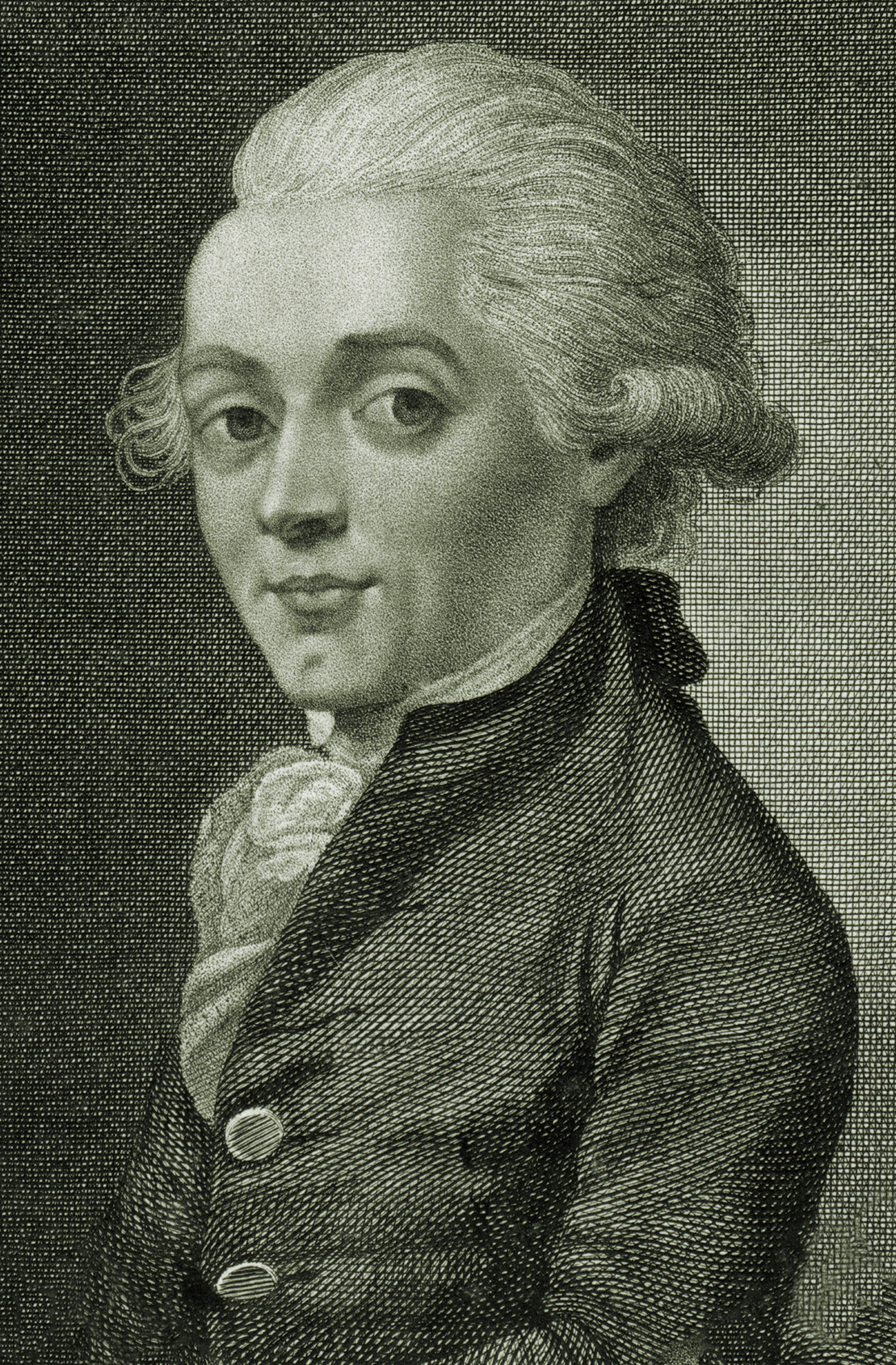
This was to be Blanchard’s 45th ascension. He had come to Philadelphia with a well-earned reputation in Europe. With Dr. John Jeffries, an American, he had sailed his balloon across the English Channel from England to France on January 7, 1785, making the pair the world’s first international air travelers.
The future aeronaut was born at Petit Andelys on July 4, 1750. He demonstrated early that he had an inventive mind. At age 12, he invented a rat trap which, when sprung, would cause a pistol to go off, assuring a rodent’s prompt demise. Four years later, he constructed a velocipede that he propelled from Petit Andelys to Rouen. Later, as a professional engineer, he designed a hydraulic pump system that raised water 400 feet from the Seine River to the Château Gaillard.
The young genius became intrigued with the flight of birds in 1781 and constructed an ornithopter with large wings that were flapped by the pilot, using hand and foot levers. Of course, the machine didn’t work. But when the Montgolfier brothers proved on June 5, 1783, that balloon flight was possible, the eager Blanchard turned his attention to this more sensible and attainable means of flight.
Blanchard built his first balloon a few weeks after the Montgolfier success and made his initial flight on March 2, 1784. From that time on he was a confirmed “balloonatic” and traveled all over Europe giving demonstration flights. He was the first to make ascensions in Germany, Poland, the Netherlands and Austria, and he wanted to be first to sail the New World’s skies as well. So it was that Blanchard was in the new nation’s capital city that wintry day after 44 successful ascensions.
The zestful aeronaut explained in his Journal of My Forty-Fifth Ascension that he came to the New World because “the [Western] Hemisphere had as yet only heard of the brilliant triumph of aerostation [the art or science of ballooning]; and the people who inhabit it appeared to me worthy of enjoying the sublime spectacle that it affords.” He added, “The eagerness which I thought I discovered in the public to see Montgolfier’s sublime discovery reduced to practice, everything seemed to tell me that I might, with confidence, display the mechanism of an aerostat [balloon], to make it soar above the clouds, and convince the New World that man’s ingenuity is not confined to earth alone, but opens to him new and certain roads in the vast expanse of heaven.” Whether for money, fame, scientific research or fun, the daring aeronaut had thus far kept his promise to “display the mechanism of an aerostat.”
There were good reasons why Blanchard wanted to use the prison yard for his takeoff point. First, he needed protection from vandals for his balloon and the hydrogen-making “ventilator” during the preparations. Second, the walls around the prison would assure that the brisk winter winds would not damage the bag during the inflation process. And last, he had to have money to “lighten the burden of my expenses.” It would be easy to keep those without tickets from witnessing the departure. When the tickets were collected at the prison gate, however, only about 100 spectators had been admitted to an area that could have held an estimated 4,800 spectators. Most of the crowd had prudently decided they didn’t need to view the departure ceremony; they could witness the flight as soon as the daring aeronaut rose in his “aerostat” above the prison walls.
There was a flurry of excitement outside the prison at a quarter to 10, when a carriage bearing President George Washington arrived. As the dignified chief executive stepped down, the crowd hushed respectfully. Fifteen cannons roared in salute. Inside the yard, Blanchard was ready. When the president approached, followed by the French ambassador and other dignitaries, Blanchard took off his plumed hat, bowed briefly and exchanged pleasantries with his distinguished guests.
“At 9 minutes after 10,” Blanchard wrote in his Journal, “I affixed to the aerostat my car, laden with ballast, meteorological instruments, and some refreshments with which the anxiety of my friends had provided me. I hastened to take leave of the President, and of Mr. Ternant, Minister Plenipotentiary of France to the United States.”
A well-wisher shoved a small black dog into Blanchard’s arms which he accepted rather dubiously. He dropped the animal into the basket and prepared to board. As Blanchard climbed into the wicker basket, President Washington shook his hand, wished him bon voyage, and handed him a “passport” letter recommending “to all citizens of the United States, and others, that… they oppose no hindrance…to the said Mr. Blanchard” and assist him in his efforts to “advance an art, in order to make it useful to mankind in general.”
Blanchard thanked the president, and as the artillery battery fired a final salvo, he threw out some ballast, nodded to his assistants Peter Legaux and Dr. Nassy to let go the restraining ropes, and was lifted gently skyward. Waving his hat in one hand and a flag in the other, he acknowledged the oohs and aahs of the crowd watching open-mouthed below.
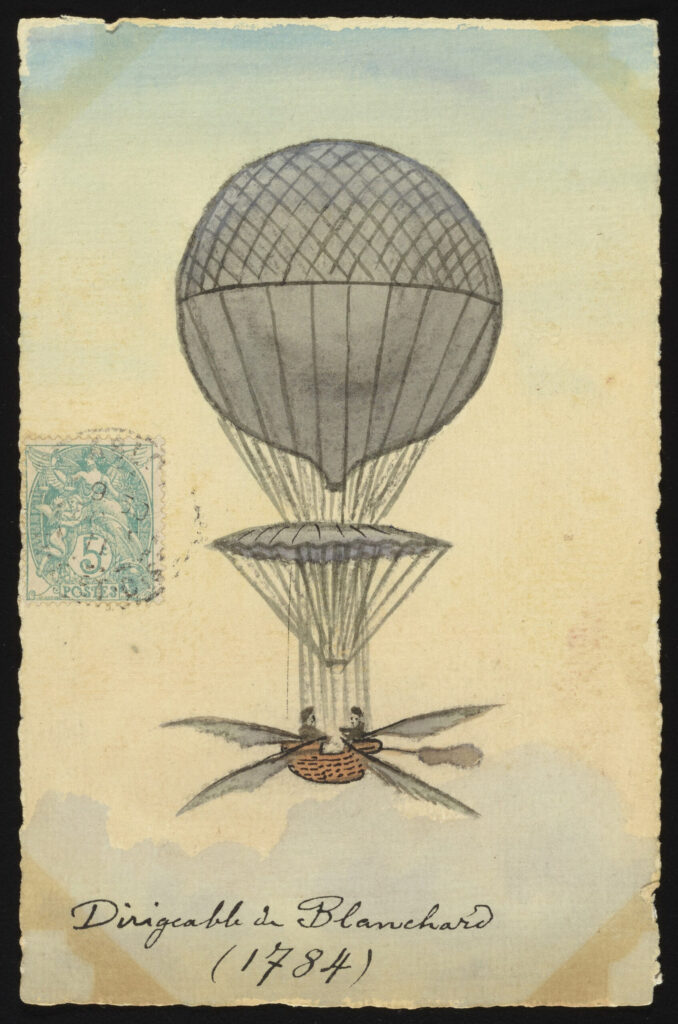
“My ascent was perpendicular and so easy,” he said, “that I had time to enjoy the different impressions which agitated so many sensible and interesting persons who surrounded the scene of my departure, and to salute them with my flag, which was ornamented on one side with the armoric bearings of the United States, and on the other with the three colors so dear to the French nation. Accustomed as I long have been to the pompous scenes of numerous assemblies, yet I could not help being surprised and astonished when, elevated at a certain height over the city, I turned my eyes towards the immense number of people who covered the open places, the roofs of the houses, the steeples, the streets and the roads, over which my flight carried me in the free space of the air. What a sight!”
General John Steele, comptroller of the U.S. Treasury, was astonished at what he saw. In a letter to a friend, he wrote, “Seeing the man waving a flag at an immense height from the ground, was the most interesting sight that I ever beheld, and tho I had no acquaintance with him, I could not help trembling for his safety.”
Blanchard rose steadily upward. At about “200 fathoms,” a mild breeze developed from the northwest and carried him toward the Delaware River. A flock of wild pigeons flew by and scattered into two groups, frightened at the sight of a human being invading their special realm. The small dog whimpered restlessly when he heard them flutter by, but was reassured by a pat on the head. Over the river, the balloon leveled off “in a state of perfect equilibrium in the midst of a stagnant fluid” at 5,800 feet. As Blanchard proceeded slowly southeastward, he observed the sparkling sunbeams on the water below; he later wrote, “this river appeared to me like a ribband [sic] of the breadth of about four inches.”
Mindful that he intended to play the role of an aeronautical scientist, Blanchard became the first test pilot in America by performing a number of experiments during the flight. He filled six bottles “with that atmospherical air wherein I was floating” and sealed them “as the accuracy of the experiment required.”
Next, Blanchard timed his pulse with his pocket watch. He carefully noted that “my observations gave me 92 pulsations in the minute (the average of 4 observations made at the place of my elevation) whereas on the ground I had experienced no more than 84 in the same given time….”
The scientist-aeronaut then weighed a lodestone that on the ground “raised 51Ž2 ounces avoirdupois” but at his greatest altitude weighed only 4 ounces. He made further notes concerning pressure and temperature before he turned to observations of the weather. He reported that “a whitish cloud withheld from my sight for several minutes a part of the city of Philadelphia….A thick fog covered the south; toward the east…a mist arose, which prevented me from reconnoitering the area.”
The wind began to increase, and the balloon continued to drift on a southeasterly course across the New Jersey side of the river. Blanchard relaxed briefly and satisfied his appetite “with a morsel of biscuit and a glass of wine.” He thought he saw the Atlantic Ocean in the distance and made preparations to descend. Mindful that his delicate instruments might break on landing, he carefully stowed them in boxes, cleared away several decorations from the side of the basket, valved out some hydrogen, and emptied several excess ballast bags overboard.
Guiding its downward course carefully by manipulating the gas valve and judging the weight of remaining ballast, Blanchard steered the balloon to a safe landing in an open, plowed field near the town of Woodbury, N.J., 46 minutes after his departure from the City of Brotherly Love. He had traveled about 15 miles. His canine passenger immediately debarked and made off for the nearest tree. The first aerial voyage in America had been brought to a successful conclusion.
Blanchard worked quickly to let the gas out of the silken globe so that it would not drag across the field into a clump of nearby trees. He unloaded his instruments and found them all in good shape except his barometer, which was broken.
Blanchard now realized he had a problem shared by all balloonists, who invariably land far from their takeoff points. How was he going to get back to Philadelphia? He took out a compass and sighted toward the northwest—directly toward the figure of a farmer who was staring open-mouthed at this strange foreigner who had dropped so silently from the skies.
Since he knew little English, Blanchard yelled to the man in French. This frightened the farmer, who stepped backward several paces. Afraid the man would run away, Blanchard held up the bottle of wine and gestured to him to come closer for a drink. Suspicious and cautious, the husky farmer approached warily and took a sip, but only after the stranger downed a swig first. Blanchard soon had a willing helper, thanks to the medium of “the exhilarating juice of the grape.” Although they could not converse and the farmer could not read the passport letter Blanchard carried, he did recognize the name Washington when the aeronaut spoke his name.
A second farmer arrived, armed with an ancient musket. Frightened at seeing the huge globe lying on its side, he dropped his gun and lifted his hands skyward in prayer. The first farmer explained what he understood of the situation. Since the second farmer could read a little and understood the name Washington, Blanchard had no trouble enlisting his help from that point on. Blanchard commented: “How dear the name Washington is to this people! With what eagerness they gave me all possible assistance, in consequence of his recommendation!”
More people appeared, and Blanchard proudly showed them Washington’s letter. The name Washington continued to make the impression he hoped for, and everyone tried to help this intriguing stranger. Several men neatly folded his balloon and stowed it in a wagon. A group of them then escorted him to Cooper’s Ferry on the banks of the Delaware River, where he was transported across to the Pennsylvania side. Before he bid his new-found friends goodbye, however, he quickly drew up a document and asked them to certify “that we the subscribers saw the bearer, Mr. Blanchard, settle in his balloon in Deptford Township, County of Gloucester, in the State of New Jersey, about 10 o’clock 56 minutes, a.m….on the ninth day of January, anno Domini, 1793.”
Monsieur Blanchard arrived back in Philadelphia that evening. He was greeted by a cheering crowd of well-wishers who formed lines to shake his hand. At 7 p.m., he paid his respects to President Washington and presented him with the flag he had borne aloft on his epic flight.
The brief flight had a deep effect on all who witnessed the takeoff. Dr. Benjamin Rush, in a letter to a colleague, wrote: “For some time days past the conversation in our city has turned wholly upon Mr. Blanchard’s late Aerial Voyage. It was truly a sublime sight. Every faculty of the mind was seized, expanded and captivated by it, 40,000 people concentrating their eyes and thoughts at the same instant, upon the same object, and all deriving nearly the same degree of pleasure from it.”
The aeronaut had wanted not only to make history that day but also to be rewarded financially. However, the $405 derived from ticket sales plus another $263 donated by the crowd outside the prison only partly defrayed the $1,500 in expenses he claimed to have incurred. Blanchard was unable to secure backing for a second flight, but, determined to make up for his losses, he remained in Philadelphia. He received help from the consul general of Genoa, who tried to mount a fund-raising campaign but failed.
Governor Thomas Mifflin offered Blanchard the free use of an office in the city. Blanchard was able to build a large “aerostatical laboratory” to house his balloon, car and some mechanical oddities, and thus lure paying customers inside for a small admission fee. In April 1793, he exhibited a wheeled automaton that he called the Curious Carriage. It featured a mechanical eagle that flapped its wings and made it appear as if it were moving by its own power.
Blanchard planned a second balloon flight with Joseph Ravara. But first he had to reduce his deficit and save enough cash to cover his new expenses. The aerostatical laboratory, open every day, could not generate enough cash at 25 cents a person. Still undaunted, he began flying small tethered balloons with animal passengers that would be released automatically by a fuse. The “passengers” would float to earth by means of a crude parachute or “falling screen.” The first drop of a dog, cat and squirrel took place on June 6, 1793. Unfortunately, it was witnessed by “few paying, but many nonpaying spectators,” according to the General Advertiser.
Although his income was meager, Blanchard had moral support from the Federal Gazette. The editor wrote: “There appears to be a prevailing disposition to compensate him. We hope all will step forward before it is too late.” On a parachute flight scheduled to take place in mid-June, Blanchard pleaded in the press that “those persons who are acquainted with the expenses of the artist will honor him with their company inside the said place.”
Blanchard’s efforts were finally thwarted by an epidemic of yellow fever that gripped the city and the surrounding area. Government and business both came to a halt. People were unwilling to gather even in small groups. Blanchard sailed to Charleston, S.C., in the fall of 1795, where his efforts to exhibit his balloon and Curious Carriage did not arouse much interest. He moved to Boston after a few months, and although his arrival sparked serious interest in ballooning there, his personal fortune still did not improve. In fact, he was sued for $370 by Dr. Jeffries, a native of Boston and his colleague on the famous cross-Channel flight. Jeffries won the suit, and Blanchard moved to New York in 1796.
The French aeronaut once again tried to get financial backing for another flight. He was offered a home and all expenses if he would allow Gardiner Baker, one of New York’s pioneer showmen, to handle his business affairs. Baker tried to get subscriptions amounting to $3,000 but to no avail. A “balloon house” was built, in which to construct a new balloon, but it was destroyed by a severe windstorm. Blanchard’s 16-year-old son, who had been working on the roof, was killed.
Blanchard, still undeterred from his quest for solvency, went back into business with small-scale animal balloons. Once again, his efforts to interest the public in ballooning were for naught, so he returned to France in May 1797.
He made his 46th ascent the following August at Rouen, followed by 13 more ascensions in Europe. Before his 60th flight, however, he had a heart attack from which he never recovered. Blanchard died on March 7, 1809, at the age of 56.
Blanchard’s second wife—Marie-Madeleine-Sophie Armant, who was 18 years old when the two married in 1798—carried on the Blanchard family name in ballooning and became the best-known woman aeronaut in Europe. However, Madame Blanchard also had the dubious honor of being the first woman balloonist to die in an aerial accident. When her balloon caught fire during a pyrotechnic night flight on July 6, 1819, she fell out of the basket, struck a roof and fell to her death in the street.
It has been more than two centuries since Blanchard’s historic first flight in the United States. Despite his lack of success in making a business out of ballooning, he, more than anyone in the first generation of aeronauts to perform in the new nation, focused public attention on this first method of manned flight. He could not have known the destiny of the new nation he visited. Nor did he foresee the scientific achievements in aerial transportation that would follow his epic voyage into the untried skies of America. He could be sure of only one thing: He was first!