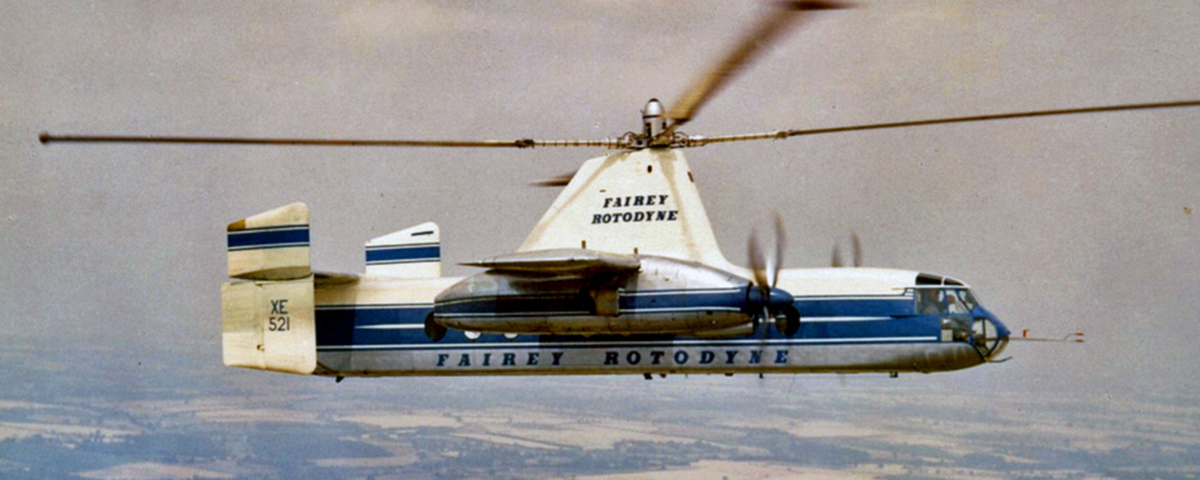
What does an aircraft company do when military contracts dry up? Just as some companies are asking themselves that question in today’s postCold War economy, the Fairey Aviation Company, Ltd., asked itself the question at the end of World War II after having been a major producer of British carrier-based aircraft since World War I. Fairey’s answer was to reinvent the helicopter and revolutionize the short-haul airline industry. After 15 years of effort, its unique project, the Rotodyne, came within an inch of achieving that goal.
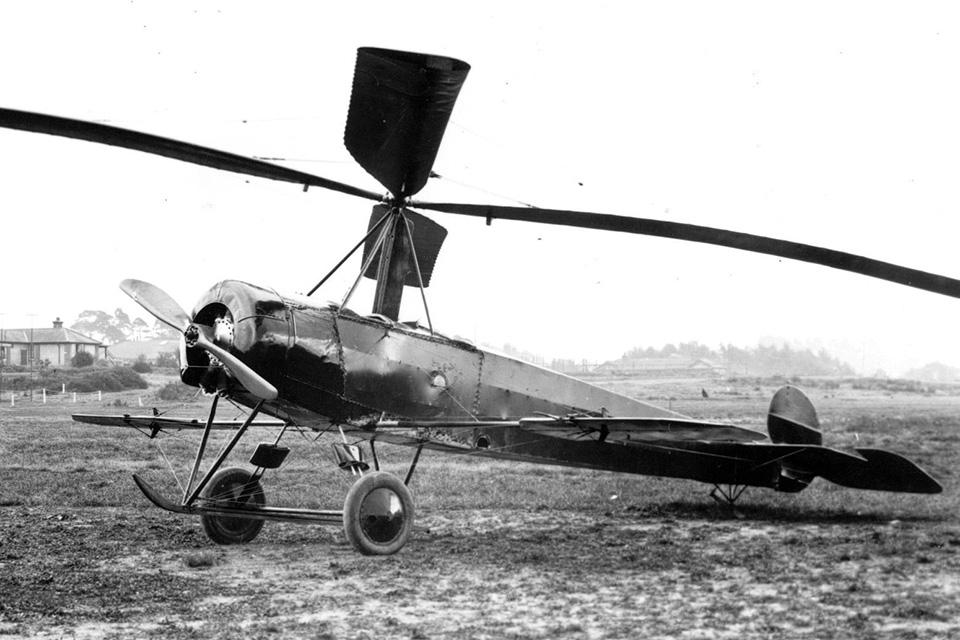
Long before powered flight was actually achieved, inventors and aircraft designers had attempted to combine the speed of horizontal flight with the ability to take off and land vertically. The development of rotary-wing aircraft was the first practical solution to that problem. The first successful rotary-wing craft was the autogiro, first developed in Spain by Juan de la Cierva in 1923. Unlike the later helicopter, the autogiro did not have a powered rotor. Propulsion came from a propeller in the conventional manner, and the rotor was utilized solely for lift in autorotation. Control was achieved by means of elevators, a rudder and usually ailerons, although a degree of roll control could also be maintained by varying the angle of the rotor head. The autogiro achieved an impressive STOL (short takeoff and landing) performance, but it could neither take off vertically nor hover.
The more familiar helicopter, as perfected by Igor Sikorsky in 1939, took the concept one step further by utilizing the powered rotor for forward propulsion as well as for lift. By the end of World War II, the helicopter showed considerable development potential, while the autogiro had become a dead end.
The helicopter concept itself was far from perfect, however. Not the least of its intrinsic drawbacks was its limited maximum speed. That was partly because the portion of the rotor that moved opposite to the direction of flight, referred to as the ‘retreating blade,’ had a tendency to stall as airspeed increased, resulting in excessive vibration. The helicopter also built up a disproportionate amount of drag as its speed increased because of the forward tilt of the rotor, which was necessary since it provided the aircraft’s forward thrust.
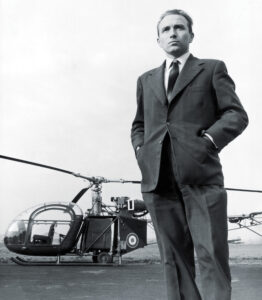
Fairey Aviation initiated development of a new type of rotary-wing aircraft in 1946. It was intended to combine the advantages of the autogiro, helicopter and airplane. The company was well-equipped for such an ambitious project. Doctor J.A.J. Bennett, who led the development team, had formerly been a research engineer at the Cierva Autogiro Company. During World War II, Dr. Bennett had also studied rotary wing aircraft development in the United States as principal technical officer to the British Air Commission in Washington, D.C. The Fairey design team also included Squadron Leader B. Arkell and Wing Commander R.A.C. Brie, both of whom were among the first British pilots to qualify in rotary-wing aircraft.
The idea behind the ‘compound helicopter,’ as Fairey called its concept, was essentially simple. The aircraft would take off and land vertically with a power-driven rotor, like a helicopter, using a controllable-pitch propeller for yaw control. Once airborne, all propulsive power would be transferred to the propeller, with lift being generated by the then- autorotating rotor and a pair of small, conventional wings. The combination of lift from the wings and the reduced drag of the autorotating rotor would, theoretically, produce an aircraft far more efficient than a conventional helicopter.
The flight controls of the compound helicopter were arranged in such a way that the rotor’s collective pitch, which controlled lift in the helicopter mode, would change automatically as the throttle was opened or closed. Roll and pitch were controlled by tilting the rotor head. A single tractor propeller in the starboard wingtip was used to control yaw, as well as to provide forward thrust in the autogiro mode. A conventional tail with an elevator and twin rudders was installed to maintain the aircraft’s trim in horizontal flight and to control the aircraft in the event of engine failure.
The first of three compound-helicopter prototypes, called the Gyrodyne, had its maiden flight on December 7, 1947. Powered by a single 520-hp Alvis Leonides radial engine, it set a helicopter world speed record of 124.3 mph on June 28, 1948. Unfortunately, it was destroyed 10 months later when its rotor head disintegrated in midair, killing the pilot and flight observer.
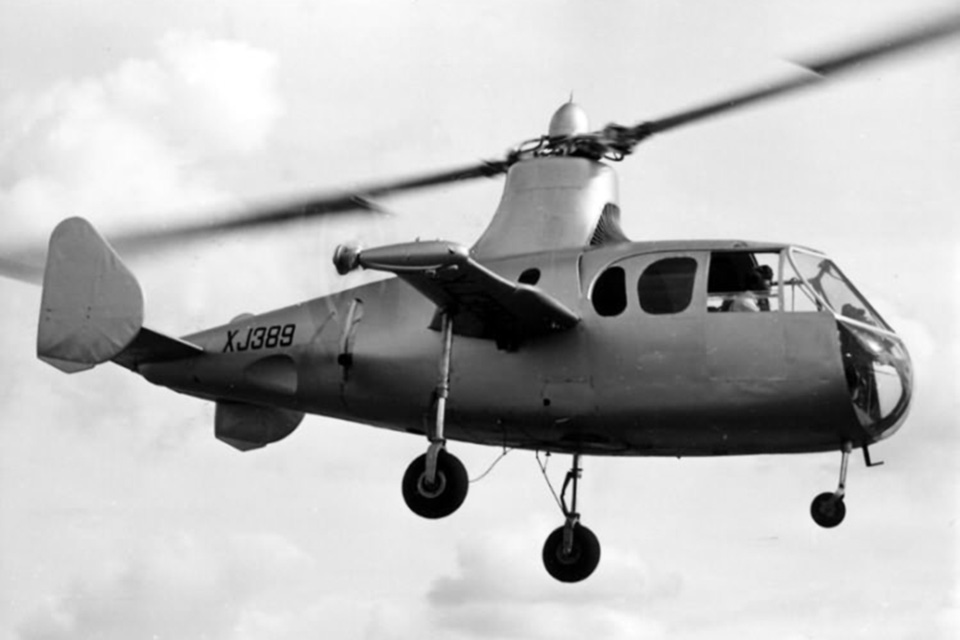
As a result of that tragic accident, Fairey completely revised its compound helicopter project. Four years elapsed before the second prototype, known as the Jet Gyrodyne, appeared. That aircraft was characterized by an entirely new transmission system that was intended to simplify and strengthen the rotor. Contrary to its name, the Jet Gyrodyne was actually powered by the same type of reciprocating engine as that installed in the original prototype. Instead of transmitting its power through a mechanical gearbox, however, pressurized air was pumped into miniature jet nozzles located in the tips of the rotor blades, by means of a pair of compressors. The compressors, modified from surplus Supermarine Spitfire superchargers, were driven by the engine. Fuel was delivered by centrifugal force to jet burners at the tips of each rotor. Power for level flight, and for yaw control in the helicopter mode, was provided by a pair of controllable pitch pusher propellers mounted in the wingtips.
Flown for the first time in January 1954, the Jet Gyrodyne proved to be somewhat underpowered and could only carry enough fuel for a 15-minute flight, but it served as the experimental model for a larger and more ambitious project that was being developed concurrently–the Fairey Rotodyne.
Outwardly, the Rotodyne looked like a cross between a helicopter and an airliner–which, for all intents and purposes, was exactly what it was. The aircraft had a wingspan of 48 feet 6 inches and an overall length of 58 feet 8 inches. The production version was intended to carry 57 passengers.
The Rotodyne was powered by a pair of 2,800-hp Napier Eland turboprop engines mounted in nacelles slung underneath the wings. The engines drove a pair of four-bladed, controllable-pitch, tractor propellers that, as in the Jet Gyrodyne, doubled as yaw stabilizers when the aircraft was operated as a helicopter. A 90-foot-diameter rotor was mounted atop a tall fuselage pylon. The rotor was powered by jets installed at the tips of its four blades, similar to the arrangement used on the Jet Gyrodyne. Each engine provided compressed air for a pair of tip jets on opposite sides of the rotor.
Most of the power from the Rotodyne’s turboprop engines was diverted to nine-stage axial compressors located behind them for vertical takeoff. The compressed air produced was then ducted to the jet nozzles in the rotor tips, where it was combined with fuel and ignited. A small amount of residual power was made available to the propellers for yaw control. Once the aircraft had gained sufficient altitude and speed, the compressors were disconnected by means of hydraulic clutches and all engine power was then diverted to the propellers.
Once the Rotodyne was in forward flight, about half of its lift was generated by the autorotating rotor, and the remainder by its wings. Landing could be accomplished in autorotation, or by engaging the compressor’s clutches and relighting the tip jets for a conventional helicopter landing. The flight crew could accomplish, with practice, the transition between helicopter and autogiro modes in approximately 30 seconds.
The future of the Rotodyne seemed assured in the mid-1950s. Britain’s regional carrier, British European Airways (BEA), had issued a specification for just such a short-haul/medium-haul aerial ‘bus’ in December 1953. Other commercial operators were also showing interest. Development was slow, however. It was not until November 6, 1957, that the prototype was finally flown, and then only in the helicopter mode. Transition between helicopter and autogiro flight was not achieved until April 10, 1958.
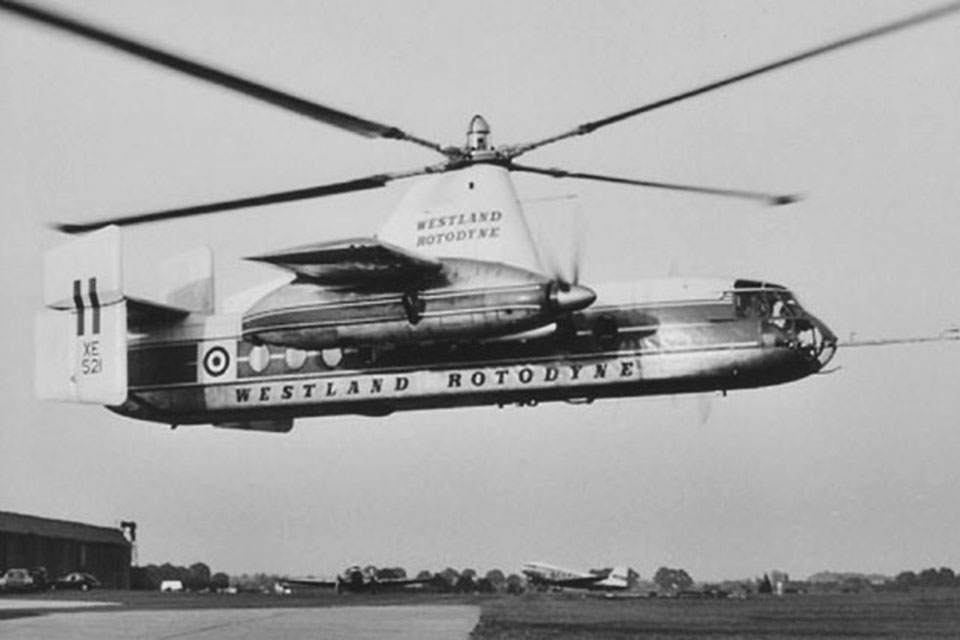
The Rotodyne established a world speed record on January 5, 1959, for ‘convertiplane’ type aircraft of 190.9 mph, exceeding the old record by 30 mph. The prototype’s capabilities were publicly demonstrated for military and commercial officials the following June at the Paris Air Show. Prospective orders were negotiated with operators in Britain, Canada and Japan. An American company, Kaman Aircraft Corporation, arranged for a sales and service contract in the United States, as well as a license to manufacture the aircraft.
The Rotodyne’s most promising potential customer, apart from BEA, was New York Airways (NYA). The world’s first scheduled airline to use rotary-wing craft exclusively, NYA specialized in commuter flights between downtown New York and various airports on the outskirts of the city. NYA’s service involved the operation of passenger helicopters to and from the roof of the Pan Am Building in the heart of Manhattan. NYA signed a letter of intent for five Rotodynes in March 1959, with an option to acquire 10 more, at $1.5 million apiece. It was calculated that the Rotodyne, with its generous passenger capacity, could reduce the airline’s operating cost per seat/mile by at least 50 percent over the helicopters.
The NYA order was, however, contingent upon the availability of a larger and more powerful 65-passenger version of the Rotodyne. Fairey estimated the development of that aircraft would require an additional expense of 8 to 10 million pounds sterling. And at that point, the entire project began to go awry. A British government offer to loan Fairey half of the development cost of the new model was further contingent on a firm order for that aircraft from BEA. In order for the BEA and NYA orders to be confirmed, however, the new prototype had to be flying by the autumn of 1961.
The Rotodyne was also having difficulty meeting minimum noise-level requirements, a new problem that the British aviation industry later would encounter again with the Concorde supersonic jetliner. Although none of the Rotodyne’s remaining technical problems appeared to be insoluble, time and money were rapidly running out.
Matters were complicated further when the British helicopter industry was amalgamated into a single entity in February 1960. Fairey’s aircraft division was merged with Bristol and Westland, and the prototype was flown thereafter with ‘Westland’ emblazoned on its fuselage. Corporate reorganization diverted attention from Rotodyne development at a critical juncture. Prospective customers got the impression that Westland’s enthusiasm for the Rotodyne was waning, and their own interest began to waver. Rotodyne development continued in a desultory manner until February 1962, when–after four years of flight testing and the expenditure of 11 million pounds–the entire project was canceled.
There have been many experiments with convertible aircraft since the Fairey Rotodyne. They have come in a wide variety of shapes and sizes, of which the BellBoeing V-22 Osprey is the latest. The one factor they all seem to have had in common was their respective designers’ conviction that, with the expenditure of just a little more time, effort and money, they had the potential for revolutionizing the aviation industry. With the exception of the Hawker Siddeley Harrier ‘jump jet’ fighter-bomber, the Fairey Rotodyne probably came closer to commercial success than any of those interesting aircraft. But for a little more time, effort and money.
This article was written by Robert Guttman and originally published in the May 1996 issue of Aviation History.
For more great articles subscribe to Aviation History magazine today!