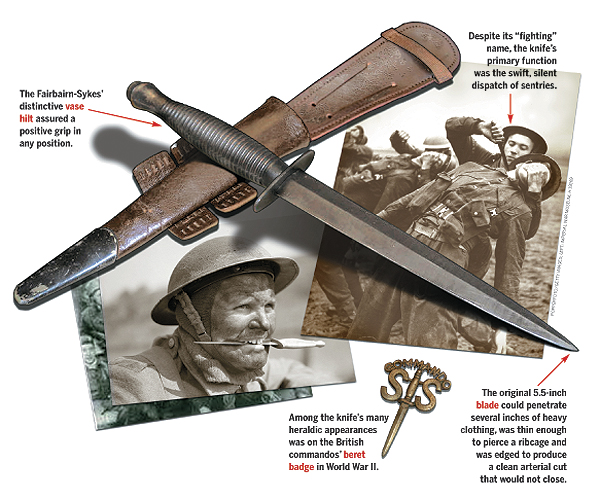
When Major William Ewart Fairbairn, chief of police for the British concession in prewar Shanghai, China, collaborated with Eric Anthony Sykes to design a special knife, he had murder on his mind. Conceived for the close-in combat then common in Shanghai’s streets and back alleys, the Fairbairn-Sykes fighting knife saw wartime use by several Allied assault forces. London’s Wilkinson Sword began full-scale production in January 1941, and by war’s end it and other manufacturers had produced almost 2 million knives of varying patterns and quality, some 20,000 seeing service with the U.S. Office of Strategic Services, precursor of the CIA. Brig. Gen. Robert T. Frederick, commander of the American-Canadian 1st Special Service Force (aka Devil’s Brigade) designed his own variation of the knife, the V-42 stiletto, manufactured in western New York by W.R. Case & Sons.
Still in use today, the Fairbairn-Sykes fighting knife graces the insignias of the British Royal Marines, U.S. Army Rangers, Dutch Commando Corps and Australian 2nd Commando Regiment. It also features prominently in both the Combined Services Memorial in Westminster Abbey and the Ranger Monument at Fort Benning, Ga.