When infantrymen of the 1st Marine Division waded ashore at Da Nang in March 1965, the conflict in Southeast Asia might have seemed quite a low-key affair, as banners and pretty girls wearing flower garlands welcomed America’s crack troops. But when he deployed the Marines, President Lyndon B. Johnson significantly escalated the war. They were sent to Vietnam to protect airfields from Viet Cong guerrilla attack, but the Marines were soon in the midst of heavy action and were requesting their own air support.
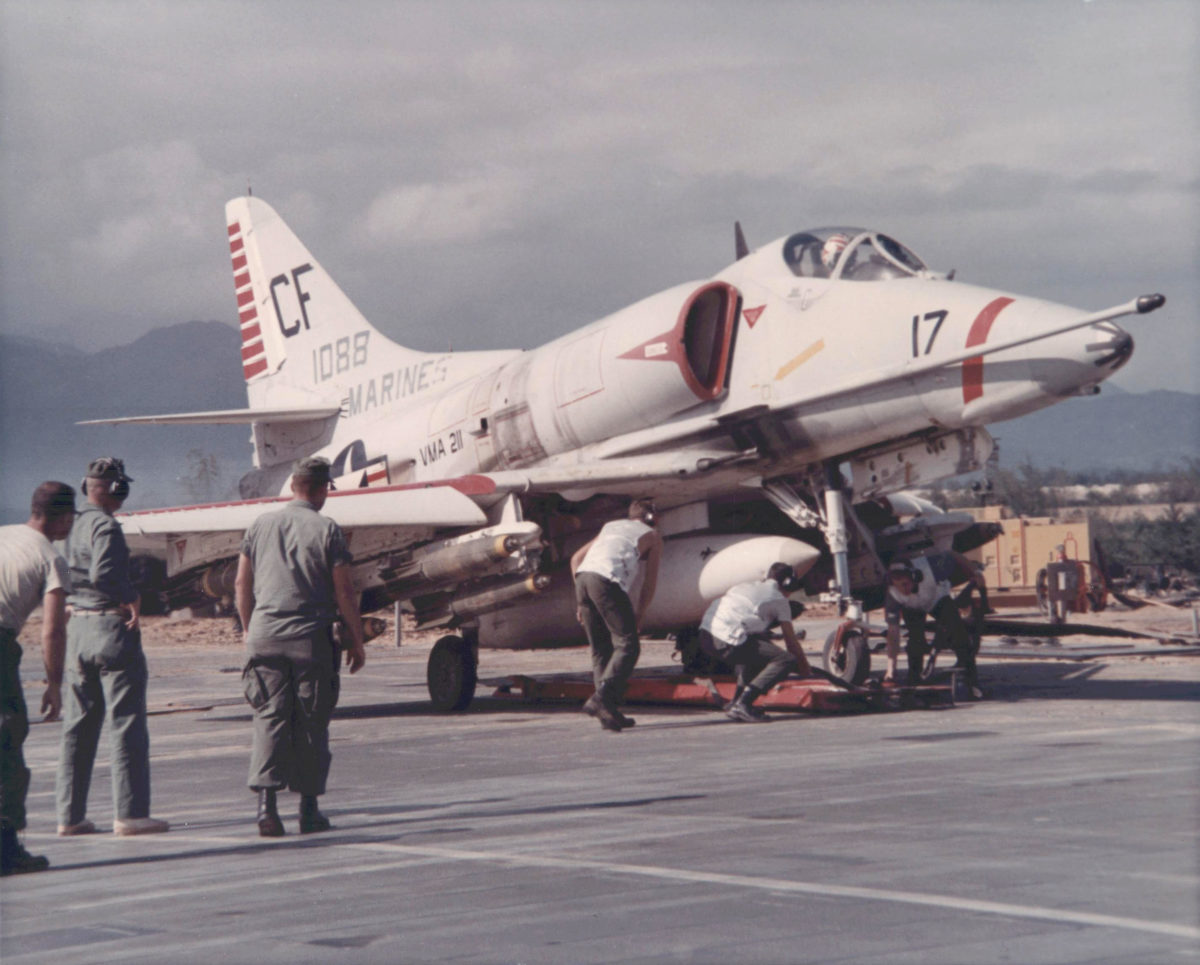
The Corps’ air inventory in 1965 included the diminutive Douglas A-4 Skyhawk. Designed as a Navy shipboard attack airplane, the A-4 had the smallest possible airframe to assist stowage aboard carriers. By 1965, as the A-4E, the Skyhawk had become a highly capable warplane. The A-4 had been flown by the Corps since 1957, but it had waited eight years to make its combat debut in the hands of Marine pilots.
The A-4E was armed with two internal 20mm cannons and could carry additional guns in external pods. With three stores stations available in the A-4C and five in the A-4E ‘Echo, Marine pilots could deliver approximately 8,500 pounds of ordnance–iron bombs weighing up to 1,000 pounds, napalm, Zuni semi-guided rockets, cluster bombs, and unguided rockets. The A-4 was fast, maneuverable and rugged, well able to survive combat in Vietnam, where anti-aircraft artillery and small arms were the enemy’s principal weapons.
The Marine landings coincided with a need for a new air base on the coast in order to reduce flight time to targets in Quang Tin province and adjacent districts. Da Nang was the first Marine air base in South Vietnam. A second airfield was sorely needed, and Chu Lai, located about 50 miles south, was chosen.
Marine Aircraft Group 12 (MAG-12) would direct most operations assigned to the A-4 force in South Vietnam, plus bring in new squadrons as required. MAG-12 was commanded by Colonel Dean Macho, an energetic and resourceful officer who usually led from the front. Macho would fly numerous A-4 strike missions.
Navy Seabees sweated in 100-degree-plus temperatures to prepare the Chu Lai site for an AM-2 aluminum plank runway, dubbed the tinfoil airstrip. Designated SATS, for short airfield for tactical support, the facility had been designed for areas where no airfield existed. The one at Chu Lai initially had a 4,000-foot runway, taxiways, a parking ramp and, later, a catapult and arrester gear. As one individual put it, Chu Lai eventually had everything a Navy carrier had except the water.
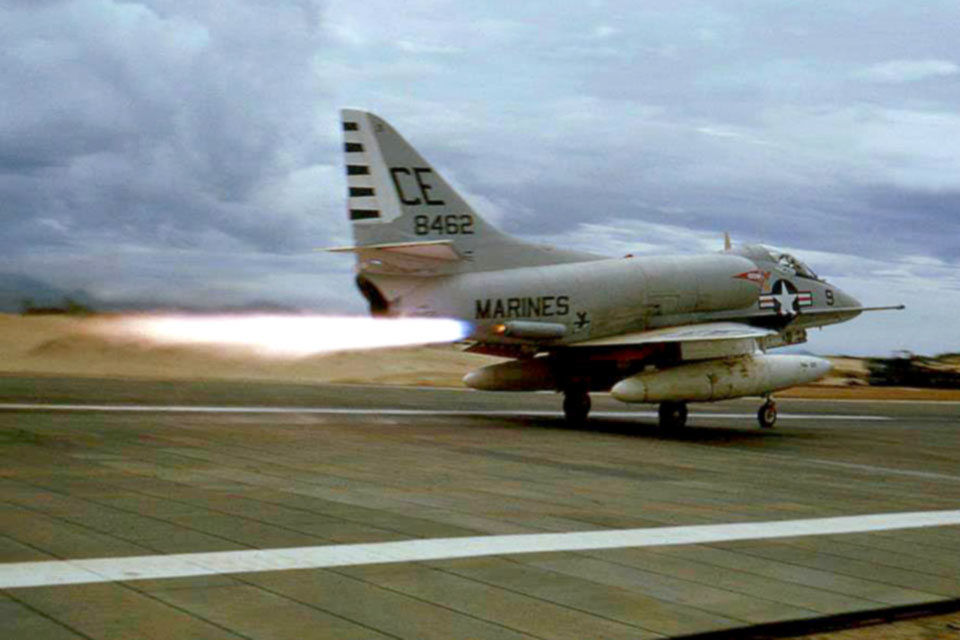
A launching catapult was not immediately available, but Chu Lai had ample supplies of JATO (jet-assisted takeoff) bottles for an extra push on takeoff. These dry-fuel rockets were attached to the rear fuselage of each A-4 to give a five-second burn that generated 3,500 pounds of thrust. Using them cut the A-4’s takeoff distance in half.
On June 1, 1965, Colonel John D. Noble, commanding MAG-12, flew into Chu Lai in a Skyhawk, leading three other A-4s belonging to Lt. Col. Robert W. Baker’s squadron, VMA-225, into the new air base. Those Skyhawks were followed later the same day by four A-4s of the VMA-311 Tomcats, commanded by Lt. Col. Bernard J. Stender.
The urgent need for Marine fixed-wing air support was demonstrated by the fact that on the same afternoon he arrived, Baker was briefed to fly Chu Lai’s first airstrike. His aircraft duly hit targets identified by Vietnamese army troops who were in contact with the enemy six miles north of the base. The close proximity of the enemy to South Vietnamese air bases was a fact that the Marines learned to accept.
Combat flying for the VMA-311 Tomcats began on June 2; the first of two four-plane sections flown that day was launched in the morning. Noble led, followed by Stender, who ran his engine up to 85 percent power for the standard fuel state check prior to calling the tower for takeoff clearance. The ground people answered, and Stender moved to acknowledge the message, but instead of keying the microphone button he hit the JATO firing button. The A-4 leaped forward. There was little to be done, for Stender was on his way, blowing sand for a mile, as one eyewitness described it. Fortunately, the A-4 responded to the controls, and Stender’s four aircraft went on to bomb and strafe Viet Cong forces in Quang Ngai, about 20 miles south of their base.
All 20 of VMA-311’s aircraft had arrived at Chu Lai by June 16 to begin an intensive period of operations. On June 23, Stender was gratified to receive a message from the U.S. Air Force 2nd Air Division, which directed the majority of fixed-wing airstrikes throughout the country. It cited VMA-311 for the finest close air support we have ever seen.
Any achievement by the Marine fliers was often in spite of the facilities at Chu Lai. The runway demanded constant repair and shoring up to prevent the aluminum planking from sinking into the sandy subsoil. While the tactical airport concept worked well enough, the sheer pace of Southeast Asian air operations kept the maintenance teams very busy.
Vietnam’s inclement weather necessitated the use of electronic systems designed to outsmart this natural enemy. Among those used by the A-4 was the General Electric AN/TPQ-10 precision radar, which facilitated night and bad-weather ordnance delivery. Directed by a ground controller, the pilot made his target run-in, set the bomb sequencing switch and put the aircraft into altitude hold mode on autopilot. No visual reference point was required on his part, and the computerized system was able to initiate directional changes automatically. It released the ordnance at the correct altitude and time via radio signals received by the A-4’s onboard computer.
With the A-4Cs of VMA-225 and the A-4Es of VMA-311 in place at Chu Lai, MAG-12 added a third Skyhawk combat unit, VMA-214 Black Sheep, before the end of June 1965. Such was the rapid buildup of American forces in South Vietnam. Also flying the A-4C, VMA-214 had a front-line establishment of 20 aircraft, as did the other squadrons.
As the Vietnam ground war increased in intensity, the Marine A-4 squadrons began piling up a high number of mission credits. The targets were only a few minutes’ flying time away from their base, hence pilots could fly multiple sorties in a single day. It became routine to reckon sortie totals by the thousands. The continual proximity of enemy troops to U.S. air bases occasionally resulted in A-4s dropping their ordnance almost before the pilots had retracted their wheels.
North Vietnamese forces made numerous attempts to destroy or damage U.S. aircraft at their bases. Chu Lai was attacked on several occasions. During Operation Starlite in August 1965, the Skyhawks successfully flew to protect both their own ground troops and their base.
MAG-12 increased its total A-4 assets to about 80 aircraft by the fall of 1965 with the arrival in mid-October of VMA-211, the famed Wake Island Avengers. That name recalled the squadron’s Pacific combat record during WWII. As not to stretch Chu Lai’s facilities too far, A-4 squadrons were regularly rotated back to Japan as others came in to fly combat tours. VMA-224 Bengals had arrived in October, to be followed by VMA-223 Bulldogs in December. Pilots were immediately thrown in to support Operation Harvest Moon, a joint AmericanSouth Vietnamese sweep between Da Nang and Chu Lai. Completed on December 20, the operation required extensive air cover, and at the end of it, VMA-223 considered itself duly bloodied.
On December 29, 1965, VMA-211 lost 1st Lt. Thomas F. Eldridge, whose A-4E was hit by .50-caliber fire as he rolled in on enemy positions during a helicopter escort. Despite a leg wound, Eldridge was able to drop his load of napalm and turn for base. Unfortunately, he was killed when his crippled craft crashed 13 miles from Chu Lai.
January’s rains undermined Chu Lai’s runway, but air operations continued with the aid of JATO and the arrested-landing system that had since been installed. An adaptation of the carrier arrester-wire system, the arrested-landing system could stop a landing Skyhawk in 600 feet. It quickly proved its usefulness, as did other naval aircraft arrester systems used for land bases. All Marine A-4s retained their tail hooks so they could use this landing system. Numerous pilots were saved when they returned home with bullet-riddled A-4s that possibly had damaged hydraulics and were consequently at risk of a belly landing or a runway overrun.
VMA-223’s arrival in December had brought the total number of Marine A-4 squadrons that had seen action to date to six. Since other aircraft were now using Chu Lai, the maximum number of A-4 squadrons allowed at the base at any one time was set at four–a rule enforced until 1970.
A series of bloody firefights in the A Shau Valley area in March 1966 claimed the first VMA-311 pilot to be lost in action. First Lieutenant Augusto Gus M. Xavier, who was attacking targets in mountainous terrain in the predawn darkness of March 19, failed to pull out of a strafing run. Xavier’s aircraft was one of two Skyhawks lost during an intensive operation to rescue American and South Vietnamese garrison troops cut off by superior enemy forces. A Shau remained North Vietnamese territory and was a hot combat zone very familiar to the Marine A-4 pilots.
Skyhawks were hit by enemy fire on numerous occasions, and many managed to return to base–testimony to both the pilots’ skill and the strength of the A-4’s airframe. Accidents, an occupational hazard of operational flying, were kept well within reasonable limits. All the Chu Lai A-4 squadrons accumulated impressive records for flight safety. Chu Lai’s catapult system became operational on May 14, 1966. Powered by two General Electric J79 jet engines, the base catapult was able to launch Skyhawks on either north or south runway headings. Everyone who had operated out of Chu Lai had remarked on the base’s similarity to a carrier deck–and now the catapult and the arresting gear reinforced that perception.
Operation Hastings in July 1966 represented the largest Marine Corps operation to date, with the Tomcats providing support for actions against the 324th North Vietnamese Infantry Division. By August, the squadrons had chalked up 7,000 combat sorties, with the average pilot logging between 600 and 700 combat flying hours a month.
One VMA-311 pilot, 1st Lt. Thomas H. Hawking, was killed during a rescue attempt on September 6. Having ejected from his A-4 after hitting trees during a bombing run, Hawking grabbed a line trailed by a UH-1, but as the Huey climbed, the pilot fell to his death.
On September 21, the enemy carried out a mortar attack on Chu Lai, wounding some of VMA-223’s personnel. But despite the attentions of the enemy, the base had become invaluable to the Marines, and its facilities were continually improved.
A 10,000-foot concrete runway (which became known as Chu Lai West), plus aircraft hardstands and taxiways, were completed by October 1966. That December, the VMA-121 Green Knights became the seventh and last Marine A-4 unit to fly Vietnam combat missions. This squadron had been the first to deploy Marine Skyhawks over Southeast Asia when it operated briefly from Ubon, Thailand, in 1962 to help thwart a possible anti-government coup. No threat had materialized, and VMA-121 had returned home without firing a shot.
On February 3, 1967, the Bulldogs set a one-day, 59-sortie record for the Skyhawk, during which the squadron continued to fly a mix of A-4Cs and A-4Es. Along with the other A-4 squadrons, VMA-223 also flew close air support sorties during Operation Double Eagle in February and Operation Utah in March. The Bulldog pilots were rapidly becoming veterans, and their commanding officer, Lt. Col. Robert B. Sinclair, was congratulated for flying the squadron’s 10,000th accident-free hour.
In addition to having considerable success with radar bombing, Marine A-4 pilots worked with Air Force forward air controllers and used their own tactical air coordinator aircraft, which as of 1967 were two-seat TA-4Fs. Retaining the two-cannon armament and similar stores delivery capability of the single seaters, the TA-4F dual-control trainer also generally duplicated the combat models’ avionics fit, making for ease of maintenance. The TA-4F was flown by Headquarters & Maintenance Squadrons (H&MS) 12 and 13 at Chu Lai, and H&MS-11 at Da Nang.
Tactical air control increasingly passed to jet aircraft during the war. However, the Cessna O-1E Bird Dog is probably most popularly associated with that role in Vietnam. It took a lot to impress the lightplane pilots, who risked their necks for nothing if the targets they marked were not hit hard.
On the afternoon of April 19, 1967, two A-4Es from VMA-121 showed how well it could be done. Flown by Captain Robert C. Blackington (flight lead) and his wingman, 1st Lt. Samuel B. Vaughan, the Skyhawks had twice struck targets adjacent to rice paddies about 21 miles south of Chu Lai. Then the forward air controller called them in again. After our spotter told us of the Viet Cong activity, Blackington recalled, I immediately made a run, dropping two 250-pound bombs. Vaughan followed about a mile behind me, dropping identical ordnance. Vaughan was of the opinion that the fires the Skyhawks had started indicated a hidden ammunition dump, but the forward air controller remained skeptical that the target had been totally destroyed.
On his target assessment overflight, the Air Force pilot noted more enemy troops and called for another pass from both A-4s. More bombs were dropped, and on his final run Blackington fired 200 rounds of 20mm ammunition. Once more the O-1E flew over the target. This time the Bird Dog pilot was satisfied and commented, You guys do excellent work.
Marine pilots flying the small, maneuverable Skyhawk were indeed popular candidates for close air support because they rarely lost any time in arriving over the target. The A-4 squadrons had initiated hot pad alerts at Chu Lai, during which a section of armed aircraft awaited the scramble call with pilots in their cockpits and engines turning over.
There were enough hazards to be faced by Marine airmen south of the Demilitarized Zone without undue attention from the enemy’s defense trump card, the SA-2 Guideline surface-to-air (SAM) missile. It was used mainly in the North, but two Marine Skyhawks were to fall victim to SAMs during the war, one of them flown by Major Ralph E. Brubaker of the Tomcats. On July 6, having ejected after his A-4 became uncontrollable when the missile detonated, Brubaker suffered a dislocated knee. Safely on the ground, he was rescued by helicopter.
By the end of 1967, little progress had been made toward a successful end to the war. The North Vietnamese planned a nationwide coup to unite the country under Communist rule that was timed to start during the 1968 Tet, or lunar new year, celebrations. When the Tet Offensive began in January 1968, a focal point of the North Vietnamese attacks was the U.S. outpost at Khe Sanh. Having been isolated by the loss of the A Shau Valley area in 1966, the garrison expected an attack, and the 26th Marines stationed there were hardly taken by surprise when the offensive began.
The core of the enemy offensive was concurrent attacks on towns and U.S. installations throughout South Vietnam. Among the targets was Chu Lai, where, on January 31, rockets injured two men from VMA-311, damaged four of that squadron’s A-4s and destroyed part of the bomb dump. In retaliation, the Bulldogs destroyed an enemy rocket dump south of their base on February 25.
The battle to prevent the capture of Khe Sanh became one of the epic ground-air actions of the war. It included a huge logistics airlift to bring the Marine defenders food, medical supplies and ammunition. To help this effort, the Corps devised the Super Gaggle formation, which centered on a Lockheed Hercules C-130 cargo plane, flying with helicopter and fixed-wing aircraft escort.
Twelve A-4s flew the first Super Gaggle on February 24, 1968, joining 20 CH-46 and UH-1E helicopters on a mission coordinated by a TA-4F. The role of the Skyhawks was to sanitize the en route and landing areas by working them over with bombs, napalm and 20mm cannon fire. Operation Niagara, the huge, coordinated air plan to hold Khe Sanh helped break the Tet Offensive; yet the break was not exploited, and the United States ultimately began withdrawing combat units. A number of bases lost their front-line status, among them Chu Lai. It was handed over to the Army on September 3, 1970; the last Marine sorties were flown from there on September 11.
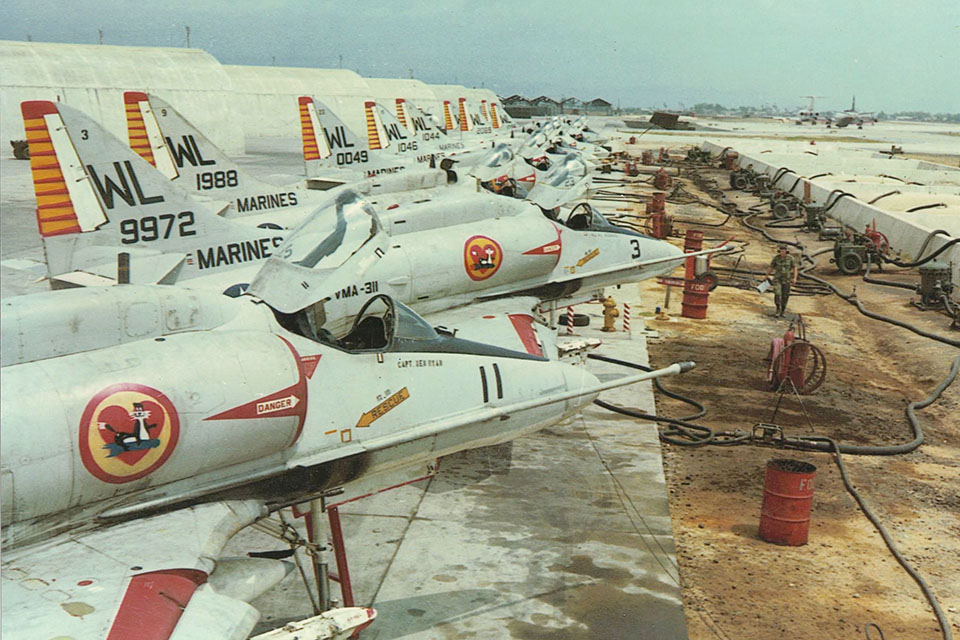
MAG-12 had meanwhile departed Vietnam in February 1970 and relocated in Japan; VMA-211 accompanied it, while VMA-223 returned home. The Marine combat units that remained in Vietnam moved to Da Nang, among them VMA-311, which then came under the operational control of MAG-11 and continued to support the ongoing war in Laos and Cambodia. One of the earliest arrivals in the war zone, VMA-311 had by May 7, 1971, flown 47,663 sorties. That looked like the end of the war for VMA-311, but on March 30, 1972, the North Vietnamese invaded the South, and the squadron flew into Bien Hoa, near Saigon. On May 1, VMA-311 began flying combat missions again. Many sorties were flown into Cambodian border regions, and on August 29, 1st Lt. Charles G. Reed flew VMA-311’s 50,000th sortie. The squadron went on to raise its sortie total to 54,625 before the war’s end.
Even after the successful containment of the April 1972 invasion of South Vietnam–the Eastertide Offensive–operations in Laos and Cambodia continued to attract American air support. But it was clear that after the January 1973 cease-fire, the United States was, militarily speaking, out of Vietnam for good. VMA-311 was to be the last air combat unit of all the U.S. services to leave that war-ravaged country, but it took some weeks for the cease-fire to take complete effect. Not until January 28 did VMA-311 ground personnel refuel the last A-4s, hang the last bombs–painted red, white and blue for the occasion and daubed with slogans–on the airplanes and strap in the last duty pilots.
Fittingly, Dean Macho, commander of MAG-12, led the mission, a strike into the Mekong Delta region. Asked if their target lay east, west, north or south of a marked point, the Vietnamese forward air controller simply replied, Roger. The comment was indicative of the hold the enemy had on the country. Da Nang’s ground troops waited anxiously for the Skyhawks to return. They all did, 1st Lt. Thomas Boykin’s aircraft being the last to land. He reported that, true to form, the enemy had hit his aircraft over the Mekong Delta area, but the minor damage had not given him any problems. Boykin said, I dropped the last bomb….I’m glad it’s over.
Lieutenant David Mowrey told a reporter that his war had been a hell of an education. He added something that could be echoed by almost every combat flier, The common denominator of the guys here is that we love to fly, but the sad thing is that in terms of quality and quantity, the best flying comes when you’re in a war.
This article was originally published in the May 1996 issue of Aviation History. For more great articles subscribe to Aviation History today!