
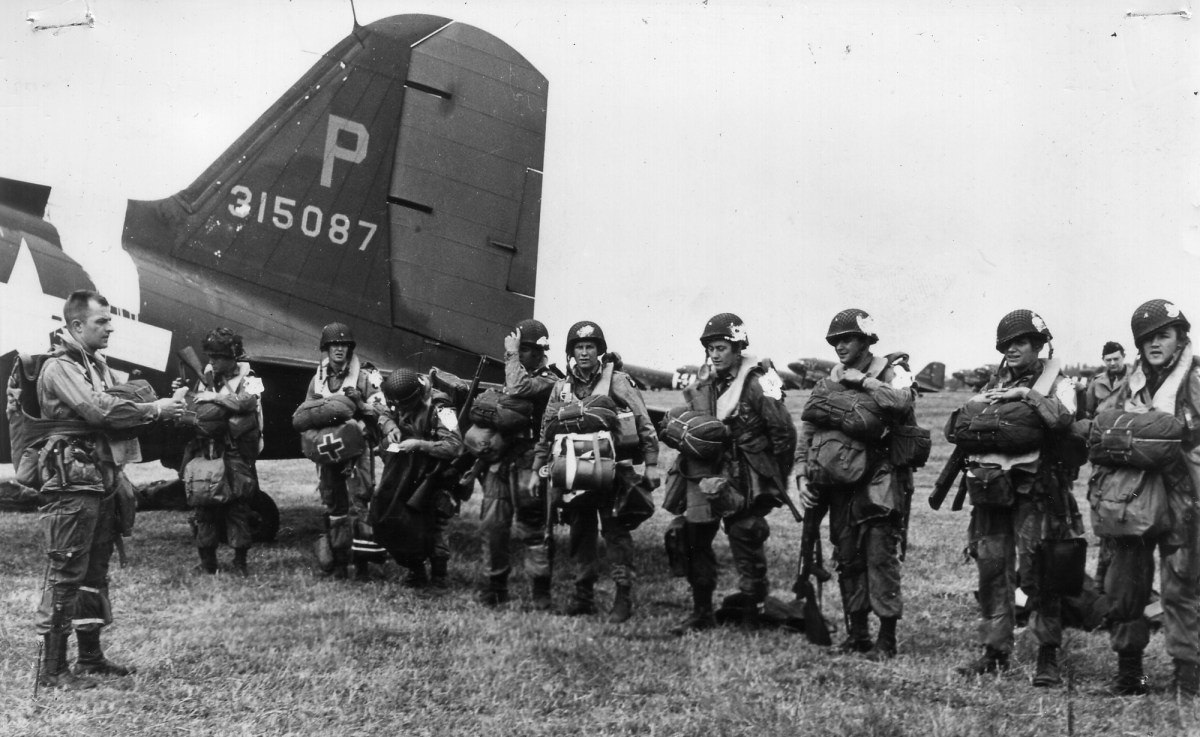
“Everyone was trying to figure out exactly where we were going,” remembers Amos “Buck” Taylor, a sergeant in the 506th at the time. “We knew it was probably going to be Normandy, but exactly where nobody knew.” Though the location of the invasion had not yet been revealed, the men had some idea of what Gen. Bill Lee, former commander of the 101st, had called “the responsibility ahead of us.” The past nine months had been a blur of grueling training exercises that had tested the mettle even of these men, elite volunteers trained to jump directly into the turbulence of combat. Their training had culminated in Exercise Tiger, a full-scale rehearsal of D-Day that had involved all units of the 101st Airborne.
In a few short hours, at Exeter Airfield, the men of 3rd Battalion would discover their objective: to lead the way on D-Day by seizing and defending two bridges spanning the Canal de Carentan—vital links between the German bases in and around Carentan, a small port city just south of the Cotentin Peninsula, and the American invasion beaches.
On the following pages, the men of the 506th recall the days leading up to the perilous night drop that launched the largest military invasion in history.
Staff Sgt. Ed Shames, Company HQ: “There were about 30 people [at the initial briefing on May 27]…. The tent fell silent as the SHAEF officer stood up in front of a flip chart mounted on a stand. The guy did the big showbiz thing, like a magician pulling a rabbit from a hat. He flipped open the cover of the chart to reveal a large heading that read, ‘operation overlord—the invasion of normandy june 4.’ [Third Battalion’s commanding officer, Lt. Col. Robert] Wolverton jumped out of his seat and said, ‘I had a hunch it was going to be there, boys, I knew it, I knew it!’”
Sgt. Ralph Bennett, H Company: “It seemed to be raining a lot. Each day we attended lectures, had close order drill and unarmed combat, cleaned weapons and sharpened knives. We worked from 6 a.m. to about 5 p.m. A lot of the guys would spend their evenings watching movies…. What I remember most were the briefings. The sand table tent was full of maps and aerial photographs and we attended at least two platoon-strength lectures there. Each would last about half an hour, then we would move on to the next thing.”
Shames: “Wolverton had the same concerns and questions that everyone else was voicing during the week running up to the invasion…. He told me to stay in the tent and make sure everyone got the assistance they needed. [Sgt. Frank] Padisak had returned alone to our tent at least six times more than anyone else, only to go over the same information time and time again, all in infinite detail. [Sgt.] Joe Gorenc smiled at me as he said, ‘What’s wrong with this guy, is he stupid or something?’ I said, ‘Can’t you see what’s driving this man?’”
Cpl. Hank DiCarlo, H Company: “Cpl. John Purdie decided to give up his stripes. He just didn’t want the responsibility of making life and death decisions that could impact on his fellow squad mates. Someone had to do the job so our squad leader, Frank Padisak, chose me.”
Tech. Fifth Grade John Gibson, Medical Detachment: “When you are preparing for a very dangerous mission you think of family and good friends. You don’t know if you’ll ever see them again—life becomes precious and you appreciate everything. The medical detachment seemed to do a lot of waiting and sitting around. I remember, just to take my mind off things, playing blackjack for hours with Sgt. Tom Newell—Tom cleaned me out real good. The amounts betted were small and I didn’t see any big money gambled in the marshaling area.”
DiCarlo: “We were given emergency medical kits, arm flags, and mimeographed maps of the jump area. I still have my copy and to this day have never been able to decipher it! Our stay in the marshaling area built up to a fried chicken, steak, and strawberry ice cream finale, the first we’d had since coming to the UK. We were told we’d be taking off on the night of June 4, but this was later changed to June 5.”
Pfc. Teddy Dziepak, I Company: “[The afternoon of June 5] we had all kinds of critiques telling us where we were supposed to go, when we were going to jump, what we were going to do. We were issued our ammunition at about 5 p.m. Then we started cleaning up our areas, sharpening knives, and blackening our faces.”
Around 8 p.m. on June 5 Colonel Wolverton asked his men to gather on the parade ground. A 30-year-old West Point graduate, Wolverton had a reputation for being forthright with his men, and was well liked for it. He said, “Men, I am not a religious man and I don’t know your feelings in this matter, but I am going to ask you to pray with me for the success of the mission before us. I would like you to get down on your knees and pray and while you do this do not look down, but look up, with heads held high to the sky. God almighty! In a few short hours we will be in battle with the enemy. We do not join battle afraid. We do not ask favors or indulgence but ask that, if you will, use us as your instrument for the right and an aid in returning peace to the world. We do not know or seek what our fate will be. We only ask this, that if die we must, that we die as men would die, without complaining, without pleading and safe in the feeling that we have done our best for what we believed was right. Oh Lord! Protect our loved ones and be near us in the fire ahead, and with us now as we each pray to you.”
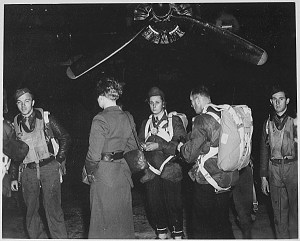
Bennett: “Colonel Wolverton talked to us just like he was one of the guys and seemed genuinely concerned at the prospect of us not all getting back alive. No one spoke during the whole thing and you could have heard a pin drop. Afterwards he dismissed us and we returned to our own tents. I picked up my Thompson and all my gear and marched the squad out to join the battalion for the final parade. Then, loaded down like pack mules with all of our equipment, we made our way out to the planes.”
Shames: “Most of my team had gone out to the airfield. [Capt. Charles] Shettle [S3 operations officer] came in and I remember him setting his prismatic compass with a bearing for the road bridge…. Before the battalion departed I took down the maps and aerial photographs from the sides of the tent, crammed as much stuff as I could into my musette bag, grabbed my M1 and went out to Colonel Wolverton’s aircraft. I didn’t even have time to blacken my face.”
Capt. Barney Ryan, Medical Detachment: “I realized I’d left the airsickness tablets in my tent and rushed back to get them. I scooped some pills off the table and when I reached the aircraft gave them to the men. After putting them in their mouths they spluttered, ‘What the hell are you trying to do to us—these are salt pills!’ Luckily nobody got airsick.”
Capt. Don Orcutt, pilot, 440th Troop Carrier Group: “Each squadron had its own location on the airfield. All the planes for the mission were numbered with large white chalk figures on the left side just in front of the main cabin exit door. [Lt. Col. Frank] Krebs taxied around the perimeter displaying his chalk number for all to see and we fell numerically into line behind him. At 11:50 p.m. 45 aircraft were lined up ready for takeoff. We had a signalman who flashed a green light at the end of the runway. If my memory serves me correctly, we took off at 10-second intervals and the entire group was airborne in roughly eight minutes.
The colonel flew at a speed of 130 mph and as each aircraft took off it went ‘balls out’ playing catch the leader before eventually falling into position. Every plane had a series of dim blue lights, three on each upper wing surface and three on top of the cabin. After staring at those for a while your eyes began to cross. Krebs kept his landing lights on so that outbound planes could spot the head of the formation. This was always a little bit hairy because there was little room for error, particularly at night.”
Ward Smith, war correspondent: “Almost before we realized it we were off…. ‘Say,’ someone sang out suddenly, ‘what’s the date? I’ll feel kinda dumb down there if some guy asks me and I get it wrong.’ We all laughed uproariously at things like that—the littlest things, the silliest things. We exchanged cigarettes and we talked on, but somehow never about things that mattered.”
Gibson: “Talking over the roar of the engines was almost impossible but I yelled at my buddy, ‘How do you feel, Lee?’ After two attempts at making him hear, Lee replied, ‘Better than expected, how about you?’ I yelled back the same answer he gave me. Inside I was nervous, had butterflies in my stomach and my hands were damp and cold with sweat. The plane rocked and fell a few feet, only to quickly regain its position. As we approached the peninsula I could see our formation of aircraft stretching for what seemed like miles behind us.”
Orcutt: “A layer of clouds became visible that looked like they rose to a height of at least 3,000 feet. Continuing at our present altitude would have meant flying into the cloudbank. The colonel [Krebs] chose to descend and fly under the overcast—a wise move as it turned out. He must have studied terrain maps of the peninsula and knew how low he could go without danger, as our new height of about 900 feet above sea level was just right.”
Dziepak: “Some of the guys were praying, smoking cigarettes, or being sick. As we crossed the coast the red light went on. The enemy fire coming up at us was heavy. You could hear shrapnel ripping through the fuselage and we wanted out!”
Bennett: “When the red light flicked to green nobody moved. I could hear people shouting, ‘For Christ’s sake let’s go, let’s get out, what’s happening up there and why aren’t we moving?’ I was the ‘push out man’ and it was my role to clear the plane. I started pushing and shoving furiously from the back and suddenly the stick began to move. I think this delay may have actually saved our lives.”
Pvt. Bill Galbraith, I Company: “The plane didn’t slow down for the jump and most of us lost our leg packs because of the exit speed. We were completely unaccustomed to parachuting with those things, as we’d never jumped with them before. The gun, ammunition, and everything my crew needed was lost when our leg bags broke free.”
Orcutt: “With the last man gone I stopped the watch and it showed 36 seconds had elapsed (more than twice as long as normal—someone must have stumbled and held the stick up) and applied the power as needed to maintain position in formation. I had no way of knowing at the time what was going on behind me.”
The men of 3rd Battalion were supposed to land in Drop Zone D, the southernmost drop zone, southwest of Utah Beach. The paratroopers ended up miles away from one another, often without their equipment. They searched for their squad mates in the dark, joining up with men from other companies and divisions as they made their way toward the bridges. Though more men from 3rd Battalion were dropped on target than from any other battalion in the 101st, they were the last of the division to jump, and by that time the Germans were expecting them.
Shames: “I had plenty of time to look around as I was in the air for about 50 seconds, which meant I must have jumped at around 1,000 feet. I was heading toward a burning industrial area and fighting desperately to control my drift…. I knew that I’d landed in Carentan [the location of a German corps headquarters] and the words ‘avoid at all costs’ kept running through my head.”
Pvt. Ray Calandrella, Company HQ: “After cutting myself out of the risers I set about chopping a small piece of nylon from my reserve chute as a souvenir. I pulled the D-ring and the brilliant white canopy burst out announcing for all to see that I had arrived! In a panic I gathered up the billowing chute and wrapped it inside my camouflaged main canopy. I then lay quietly on the ground trying to calm down.”
Staff Sgt. Roy Burger, HQ Company, 81mm Mortar Platoon: “We were badly scattered. I joined up with Corporal Allison and we eventually made our way out of the marshes. It was dark and we were lost. However, shells fired from the battleships were constantly going overhead and this helped us work out where the coast was. At daylight, dodging German troops, we headed toward the sea. The naval bombardment was terrific and we assumed our troops must have landed on the beaches.”
DiCarlo: “While the mental side of me was dealing with the shock of seeing real enemy soldiers the physical side lifted my rifle and I fired eight rounds at them—they all hit the ground. I reloaded and approached them from behind. I checked the bodies and discovered that all three were dead.”
Calandrella: “I saw the hunched shape of a man creeping toward me through a gap in the hedge. As he got closer I began to run a couple of scenarios through my head—should I use the bayonet or squeeze the trigger? I didn’t want to do either but time was running out, so I nervously used my cricket. Click-clack—no response. I repeated the process. Click-clack—there was still no response and I raised my rifle to shoot. Suddenly I noticed a jump rope hanging from the guy’s belt—it was 1st Lt. Howard Littell, our 81mm platoon leader.
After introducing myself I whispered, ‘Why the hell didn’t you use your cricket?’ In a hushed voice Littell replied, ‘I’m sorry, I just couldn’t find it.’ ‘Couldn’t find it!’ I said in disbelief. ‘I came that close to pulling the trigger.’ Littell just shrugged his shoulders and told me he’d got separated from the rest of his stick and that I should join him.”
DiCarlo: “One nervous trooper fired at an imaginary German column during the march to the bridge, sending us all into the shelter of roadside ditches. As our group increased in number the NCOs split us into six-man units, as we were frequently coming under hostile fire. I was amazed that we hadn’t received more attention from the enemy. We were moving alongside a hedgerow and Roy [a trooper from the 82nd Airborne] decided to take a look over the top. As he peered over a German soldier did exactly the same thing. The two of them stared at each other for a few moments before slowly sinking back to the ground. As we scuttled away I threw a grenade over the hedge. If the German had left as quick as we did then I am sure it did him no harm.”
Pfc. Jimmy Martin, G Company: “The loneliest feeling I ever had in the world was hitting the ground and realizing there was no one else in sight. I lay on my back unbuckling my harness—why I didn’t cut myself free I’ll never know! Just as I was making final adjustments to my equipment a mortar shell plopped down about 15 feet away. I moved out and then noticed someone sneaking along. I challenged him and discovered it was my buddy Spiller, a machine gunner from 2 Platoon. After a while Staff Sgt. Charles Skeen and my squad leader Sgt. Don Austin joined us. We eventually formed a small group, which comprised about a dozen men from several companies, and made for the bridges.”
Shames: “It was nearly broad daylight and I stepped up a gear as we approached the [road] bridge. On arrival Captain Shettle shouted, ‘Boy, am I ever glad to see you and why on earth are you still wearing your parachute pack tray?’ Due to the shock and excitement of landing in the milk factory I’d forgotten to take it off and was wearing it like an extra layer of clothing. This may sound crazy, but it made me feel safer in some strange way.”
Of the 575 men from 3rd Battalion who jumped that night, 75 were taken prisoner and 93 were killed during the Normandy campaign—including Colonel Wolverton, who landed in a tree on D-Night and was shot by Germans as he struggled to untangle his harness from the branches.
Despite those losses, 140 3rd Battalion paratroopers managed to seize the bridges in the early hours of June 6, and they held them for three days. But because their radio equipment had been lost during the drop, they were unable to report their success to the division. Having heard nothing, the air force assumed that the mission had failed and that 3rd Battalion had been wiped out. On June 7, they sent a pack of fighter-bombers that strafed and destroyed both bridges. Incredibly, only one American was killed by the friendly fire.
The 506th, along with the rest of the 101st Airborne, would hit the silk again for Operation Market Garden and the Battle of the Bulge. But for many of them, nothing would compare to the exhilaration and terror they experienced in the first days of the Normandy campaign. “Sixty-five years on and I can still smell the riverside and the foliage that grew there,” said Hank DiCarlo. “I found myself in many dangerous situations later in the war, but nothing came close to the emotional ride I experienced during my time at the bridge and the immediate aftermath.”
Excerpted from Tonight We Die As Men by Ian Gardner and Roger Day. © 2009 by Ian Gardner and Roger Day. Reprinted with permission of Osprey Publishing.
To see Ed Shames speak about his experiences in the 506th Parachute Infantry Regiment during World War II, click here.