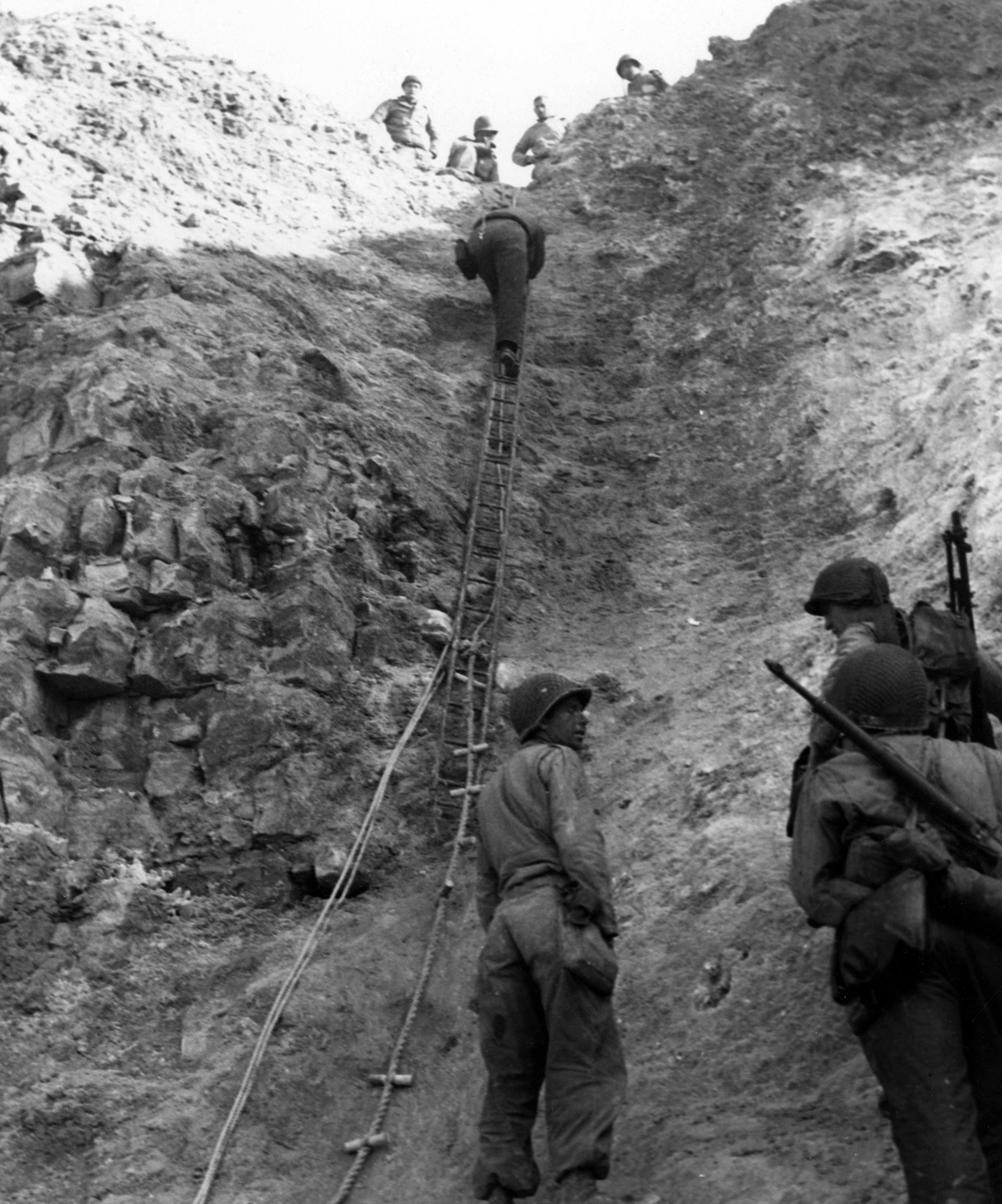
History is rife with misconceptions, and World War II is no exception. As a result of an error in Cornelius Ryan’s book The Longest Day, more than 76 years after its famous attack up a sheer 100-foot cliff, the heroic 2nd Ranger Battalion is still fighting–this time to get the truth out about what took place at Pointe-du-Hoc in Normandy.
Ryan implied that the Ranger mission to destroy the German gun battery at Pointe-du-Hoc was a wasted effort. In fact, 1st Sgt. Leonard Lomell of Toms River, N.J., and Staff Sgt. Jack Kuhn of Altoona, Pa., personally saw to it that the Ranger mission was accomplished early on the morning of June 6, 1944. Supported by their comrades in D, E and F companies of the 2nd Ranger Battalion, Lomell and Kuhn, who were members of the 2nd Platoon, Company D, pushed ahead of the roadblock they had established and completed what then Lt. Gen. Omar N. Bradley later described as the most difficult mission he had ever given any soldier in his command.
The objective of every one of the 225 Rangers who assaulted Pointe-du-Hoc during the early morning hours of D-Day was to eliminate a battery of six 155mm guns of the 726th Infantry Regiment. The German artillery, which had a 10-mile range, had the potential to wreak havoc on two of the Allied invasion beaches, Utah and Omaha, by plastering the landing areas with high explosives and shrapnel. Using incredible stealth, Lomell and Kuhn located the battery, unguarded but ready for use, in the heavy foliage of a swale between two hedgerows on an old Norman farm track. They destroyed the guns, accomplishing the Rangers’ mission.
Despite the fact that Kuhn and Lomell survived to tell their story, the notion that the Pointe-du-Hoc assault was a failure has persisted. After an examination of what took place during the early morning hours of D-Day, the only logical conclusion is that the Rangers did not fight and die in vain. Kuhn and Lomell told their story in an interview for World War II Magazine.
World War II: Gentlemen, let’s begin from the moment you disembarked from the troop ship Amsterdam.
Kuhn: We disembarked about 4 o’clock in the morning from Amsterdam. It was about a 10-mile trip in to the beach.
Lomell: Amsterdam was a Channel steamer, a regular steamer. We had private rooms. The flotilla of about 5,000 ships was 11 or 12 miles off the beach. We went to sleep and, God, before we knew it, we had to be up and on deck at 4 o’clock. The weather was bad. We were on an English ship and got into LCAs [landing craft, assault] manned by Royal Navy men. To go 12 miles in those heavy seas and stormy weather took quite a while. Just about an hour before H-hour they ceased bombing with aircraft. That’s when [the battleship] USS Texas hit the Pointe with her shelling. Mind you, we all believed that there were guns on the cliff top as we had been taught. We had studied the Pointe and saw the positions from aerial photographs, but later found that they were telephone poles and not gun barrels.
We were watching the assault like a bunch of country boys at a fair or something. It was exciting, believe me. Waves were breaking over our LCA, and the guys had to take their helmets and bail because the pumps on the boat couldn’t take the water out of it. Jack and I were up in the bow of our boat, number 668. We saw that we were heading for something that looked strange to us. We suddenly became aware that we weren’t heading for Pointe-du-Hoc. It must have been Pointe-de-la-Percée. I didn’t know where the hell it was, but it sure didn’t look like Pointe-du-Hoc. Lieutenant Colonel James Rudder [the commanding officer of the 2nd Ranger Battalion] saw it at the same time and brought about a correction with the coxswains. We took an abrupt right and proceeded about three miles along the coast, about 300 yards offshore, parallel to the cliffs of Pointe-de-la-Percée, where C Company of the 2nd Battalion was landing. As we made our way the Germans were popping up along the top of the cliffs shooting at us with anything they could–machine guns, rifles and mortars, et cetera.
It suddenly occurred to all of us, particularly D Company: ‘Hey, we’re not going to be able to do what we were trained to do. D Company was assigned the mission of going around the Pointe and landing on the west side of it. Our assignment was to take out three gun positions–4, 5 and 6. Because of the mistake in navigation by the British coxswains, we had lost about a half hour. We were coming from the east to the west, where E and F companies were supposed to land, and we said: God, we don’t have time. We’re running late already. To hell with this, we’ll jam right in between them. We only had two boats left [the boat containing Company D commander Captain Harold Duke Slater had been swamped and sunk], so we jammed in there and landed in tight, between E and F companies, to make our assault up the ropes.
My whole psyche that day was like I was in a football game. I remembered my instructions, and we charged hard and low and fast. That was our secret, and we stayed together. The 2nd Platoon stayed together as a team on D-Day. We got in, and our ramp went down and all hell broke loose. The boat leader goes off the front straightaway. I stepped off the ramp, and I was the first one shot. The bullet went through what little fat I had on my right side. It didn’t hit any organs, but it spun me around and burned like the dickens. There was a shell crater there underwater. I went down in water over my head with the spare rope, the hand launcher and my submachine gun. Keeping in mind that the idea was to get to the top as fast as we could, I got myself together and went up the cliff.
Foremost in our minds was the challenge of getting up that cliff, which was wet from rain and clay and very slippery. The Germans were shooting down. They were cutting ropes. They were trying to kill us. I’d already been shot. Were we going to make it to the top? Were we going to get shot? These are the things we were thinking about. I think we were too cocky to be too fearful or frightened. I never thought I was going to get killed. These guys were positive thinkers. I don’t think they thought much about getting killed. They thought if they got an even chance in a fight they would win as they always had.
Concentrating on what I had to do and climbing the slippery, muddy rope was exhausting. Next to me was Sergeant Robert Fruhling, our radio man, struggling with his 500 radio set with a big antenna on it. We were approaching the top, and I was running out of strength. Bob yelled, Len, help me. Help me! I’m losing my strength. I said, Hold on! I can’t help you. I’ve got all I can do to get myself up. Then I saw Sergeant Leonard Rubin. He was all muscle, a born athlete, a very powerful man. I said, Len, help Bob! Help Bob! I don’t think he’s going to be able to make it. He just reached over, grabbed Bob by the back of the neck and swung him over. Bob went tumbling, and the antenna was whipping around, and I was worried that it was going to draw fire. That’s all I was thinking about. I was also worried about falling off the cliff with him. I yelled, Get down! You’re gonna draw fire on us! You know, you get excited.
When I went over the top, I tumbled into a shell crater. There was Captain Gilbert Baugh. He was E Company’s commander. He had a .45 in his hand, and a bullet had gone through the back of his hand into the magazine in the grip of the .45. He was in shock and bleeding badly, and there was nothing we could do other than to give him some morphine and say, Listen. We gotta move it. We’re on our way, Captain. We’ll send back a medic. You just stay here. You’re gonna be all right. It was then that we left the crater where we had gathered together as we came over the cliff. We jumped into a bigger crater, and it held maybe a dozen of our guys. We couldn’t get all 22 together in one crater for the move toward 4, 5 and 6 gun emplacements. We hadn’t counted on craters being a protection to us. We would have lost more men, but the craters protected us.
Lomell: We made a move to jump to the next crater. Sergeant Morris Webb was behind me, and Corporal Robert Carty was in back of Webb with a fixed bayonet. The Germans opened fire on us as we started out, and we jumped back to avoid the fire. Well, Webb jumped onto Carty’s bayonet. Carty didn’t mean to do it. He was just down behind, ready to come up. I saw the bayonet sticking through Webb’s thigh. When I ran by him, I got my morphine and socked him in the thigh. I yelled, I can’t stay here, Webb, I gotta keep moving! We’ll send a medic to you! At that time somebody else came and took over as we made our way over to the west side of the Pointe to gun positions 4, 5 and 6. There were no guns there, and we thought, What the hell? What’s happened here? There never were any guns here! There was no evidence that there were ever any guns there.
WWII: How many men had you lost at that point?
Lomell: I know that by the time we got to the coastal road we only had 12 or 13 men left, so in getting to the road 10 men had become casualties. They were killed, wounded or injured. The Germans would fire on us, and then we’d go for them, but we knew we couldn’t take the time to get into sustained firefights. Our orders were to get the guns as quickly as possible. Our [secondary] orders were to establish a roadblock on the coastal highway to prevent German troops from going east to Omaha Beach to help out there. Once we got to the intersection, Jack and I got across into the ditch. Private Jack Conovoy was our scout. For some reason he was third going across the intersection, and they shot him right in the behind and he went down flat. Their riflemen and snipers were aiming at intersections. He went down and yelled, I’m hit! We shouted, Well, come over here! He crawled over and dropped his pants and, sure enough, it had gone through one cheek and then the other and the bullet was sticking out. He wanted it for a souvenir. He was yelling, Save the bullet! Save the bullet! I saved the bullet, and we stuffed sulfur into the bullet holes. We pulled his drawers back up and went down the road. We turned right, which would be westward, to go toward Grandcamp, where we could have good observation along the road to see the Germans as far away as possible. If they were to attempt an advance eastward up the coastal road, we were to stop them, and that’s where our D Company roadblock was established.
WWII: Your job was to stop anything coming down the road heading for Omaha?
Lomell: That was the order. All 225 of us had the same orders. Every company had those orders. It just so happened that D Company ended up on the extreme west flank, thank God.
Kuhn: They told us to cut the coastal highway. We went over and set up the perimeters at that spot. At that moment, Len and I, standing in the road, were the farthest Rangers into enemy territory.
WWII: This was about 8 o’clock in the morning?
Lomell: Yes. Within an hour we were out at the coastal highway. I want to point out that this was not inherent heroism. This was just plain common sense and good rangering. As we left the group at the Pointe, the Germans opened up with 88mm guns, laying in crawling fire. What they were trying to do was start at the edge of the cliffs, knowing that we were trying to get inland. Of course, that makes you move faster, because it’s crawling up your back. That’s why we were able to get out to the coastal road within an hour. We were moving fast, and we had lost about a half hour’s time. When we had running room, we ran straight at them, running hard and low and hitting hard and low, like my football coach always told me. It didn’t occur to me until years after the war why they [the Germans] lifted that fire. They lifted it because of their gun positions just south of the coastal road. The section sergeants took charge of the roadblock, and Jack and I decided to take a look at the sunken secondary road. So we just took the road inland. We thought there might be evidence of tracking and vehicle use. The guns had to have been taken off the Pointe. We were looking for any kind of evidence we could find and it looked like there were some markings on the secondary road where it joined the main road. We decided to leapfrog. Jack covered me, and I went forward. When I got a few feet forward, I covered him. It was a sunken road with very high hedgerows with trees and bushes and stuff like that. It was wide enough to put a column of tanks in, and they would be well hidden. We didn’t see anybody, so we just took a chance, running as fast as we could, looking over the hedgerow. At least we had the protection of the high hedgerows. When it became my turn to look over, I said, God, here they are! They were in an orchard, camouflaged in among the trees.
Now, when you camouflage five big howitzers, 5-inch guns, these are not ordinary, run-of-the-mill artillery that you cart around behind jeeps. These had stabilizers and everything on them. The wheels went up over our heads. Their muzzles went way the hell into the air, above our reach. People say we took them out with fragmentation grenades. That’s not so. We couldn’t even reach the muzzles. Where they protruded out of the orchard they had netting over them. That’s why the aerial photographs never indicated that they were there. They were about a mile inland from the Pointe and the cliffs’ edge.
When we got to the gun position and looked over, I saw some Germans being talked to. They were gathering there, putting on their jackets. It was 8 o’clock in the morning or thereabouts. I guess they were organizing themselves. Their positions were textbook ready. There was nothing to indicate that the guns had been fired. There were no ejected shells. If you know what an artillery position looks like, they’re never that perfect after they’re fired. The entire battery, five big coastal guns, were there at the ready. All the shells were stacked, and there was no debris–no empty shells or powder bags. If you’ve ever been in an artillery outfit after it’s been engaged, it’s a mess cleaning up after it. This position was in perfect order. I believe the reason they couldn’t fire was because E Company had taken out their observation post at the Pointe first thing. That was where their concrete observation bunker was. They had no directions to fire with, no firing orders. Their lines of communication had been cut off. I don’t think those Germans knew there were any Rangers or American soldiers within a mile of them. They were so nonchalant about walking around, acting as if there was no enemy about because we were so quiet. They weren’t in a hurry to do anything. Some have said: We don’t believe it. No good artillery man ever left his position unguarded. Well, all I know is, that morning there weren’t any guards in their gun position. We didn’t draw any fire at any time while near their guns. Maybe they were waiting for a roving OP [observation post] to set up, or maybe they thought there would be incoming shelling from Texas after the 88s stopped their crawling fire.
Kuhn: They didn’t expect us.
Lomell: They never appeared to me to be worried about the cliffs. That was their rear. They wanted to protect everything in their new rear area [the landward side]. Now, people say to me, But they must have heard the grenades. No, they didn’t. Thermite grenades are silent, but I didn’t know if I was going to meet some guard who was sound asleep at his position or what.
WWII: How did you actually destroy the guns?
Lomell: Jack covered me, and I went to the guns with two thermite grenades, Jack’s and mine. The heavily foliaged dip in the swale was deep enough to keep me out of the Germans’ line of sight. I put one thermite grenade in each of the first two guns’ visible moveable gears. Then I took my Tommy gun, wrapped it in my field jacket and smashed the sights on all five guns [for unknown reasons the sixth gun was missing]. I didn’t know if I was going to get back in there. I wanted to do as much damage as I could. After I did the job, I went back to Jack and said, We gotta get some more grenades! We immediately ran back to the guys at the roadblock, where they gave us all their grenades. As fast as we could, we ran back up the road. We wanted to see if the Germans had heard anything. They hadn’t. They still didn’t appear to have their lines of communication open. Their observation post had been knocked out. Jack watched them to see that they didn’t kill me.
Kuhn: When we came back with all of the grenades I placed some on the No. 1 gun. Len had already put one on it. I would say, offhand, that’s the only one I put anything on.
Lomell: I depended on Jack to give me cover to protect me. While I was in there I couldn’t see the Germans. By use of the thermite grenades I tried to weld moving parts, gears, cranks, hinges, breech blocks, anywhere I could find to place a couple of thermite grenades. Through their intense heat, they would weld moving parts together and render the guns inoperable. That moving, flowing molten metal, wherever it eventually got to, must have done the trick. I don’t think I spent 10 minutes, all told, destroying those guns. I was satisfied that I had done what I was trained to do. We never looked back. We didn’t waste a second.
WWII: Jack, what were you thinking while Len was damaging the guns?
Kuhn: It was a beautiful sight. I got to the point where I was starting to enjoy it in this respect: Hey, I’m watching these guys. They don’t know it. I was getting almost cocky, but I was afraid of being detected and hoping that nobody would look up. They wouldn’t have seen me, and I had this feeling that I had power over them. It was like, Hey, I got these guys where I want them. Then I realized: Wait a minute. If Len goes up there and these guys come toward us, I’ve got about three clips of ammo.
Lomell: We were nervous and fast. I was making my way back, and Jack said: Hurry up! Hurry up! Let’s get the hell out of here! I was doing the best I could, and going as fast as I could and I crawled up the embankment of that swale and an explosion went off that threw the both of us through the air into the sunken road. We couldn’t hear each other because of the ringing in our ears. All we knew was that we were running as fast as we could down that sunken road back to our Rangers’ roadblock. I felt so secure in the arms of those 10 guys. But what good were 10 guys against at least 150 Germans we had seen in the last half hour?
WWII: When the Rangers saw you running back, what was their reaction?
Kuhn: First of all, they didn’t know what we had done. They heard this explosion and…I remember Private Larry Johnson, I could have hugged him. He was all by himself there at the road intersection. He said, What the hell was that? I said, We don’t know but, Larry, the guns are inoperative. Unfortunately, Larry was killed on another day. I can’t understand why a German patrol wasn’t dispatched after that to see what the heck the explosion was and what was up there at the intersection.
WWII: Did you ever get to see the guns after you were relieved on D-plus-2?
Kuhn: I had every intention of getting back to see the guns. But I no sooner got back to the company than we moved out toward Isigny. I remember marching past the road and realizing that if I went down there a couple hundred yards and came back the Rangers would have been a mile down the road. I didn’t risk it.
While the D-Day mission had been accomplished, by Lomell and Kuhn and the other brave men of the 2nd Ranger Battalion, the battles and the war were far from over. Brest, Hill 400 and dozens of other nameless Ranger battles remained to be fought.
The Rangers weren’t relieved at Pointe-du-Hoc until June 8, after 2 1/2 days of mounting a continual defense against fierce counterattacks by elements of the German 914th Infantry Regiment. On the evening of June 6, 25 Rangers from the 5th Ranger Battalion joined the men at the Pointe after fighting their way overland from Omaha Beach.
After two days, only 90 of the original 225 Rangers who had led the assault on Pointe-du-Hoc were still able to man their positions when troops of the 116th Regiment, 29th Infantry Division, finally broke through from the west to relieve them. The Rangers had accomplished one of the first and most critical missions of D-Day, but at a terrible cost.
Len Lomell received the Distinguished Service Cross and Jack Kuhn the Silver Star for their actions. Before the war ended Lomell was wounded three times and received a battlefield commission. He returned home to complete law school and later established a successful practice in New Jersey.
Jack Kuhn made it to V-E Day without a scratch and ended the war as a 1st sergeant. After a stint in the Marine Corps during the Korean War, he joined the Altoona Police Department, working his way up through the ranks to retire as chief of police.
The 2nd Ranger Battalion received the Presidential Unit Citation for its valiant efforts during the Normandy assault. The hundreds of Rangers who were wounded later received Purple Hearts. The historical record should reflect that the Rangers’ sacrifice was not in vain.
Michael H. Frederick and Joseph F. Masci, who interviewed Lomell and Kuhn, are members of the World War II Combat Research Group. Further reading: The Longest Day, by Cornelius Ryan; Six Armies in Normandy, by John Keegan, and D-Day, by Stephen Ambrose.
This article originally appeared in the July 2001 issue of World War II. For more great articles be sure to pick up your copy of World War II.