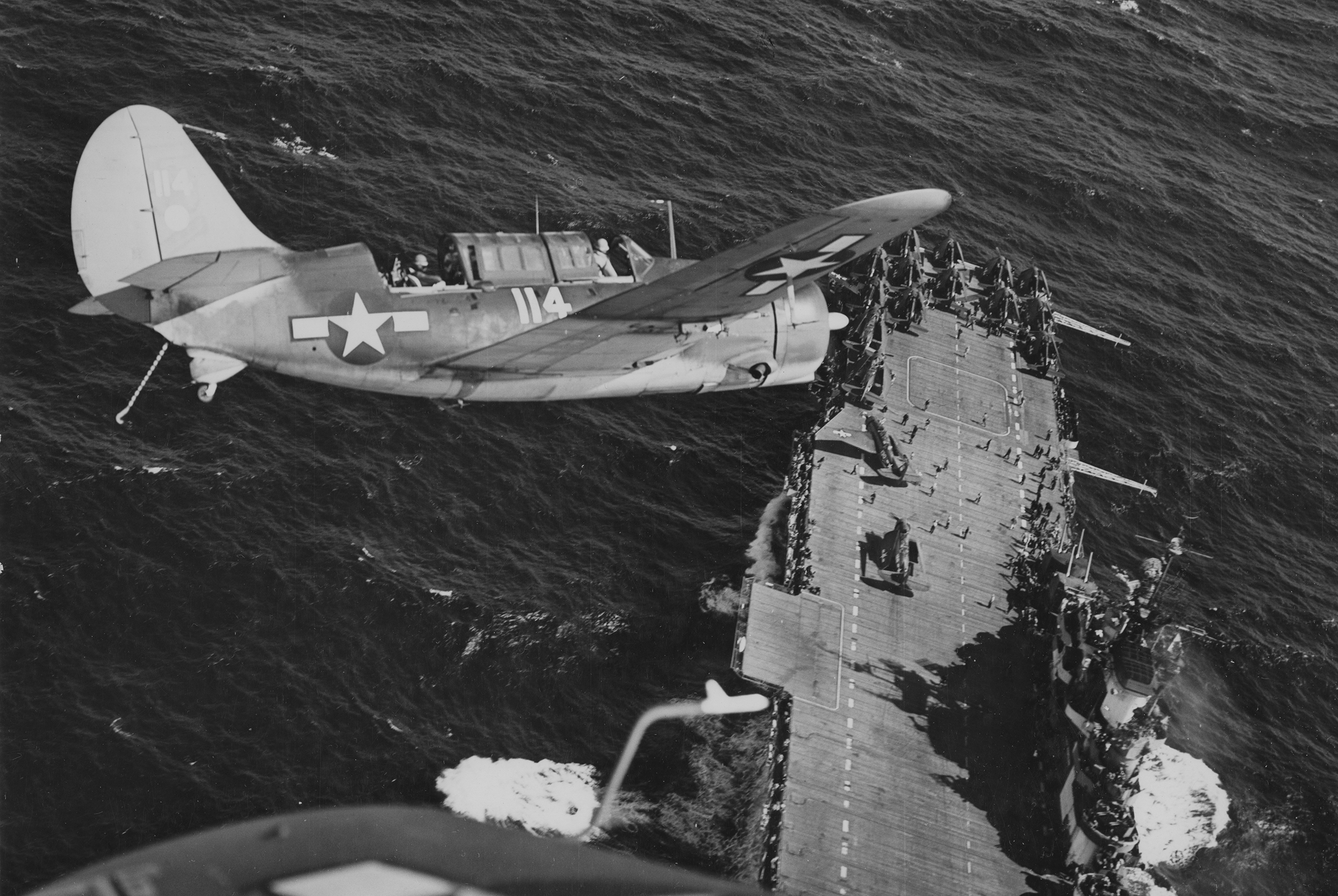
On the whole, American servicemen enjoyed an overwhelming superiority in the quality as well as the quantity of weaponry during World War II. The legendary reputations of the jeep, Douglas C-47, M-1 Garand rifle and North American P-51 Mustang, for example, were all well-deserved. Some American weapons fell short of expectations, however. One notable example was a dive bomber developed by Curtiss for the U.S. Navy, the SB2C Helldiver.
By and large, the aircraft that operated from the U.S. Navy’s aircraft carriers after 1942 were markedly superior to their Japanese counterparts. That opinion was shared by Britain’s Naval Air Arm, which operated numerous Grumman Wildcats, Hellcats and Avengers, as well as Vought Corsairs, from its carriers. It is significant, however, that the Royal Navy rejected the Helldiver for combat service, even while it continued to use the antediluvian Fairey Swordfish biplane torpedo bomber until the end of the war. Indeed, so disappointing was the SB2C’s performance that Captain Joseph J. Clark, commanding officer of USS Yorktown—one of the first carriers on which the aircraft was deployed—recommended that it be withdrawn from service and production canceled. It is also interesting to note that a Douglas SBD Dauntless, rather than an SB2C, has been preserved in the National Air and Space Museum in Washington, D.C., to represent a World War II-era Navy dive-bomber.
The Curtiss SB2C was the last of a line of aircraft developed for the U.S. Navy specifically for the role of dive-bombing. That tactic was first used by a Marine aviator, Lieutenant (later Brig. Gen.) Lawson H.M. Sanderson, during operations in Haiti in 1919. Up until that time, aircraft had dropped their bombs from a level attitude. Marine fliers found that they could achieve a far greater degree of precision by releasing their bombs while aiming their planes directly at their targets in a steep dive of 70 degrees or more. Dive-bombing was officially adopted by the Navy as a regular part of its operational repertoire in 1928.
The U.S. Army Air Corps was convinced that it could hit any target from high altitude by means of level bombing, using precision optical bombsights. That belief seemed to be justified by Brig. Gen. William ‘Billy’ Mitchell’s highly publicized bombing of captured German warships in June 1921. Those targets, however, had been immobile. The Navy believed that a relatively small moving target, like a warship taking evasive action, would be virtually impossible to hit by level bombing. Naval aviators felt that pinpoint dive-bombing attacks, delivered simultaneously with coordinated low-level torpedo-plane attacks, would be the most effective method of dealing with an enemy fleet. By the same token, the Marines believed that dive-bombing afforded the best available way to provide close air support without endangering their own ground troops.
Another reason the dive-bombing technique held a greater appeal for the Navy than for the Army was the fundamental differences in the two services’ operational requirements. Army bombers could be built with unlimited size and load-carrying ability. If the power of available engines was insufficient, the Army could simply build the planes with two, three, four or more engines. If an airfield was too short for the operation of such large aircraft, the Army could simply lengthen the runway. Naval aircraft, in contrast, were restricted both in size and in the number of bombs they could carry because of the length of the aircraft carrier flight decks from which they operated. Naval aviation tactics therefore emphasized the accurate placement of a relatively small payload rather than smothering the target with as large a bombload as possible. The same principle held true for Marine aviation’s role in tactical close air support.
Initially, Navy scouting and fighter aircraft carried out dive-bombing missions. The first airplane designed specifically as a dive-bomber was built by the Curtiss division of the Curtiss-Wright Corporation. Curtiss had been designing aircraft for the Navy since 1911, after Eugene Ely used one of Glenn H. Curtiss’ planes to make the first takeoff from a ship—the cruiser Birmingham—on November 14, 1910, followed by the first shipboard landing, on the cruiser Pennsylvania, on January 18, 1911. In 1928, Curtiss redesigned its F8C-1—a Marine version of the Falcon series of two-seat fighter-bombers—with a more compact and robust airframe, and the new 450-hp Pratt & Whitney R-1340 radial engine. In spite of the fact that prototype XF8C-2 crashed on December 3, 1928, just days after its first flight, Curtiss built an identical plane that satisfied the Navy enough to achieve production status as the F8C-4. It was the first of three Curtiss designs to be called Helldiver.
The name was pure hyperbole that originated with the Navy and Marine pilots who first developed the dive-bombing technique, which they demonstrated at airshows throughout the country during the 1930s. German World War I ace Ernst Udet was so impressed by one of those public dive-bombing demonstrations that in 1934 he persuaded the German air ministry to purchase two Curtiss Hawk II fighter dive-bombers for evaluation by the Luftwaffe. The eventual result was the development of the infamous Junkers Ju-87 Stuka. To the American public, the term “helldiver” was associated with breathtaking power-dives and dazzling displays of airmanship. Curtiss thought it only fitting that the name be applied to its purpose-built dive-bomber, although it was not officially used by the Navy.
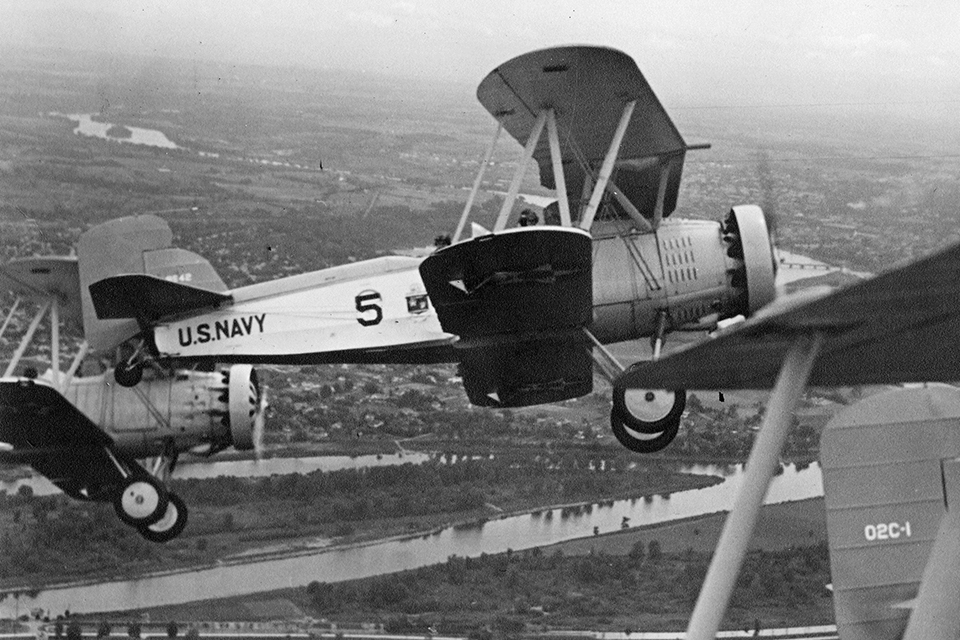
The first of an eventual 25 F8C-4s entered service with fighter squadron VF-1B aboard the carrier Saratoga in 1930. By then, however, they were already slower than the single-seat fighters they were intended to accompany into combat, and the first Helldiver was out of naval service by the end of 1931. Land-based F8C-5s used by the Marines were redesignated as O2C-1 observation aircraft and assigned to squadrons VO-6M at Quantico, Va., and VO-7M in Nicaragua–where they saw some use as dive bombers against Augusto César Sandino’s rebels until February 1933.
Adapted from fighters and scouting planes, the early dive bombers were not well-suited to their roles. As a result, the Navy and Marines developed a series of specialized aircraft during the 1930s that had no counterparts in the Army Air Corps. Since the dive bombers were required to perform the secondary function of reconnaissance, the Navy referred to them as scout bombers and gave them the designation SB.
Dive bombers had two features that distinguished them from other combat aircraft. One was the provision for dive brakes, usually in the form of split flaps, to retard the plane’s diving-speed, giving the pilot more time to aim his bomb. The dive brakes also reduced stress on the airplane when it pulled out of its steep dive. The other unique feature was a special hinged bomb rack, or crutch, mounted under the fuselage, which swung the bomb clear of the propeller arc after it was released.
Curtiss’ second Helldiver evolved from the XF12C, a parasol monoplane two-seat fighter with enclosed cockpits and retractable landing gear. Designed under the direction of Raymond C. Blaylock, the XF12C-1 first flew in early 1933, but by the end of the year the Navy had selected the Grumman FF-1 and FF-2 biplanes for the two-seat fighter role. Curtiss redesignated the plane XS4C-1 and then XSBC-1, in hopes of having it accepted as a scout bomber. After the XSBC-1 crashed in September 1934 due to a failure in the wing-folding joint, the Navy contracted Curtiss to rebuild the prototype as a biplane. Curtiss did so and also redesigned the fuselage and tail surfaces to produce the XSBC-2. When the plane’s Wright Twin Whirlwind engine proved unreliable, the Navy ordered it replaced with a Pratt & Whitney R1535-82 Twin Wasp Jr., driving a Hamilton-Standard three-blade propeller. Tested in March 1936, the re-engined XSBC-3 had a maximum speed of 220 mph at 9,500 feet, a range of 635 miles carrying a 500-pound bomb, and a range of 1,190 miles after substituting a 45-gallon auxiliary fuel tank to use the plane in a scouting role. The new dive bomber was accepted for production on August 29, and the first SBC-3s–given the resurrected name of Helldiver by Curtiss, although once again the Navy did not officially refer to them as such–began entering service with VS-5 aboard the carrier Yorktown, VS-3 on Saratoga and VS-6 on Enterprise in late 1937.
After completing its 83-plane contract for the SBC-3, Curtiss introduced an improved version with a 950-hp Wright Cyclone R-1820-34 nine-cylinder radial engine in 1938, the extra power allowing the plane to carry a 1,000-pound bomb. The Navy bought 124 of that variant, the SBC-4, but in that same year Curtiss began designing a replacement. By that time, the conservative Naval Bureau of Aeronautics was finally coming to realize that the biplane’s days were numbered. In any event, the SBC was the last U.S. combat biplane. When the Navy ordered the first prototype of the SB2C monoplane on May 15, 1939, the plane was expected to represent a quantum leap in dive-bomber technology.
Uncouth individuals are sometimes accused of having been brought up in a barn. In the case of the SB2C, the analogy is appropriate. Because of Curtiss’ commitments to build P-40s for the Army Air Forces and Hawk 75 fighters for export, working space at their factories was at a premium. Therefore, most of the design and construction of the XSB2C-1 prototype was actually carried out in a cattle barn on the Ohio State University fairgrounds.
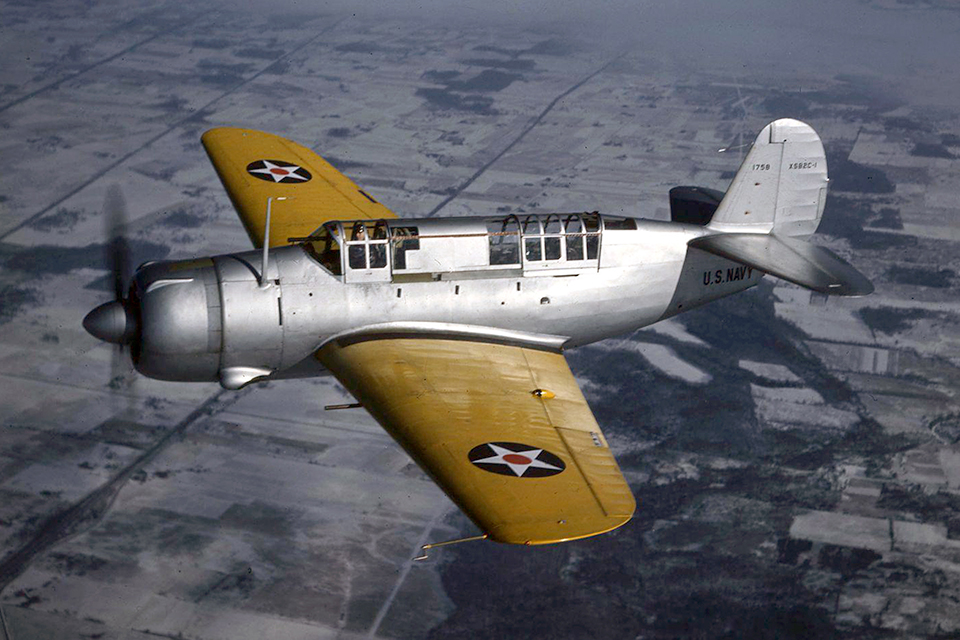
The XSB2C-1 had a length of 36 feet 9 inches and a wingspan of 49 feet 8 inches. It was a two-seat, single-engine monoplane with folding wings to facilitate storage aboard an aircraft carrier. The plane also possessed a feature unique for carrier-based aircraft at that period–an internal bomb bay. Again produced by Blaylock’s design team, the XSB2C-1 was built around a 1,500-hp Wright R-2600 Cyclone radial engine, the same engine that Grumman would use with more satisfactory results in the dive bomber’s stablemate, the TBF Avenger torpedo bomber.
By the time the prototype was assembled and flown for the first time at Curtiss’ plant in Buffalo, N.Y., on December 18, 1940, much of the world had been plunged into war. Although not yet involved in the conflict, the United States was beginning a massive rearmament program, both on its own behalf and on behalf of the Allies. Curtiss and the Navy were already committed to the large-scale production of the SB2C as a replacement for the Navy’s current dive bombers, the Vought SB2U Vindicator, the Douglas SBD Dauntless and Curtiss’ own SBC. Of the three types, the Vindicator and the SBD were regarded as rapidly approaching obsolescence. Although the SBC-4 was already considered obsolete, Curtiss modified 50 of them for use by the French navy. Delivered too late to see action in the Battle of France, the French SBC-4s sat out World War II in Martinique, where their possession by the Vichy French government provided a diplomatic headache for the U.S. State Department.
Although a massive production program was planned around the SB2C before the prototype ever took to the air, the airplane itself was already showing signs of trouble. Wind-tunnel tests had demonstrated that the plane’s stalling speed would be unacceptably high, and the wing had to be enlarged by 10 percent before the first flight was even attempted. There were also problems with the new R-2600 engine and the Curtiss Electric propeller. More important, the plane demonstrated serious handling problems. Because of the dangerous nature of carrier operations, superior low-speed handling and stalling characteristics were essential to shipboard aircraft. Yet the XSB2C’s low-speed stability and stall characteristics proved rather worse than average, even for a land-based plane. In February 1941, two months after its first flight, the prototype crashed on final approach, and further flight testing was delayed until October. Barely two months after that, on December 21, the rebuilt prototype was destroyed in another crash. The pilot had been forced to bail out when the starboard wing and tail collapsed during a test dive.
Under normal circumstances, the Navy would probably have cut its losses at that stage and canceled the SB2C. Exactly two weeks before the prototype’s second crash, however, Japanese carrier planes had attacked Pearl Harbor, and the United States–now officially involved in the conflict–was gearing up for a truly massive war production effort. A brand-new factory had been built by Curtiss in Columbus, Ohio, specifically to manufacture SB2Cs. The work force had been hired, raw materials allocated and numerous subcontractors lined up to produce dive bombers by the thousands.
At that stage, no one seriously doubted that Curtiss, with its wealth of previous experience, would be able to perfect the new dive bomber. When the United States entered World War II, Curtiss was mass-producing P-40 Warhawk fighters for the U.S. Army Air Forces and Allied air forces. It was also building the AT-9 twin-engine trainer and the C-46 Commando twin-engine transport. As for the Navy’s needs, in addition to the SB2C, Curtiss was developing the SO3C Seagull two-seat spotter seaplane for use on cruisers and battleships equipped with catapults. Despite the wide variety of work in which it was engaged at that time and the loss of the prototype, the Curtiss design staff persevered with its efforts to perfect the SB2C.
More than 880 changes had to be incorporated into the SB2C’s design before the Navy was satisfied. Many of the alterations were demanded in response to combat experience over Europe, such as self-sealing fuel tanks and additional armor protection. The Navy also wanted the twin fuselage-mounted machine guns replaced by a pair of wing-mounted 20mm cannons. That alteration, in turn, dictated the relocation of some of the fuel tanks and other internal equipment. The majority of the design changes, however, sought to alleviate the airplane’s unsatisfactory handling characteristics. In that effort, Blaylock and his staff were never completely successful. One reason for the plane’s instability was that the fuselage was not long enough, due to the Navy’s requirement that the SB2C fit on existing aircraft carrier lifts. One potentially dangerous result of the plane’s instability was that if the pilot had to abort a landing, gunning the engine could cause the plane’s nose to pitch up so much that he might lose control or even stall over the carrier deck. In order to solve the problem, the tail section was progressively enlarged, to such an extent that it was later said that the SB2C’s rudder was big enough to steer a battleship.
The SB2C also had poor aileron effectiveness below 90 knots. Since the approach speed for the carrier deck landing was 85 knots, the plane was dangerously close to being out of control at the most critical phase of its flight. At high speeds, such as those attained during the plane’s attack dive, the ailerons became heavy, making it difficult for the pilot to aim the airplane at the target. That problem, combined with excessive tail buffeting caused by the plane’s dive brakes, meant that the SB2C was a less accurate dive bomber than the older SBD.
The numerous modifications also raised the empty weight of the production SB2C-1 to 10,114 pounds, compared to the prototype’s 7,122 pounds, an increase of 42 percent. The inevitable result of all that added bulk was a marked deterioration in the plane’s performance.
Between the setting up of production facilities and the large number of design modifications, it took Curtiss an inordinate amount of time to get the SB2C into service. The first production SB2C-1 finally took to the air in June 1942. Curtiss was not shy about recycling a good nickname, as attested to by the many fighters it produced bearing the name ‘Hawk,’ and the SB2C became its third dive bomber to bear the evocative name Helldiver–and, in this case, the Navy officially accepted it as well. Unfortunately, the SB2C was not destined to live up to its inspiring moniker, and Navy airmen coined what they regarded as more appropriate names for it. For them, the Curtiss dive bomber was ‘The Big-Tailed Beast,’ or simply ‘The Beast.’ It became a standing joke that the plane’s official designation was really an acronym for ‘Son-of-a-Bitch, 2nd Class.’
The Helldiver first saw combat with bombing squadron VB-17 from the carrier Bunker Hill during an attack on Rabaul on
November 11, 1943, nearly three years after the first flight of the prototype. In contrast, Grumman’s TBF Avenger prototype had flown for the first time on December 23, 1941, and the first TBF-1 squadron, VT-8, had gone into action at the Battle of Midway on June 4, 1942, less than six months later.
The Curtiss dive bomber’s debut with the fleet was less than promising. Although the Helldiver had originally been intended to exceed the performance parameters of the Dauntless by a wide margin, VF-17’s commander, Lt. Cmdr. James E. Vose of VB-17, declared that–aside from folding wings, a feature the Dauntless never possessed–‘the SB2C offered little improvement on the SBD…the SBD would be my choice.’
It was not difficult to see his point. The SB2C-1 could carry a single 1,000-pound or 1,600-pound bomb in its internal bomb bay, plus two 100-pound bombs externally under the wings. It had a top speed of 281 mph and an initial climb rate of 1,750 feet per minute. The Helldiver’s maximum range was 1,100 miles, and its combat radius was 276 miles. By comparison, the SBD-5, which carried the same bombload, had a top speed of 253 mph and could climb at 1,620 feet per minute. The Dauntless’ maximum range was 1,100 miles, and its combat radius was 285 miles.
Moreover, the supposedly obsolescent Dauntless enjoyed the lowest combat loss rate of any U.S. Navy aircraft of that period. SBDs acquired an enviable reputation in the critical battles of the Coral Sea, Midway, the Eastern Solomons, Santa Cruz and Guadalcanal, and many Navy dive-bomber crews were understandably reluctant to relinquish an airplane that had earned their trust. A less charitable VB-17 pilot irreverently remarked that ‘the SB-Deuce had more bugs than an Oriental flophouse.’
Commander Herbert D. Riley, who served on the staff of the deputy chief of Naval Operations (Air) during that period, was one of the officers responsible for procuring new aircraft for the Navy. He later recalled that ‘the SB2C was so tricky to fly, compared to the SBD, and so hard to maintain that the skippers of the new carriers preferred to have the old SBDs. We had quite a battle forcing the SB2C down their respective throats.’
Curtiss was less successful in forcing the Helldiver down the throats of the British Admiralty, which only procured 26 of the planes. Only one Naval Air Arm squadron received Helldivers, and that unit was quickly disbanded without ever serving on a carrier. Captain Eric Brown, the test pilot who evaluated the Helldiver for the Royal Navy, flew nearly every type of dive bomber, including a captured Ju-87 Stuka. After piloting the SBD-5 Dauntless, the Vultee Vengeance and the Helldiver, Brown rated the Curtiss product a distant third. ‘One could only sympathize with the U.S. Navy pilots flying this unpleasant aircraft from carriers in the Pacific,’ he later wrote.
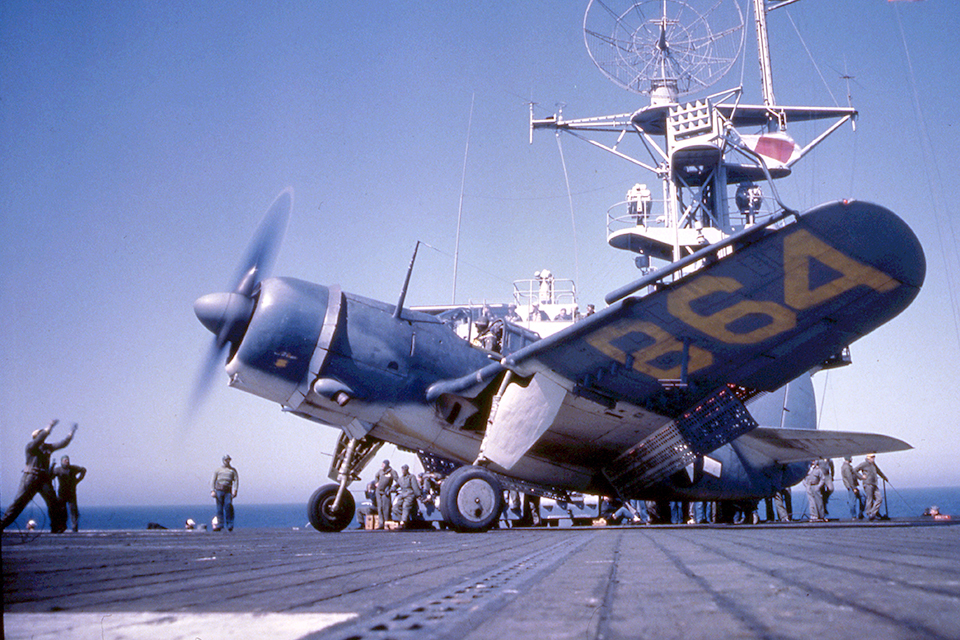
When the Navy permitted 20th Century Fox to film background scenes for one of their upcoming motion pictures aboard the second carrier Yorktown during her shakedown cruise in 1943, they got a spectacular shot of one of the new Helldivers plunging into the sea off the end of the flight deck while trying to take off. Obviously unwilling to waste such a dramatic piece of footage, the studio managed to work the scene into their feature film, appropriately titled A Wing and a Prayer. In the film scenario, the crash is attributed to pilot error brought on by battle fatigue. In reality, however, by the time the film was released, SB2Cs failing to get airborne were becoming a common sight aboard American carriers. A vivid memory among early-model Helldiver crewmen–including my father, Paul D. Guttman, a Navy combat photographer who sometimes flew in the ‘back seat’–was that while other aircraft types would lift off the deck and climb away, the overweight, underpowered SB2Cs would often reach the end of the deck and simply drop out of sight. Most of them would reappear a few seconds later, struggling for altitude, but inevitably a few did not make it.
Lieutenant H. Paul Brehm, who flew SB2Cs with Air Group 87 aboard the carrier Ticonderoga, described an all-too-typical scene at the beginning of his unit’s airstrike against the Japanese battleship Hyuga on July 24, 1945: ‘Lieutenant Al Matteson was the first off. His plane got to the bow, but his wing loading was unbalanced. He started going into a tight right turn. Matteson’s plane hit the water hard, and the Helldiver just disintegrated. I saw only one person getting out of the crash debris. All I thought was, ‘Hell, we’ve lost our first plane for today’s strike, and we haven’t even completed the launch.’ The next plane, following Matteson, got a little more deck run, but he, too, dropped off the bow, turning in a right arc. But moments later he was climbing skyward.’
Arguably the nadir of the Helldiver’s fortunes occurred during the American carrier strikes against Vice Adm. Jisaburo Ozawa’s retiring carrier force on the second day of the Battle of the Philippine Sea. Of the 51 SB2Cs that took part in the long-range strike on June 20, 1944, 43 were lost–15 percent to Japanese fighters or anti-aircraft fire and 70 percent to fuel exhaustion or crashes. It was the highest percentage of a single U.S. Navy aircraft type ever lost in a single mission. During the same mission, 27 of the aging SBDs were also launched, of which one was shot down by enemy fighters and three were operational losses–a total of 15 percent. The remaining 24 Dauntlesses returned to the task force, in spite of the added drag and fuel consumption caused by their external ordnance. Much to the regret of many carrier airmen, at that time Douglas was scheduled to cease production of the Dauntless in three weeks, while Curtiss was still laboring to produce a better Helldiver.
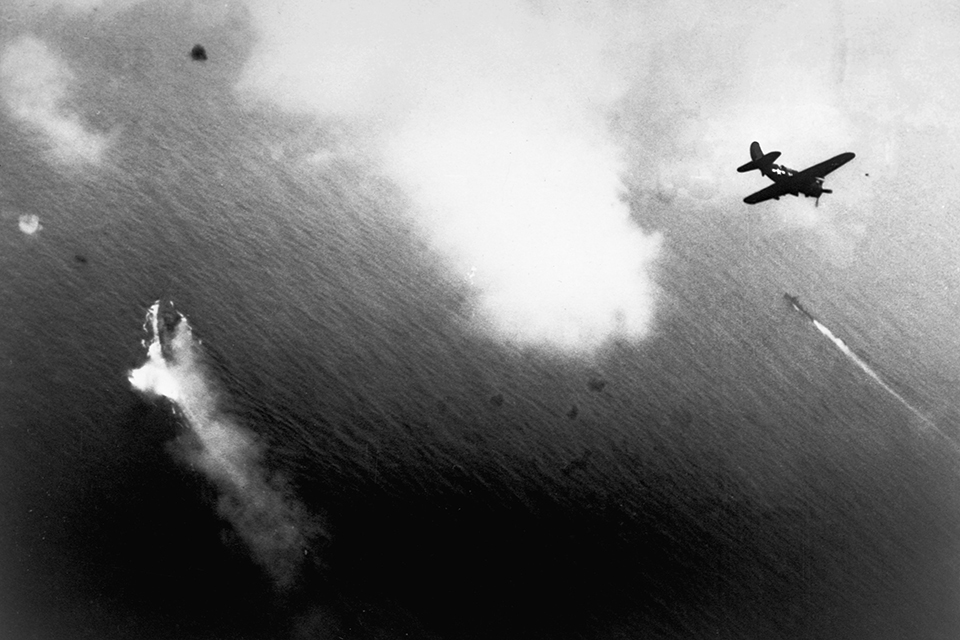
With the appearance in 1944 of the SB2C-3, which had a more powerful engine and a four-blade propeller, the Helldiver’s fortunes began to improve. Serving alongside Avengers for the remainder of the war, Helldivers were instrumental in the sinking of the two largest warships of World War II–the Japanese battleship Musashi during the Battle of Leyte Gulf on October 24, 1944, and her sister Yamato on April 7, 1945, during the Okinawa campaign. Helldivers also extensively supported ground troops and Marines during the Pacific island-hopping campaign.
By the time of the invasion of the Philippine Islands in October 1944, however, the second generation of Navy fighters, the Grumman F6F Hellcat and Vought F4U Corsair, was proving capable of carrying an offensive bombload virtually equal to that of the Helldiver. Moreover, once they released their bombs, the fighters were much better able to take care of themselves in aerial combat than any of the dedicated dive-bomber types. Consequently, a higher percentage of carrier air groups was composed of fighters, at the expense of dive bombers.
Another change that had come about in the years since the SB2C had first been conceived was the advent of high-velocity aircraft rockets that enabled pilots to hit surface targets accurately without subjecting themselves and their planes to the violent stress of a power dive. Rockets were fired from a Navy aircraft for the first time on August 20, 1943, three months before the Helldiver’s combat debut. The missiles were so successful that on May 18, 1944, the chief of naval operations announced that all Navy combat aircraft would be equipped with rockets. Starting with the SBC-4, the Helldiver was equipped to carry eight 5-inch rockets under its wings. The same rockets, however, could be carried by the more versatile fighter aircraft just as well.
In addition, by the end of World War II, the Navy had introduced the 11.75-inch ‘Tiny Tim’ rocket into service. A 10-foot-long missile weighing 1,250 pounds, the Tiny Tim packed the destructive power of a 500-pound bomb. The Exocet of its day, the Tiny Tim missile could be launched from an F4U Corsair.
A final Helldiver variant, the SB2C-5, appeared early in 1945 and had a greater fuel capacity. After World War II ended, however, the importance of the dive bomber diminished rapidly. The only perceived potential enemy was then the Soviet Union, which possessed few large capital ships to provide targets suitable for dive bombers. Far greater emphasis was expected to be placed on anti-submarine warfare (ASW). During the immediate postwar period, the TBF Avenger, with an internal weapons bay twice the size of the Helldiver’s bomb bay, was regarded as a far more versatile and effective carrier-based ASW platform than the SB2C.
The postwar generation of Navy strike planes were large, single-seat, piston-engine aircraft that were not optimized for the dive-bombing role. The Navy dropped the SB (scout-bombing) designation for those aircraft, redesignating them ‘A,’ for ‘attack.’ Vought introduced a postwar version of the Corsair, called the AU-1. Standard F4Us were also used extensively for ground attack during the Korean War. By far the most successful of the Navy’s new generation of attack aircraft, however, was the Douglas AD-1 Skyraider. Later known simply as the A-1, the Skyraider saw service with both the Navy and the Air Force during the Vietnam War.
Curtiss-Wright’s reputation as an aircraft manufacturer was not enhanced by its World War II products. As a result of pressure from the Chinese government, the Curtiss C-46 Commando transport was prematurely introduced into service flying ‘The Hump’ over the Himalayas. Like the SB2C, the C-46 suffered in comparison with a Douglas-built predecessor, the legendary C-47. Although the P-40 Warhawk was formidable at the beginning of the war, Curtiss persisted with its development long after its performance had been eclipsed by newer typeslike the Republic P-47 Thunderbolt and North American P-51 Mustang. Curtiss spent a great deal of effort on the SO3C Seagull scout floatplane.
Despite its shortcomings and the length of time it took to enter service, the SB2C was produced in greater numbers than any other dive bomber in history. A total of 7,140 Helldivers were produced by Curtiss, as well as in Canada by Fairchild Aircraft Ltd., which built 300 SBFs, and Canadian Car and Foundry Co., Ltd., which built 894 SBWs. Included in that total were 2,054 of the most numerous model, the SB2C-4, and 900 A-25A Shrikes.
Undeniably, Helldiver squadrons made a considerable contribution toward winning the war in the Pacific after 1943. Fifty years later, however, an objective assessment of the SB2C’s merits can only conclude that the success of those squadrons owed far more to the gallantry and skill of their aircrews than to the quality of the aircraft in which they flew.
This article was written by Robert Guttman and originally published in the July 1999 issue of Aviation History. For more great articles subscribe to Aviation History magazine today!