If the Curtiss P-40 Warhawk was not the best fighter in the arsenal of the U.S. Army Air Corps (USAAC) when the United States entered the conflict, it was the most numerous type available. The Lockheed P-38 Lightning could outperform the P-40, especially at high altitude, but the P-40 was less expensive, easier to build and maintain, and — most important — it was in large-scale production at a critical period in the nation’s history when fighter planes were needed in large numbers.
A total of 11,998 P-40s were built before production was finally terminated in 1944. Warhawks constituted the principal armament of the U.S. Army Air Forces (USAAF) fighter squadrons throughout 1942 and 1943. Even after the appearance of newer types of fighter aircraft in the USAAF rendered the P-40 obsolete, it continued to contribute to victory in a variety of Allied air forces.
The P-40 was the product of a long development process that began when the USAAC invited various aircraft companies to submit designs for its 1935 fighter competition. Curtiss and Boeing had dominated the U.S. Army and Navy fighter plane business since the end of World War I. In 1933, however, Boeing had beaten Curtiss in competition for a lucrative Army fighter contract with its innovative P-26 Peashooter. The P-26 was a monoplane of all-aluminum, stressed skin construction. Ralph Damon, the head of Curtiss, was determined that his company’s next fighter should have the benefits of the latest design and construction technology. In 1934, he hired Donovan R. Berlin as Curtiss’ new chief engineer. Berlin had previously worked at Douglas and Northrop, two firms that had been at the cutting edge of aircraft design.
The four rival designs for the 1935 fighter competition, from Curtiss-Wright, Seversky, Vought and Consolidated, were the first really modern fighters to be evaluated by the Army. All four were low-wing monoplanes of all-metal, stressed-skin construction with retractable landing gear and enclosed cockpits.
Curtiss designated its entry the Model 75. Since all Curtiss fighter aircraft had been called ‘Hawks’ since the mid-1920s, the new fighter became known as the ‘Hawk 75.’ Powered by a 900-hp Wright air-cooled radial engine, the Hawk 75 was first flown in May 1935 and demonstrated good maneuverability and flying characteristics. Initially, however, the USAAC rejected the Hawk 75 in favor of the Seversky P-35. It subsequently reversed that decision, however, and in 1937 it ordered 210 of the Curtiss fighters — the Air Corps’ largest order of a single type of fighter aircraft since the end of World War I. Fitted with a more powerful Pratt and Whitney R-1830 Twin-Wasp radial engine, the new fighter was designated the P-36A.
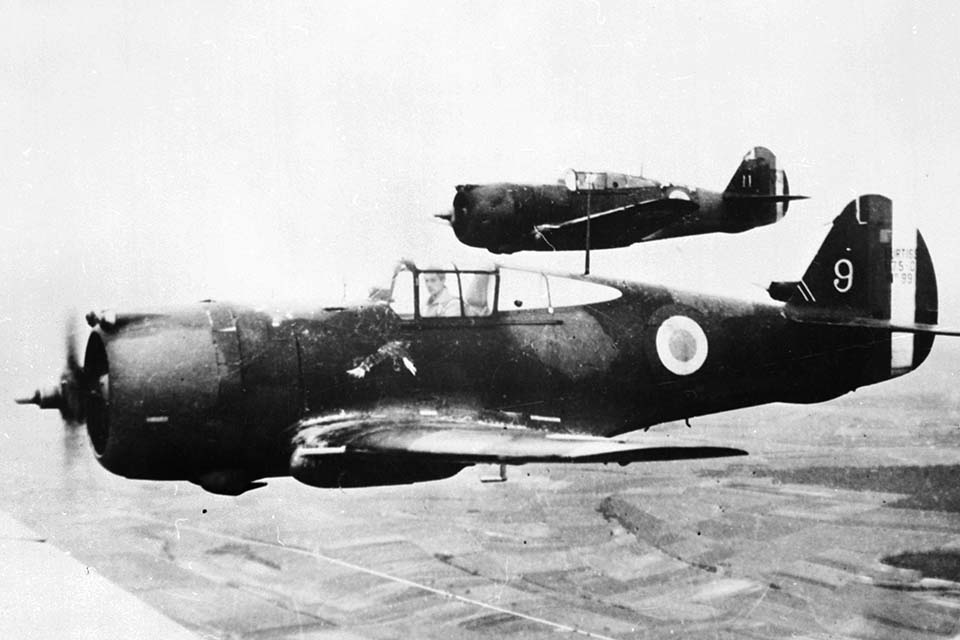
Significant as the USAAC order was, it was small compared to the total number of Hawk 75s sold overseas. Curtiss had been selling large numbers of Hawk biplane fighters to various nations in Europe, Asia and Latin America since the 1920s. With war clouds gathering throughout the world in the late 1930s, Curtiss had little difficulty finding foreign buyers for its new monoplane.
By far the largest customer for the Curtiss fighters was France. At the time of the 1938 Munich crisis, the French aircraft industry was having difficulty meeting its air force’s demands for modern fighters. The French government decided that the most expedient solution to the problem was to order 730 Hawk 75s from Curtiss, in the neutral United States. H-75As, as the French called them, were the most numerous fighters in the Armée de l’Air’s inventory when WWII began, and they shot down more German planes than any other French fighter aircraft. The Hawk 75s that had not yet been delivered to France before the country surrendered to Germany in June 1940 were transferred to Britain’s Royal Air Force (RAF), which called them Mohawks.
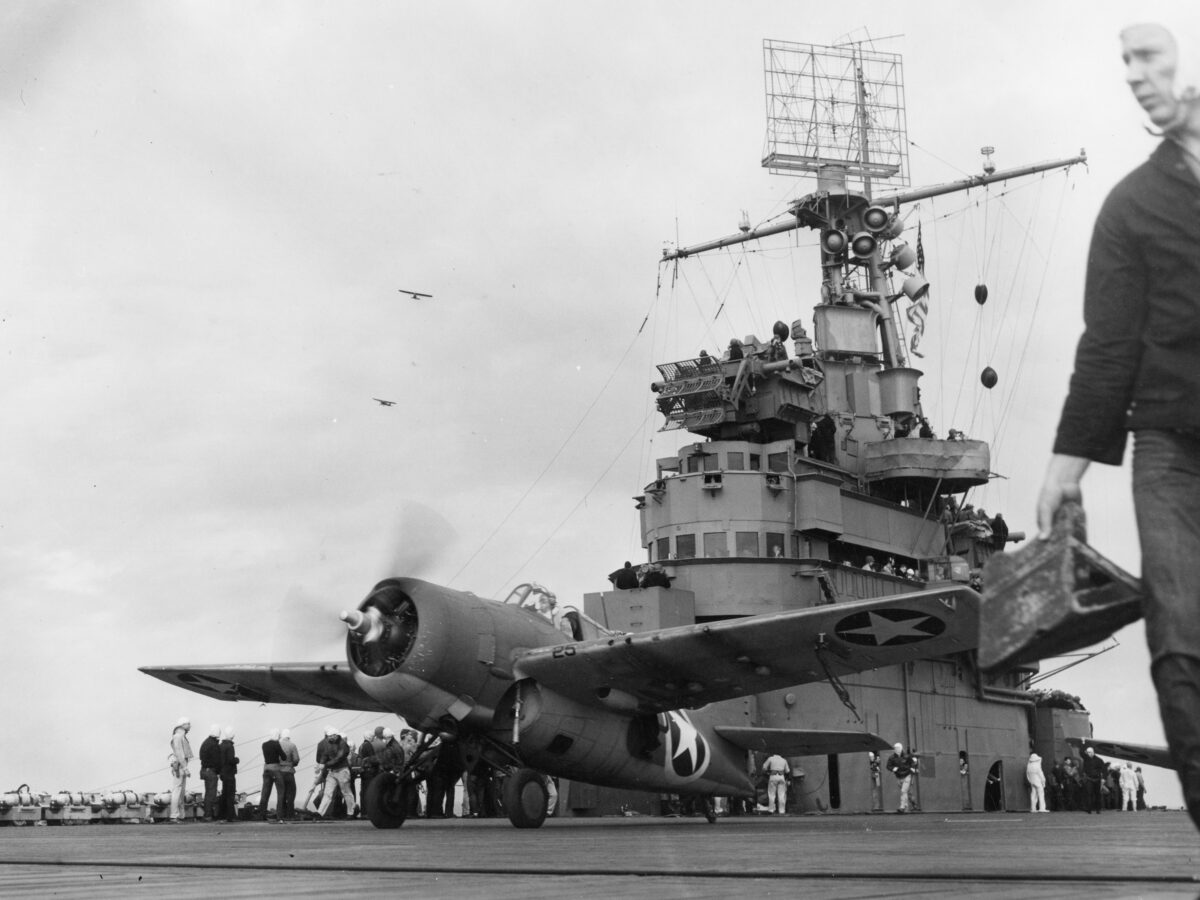
Some of the French H-75As were seized by the Germans after France’s collapse and sold to the Finns for use against the Soviet Union. Others, still in French hands, were transferred to North Africa, where they continued to operate under the control of the Vichy French government. On at least one occasion, during the Allied landings in Morocco in November 1942, Vichy French H-75As tangled unsuccessfully with U.S. Navy Grumman F4F Wildcats.
Recommended for you
Since the end of World War I, domination of the world’s aviation engines had been alternating between liquid-cooled in-line engines and air-cooled radial engines. The liquid-cooled engines were generally more powerful, but they were also heavier, more complex and vulnerable to damage if the coolant leaked out. The radial engines were lighter and more compact, but their larger frontal area created aerodynamic drag. As it happened, the Hawk 75 was developed at a time when the liquid-cooled V-12 engine was just beginning to come back into vogue, both in Europe and the United States. The principal reason was the introduction of high-temperature cooling utilizing Glycol rather than water, a development that made it possible to reduce weight and drag by decreasing the size of the cooling radiator by as much as 75 percent.
In February 1937, while the USAAC was still evaluating the P-36 for production, it contracted with Curtiss to re-engineer the fighter to test the potential of a highly promising new liquid-cooled V-12 engine, the turbosupercharged General Motors Allison V-1710. To save money, the factory rebuilt the original Hawk 75 prototype to create the new prototype. First flown in 1937, the XP-37, as the new fighter was called, was not an unqualified success. Although its 1,150-hp Allison engine and aerodynamic lines gave it far better performance than the P-36, it had a number of serious drawbacks as a combat plane. The General Electric turbosupercharger boosted the engine’s critical operating altitude — i.e., the altitude at which the supercharger would operate at peak efficiency — to 20,000 feet, but it proved unreliable and likely to catch fire. In addition, the cockpit had to be moved aft to balance the heavy engine and its bulky turbosupercharger, which reduced pilot visibility.
Despite the promising performance of the turbosupercharged Allison engine, the problems encountered with the XP-37 were rapidly reducing the likelihood that the airplane ever would be placed in production. Therefore, Don Berlin decided to take a different approach to a P-36 derivative equipped with an Allison engine. On March 3, 1938, Curtiss submitted a proposal to the Air Corps to modify a P-36 airframe to accept an Allison engine fitted with a mechanically driven supercharger. The modifications to the airframe were less extreme than those required for the XP-37, as they did not require moving the cockpit aft. The engine also proved to be more reliable than the turbosupercharged Allison used in the XP-37, although its critical operating altitude was reduced to 10,000 feet, with performance falling off at higher altitudes up to its service ceiling of 32,750 feet. At Curtiss the new fighter design was known as the Model 81, but the Air Corps called it the XP-40.
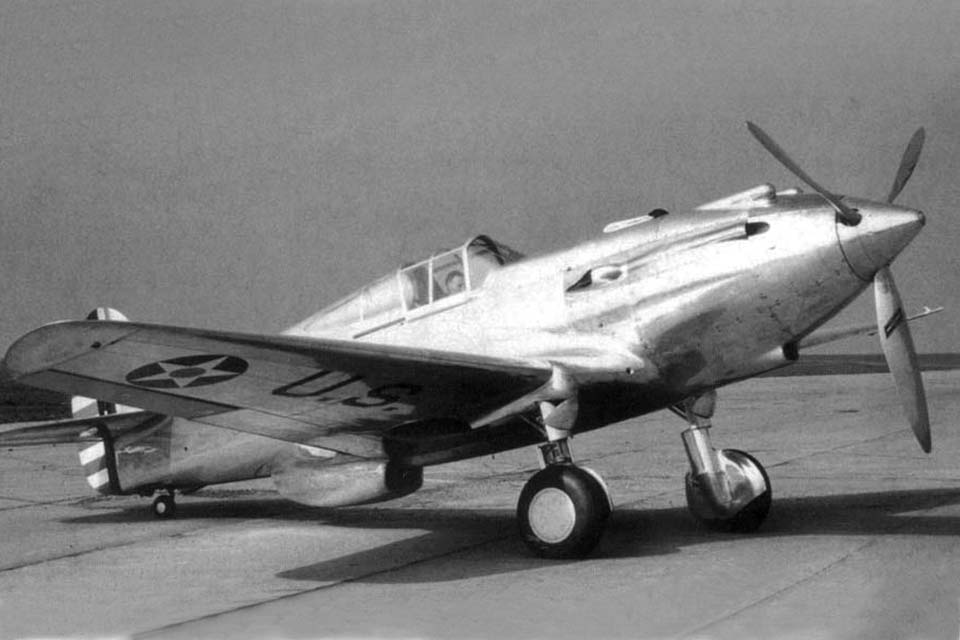
The prototype XP-40 was first flown on October 14, 1938, only two weeks after the settlement of the Munich crisis bought the world a one-year reprieve from war. It was modified from the 10th production P-36A airframe. The XP-40’s sharply pointed nose was longer than that of the P-36, though not so long as that of the XP-37. Since the cockpit was not displaced aft, the pilot’s view was better than in the XP-37. The radiator, which had been buried in the fuselage between the engine and cockpit of the XP-37, was now installed under the fuselage, aft of the wings.
Although Curtiss had guaranteed that the XP-40 would achieve 360 mph, the prototype was not immediately able to do so. After a series of modifications that took several more months, however, the fighter demonstrated a top speed of 366 mph at 15,000 feet. The most conspicuous change was the relocation of the radiator to a new position under the nose, giving the P-40 its most characteristic feature.
The XP-40 won the Army’s 1939 fighter competition against the Lockheed XP-38 Lightning, Bell XP-39 Airacobra, Republic AP-4, and Curtiss’ own XP-37 and Hawk 75R, the latter a turbosupercharged version of the radial-engine P-36. The XP-38 outperformed the XP-40, especially at high altitudes, and was more heavily armed, but the XP-40 had the advantage of being based on an existing fighter design that was already on the production line. That meant that Curtiss could put the P-40 into production with a minimum of delay, and at the highly competitive price of $24,566.60 apiece. On April 26, 1939, Curtiss was awarded a contract for 524 P-40s — once again, the largest order for fighter planes placed by the Army since 1918.
The P-40 prototype was armed with one .50- and one .30-caliber machine gun — the standard USAAC fighter armament during the 1930s — but the production model was armed with two .50-caliber machine guns. In keeping with President Franklin D. Roosevelt’s policy of making the latest American military hardware available to the Allies, 140 of the original batch of P-40s were diverted to France. They were armed with one .50-caliber machine gun in the fuselage and four 7.5mm guns in the wings. None of those P-40s were delivered by the time France capitulated, however. Instead, the export P-40s were delivered to the RAF and became known as Tomahawk Mk.Is.
The British were grateful for all the combat aircraft they could get in 1940, but they did not regard the Tomahawk Mk.I as suitable for combat. Many of the Tomahawk Mk.Is still had metric instruments and other French equipment that were not compatible with RAF service, and their French throttle control levers worked in reverse of the way British or American ones did. More important, they lacked self-sealing fuel tanks and had neither armor nor bulletproof windscreens to protect their pilots. Consequently, the Tomahawk Mk.Is were relegated to tactical reconnaissance duties.
As a result of European combat experience, Curtiss installed armor in the P-40 and increased its armament, adding a .30-caliber machine gun in each wing. The improved fighters were called P-40Bs by the Americans and Tomahawk Mk.IIs by the British. The next model, known as the P-40C, also had self-sealing fuel tanks and yet another .30-caliber machine gun in each wing. The USAAC ordered a total of 324 P-40Bs and P-40Cs during 1941. At the same time, the British ordered 930 P-40Cs. Those with British radio equipment were called Tomahawk Mk.IIas, while the ones delivered to the RAF with American radios were designated Tomahawk Mk.IIbs.
First flown in April 1941, the P-40C was considered the first truly combat-ready version of the P-40 line. A price had been paid for the necessary improvements, however. The aircraft’s gross weight had increased from 7,215 to 8,058 pounds, an increase of 843 pounds or approximately 11 percent, with no increase in engine power. The P-40C’s rate of climb suffered, it was less maneuverable, and its maximum speed fell to 340 mph. By comparison, the Messerschmitt Me-109E used by the Luftwaffe in 1941 weighed only 6,100 pounds and had a top speed of 360 mph. Air Chief Marshal Sir Kenneth Cross, who served in the RAF’s Desert Air Force, recalled that ‘the Tomahawk was beautifully built, but…short on performance compared to the (Messerschmitt) 109F and G.’
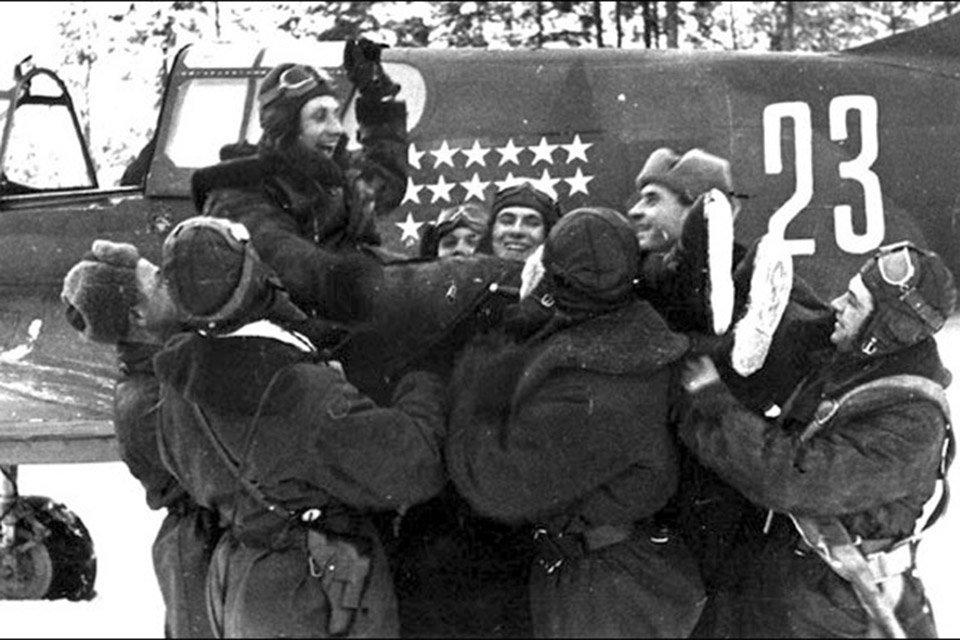
By the end of 1941 the USAAC had deployed P-40s overseas. Thirty were flown to Iceland from the aircraft carrier Wasp, and 99 of them were stationed in Hawaii. In addition, four squadrons of P-40s were deployed in the Philippines. It was with the British that the Tomahawk Mk.IIs first saw action, however, flying reconnaissance sorties and fighter sweeps across the English Channel with the RAF and Royal Canadian Air Force (RCAF) in 1941. By May 1941 Tomahawks were also operating in the Middle East, eventually serving in that theater with Australian and South African fighter squadrons as well as the RAF. In addition, the British sent 195 Tomahawks to the Soviet Union after the Germans invaded that country on June 22, 1941.
The first serious use of the P-40 as a fighter occurred when Iraqi forces led by Rashid Ali El-Ghailani rose against the British in Iraq on May 2, 1941. When the Germans and Italians sent aircraft to assist the revolt, staging from Vichy French bases in Lebanon and Syria, the British sent three Bristol Blenheims to bomb the air base at Palmyra on May 14, escorted by two Tomahawks of No. 250 Squadron, RAF, flown by Flying Officers G.A. Wolsey and F.J.S. Aldridge. The Iraqi revolt was crushed by May 30, but the British decided that Vichy France’s violation of neutrality justified the invasion and occupation of Lebanon and Syria. Tomahawks of No. 3 Squadron, Royal Australian Air Force (RAAF), took part in the first attack on June 8, helping to destroy a Dewoitine D.520 fighter and damage three others at Rayak airfield. Elsewhere on that same day, two of No. 250 Squadron’s Tomahawks drew first blood for the P-40 in the air when they shot down an Italian Cant Z.1007bis reconnaissance plane five miles northwest of Alexandria, Egypt. The Vichy French put up a spirited fight before finally signing an armistice on July 14, but the Tomahawks of No. 3 Squadron RAAF also acquitted themselves well, holding their own against France’s top-of-the-line D.520s and shooting down two out of eight German Junkers Ju-88As of II Gruppe, Lehrgeschwader 1, operating from Crete, that tried to interfere with British landings on the Levantine coast on June 12.
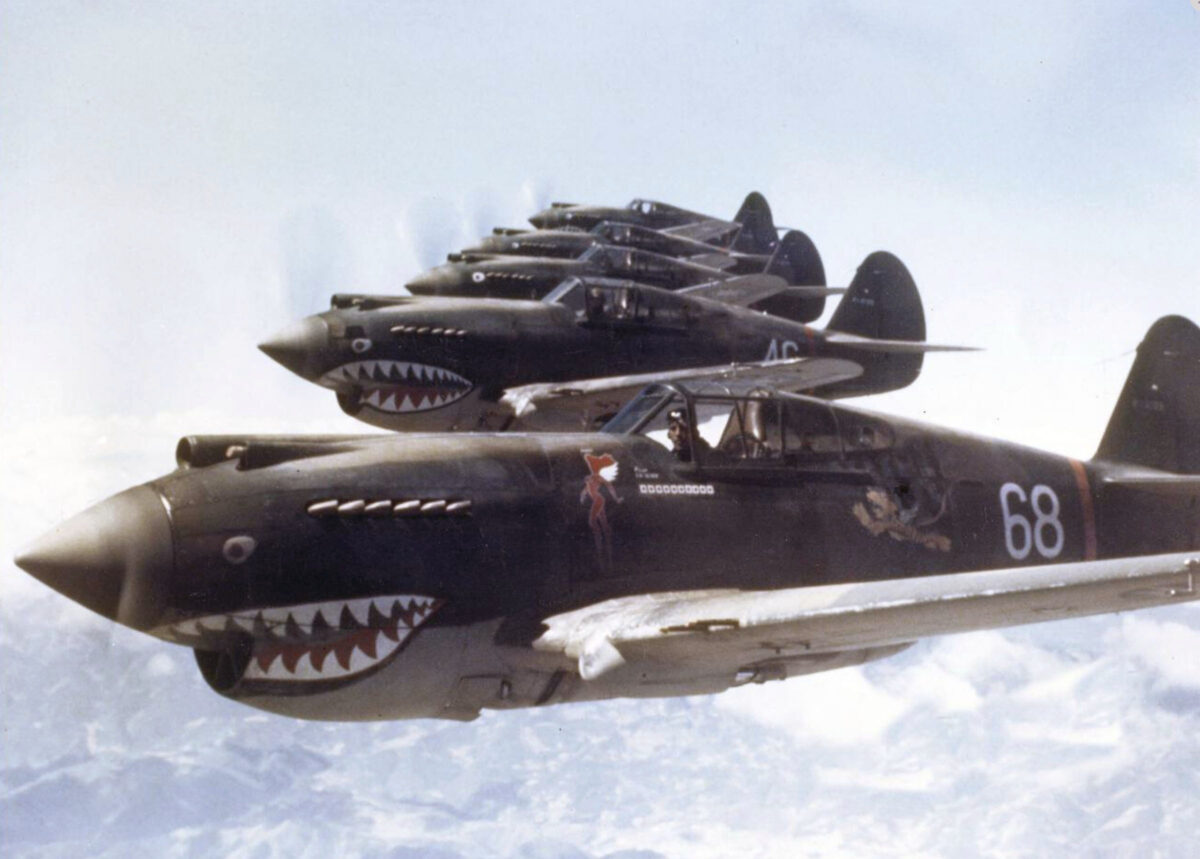
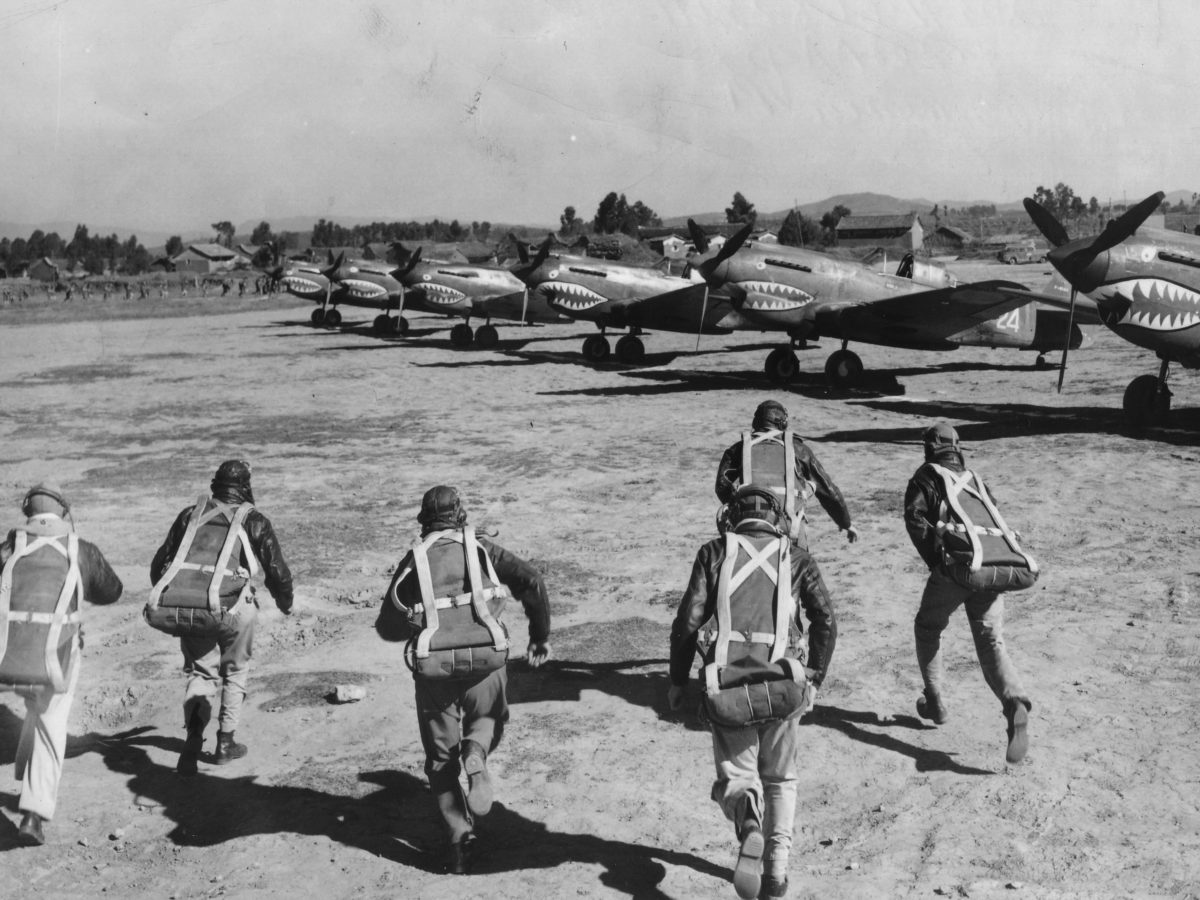
During the summer of 1941, No. 112 Squadron RAF, which had lost all its Gloster Gladiators in Greece the previous spring, was re-equipped with Tomahawks. Its pilots took one look at their sleek new mounts and decided that the P-40’s cowling would make an ideal place to paint the squadron badge, a black cat. The results, however, looked more fishlike than feline, and soon a variety of shark mouths were being applied to the Tomahawks and, later, to the deeper-jowled Kittyhawks. For some reason, British authorities did not discourage No. 112 Squadron’s flamboyant liveries. The P-40 shark mouth would soon be adopted in other units and other air forces.
David B. Brown, who flew Kittyhawks in No. 112 in 1942 and later Supermarine Spitfires, recalled: ‘The Kittyhawk, while offering a more roomy and comfortable cockpit than the Spitfire, with a bonus of improved visibility, was more sluggish on controls and inferior in performance when compared with the Spitfire V. Furthermore, even though we could cope with moderate aerobatics and mock dogfights, there was still a feeling of ‘touchiness’ about the P-40 so that you wanted plenty of altitude before you could relax….’
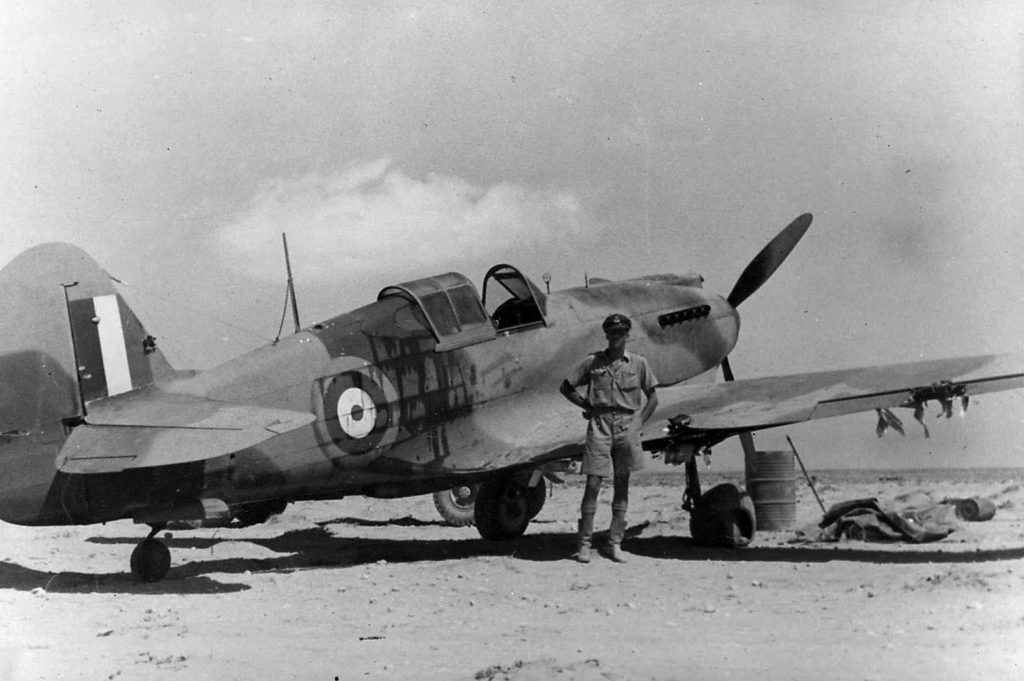
Me-109F aces such as Hans-Joachim Marseille took a grisly toll of P-40s, but some of the more talented Commonwealth pilots rang up their own fair tallies of Axis planes while flying the Curtiss fighters. Australian ace of aces Clive R. Caldwell, flying Tomahawks in No. 250 Squadron and later Kittyhawks as commander of No. 112 Squadron, was credited with 18 German and Italian aircraft, plus two to four shared, six probables and 15 damaged over the Western Desert, later adding seven Japanese planes to his score while flying Spitfires over the South Pacific.
American P-40s first saw action at Pearl Harbor on December 7, 1941. Of the 99 P-40Bs stationed in Hawaii that day, only seven managed to get airborne during the attack. They shot down five Japanese planes, including four — two Nakajima B5N2 torpedo bombers, a Mitsubishi A6M2 Zero fighter and an Aichi D3A1 dive bomber — by 2nd Lt. George S. Welch of the 47th Squadron, 15th Pursuit Group. By the end of the day, however, only 25 P-40s remained operational. Three had been shot down, and the rest were destroyed on the ground.
In the Philippines, as in Hawaii, attrition was high — 26 P-40s were destroyed on December 8, 1941, mostly because they were caught on the ground. Although initially shocked by the startling performance of the Zero fighters that faced them, the four squadrons of P-40s put up a gallant struggle against the Japanese invaders.
The first USAAC ace of World War II was 1st Lt. Boyd D. Wagner, a P-40E pilot of the 17th Squadron, 24th Pursuit Group, in the Philippines. During a surprise attack on the Japanese army’s 50th Sentai, newly arrived at Aparri airfield on December 12, Wagner was attacked by four Nakajima Ki.27 fighters. He evaded two, then suddenly cut his throttle to make the other two overshoot him and shot down both. After strafing five to seven Japanese planes on the ground, Wagner was attacked by three more Ki.27s but managed to shoot down two of them and then escaped. He was subsequently awarded the Distinguished Service Cross, as was 1st Lt. Russell M. Church, Jr., who was shot down in flames and killed by anti-aircraft fire in the course of the raid. Wagner repeated his performance at Vigan field on December 16, hitting eight enemy planes on the ground and shooting down a Ki.27 that managed to take off, for his fifth victory in as many days. By then, however, there were too few of the Curtiss fighters available to do more than delay the inevitable. Lacking spare parts and replacement aircraft, the Americans were overwhelmed by May 1942.
Thomas L. Hayes, who flew P-40Es with the 35th Pursuit Group, was originally supposed to go to Mindanao, but when his squadron was unable to reach the Philippines it was diverted to Java in mid-January 1942. ‘The water-cooled Allison…moved the center of gravity forward,’ Hayes recalled. ‘The P-40 was much heavier than the P-36, and visibility was somewhat restricted with that extended nose. The P-40 also had more difficult landing characteristics than the P-36 — its greater weight, combined with the narrow landing gear and long nose, gave it a greater tendency to ground loop.’
‘The most serious deficiency in my training was gunnery,’ he added. ‘The only time I had squeezed the trigger was strafing an oil slick dropped in the Pacific. Tactics were a close second. We were indebted to our veterans, who told us, ‘You’re not going to turn and fight with a Zero — you won’t live to tell about it.’ Tactics were hit and run — if one had the altitude on a Zero, one could dive and get him. But engagements usually began with the Japanese above the P-40s — they threw the first punch.’
Hayes was shot down and wounded by a Zero on February 20, 1942, crash-landing his P-40E in a rubber plantation. After escaping from the Dutch East Indies, he went on to fly P-39s over New Guinea, and North American P-51s over Europe with the 357th Fighter Group, Eighth Air Force, finishing the war with credit for destroying 8 1/2 German aircraft.
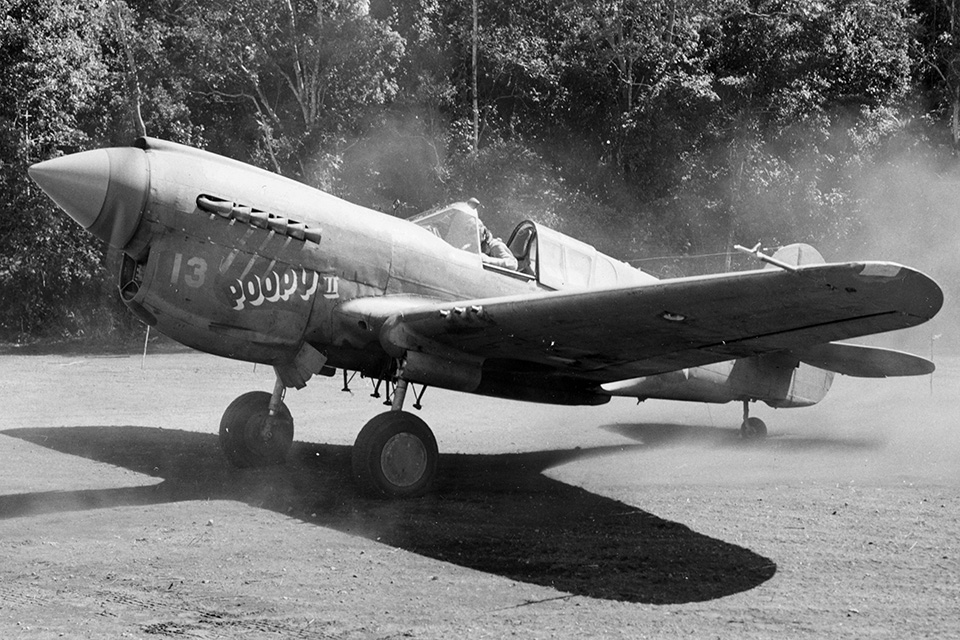
By far the most renowned of all Curtiss fighters were the 100 dispatched to China for use by the American Volunteer Group (AVG), or ‘Flying Tigers.’ Usually referred to as P-40s, they were technically Tomahawk Mk.IIbs that had originally been built for the British. The Flying Tigers got the idea for their famous shark mouth marking from magazine photographs of No. 112 Squadron’s colorful Tomahawks. The AVG’s exploits made the shark mouth so famous, however, that P-40 units all over the world began copying it from them.
The AVG never had more than three squadrons of 18 P-40s at any time. Flying their first combat mission on December 20, 1941, the Flying Tigers operated under extremely difficult conditions at the end of the world’s longest supply line — and with the war’s lowest supply priority. Nevertheless, by the time the group disbanded six months later, its pilots had shot down 286 Japanese aircraft. During a period in the war when everybody else in the Far East was being soundly defeated by the Japanese, their achievements were truly phenomenal.
The AVG owed its success to the tactical doctrines developed by its leader, Colonel Claire Lee Chennault. A former USAAC fighter pilot who had carefully observed Japanese aircraft over China, Chennault understood the strengths and weaknesses of both the Japanese and American fighters. Using that knowledge, he established an advance warning system, which involved Chinese observers relaying information to AVG air bases, giving his pilots prior intelligence on what Japanese forces were coming and when they would arrive. He also drilled three fundamental rules into his pilots. First, never ever try to turn with a Japanese fighter in a dogfight, since it could maneuver its way onto a P-40’s tail within two turns; instead, use the P-40’s superior diving speed to escape, then climb and re-engage. Second, Chennault advocated head-on passes, because the Curtiss, with its two .50- and four .30-caliber machine guns, could outgun its Japanese army counterparts, which were still armed with only two 7.7mm weapons. The third rule was to harass the Japanese planes after they retired — since they lacked self-sealing fuel tanks, a few holes in their tanks would probably cause them to run out of fuel before they reached their home bases. These rules were the secrets of the Flying Tigers’ success.
Technically, the AVG personnel were U.S. civilians employed by the Nationalist Chinese government. Because of that, their P-40s were painted with Chinese insignia. Their success, highly publicized in the United States, was actually something of an embarrassment to the USAAC and its successor, the USAAF. The AVG was disbanded when an agreement was reached with the Chinese government to induct the Flying Tigers and their P-40s into the USAAF on July 4, 1942.
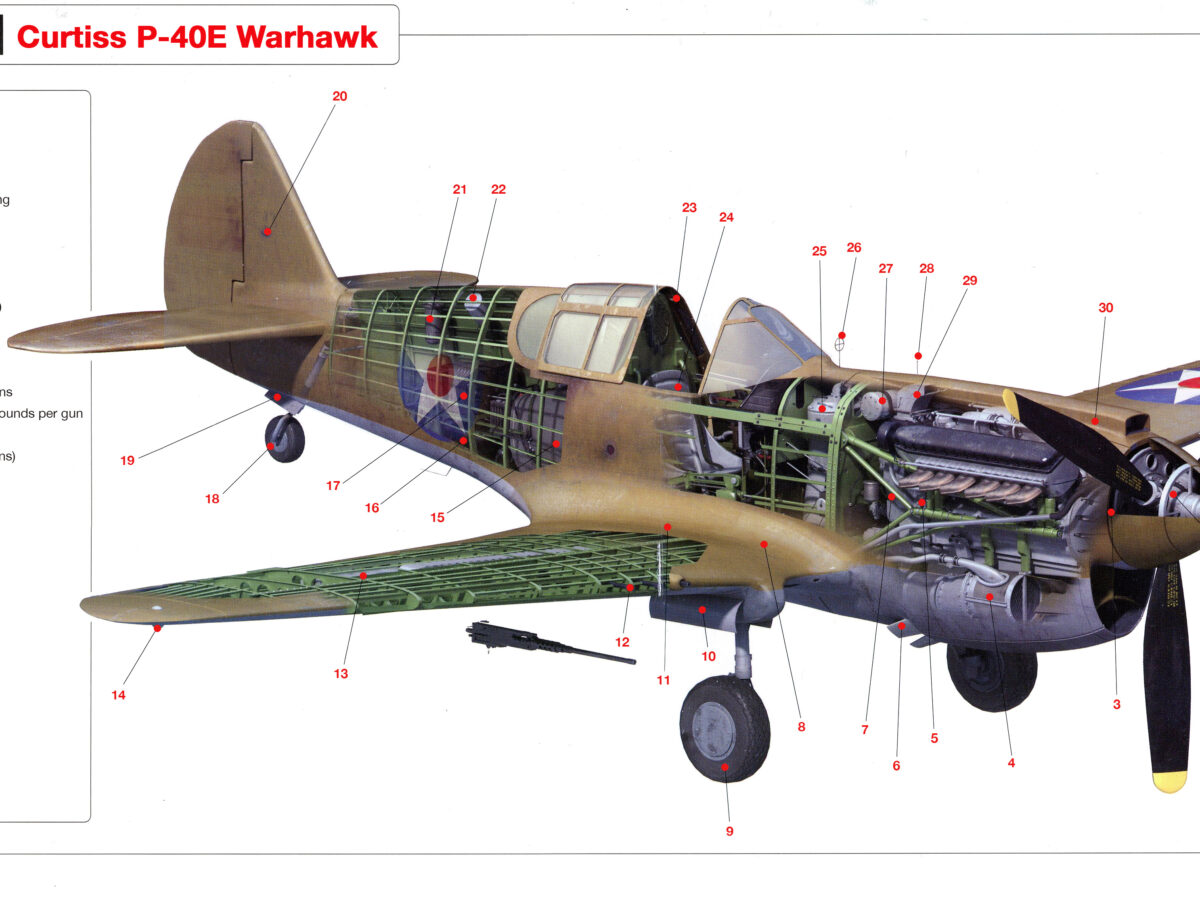
Curtiss-Wright was well aware of the P-40C’s shortcomings. In 1940 it developed a replacement fighter, mounting 10 machine guns and powered by an improved version of the Allison engine. Known as the XP-46, the new fighter did not enter production because Maj. Gen. H.H. Arnold, the Army Air Corps chief of staff, insisted that P-40 production should not be interrupted. Instead, Curtiss-Wright developed a new version of the P-40 incorporating the same 1,150-hp Allison V-1710-39 engine intended for the XP-46. The new P-40’s nose was considerably altered because the new engine was shorter and had a higher thrust line, and the radiator air intake was enlarged. The armament was changed to four .50-caliber guns in the wings. First flown in May 1941, the improved fighter was called the P-40D Warhawk by the USAAC and Kittyhawk Mk.I by the British. In April 1941, Curtiss built the first of 2,320 P-40Es, or Kittyhawk Mk.Ias, armed with six .50-caliber wing guns.
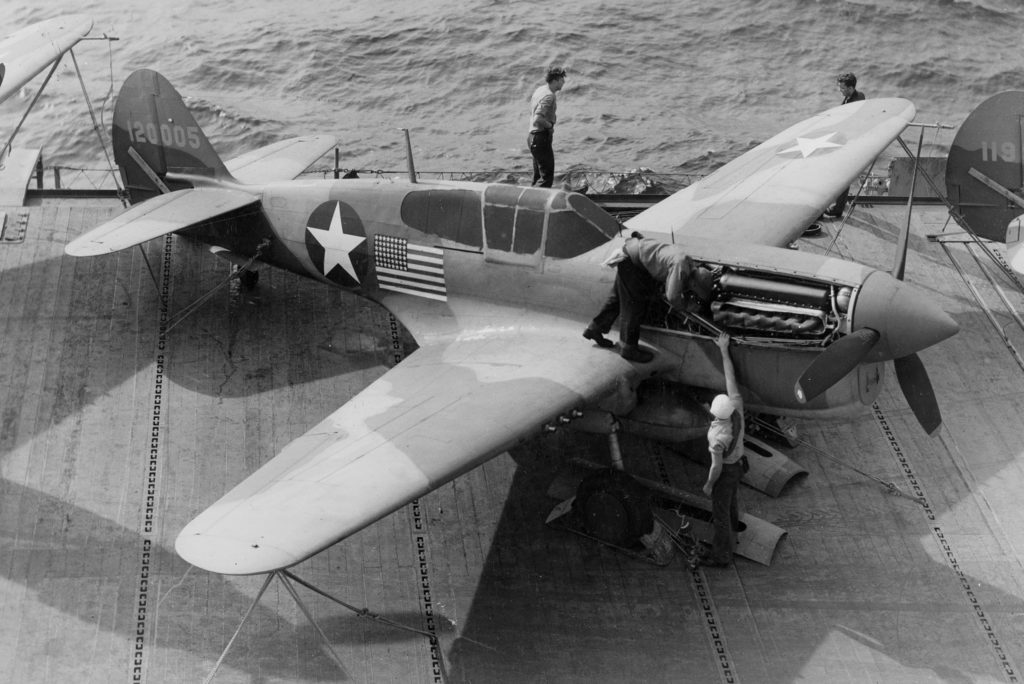
In an attempt to improve the P-40’s performance above 15,000 feet, Curtiss installed a Rolls-Royce Merlin engine in a P-40D to produce the XP-40F. The British were concerned that Rolls-Royce might not be able to supply enough Merlin engines for their own and the Americans’ needs, and at the same time, General Arnold was concerned that Allison could not supply sufficient liquid-cooled engines to fulfill the Army Air Corps’ requirements. As a result, on September 13, 1940, the British contracted Packard to build 6,000 Merlins for the RAF and 3,000 for the USAAC. The production P-40F Warhawk, or Kittyhawk Mk.II, became the first American fighter to use the 1,300-hp Packard Merlin and first flew in October 1941. With a top speed of 364 mph, the P-40F was 10 mph faster than the P-40E. The only external difference between the P-40E and F was the absence of the air scoop on top of the P-40F’s cowling, due to the Merlin’s updraft carburetor. A total of 1,311 P-40Fs were built, as well as 700 similar but lighter-weight P-40Ls. When the supply of P-40F and L airframes outstripped the supply of Packard Merlins early in 1943, 600 of them were completed with Allison engines and designated P-40Rs.
Between 1942 and 1943 the P-40Es were superseded by 1,300 improved aircraft with 1,325-hp Allison V-1710-73 engines, called P-40Ks. The P-40M was a similar, but lighter version of the P-40K with a carburetor air bypass grille on the cowling just forward of the exhausts. The aircraft’s tail was also slightly lengthened to improve directional stability. Both models were designated Kittyhawk M.IIIs by the RAF.
In order to further improve the P-40’s performance, Curtiss introduced additional weight-saving measures, including reducing the amount of fuel and eliminating two of the wing-mounted .50-caliber guns. At the same time, the designers improved rear visibility by increasing the glazing behind the cockpit. Called the Kittyhawk Mk.IV by the British, the lightweight P-40N Warhawk was the most-produced P-40 variant. With a top speed of 378 mph, the P-40N also had the best performance of the production-model P-40s. The 5,219th and last P-40N was completed on November 30, 1944. In addition to the USAAF, P-40Ns were used by the Dutch, Australians and New Zealanders in Europe and the South Pacific, and many were supplied to the Soviet Union.
In 1944, Curtiss-Wright made a final attempt to improve the P-40 by installing an enhanced 1,425-hp Allison V-1710-121 engine equipped with a two-stage supercharger in a P-40K. A new-style radiator was also built into the wing center section. The XP-40K was rebuilt three times. In its final form, with a shallow chin air scoop, clipped wings and a bubble canopy, the Curtiss fighter’s appearance was somewhat reminiscent of a P-51D Mustang. The XP-40Q, as the new version was redesignated, was the fastest of the Warhawks, with a top speed of 422 mph at 20,000 feet. Unfortunately, by the time the XP-40Q was built, the more capable P-51D was already available in large numbers. Only three were built, and only one was evaluated — and rejected — by the USAAF.
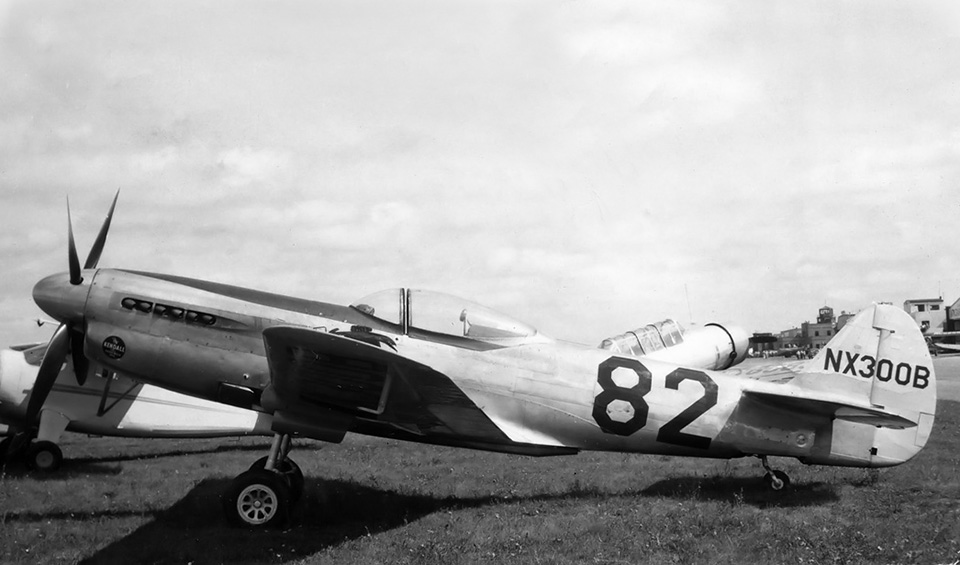
One XP-40Q turned up in Cleveland, Ohio, for the Thompson Trophy Race on September 1, 1947. Flown by Joe Ziegler, the Warhawk was excluded from the race because it qualified 13th, and only 12 planes were supposed to be allowed to compete. Ziegler started the race anyway, but on the 13th lap the XP-40Q’s engine stopped. Ziegler was forced to bail out, breaking one of his legs, and a woman spectator was injured by the jettisoned canopy. Thus ended the career of the ultimate P-40.
The P-40’s performance was always regarded as inferior to its German contemporaries, the Me-109 and Focke Wulf Fw-190, especially at altitudes above 15,000 feet. It could also be outmaneuvered and outclimbed by the Japanese Mitsubishi Zero. The availability of better fighters, such as the P-38 Lightning, P-47 Thunderbolt and P-51 Mustang, rendered the Warhawk obsolete by 1944. Nevertheless, many continued to be used in the South Pacific and China-Burma-India theaters right up until the end of World War II. Some P-40Ns were retained after the war by the Dutch East Indies Air Force and the Nationalist Chinese Air Force. The last known instance of P-40Ns’ being used in action was by the Dutch against Indonesian insurgents in 1948.
The P-40N was not only the last production model of the Warhawk family but also the last production fighter from Curtiss-Wright. Curtiss produced several fighter prototypes in an effort to supersede the P-40, but none were accepted for production due to the availability of more suitable existing models, such as the North American P-51. The last Curtiss fighter was the XP-87 Blackhawk, a postwar four-engine jet night fighter that was rejected by the U.S. Air Force in favor of Northrop’s F-89 Scorpion. The company still had several important military aircraft in production after the P-40 program was terminated, including the C-46 Commando transport, the SB2C Helldiver dive bomber and the SC-1 Navy scout seaplane. However, Curtiss-Wright’s dominance of the American fighter business, which had lasted since the early 1920s, ended with the P-40.
Although the P-40 was not the best fighter plane of its era, it was among the most ubiquitous. Few aircraft have seen combat in as many theaters, under as wide a variety of climactic conditions, or with as many different air arms as the Warhawk. P-40s were in action from the Arctic to the tropics, from the desert to the jungle, and from sea level to the Himalayas. In addition to the U.S. Army Air Forces, Warhawks were used by British, Australian, New Zealand, South African, Canadian, Dutch, Free French, Soviet, Chinese, Egyptian and Turkish fighter units. Whether it was known as the P-40, the Tomahawk, the Kittyhawk or the Warhawk, Curtiss-Wright’s fighter was one of the truly classic combat aircraft of World War II.
This article was written by Robert Guttman and originally published in the November 2000 issue of Aviation History Magazine. For more great articles subscribe to Aviation History Magazine today!