It was the Union’s turn to suffer. For three years its forces had steadily grown stronger along the North Carolina coast. Federal soldiers occupied most of the eastern part of the state. Few ports remained open, and even those were increasingly restricted by the dishearteningly effective Union blockade. Now, it was early 1864, and Confederate North Carolina was in dire straits. As their once consistent stream of supplies slowed to a trickle, Confederate leaders sought a way to break the Union blockade. Their solution came in the form of a mammoth ironclad ram named after the Albemarle Sound, where she had been built and where she would terrorize Union ships for months to come. She was the Albemarle, and there was not a Federal vessel afloat that could stop her.
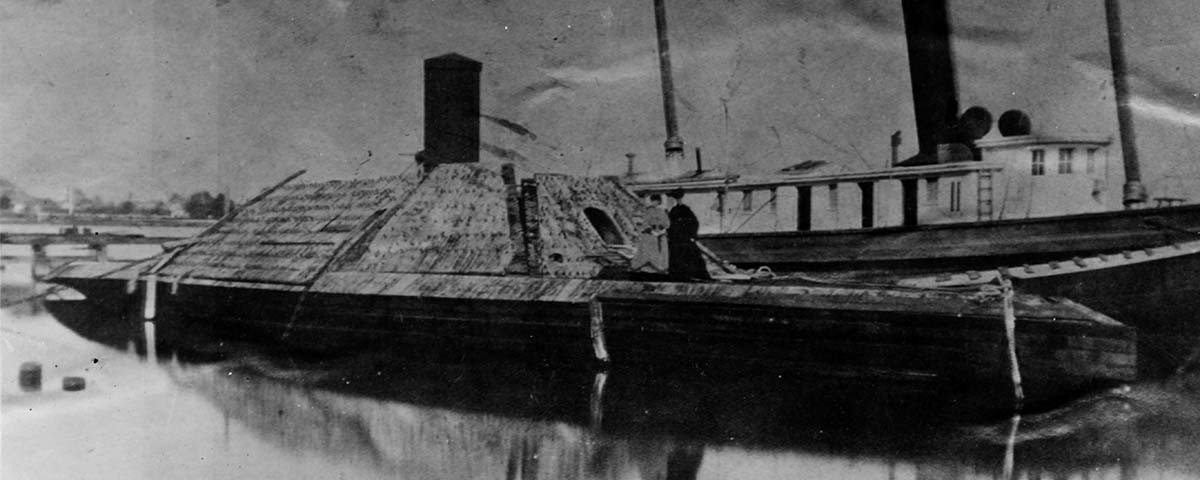
The Confederates had been working on the Albemarle since 1863. Gilbert Elliott, a 19-year-old marine engineer and native North Carolinian, had been awarded a contract to build an ironclad ram capable of driving the Yankee invaders from his home state. Working under the direction of James W. Cooke, who was to command the ship, Elliott set up his’shipyard’ in the cornfield of a Peter Smith on the west side of the Roanoke River, not far from Hamilton. The site was ideal: close to raw materials and able crewmen yet far enough upstream to be safe from surprise Union patrols. While Cooke collected the necessary men and equipment, Elliott scavenged for whatever iron he could find. After a year of dogged work, the hull of the Albemarle slid out of Smith’s cornfield and into the river.
Designed by John L. Porter, the chief constructor of the Confederate navy, the Albemarle was 152 feet long with a draft of slightly less than 9 feet. Her two deadly Brooke guns were mounted on pivot carriages that allowed each gun to fire through three different gunports. These two guns, along with the ship’s four-inch-thick iron plating and heavily reinforced bow, made the ram the nemesis of the wooden ships of the Union blockade on the Albemarle Sound. As if that were not enough, the Albemarle‘s shallow draft enabled her to ply the waters of North Carolina’s inland bays where the larger and more powerful Union monitors would run aground.
By 1864, the Union forces had moved across the sound and established a strong base on the Roanoke River at Plymouth, some 40 miles downstream from Hamilton. In April, the Albemarle was ordered to participate in a combined river and land attack on that base. As the ram floated down the Roanoke to meet the enemy, blacksmiths and carpenters were on board, still putting the finishing touches on the Confederate warship.
Afternoon was turning to evening on April 17 when the Confederates neared Plymouth. The Union army forces on shore anchored their line’s flanks on the Roanoke River, where the Federal navy was assumed to be superior to the approaching Rebel flotilla. Even so, Lieutenant Commander Charles W. Flusser, who was in charge of the Union naval squadron at Plymouth, knew the Albemarle spelled trouble. Federal ships had placed obstructions in the Roanoke, and Flusser had two of his vessels, the Miami and the Southfield, chained together to ensnare the ram between them.
As the Confederate land assault commenced, Cooke steered the Albemarle down the Roanoke. On April 18, during a night of heavy rain, Cooke learned of the obstacles in the river and sent Elliott ahead to reconnoiter. Elliott studied the obstructions from his small boat, carefully gauging the depth of the water; the heavy spring rain had caused the river to rise, and Elliott was satisfied that there was enough water for the ram to pass safely. He reported this to Cooke, who ordered the Albemarle forward.
By daybreak, the ship had glided safely over the obstructions. A short time later it was spotted by Union troops manning a battery at Warren’s Neck. The gunners opened fire on the Confederate vessel, but their shells bounced harmlessly off her thick hull. One sailor inside the Albemarle recalled that the ‘noise made by the shot and shell as they struck the boat sounded no louder than pebbles thrown against an empty barrel.’
Cooke continued down the river, wasting no ammunition on the insignificant fort. After the ram quietly passed a second Union fortification at Boyle’s Mill, the Confederates spotted the Miami and the Southfield. Cooke deftly maneuvered the Albemarle close to the shore, out of the reach of the Union vessels with their deeper drafts. Then he aimed her at those vessels and plunged full speed ahead. The iron ram that protruded from the Albemarle‘s bow struck the Southfield and drove deeply into the wooden ship’s side. The Southfield began to settle quickly, but not before the two vessels had become entangled. As the Southfield sank, she dragged the Rebel ironclad’s bow beneath the surface. Water gushed in through the Albemarle‘s gun ports, and her crew feared she was lost. But as the Union ship hit bottom, she rolled over on her side. The Albemarle broke free and bobbed back to the river’s surface.
Standing on the deck of the nearby Miami, Flusser tried to take advantage of the Albemarle‘s temporary entanglement with the Southfield. He ordered a 10-second fuse to be affixed to a cannon shell, yanked the gun lanyard, and fired directly into the Albemarle‘s hull. But the shell simply bounded off the iron plating and came back toward the Miami. Flusser watched with horror as the shell, its fuse still burning, landed at his feet; it blew up and tore him apart.
The Miami withdrew immediately. The Union naval squadron had been effectively neutralized, and the Federal land force’s flanks and rear were suddenly unprotected from the Rebel gunboats’ fire. The overconfident Federals had counted on being able to bring reinforcements up the river, but now that option was no longer open. On April 20, the Union garrison at Plymouth surrendered. The next day, Major General Benjamin Butler, commander of the Union Department of Virginia and North Carolina, sent a terse dispatch to Washington, D.C., from his headquarters at Fort Monroe, Virginia: ‘Rebel ram came down the Roanoke, passed Plymouth, sunk the Southfield, disabled the Miami, and has gone into the Sound. Flusser is killed. Great consternation there.’
The Confederacy had seemingly found its savior. Many elated Southerners believed the Albemarle would enable the Confederates to reclaim the barrier islands and reopen the coast as far south as Wilmington. On May 5, 1864, Cooke took the ship and two tenders down the Roanoke River, but a Union flotilla of seven wooden gunboats blocked her path to the sound. Then, at 4:00 p.m., the Northern ships steamed directly at the Confederate vessel. Closing to within 100 yards of the ironclad, the Yankee gunboats poured a heavy fire into the ram for nearly an hour.
By 5:00 p.m., the commander of the Federal gunboat Sassacus saw an opportunity and ordered: ‘Crowd waste and oil in the fires and back slowly! Give her all the steam she can carry!’ The Sassacus charged directly at the point where the Albemarle‘s casemate joined the hull. ‘With full steam and open throttle the ship sprang forward like a living thing,’ a Union sailor recalled. Cooke was unable to maneuver the Albemarle out of the way.
As the Sassacus‘s large paddle wheels drove her forward, the guns stopped firing and the smoke cleared. The Northerners watched as the Albemarle turned to avoid their headlong rush. An officer aboard the Sassacus called out to the crew: ‘All hands lie down!’
With a shock that ran through both vessels, the Sassacus struck the Albemarle squarely. The force of the collision splintered the Federal ship’s wooden bow. Even as the Union vessel rested on the Confederate ram, its paddles continued to splash. Water rushed into the careened ram, and this time it seemed the Albemarle really might sink. Coolly, Cooke called out to the crew: ‘Stand to your guns, and if we must sink let us go down like brave men.’
The Sassacus rode the ram for more than 10 minutes. One Union sailor remembered: ‘I saw the port of the ram not ten feet away. It opened; and like a flash of lightning I saw the grim muzzle of a cannon, the straining of the gun’s-crew naked to the waist and blackened with powder; then a blaze, a roar and rush of the shell as it crashed through, whirling me round and dashing me to the deck.’ The cannonball struck the Sassacus‘s boilers, and scalding steam filled the vessel. One sailor was killed, and many more were horribly burned. Amid the chaos, the Albemarle managed to slide from beneath the Union ship.
Unable to penetrate the Albemarle‘s iron plating, the remaining six Federal ships played out a net to foul the ram’s propellers, but a line parted and the ploy failed. An attempt to sink the ram with a torpedo also failed. In several hours of desperate combat, only a single Southerner had been lost; this unfortunate Confederate had carelessly stuck his head out one of the ram’s gunports to watch the battle, and a Union pistol shot had ended his life.
The Albemarle remained afloat, but she had taken a pounding. Her smokestack was riddled with holes and some of her iron plates were beginning to peel from her sides. The warship’s aftergun had broken off 18 inches from the end, but the undaunted Southerners had continued to fire it.
At dusk, as the Albemarle returned to Plymouth for repairs, it seemed that the Confederacy’s new war machine was achieving everything its owners had hoped it would. Union operations in eastern North Carolina had to be suspended until the ram could be dealt with effectively. Acting Rear Admiral Samuel Lee, who commanded the North Atlantic Blockading Squadron, believed a daring raid undertaken by a daring leader was the only way to defeat the Albemarle. A young Union navy lieutenant came to mind; Lee had read of William Cushing’s commando-style exploits behind enemy lines and his bold but unsuccessful attempt to capture Confederate Brigadier General Paul Hébert early in 1863. The rear admiral barked to an aide: ‘Get Lieutenant Cushing!’
The brother of the late Lieutenant Alonzo Cushing, killed while heroically commanding a Union battery at Gettysburg, William Cushing had been a close friend of the late Lieutenant Commander Flusser of the Miami. The mission Lee offered was dangerous, but Cushing jumped at the chance to avenge his friend’s death.
First, Cushing headed to New York City to find the right sort of vessel for navigating the Roanoke River. He learned that the navy was tinkering with steam launches outfitted with torpedoes. Small and maneuverable, these boats were less than 50 feet long with a draft of about three and a half feet, and two of them had been completed by the time Cushing arrived in New York. Each launch had been fitted with a small davit, and upon each davit hung a torpedo. The davit allowed the bomb to be lifted over the side and hurled forward a few feet toward an enemy ship. After the torpedo was released, a tug on a line caused a ball inside the torpedo to fall onto a percussion cap. The resulting spark detonated the bomb’s explosives. It was a tricky device that required dexterity and daring of the user, but Cushing ran the launches through several successful trials in New York Harbor and decided they would be adequate for the mission.
As Cushing made his way south by rail, the two steam launches traveled through inland waterways toward North Carolina. On the Chesapeake Bay, however, they became separated, and one blundered into Rebel-held territory in Virginia and was captured. The second launch rendezvoused with Cushing at Norfolk, Virginia. Although the young commander was distressed by the loss of one of his launches, he continued the expedition. ‘Impossibilities are for the timid,’ he later commented. ‘We determined to overcome all obstacles.’
Cushing guided the single launch through the Chesapeake and Albemarle Canal on October 27 and met up with the Union flotilla, which was cowering at the mouth of the Roanoke River, dreading the reappearance of the Albemarle. In addition to the crew he had assigned to the torpedo launch, Cushing had gathered a second group of raiders who would be towed in a cutter; if nothing else, he believed, the extra men could help his crew board and seize the ironclad. At nightfall, the two vessels began the slow voyage up the Roanoke. Every care was made to pass quietly up the river, and a rain storm helped cover their movements. Without the element of surprise, the expedition would be doomed to failure.
On the way to their target, Cushing and his saboteurs steamed past the wreck of the Southfield. The upper works of the sunken Union vessel protruded above the surface of the river, and the Confederates were using the ship as a lookout post. If he could not slip by unnoticed, Cushing hoped to run some of the men from the cutter onto the Southfield; they would silence the lookouts before any alarm could be spread. But the steam launch chugged by the Confederate pickets without being seen.
Early on the morning of October 28, heavy rain made it nearly impossible for the Union raiders to see more than a few feet ahead. When the weather cleared, Cushing’s men saw an imposing sight; the Albemarle, protected by a pen of logs that extended about 30 feet from the vessel. So far, his vessel had not been discovered by the Confederates. If he could capture the Albemarle, Cushing thought the ram’s iron plating would protect his men as they sailed triumphantly back to the Union fleet.
It was a glorious fantasy, but the voice of a Confederate sailor hailing the steam launch snapped Cushing back to reality. There would be no surprise attack now. Cushing ordered his cutter back downriver and called out defiantly to the Albemarle‘s crew, ‘Leave the ram or I’ll blow you to pieces.’ Instead, reported one Union sailor, ‘the rebels sprung their rattle, rang the bell and commenced firing.’
Cushing steered his launch directly for the wooden barriers that encircled the ram. The logs, he reasoned, must have been submerged for some time and, as a result, must have become slimy. If he hit the logs with enough force, Cushing believed, the launch might ride right over them. As his launch gained speed and drove toward the Albemarle, the Rebel gunboat’s men opened fire, but by then the Union launch was too close to allow a clear shot. The Confederates on shore, however, had no difficulty firing on Cushing and his boat.
Several shots passed through Cushing’s coat as he stood in the bow of the launch, steadying the torpedo davit. In one hand he held the line that would lower the torpedo; in the other he held the detonating line. Nearby lines would allow the lieutenant to signal steering instructions to the man at the tiller. Cushing somehow kept his balance as the launch struck the protective logs and, as he had guessed it would, slid over them.
The launch closed to within a few feet of the ironclad, and Cushing lowered the torpedo. A hail of Confederate bullets rained around him, but Cushing waited to pull the line that would release the detonating ball until he knew the bomb had settled beneath the ram’s protective shield. Finally, Cushing tugged on the line, and in seconds the torpedo exploded.
‘Men, save yourselves!’ shouted Cushing after the shock of the blast had passed. Slipping off his coat and shoes, he dove into the cold Roanoke River. Several Union sailors followed, but most were captured immediately by the Confederates.
Cushing had no clue whether his mission had succeeded or failed as he swam for land. When he finally drew his exhausted body onto the shore, he was still several miles from the Union fleet. He was lying quietly in reeds near the river’s edge when several Confederate soldiers passed close enough that he could hear them commenting on ‘how it had been done.’ Their words encouraged him, but he was not convinced his mission had succeeded until a black man gave him the news that the Albemarle had been sunk.
With newfound energy, Cushing continued to make his way toward the Union flotilla. He stole a small skiff and paddled downriver, and after a few hours he was picked up by a Federal vessel. While the fleet celebrated the news of the Albemarle‘s destruction, the exhausted Cushing rested. The dreaded ironclad that had been forged in a North Carolina cornfield and had terrorized an entire Union fleet had come to an end.
Once he had restored himself, Cushing turned with special relish to the writing of his report on the mission. He began: ‘I have the honor to report that the rebel ironclad Albemarle is at the bottom of the Roanoke River.’ When Federal naval forces recaptured Plymouth days later, the Albemarle, which lay in shallow water with her casemate peeking above the surface, was raised and condemned as a prize of war. From the Union viewpoint, the captured ship was a fitting tribute to one determined man’s victory over an ironclad giant.
This article was written by Michael Morgan and originally published in Civil War Times Magazine.
For more great articles, be sure to subscribe to Civil War Times magazine today!