An unknown major motivated a terrified 16-year-old to get out of the killing zone at Peleliu.
On the early morning of September 15, 1944, I was a 16-year-old private in A Company, 1st Battalion, 7th Marines (A/1/7), 1st Marine Division. The 1st Marine Division had made the initial land offensive effort in the Pacific theater at Guadalcanal and, subsequently, had fought in the Cape Gloucester/New Britain campaign. Now it was embarked on its third campaign, my first. The mission: to take Peleliu, in the Western Carolines, thus protecting the eastern flank of General Douglas MacArthur’s drive into the Philippines. It was an effort that many believe should not have been made.
One of the chief opponents of the landing was U.S. Third Fleet Commander Admiral William F. Halsey. However, Halsey’s pleas to have the landing on Peleliu called off fell on deaf ears. Hence the 1st Marine Division and all of its supporting units prepared to take a heavily defended island, the first wave positioning itself to move toward the landing beaches. Leading the assault was the 3rd Armored Amphibian Battalion (Provisional), composed of 75 armored amphibious tanks. The executive officer of that outfit was leading the way in his command tank.
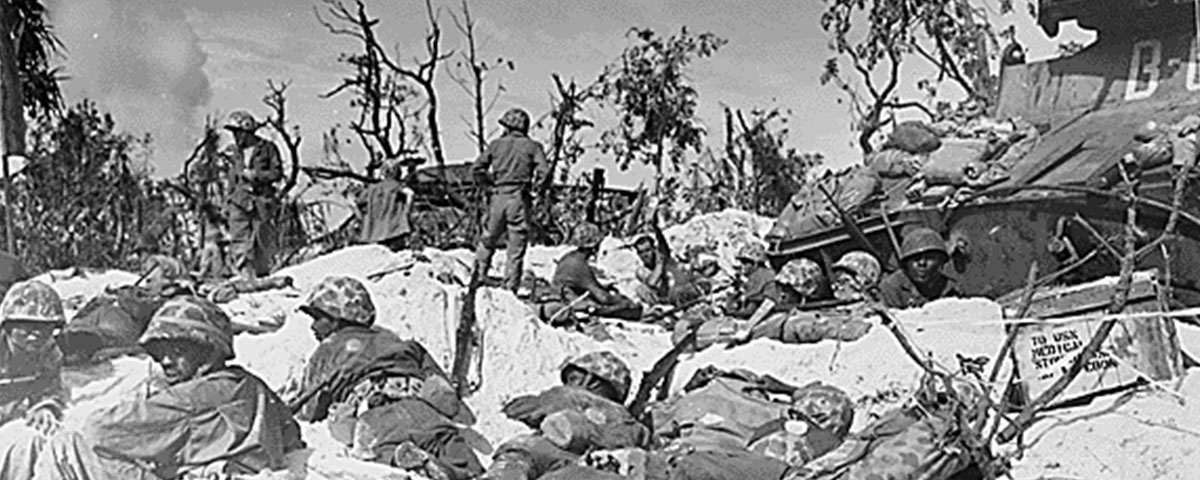
My company was to land on Orange Beach 3, which was on the far right flank of the 7th Marines sector, but somewhat to the left, or north, of a large segment of the assaulting tanks. To say that I was scared as our amtrac made its way beachward would be putting it mildly. The defending Japanese forces were unleashing a galling fire on the assaulting Marine elements–fire that seemed to increase in intensity as our amtrac ground to a halt on the edge of the beach. After vaulting over the side, with the amtrac already backing up and getting out of there, I ran up onto the beach, where I found myself among others of my company and mortar section, all of us prone on that beach and hugging its sand. The noise of the incoming fire made voice contact almost impossible. Japanese artillery and small-arms fire were dealing death wholesale upon the assaulting Marines and particularly those who chose to remain on that beach.
My fellow A/1/7 comrades and I had been instructed repeatedly in our training exercises that the beach was the last place we would want to be. The Japanese would have it “zeroed in.” After debarking from our landing craft, getting off the beach immediately was a must. Despite such instructions, in the face of the fire from our front and both flanks, we remained frozen to that beach with fear.
Never before or since have I experienced such fright. Yet neither I nor any of the people around me took any steps to avoid what was bound to happen. If we remained in that position, we would almost certainly have been killed. Actually, I do not know how long I remained there. It could not have been for more than a few minutes, but it seemed an eternity. I was terrified, and the first thing I saw that had an effect on my mind was either a detached arm or a leg that landed beside me.
As I hugged that beach, many thoughts raced through my mind. Why had I joined the Marine Corps two years earlier, at age 14, falsifying my date of birth on my enlistment papers? Why had I asked for combat duty when, after finishing boot camp and attending sea school, I had been assigned to a nice berth on a training ship tied up in the Norfolk Navy Yard?
Then, in my state of complete fear, something shook me back to reality. I heard a voice, a very loud voice. I would describe it as a booming voice, one that could be heard over all of the accompanying noises of battle, one I would never forget. I looked around me. There was nobody moving in our immediate area. I looked again, down to my right, and at a point on the beach where the fearful storm of iron and lead was raging most furiously, there was a man coming up the beach toward us. He was the only person on his feet, as far as I could see.
At that very moment, the enemy artillery, machine-gun and small-arms fire seemed to be at its height. The mortars were dropping down upon the beach all around that man. With all of the enemy fire being directed on that area, it startled me to see a man ignore it completely and unflinchingly continue to walk in our direction. At the same time, he was screaming at the troops lying huddled together on the beach.
His yell still rings in my ears today. He screamed, “Get the hell off this beach or I’ll shoot you!” He was raising hell with those of us on that beach. As he got closer, I noticed he was a major. He had on his insignia, and it surprised me that a senior officer would be there. I had never seen him before. He was armed with a Tommy gun, had a Jap shovel across one shoulder, was bloodied and mud-encrusted, and he was kicking and screaming. Just before he got to me, all I could think of was that this crazy SOB was going to kill me if I didn’t get the hell off that beach. I ignored everything else and got the hell off that beach, which undoubtedly saved my life. I learned later that just moments after my buddies and I had been moved off the beach by that major, a tremendous mortar barrage had come down right where we had been lying.
When I got up and moved, so did others of my section and company, mortarmen and riflemen–everybody started moving off that beach. It was a complete exodus, in fact. All I can say, really, is that if that major had not been clearing that beach on his own, I would have been dead right there at the age of 16.
That same night, right after midnight, my outfit came under a heavy mortar barrage. I was hit and evacuated to a ship offshore. After being treated for several days, I was interviewed by one of the Navy doctors. He indicated that I did not have to go back to the island, but if I did not do so, I might well end up in a different company. In those days, in the Marine Corps, particularly in a rifle company, it was like a family. You knew the people, and you felt safer being with them. Accordingly, I chose to go back ashore and found my outfit in the process of relieving the 1st Marines, who had been pretty badly shot up.
I finished the campaign on Peleliu with the A/1/7, and from April to June 1945, I was involved in three months of intense combat on Okinawa. Subsequently, I went into North China with the 7th Marines.
During the Korean War, I was in H Company, 3rd Battalion, 7th Marines, and commanded a rifle platoon much of the time. I was there from October 1952 to November 1953 and was promoted to gunnery sergeant. I retired from the Marine Corps in 1962 after 20 years of service but returned in 1966 during the Vietnam War, serving with the 3rd Tank Battalion in the Dong Ha area.
I have witnessed many acts of bravery and heroism on the part of Marines in combat situations. But never in all of my 221/2 years of active duty as a Marine did I observe a man with more guts than that unknown major exhibited. His heroic conduct on that beach at Peleliu stuck in my mind. It had a decided effect on me, especially after I became an NCO and was called upon to lead and train young Marines during two tours at the Marine Corps Recruit Depot, San Diego, Calif., as a drill instructor.
The major had proved to me that you do not try to win your troops over by being a nice guy. If the major had acted thus on the beach at Peleliu, if he had been there explaining the situation and pleading with us, we would have all been dead. On the other hand, he put it to us bluntly: “Get your asses off this beach or I’ll kill you. Move.” In my mind, he meant what he said, and that is how I led and trained my troops in later years. That incident immediately came to mind when I was interviewed a few years back by Bill D. Ross, who wrote Peleliu: Tragic Triumph. Ross asked me to tell him about something that stood out in my mind concerning Peleliu. I told him about the conduct of that major early on the morning of D-day on Orange Beach 3.
Upon reading Ross’ book, I found my recollections of D-day as I had told them. After the author had provided a little information about my background in the Marine Corps, he quoted me as follows: “I was in an amtrac in one of the first waves. When we hit the beach, I went over the side. It was a long jump…like falling into hell. The beach was being hit by heavy small-arms fire and mortars and artillery. There were bodies and parts of bodies all around. I was terrified.
“We had always been told to get off the beach. It was the most dangerous place to be. But many troops were still there and not moving. Out of nowhere came a major I never saw before or again. He ignored all the torrent of enemy fire, and was busy kicking and screaming at us. All I could think of was to get off the beach before that crazy SOB shot me.
“Years later, while serving as a senior drill instructor at boot camp in San Diego, I had a fellow DI who babied and talked his recruits through training. I was told this was psychology. All those years, I had thought what that major on Peleliu was using was psychology. But whatever it was, he saved our lives.”
Peleliu: Tragic Triumph was published in 1991. It brought back lots of memories of Peleliu, mostly bad, since so many great Marines died there. Among other things, however, it made me wonder what had become of that major, the most heroic Marine I had ever encountered. I often wondered whether the major had survived that terrific barrage on Orange Beach 3, as he was still walking along that beach when I last saw him, kicking and yelling at other Marines. Had he survived Peleliu? Had he survived World War II? Those questions had crossed my mind many times since September 15, 1944, but I had no way in the world to identify him, other than to remember that he was the bravest of the brave.
Of course, at the same time I was reading Bill Ross’ book on Peleliu, it was also being read by other Marines across the country and around the world. All my life, I have heard the expression that we live in a small world. Well, it is an expression that is certainly true of Marines. More so, probably, of those who served in World War II and particularly of those who were in the 1st Marine Division during that war. Another member of the 1st Marine Division Association–a well-organized and close-knit group–living in Charleston, S.C., read Peleliu: Tragic Triumph and concluded that the major to whom I had referred was his dear friend of many years, also a resident of Charleston–Lt. Col. Arthur M. Parker, Jr., U.S. Marine Corps (ret.). Those two Charlestonians met and discussed the Ross book. Colonel Parker was the major I remembered.
One thing led to another after that–first, a letter to me, then a telephone call and, finally, arrangements for a meeting in person with the man who had saved my life on September 15, 1944. The meeting took place in LaFayette, Ga., more than 48 years after the assault on Peleliu.
While, naturally, the major’s physical appearance had changed considerably, he still had that same booming voice, and I picked up on it immediately. It is hard for me to describe the meeting, except to say that it was probably the most emotional event of my life. After hearing what my newfound friend had to say about D-day at Peleliu, I can now recount his story of that day. Shortly after our first meeting, Colonel Parker remembered the events as follows: “I was real glad to see the LST [landing ship, tank] doors open, to get out in the air in the ocean, about 4,000 yards from the beach, at the line of departure. The 3rd Armored Amphibian Battalion, 75 amphibian tanks abreast, moved into position for the assault on Peleliu Island. Heavy bombardment was underway from ships, planes and whatever to clear the beach, including some LCI [landing craft, infantry] rocket ships, which were pouring rockets on the beach. When they pulled out, we went straight in.
“About 500 yards from the beach, my command tank became incapacitated, running onto a coral head–stopped dead in the water, shells flying all around–and Lieutenant Bristol, the CO of D Company and the finest officer I had, pulled out of the line against my direct orders that no one would come to the help of another if any tank became incapacitated on the way in. Yet Lieutenant Bristol couldn’t stand to see my command tank stopped. He pulled up alongside, came out of his turret and I came out of mine. We connected the tow cable from my tank to his tank, and he had just cleared us when a shell separated the cable by three feet in front of my tank.
“Once cleared, we went on to the beach. We were under heavy fire all the way. We were hit twice, set afire, and we lost one man. My tank was out of action by then–so many of the tanks were shot up and incapacitated–and I was trying to get things back together on the beach, and this is when I ran into the infantry.
“There was a whole conglomeration of troops just in one place–a dead target for the Japanese artillery and mortars–and although I had nothing to do with these infantrymen, other than to help them, they had to be gotten off of that beach or they would all be killed. They seemed to be paralyzed with fear. They wouldn’t move, so I screamed at them. I used all kinds of profanity. I had a Tommy gun slung on my arm and a Jap shovel over my shoulder and mud and blood all over me. I must have been a horrible sight to behold. These young Marines, when I started screaming at them, they started to move….But, really, to think, after all of these years that I would be remembered for this incident makes my whole life worthwhile.”
Parker went on to describe Orange Beach 3 in detail: “We had every conceivable kind of fire coming in. We had mortars coming in; we had anti-tank fire coming in; we had artillery coming in; we had machine guns, and it was about the worst place you could be. There were bodies and parts of bodies all around, and these infantry troops, those who had never seen combat or had never experienced such a barrage of fire, were just mesmerized, that’s all, and I don’t blame them. Insofar as being identified as a major in Bill Ross’ book, I had my gold leaves on my collar where they belong. That’s how he knew I was a major. I never turned my leaves under. When I was CO of B/1/7 on Guadalcanal, my two bars were right out in the open. As to time frame, you are only looking at a few minutes. Maybe five. After I had run the people off of the beach, I went on with what I was doing, and then a tremendous mortar barrage came right down where they had just left.”
Regarding my recollection that he had been the only person on his feet on that beach, Colonel Parker responded: “Well, that may or may not be entirely correct, but as far as I know, most everybody was hugging that sand. And the only reason I was on the beach was the fact my tank was shot out from under me. Otherwise, I would have been knocking out pillboxes or whatever we were supposed to do. The only reason I was walking was because my tank was burning and I had to leave it. But let me add that it has been a great pleasure, after all of these years, to meet a 16-year-old Marine as of September 15, 1944, and to be remembered, more than 48 years later, for doing a proper job.”
When I first met Colonel Parker in October 1992, I was shocked to learn that he had received no official recognition for his actions on September 15, 1944. As I told Bill Ross a few years back, what the major had accomplished on that beach was something that would be with me all of my days. It was my first time in combat, and I had been witness to the actions of a Marine Corps officer who had more guts than I ever saw exhibited again afterward. For a man to have done what he did, I think a Navy Cross would have been appropriate. While Colonel Parker is very modest and not inclined to take credit for personal bravery, I do have the satisfaction of this very brave Marine officer’s having written on the inside cover of my copy of Peleliu: Tragic Triumph the following: “To Charles H. Owen, the 16 year old private who was afraid the crazy sonofabitch might shoot me. Page 157. The unknown major, Arthur M. Parker, Jr.”
Lieutenant Colonel Arthur Middleton Parker–a descendent of Arthur Middleton, who, as a member of Congress, signed the Declaration of Independence on August 2, 1776–lost his last battle, a long, lingering fight against lung cancer, on October 27, 1995.
Marine Corps veteran Charles H. Owen resides in LaFayette, Ga. For further reading, try: Peleliu: Tragic Triumph, by Bill D. Ross; and The Devil’s Anvil: The Assault on Peleliu, by James H. Hallas.