
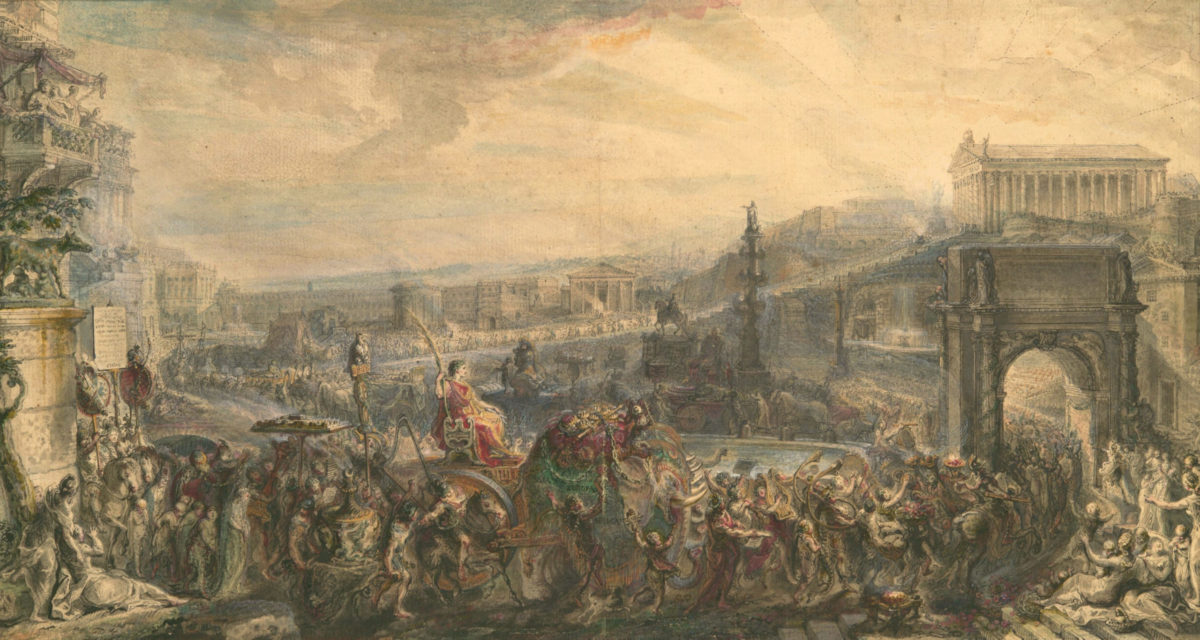
On the morning of August 9, 48 BC, Rome’s most famous general—Gnaeus Pompeius Magnus, or Pompey the Great—apprehensively prepared his troops to face the army of Rome’s most successful general, Gaius Julius Caesar. Pompey’s unease was fueled by a meteor that had shot across the sky near his camp the night before. To some of his soldiers it was an ill omen. After quelling the disturbance caused by the meteor, Pompey retired to his tent. There he dreamed of being applauded by Rome’s citizens as he dedicated a temple to the goddess Venus, Bringer of Victory. The dream must have made the great commander nervous. Venus was the goddess from whom Caesar’s aristocratic clan, the Julians, claimed to be descended. Though unknown to Pompey at the time, Caesar had vowed that very day that if Venus brought him victory at Pharsalus he would build a great temple to her in Rome.
Prelude to Battle
Almost two years before the two rivals met at Pharsalus, the Roman Republic, split by a half century of political unrest, had drifted into civil war. Pompey led the patrician faction, the optimates (best ones), composed of Rome’s aristocrats and senators. Caesar led the populist faction, the populares (favoring the people), nobles supported by Rome’s farmers, veterans and middle class. The roads that led these two great generals—relatives by marriage and former allies—to duel under the Greek sun are a testament to the turbulent politics of the republic’s last century.
Pompey began his career as a handsome, energetic young officer serving in the patrician armies of the Roman dictator Lucius Cornelius Sulla. Pompey’s campaigns against the populares in Sicily, Spain and North Africa, and in Italy against Spartacus’ fugitive gladiators in 71 BC, earned him the title “Magnus,” or Great, from his troops. The ambitious young general twice wrested from his government a triumph, Rome’s highest military honor—and one to which he was not technically entitled. In late 71 BC, Pompey and his rival Marcus Licinius Crassus were elected consuls, Rome’s two highest offices for the year 70. Pompey was virtually made a dictator in 67 when the People’s Assembly, Rome’s theoretical governing body, elected him to combat the widespread problem of piracy in the Mediterranean Sea. Although Pompey’s term was scheduled to last an unprecedented three years, through his extraordinary administrative skill and a brilliant concentration of Rome’s forces, he successfully completed his assignment in only three months.
In 66 BC, Pompey was appointed to another extraordinary command, this time against King Mithridates IV, ruler of the eastern kingdom of Pontus. Although outnumbered, Pompey defeated Mithridates at the Euphrates River and pursued him to the shores of the Black Sea. Pompey then marched throughout the East, founding cities and extending Rome’s power throughout Albania, the Red Sea region, Palestine, Syria, Armenia, Mesopotamia and Arabia.
When he returned to Rome in 62, Pompey was hailed by the citizenry as the greatest commander of his age. Unlike Sulla or the populist tyrant Gaius Marius, however, Pompey disbanded his troops upon his return and peacefully resumed a political career. Pompey’s political skill lagged far behind his military prowess, however, and he was unable to win large bonuses or farmlands for his veterans. To his humiliation, he could not even persuade the Senate to ratify the treaties he made with the eastern kingdoms until 59.
While Pompey was being lauded for his military accomplishments, a stylish rival was beginning a career that would eclipse that of his more famous contemporary. Gaius Julius Caesar, a former priest from the Julii clan, threw in his lot with the populares faction by marrying the daughter of one of Sulla’s enemies. He married into the families of Pompey and Sulla after the death of his first wife and supported Pompey in the Senate, but he also publicly championed liberal causes to garner support among the populists.
In 62 BC, Caesar was elected as one of eight praetors (military or civilian commander), Rome’s second-highest office, and subsequently assumed the governorship of the province of Farther Spain for two years. During the next year, Caesar sharpened his military skills fighting Spanish tribes and pirates, using the taxes and the loot his men collected to repay his massive debts back home.
On the strength of his victories in Spain, Caesar was elected to one of Rome’s two consul seats for the year 59 BC. As consul, Caesar bribed officials and used armed gangs to stifle his conservative opponents as he passed legislation that set aside public farmlands in Campania for Pompey’s veterans and Rome’s resettled poor. Caesar also passed economic reform legislation and ratified Pompey’s eastern treaties.
Around this time Caesar entered into a pact with Pompey and the wealthy Crassus. Under their agreement, the triumvirs pledged to support each other’s political agendas. The bargain, sealed with Pompey’s marriage to Caesar’s daughter Julia, contained one critical provision for Caesar’s postconsular governorship: As consul, Caesar was immune from prosecution by his political enemies for illegalities committed during his tenure.
After Caesar’s term expired, however, he needed a post as governor of a wealthy province to extend his immunity and extort the wealth necessary to bribe key officials when he returned. Caesar therefore was given Illyricum (western Balkans) and Cisalpine Gaul (present-day northern Italy) to govern for the extraordinary term of five years. Three legions, totaling some 18,000 men, were also allocated to Caesar. Additionally, when the governor of Transalpine Gaul (Mediterranean France) died unexpectedly, Pompey sponsored legislation that gave Caesar that province as well, plus a fourth legion.
Caesar’s appointments launched nearly 10 years of war against Rome’s northern neighbors. With his chief lieutenant, Titus Labienus, Caesar campaigned against the Helvetii from Switzerland and coalitions of Gallic, Belgic and Germanic tribes in France and the Rhineland. From 55 to 52 BC, with his term as governor extended, Caesar continued his conquest of Gaul, fighting the seagoing Venetii of present-day Brittany, invading Britain twice and subduing a host of tribes led by the great Gallic chieftain Vercingetorix. Throughout his campaigns, Caesar’s Commentaries on the Gallic Wars kept his name in front of the Roman public. In 52 BC, Caesar prepared to resume his political career in Rome, only to find Rome’s political landscape very different from the one he had left. While Caesar was fighting in Gaul, Pompey served as both consul of Rome and governor of Spain. Although he enacted many liberal reforms, Pompey gradually drifted into the patrician camp. The death of his wife Julia severed his family ties to Caesar (who had previously divorced Pompey’s cousin Pompeia), and his relations with Crassus, now governor of Syria, began to sour. As Roman politics gradually devolved into mob rule, Pompey was elected sole consul—virtual dictator—in 52 BC, and began supporting the patricians’ agenda.
Caesar, noting the fate of other returning governors who made enemies during their tenure in Italy, believed that the patricians would try to trick him into giving up his provinces—and his armies—before he could win a consulate election. If so, he would be left vulnerable to civil and criminal prosecution for official acts of corruption. Furthermore, with no military leverage against the Senate, he would be unlikely to win for his veterans the bonuses and farmlands they expected. He therefore refused to set a fixed date for relinquishing his command, setting the stage for a political confrontation with the Senate.
In 50 BC, the intrigue was complicated further when the Parthians of what is now Iran threatened Rome’s eastern province of Syria. The Senate decreed that Caesar and Pompey must each contribute one legion to Syria’s defense; Pompey’s contribution, however, would come from the one legion he had lent Caesar some years earlier during the Gallic Wars. Faced with this mandate, Caesar had no choice but to send two of his veteran legions, Legiones VI and XV, to Italy, while Pompey’s army was left intact. Ultimately, Pompey did not send the two legions to Syria, but instead held them in Capua as a brace against the coming confrontation.
The patricians became more confident than ever, pressing Pompey for his support in case Caesar tried to repeat Sulla’s takeover. Pompey confidently assured the Senate: “Wherever I stamp my foot in Italy, there will spring up enough troops in an instant—both cavalry and infantry.” Gaius Claudius Marcellus, an ultraconservative consul, spread a false rumor that Caesar was marching on Rome and ordered Pompey to take Legiones VI and XV north. Pompey’s response to this unconstitutional order was evasive. He promised to fight Caesar “unless we can do better.” Caesar in turn recalled his Legiones VIII and XII from their winter quarters, and on the last day of 50 BC, he sent his tribune, Gaius Curio, to Rome with an ultimatum: Either Pompey and Caesar would lay down their arms at the same time, or Caesar would use his armies “to avenge the wrongs done to him.”
But the Senate was now too emboldened to be cowed by such a threat from Caesar. Convinced Caesar’s goal was the overthrow of the republic, Pompey marched from Capua with Caesar’s two veteran legions, plus a third newly recruited legion. He camped them near Rome. The Senate repealed Pompey’s earlier law allowing Caesar to run for consul without giving up his command. It appointed Lucius Domitius Ahenobarbus to replace Caesar in Gaul. When Caesar’s tribunes Mark Antony (Marcus Antonius) and Quintus Cassius vetoed these and other patrician measures, the patricians forcibly expelled them from the Senate chambers and passed the Senatus Consultum Ultimum, or Ultimate Decree, empowering Rome’s officials to take whatever steps necessary to protect the republic. The Senate divided Italy into recruiting districts, placing each under a patrician who was to call for recruits in the names of the Senate and Pompey the Great.
this article first appeared in Military History magazine


Caesar Casts the Die
In January of 49, Caesar could immediately deploy his Legio XIII from Cisalpine Gaul (roughly 5,000 men), while Legiones VIII and XII were marching to reinforce him. Wary of Pompey’s seven veteran legions in Spain, Caesar sent three legions to the Pyrenees mountains to block any patrician countermoves from the west.
Caesar knew that his army was outnumbered and strategically surrounded. Its ranking general, Labienus, who felt cheated by his secondary role in the Gallic battles, was ready to defect to the patricians. Although the populace generally favored Caesar’s policies, they would not rise to support him while the result was in doubt, and Caesar’s grain supply from Gaul could not be guaranteed during a long Italian campaign. Of equal importance, Caesar recognized the political constraints on his military options in this civil war. The heavy-handed tactics he employed in Gaul would backfire in Italy by antagonizing the public, by whom he needed to be seen as the aggrieved party.
Pompey, in contrast, held three legions in Italy as well as his main army in Spain. He would have access to thousands of recruits from African and Asian provinces, whose rulers owed their careers to him. Most important, however, Pompey controlled Rome’s fleet of 500 warships and light galleys, enabling him to transfer forces from one theater to another as events dictated. Pompey believed that Caesar would have to concentrate his scattered troops in Gaul before he could move south toward Rome. By that time, Pompey would have recruited and trained additional forces and brought his veterans home from Spain.
But Caesar was not about to let that happen. On January 10, 49 BC, Caesar led 5,000 men to the Rubicon River, which marked the border of Gaul and Italy; crossing it meant war. Caesar lingered briefly, considering the implications of his actions, then made his famous remark, “Alea iacta est” (The die is cast), and led his troops over into Italy.
Ariminum fell first without a struggle. Caesar began moving south, capturing three more towns, while Mark Antony, leading five cohorts, captured Arretium on the Via Cassia, opening a second route south to Rome. Other northern Italian towns fell to the populares, who soon fielded some 20,000 hardened veterans. Throughout his Italian campaign, Caesar took pains to ensure that his troops left the townspeople and their property unharmed. He wanted no reports of atrocities jeopardizing his popular support.
Pompey, meanwhile, planned a defensive war, raising troops to hold central Italy while using Rome’s fleet to bring his Spanish army home. Contrary to his boast in the Senate, few troops sprang up at the stamp of Pompey’s foot. He even had scant response from his own veterans in Campania, many of whom owed their farms and livelihoods to Caesar’s land-reform laws. When Pompey confessed to the Senate that he could field, at most, 30,000 men in Italy—all of them raw recruits except for Caesar’s two legions, which were politically unreliable—the patricians began to panic.
Severing Pompey’s Spanish Forces
On January 17, Pompey ordered all senators to evacuate Rome or be officially deemed Caesar’s allies. He then moved Rome’s government to Brundisium on the Adriatic coast. By mid-March he had sailed from Brundisium to Dyrrachium in western Macedonia, leaving Italy—and Caesar—surrounded by his armies in Spain, Africa and Greece. Caesar moved through the peninsula with little opposition, pardoning his opponents after capturing them. Unopposed in Rome, he helped himself to the state treasury and raised additional troops, sending units to Sicily and Sardinia to secure Italy’s grain supply.
With Pompey temporarily out of reach, Caesar had two options: he could engage Pompey’s main army in Spain, or he could sail after Pompey and fight him in Greece before he could recruit troops from the east. Like Napoleon nearly 1,900 years later, Caesar chose to seek out and destroy his opponent’s main army. Leaving a detachment in Brundisium (now Brindisi), he took six legions to Spain. “I am going to fight an army without a leader,” Caesar explained, “so that I can later fight a leader without an army.”
In early 49, Pompey’s Spanish army was divided, with five legions (roughly 30,000 men) and another 5,000 cavalry stationed in the north, and two legions in southern Spain. Despite their local superiority, Pompey’s northern force commanders made no efforts to block the Pyrenees when Caesar’s advance guard approached. Instead, they took up strong positions at Ilerda, and were soon besieged by Caesar’s entire army, supported by 7,000 cavalry.
In late July, the Pompeians attempted a surprise evacuation to positions south of the Ebro River. By forced march, Caesar’s troops overtook the retreating army, and dug entrenchments in front of and behind the Pompeians. Cut off from water sources and besieged in open terrain, Pompey’s commanders capitulated on August 2. Caesar took no reprisals and forced no one to take an oath of allegiance to him. He then sent two legions under Gaius Cassius Longinus to deal with Pompey’s forces in southern Spain, which also surrendered without a fight. Having neutralized any immediate threats from Spain, Africa or Italy, Caesar’s next objective was to engage Pompey in Greece, before he could train his raw recruits.
Caesar was right to be concerned. While he was in Spain, his rival had gathered troops from Asia, Pontus, Judea, Syria, Arabia, Palestine and Egypt—all places where the name of Pompey the Great was still respected. Pompey assembled his troops into nine legions, and could count on two additional legions from Syria, led by Metellus Scipio. Pompey’s total strength was roughly 36,000 infantry, with as many as 7,000 cavalry and another 4,200 archers and slingers. With his grain supplies from Egypt and Thessaly secure, Pompey assembled a fleet of 300 ships under the command of Caesar’s former co-consul and longtime enemy Calpurnius Bibulus.
By December 49, Caesar’s main problem was a lack of transportation. He had previously lost some 40 ships to Bibulus’ fleet, and had only enough transports to take half his army to Greece. Furthermore, the winter storms were beginning to blow through the Adriatic Sea, making any crossing difficult and dangerous. On the other hand, the storms kept many of Bibulus’ ships in port. Remarking that “the most potent thing in war is the unexpected,” Caesar embarked seven understrength legions (about 15,000 men) with some 500 cavalry and supplies and sailed for Greece on January 4, 48 BC. His gamble was rewarded as he safely landed his troops near Apollonia. On the transports’ return trip, however, an alerted Bibulus swept down, destroying 30 ships and cutting Caesar off from the other half of his army.
Pompey, learning of Caesar’s troop strength and dispositions, determined Caesar’s intentions and raced his army west to his supply base at Dyrrachium. As Caesar moved up the Greek coast, he captured Apollonia and Oricum, but Pompey arrived at Dyrrachium a few hours ahead of Caesar and threw up fortifications that held back the populists and created a standoff.
The Beasts Before Pompey
In the first few months of 48, neither commander wished to give battle. Half of Caesar’s army was still in Italy, while Pompey awaited the arrival of Scipio’s two legions from Asia Minor. In the late spring, however, Caesar’s luck seemed to be turning. Four legions and some 800 cavalry under Mark Antony made a very lucky crossing from Italy, destroying several patrician ships in the process. Pompey quickly maneuvered to prevent Antony from joining Caesar’s army, but Caesar learned of the patricians’ movements and moved in behind Pompey. Wisely avoiding a two-front battle, Pompey withdrew north to Aspargium, allowing the two populist armies to unite. Caesar sent his Legiones XI and XII east to pin down Scipio’s army, and sent Legio XVII southeast to forage and subdue the Greek region of Thessaly. Then Caesar’s fortunes again turned sour. Pompey’s son Gnaeus sailed into the Adriatic with a fleet of Egyptian ships and methodically destroyed or captured Caesar’s entire fleet.
At that point, Caesar had about 34,000 infantry and some 1,300 cavalry in the vicinity of Dyrrachium; Pompey’s army outnumbered Caesar’s by about 8,000 men. Caesar managed to outmaneuver Pompey and set himself between Pompey and his base at Dyrrachium, but with no supply ships and Pompey’s superior cavalry preventing any effective foraging, Caesar’s troops were quickly reduced to digging up roots and baking them into a kind of tough bread. When patrician officers took loaves of this bread to Pompey as a sign that the populist troops were on the verge of collapse, Pompey—aware of their devotion to their commander—apprehensively remarked, “What kind of wild beasts we are fighting!”
Dyrrachium was too heavily defended for Caesar to storm until Pompey’s army had been dealt with. So Caesar took the audacious step of surrounding Pompey’s larger army and throwing up siege works, sealing the patricians in on three sides with their backs to the Bay of Dyrrachium. His objectives were to prevent Pompey’s cavalry from interfering with his foraging efforts, to isolate Pompey from his food supplies and to reduce Pompey’s stature in the eyes of his troops. In response, Pompey threw up his own fortifications. Pompey’s food supplies began to run low, but he considered evacuation out of the question, both politically and militarily—Greece was now the only theater where he outnumbered Caesar. Both commanders knew that the decisive effort had to take place there.
On July 9, Caesar vainly tried to take Dyrrachium at the north end of his lines. But while he was involved there, Pompey sent 60 cohorts plus light infantry and archers in a two-pronged attack on the southern end of Caesar’s fortifications. Caesar’s Legio IX was driven back until Antony quickly arrived with 12 cohorts and stabilized the front. Caesar returned and counterattacked with an additional 13 cohorts, retaking much of his original siege works. That ended Pompey’s offensive, but he now held an outlet to the grasslands south of the contender’s camps, and was no longer surrounded. Caesar once more sought to surround Pompey, but the 33 cohorts he sent against Pompey’s southern wing were quickly flanked by five patrician legions from the south and several cavalry units from the north. For once, Caesar was unable to control his men, who panicked and fled the field. By the time the fighting stopped, he had lost nearly 1,000 troops and 32 unit standards. At that critical point, however, Pompey merely contented himself with pursuing a handful of fugitives. When he realized that Pompey would not press his advantage against his routed flank, a relieved Caesar remarked to his officers, “The enemy would have won the war today, if they had a commander who knew how to use a victory.”
In the wake of this defeat, Caesar realized it was a mistake to besiege superior forces so close to their supply base, and withdrew to Apollonia. Pompey followed in belated pursuit. Ashamed of their failure at Dyrrachium, Caesar’s troops wanted a chance to recapture their lost standards, and his staff advised him to bring Pompey to battle. Caesar knew his troops needed more time to recover, however, and more important, Pompey’s troops needed time to lose their newfound confidence. He therefore ordered a night move into Thessaly in central Greece, where food was more plentiful and he could rendezvous with his Legiones XI and XII.
When Generals Cease to Be Generals
So far, Pompey’s strategy of avoiding a pitched battle seemed to be working. When news spread of his victory at Dyrrachium, eastern princes began sending well-equipped reinforcements to Pompey’s camp. Confidence among Pompey’s officers reached the point of hubris, and they scorned advice from Quitus Tullius Cicero and others to avoid further battle.
While Pompey and other officers believed in starving Caesar’s troops into submission, other patricians accused Pompey of needlessly prolonging the war to remain commander in chief, and insisted that he march to relieve Scipio, who was potentially threatened by Caesar’s move east.
Pompey held a council of war to discuss his options. He could use his navy to bottle up Caesar in Greece while recapturing Italy and Spain; he could lay siege to Caesar’s coastal cities, further isolating him; or he could force a decision on the plains of Thessaly. Succumbing to pressure from his self-serving retinue of senators, knights and politicians, Pompey reluctantly agreed to the third option. Referring to Pompey’s capitulation to his subordinates, Cicero later wrote, ‘From then on, this great man ceased to be a general.’
Marching eastward, Caesar’s troops rejoined Legiones XI and XII under Domitius Calvinus, who were moving south from Macedonia. During the march, the Greek town of Gomphi closed its gates to Caesar’s army after hearing of his defeat at Dyrrachium, only to be stormed and looted by his starving men.
This example was more than enough to convince other Thessalian towns to cooperate, and Caesar was soon able to resupply his troops. Caesar moved on, later writing, “Caesar, finding a suitable place in the countryside, where the crops were almost ripe, decided to wait there for Pompey’s arrival and make that the sole theater of operations.”
The “suitable place” was the north bank of the Enipeus River in Thessaly, near the towns of Pharsalus (modern-day Fersala) and Old Pharsalus. There, Caesar commanded nearly 30,000 infantry and some 1,000 Gallic and German cavalry, plus 2,000 light infantry and auxiliaries.
Pompey marched 20 miles into the Enipeus Valley and camped his legions on the slopes of a hill called Mount Dogantzes about 3 1/2 miles from Caesar’s camp. With Scipio’s reinforcements, he commanded 40,000 infantry and more than 3,000 cavalry and supporting troops. Pompey’s colorful army represented a cross-section of the Mediterranean world, with Italians, Bythinians, Phoenecians, Jews, Arabs, Cypriots, Cretans, Syrians, Egyptians, Thracians, Ionians and other contingents. Most important, his cavalry was superior to Caesar’s in both numbers and quality.
For several days, both armies arrayed for battle each morning, but did little except skirmish with the cavalry units. Pompey kept his forces lined up on the slopes of Mount Dogantzes, hoping that Caesar would be foolish enough to advance uphill. Even Caesar would not tempt fate that much. By August 8, however, he was ready to move his troops east to find a better food supply.
The Stalemate Breaks
Nonetheless, Pompey’s promise to fight had been real, even if reluctant. He informed his officers that he intended to anchor his right flank on the Enipeus River and station virtually all his cavalry forces on the far left. From there, they would rout Caesar’s inferior cavalry and then move against his right flank and rear. By the time the infantry lines clashed, Caesar’s men would be in disarray, perhaps even fleeing. To give full effect to his strategy, Pompey also ordered his infantry to stand firm to receive Caesar’s infantry charge, rather than advance to meet the enemy, so that Caesar’s men would make first contact while breathless and disordered.
Pompey’s officers, buoyed by their victory at Dyrrachium, were certain that complete victory was near. Labienus assured the patricians: “Do not suppose that this is the army that conquered Gaul and Germany. I was there for all those battles, and I don’t speak rashly on matters of which I am ignorant. A very small part of that army survives. Most of it has perished–the autumn epidemics killed many in Italy, and others have deserted or been left behind.” Senators and knights swore oaths that they would not leave the field except as victors, draped their tents with laurel wreaths and ordered their slaves to prepare victory banquets for when they returned.
As his men struck their tents on the morning of August 9, Caesar saw Pompey’s troops lining up farther down the hillside, so that neither side would have a significant terrain advantage. Surmising that Pompey had been pressured into fighting, Caesar canceled the withdrawal and hung his purple tunic from his tent, the sign of imminent battle.
When his troops were lined up, Caesar recounted to them how he and his men had spent 10 hard years together subduing 400 tribes in Gaul, Germany and Britain, while their enemies tried to disband them without a triumph or reward. He assured them that “Pompey’s star has already passed its zenith,” and exhorted them: “Remember what you promised me at Dyrrachium. Remember how you swore to each other in my presence that you would never leave the field except as conquerors.”
Pompey’s troops were already arrayed with their right flank anchored on a deep ravine near the Enipeus River. Cornelius Lentulus commanded Pompey’s right wing with his auxiliaries, a Spanish legion, and troops from Asia and Cilicia. Scipio commanded the center with his two Syrian legions and additional troops from Africa. Domitius Ahenobarbus—Caesar’s appointed replacement in Gaul—commanded the left wing with Pompey’s Italian legions. On his extreme left, Pompey stationed virtually all his cavalry with supporting archers and slingers under Labienus, and took his command post behind Domitius on the left wing.
The infantry was deployed in traditional Roman fashion of three lines, each 10 men deep, with seven cohorts of Thracian troops left behind to guard the camp. Pompey’s speech to his men concluded: “You have on your side all this strength, all these resources, and the consciousness of the cause. For we fight for freedom and for country, backed by the constitution, our glorious reputation, and so many men of senatorial and equestrian rank, against one man who would pirate supreme power.”
Leaving 2,000 of his oldest troops to guard the baggage, Caesar deployed his auxiliaries on the far left against the Enipeus River, some 300 yards from Pompey’s lines. The auxiliaries, along with the understrength Legiones VIII and IX, were commanded on the left by Mark Antony. Domitius Calvinus, commander of Legiones XI and XII, held the center, while Publius Sulla commanded Caesar’s right wing. Caesar’s prized Legio X was stationed on the far right of the infantry lines, and at the extreme right Caesar stationed his Gallic and German cavalry. Because his smaller army was stretched to avoid being outflanked by Pompey’s lines, Caesar’s lines were only about half as deep as Pompey’s. Caesar ordered his third, most experienced echelon not to engage the enemy until commanded, in effect holding it as a tactical reserve.
Caesar realized that Pompey intended to launch a heavy cavalry attack on his right and roll up his lines from the right and rear. Therefore he stripped six full cohorts—some 3,000 men—from his third rank and placed them at an angle behind his cavalry to counter the threat.
With trumpet blasts from both sides, Caesar’s men started to charge the 300 yards to the enemy lines. When Caesar saw Pompey’s men holding steady, he ordered his troops to halt halfway to catch their breath and re-form their lines. They charged the rest of the distance, hurling their pila (javelins) at Pompey’s lines and drawing their swords for hand-to-hand combat. At about the same time, Labienus’ massed cavalry charged. On Caesar’s orders, his cavalry fell back, drawing the enemy riders and their supporting troops deeper into the populist lines. The Pompeian cavalry soon found themselves flanked and under ferocious attack by 3,000 of Caesar’s veteran infantry, who used their javelins as stabbing weapons. At that moment, Caesar’s cavalry and supporting light infantry wheeled around and charged the embattled patrician cavalry, driving them from the field in disorder, and exposing their archers and slingers to massacre by Caesar’s heavy infantry and cavalry. Caesar’s combined arms group then wheeled left to flank Pompey’s left wing.
The battle was by no means over, however. Caesar’s two understrength lines were straining against the weight of Lentulus’ and Scipio’s troops on their left and center. To their credit, these two half-strength lines bore the full brunt of the battle until Caesar’s cavalry and infantry detachment moved from a defensive posture into an offensive and then flanking stance. But Pompey’s left was becoming rapidly enveloped by Caesar’s combined arms group. Pompey presumably gave the order to move some of his third echelon into a right angle on the left, but it proved too late and ineffective to prevent his left flank from being rolled. Caesar then ordered his reserve line into action. By midday, Pompey’s line began to give way.
Once a commander’s men begin to flee, there is little left for him to do. Dazed and lethargic, Pompey shuffled laconically to his tent. When the camp’s ramparts fell, he fled on horseback for Larissa on the Greek coast, leaving his Thracian troops to make a brief stand before his camp was overrun.
Although his men had fought to near exhaustion, Caesar was not about to reprise Pompey’s failure to follow up his tactical victory at Dyrrachium. He exhorted his troops to win the war, not just the battle. He caught up with Pompey’s four remaining legions on a nearby hill, and though it was nearly nightfall, he ordered his soldiers to throw up fortifications that cut off the Pompeians from their water supply. In the midsummer heat, that last effort proved decisive. The next day Pompey’s remaining legions surrendered. Caesar immediately extended clemency to his opponents and pardoned a large number of prominent patricians, including Marcus Junius Brutus, who later would conspire against his conqueror.
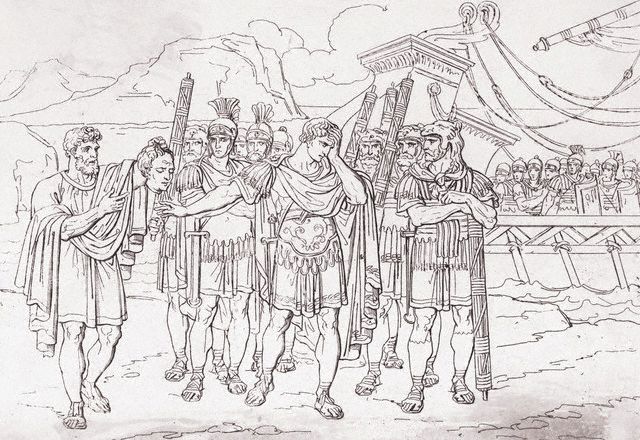
By Caesar’s account, Pompey’s losses were 15,000 killed and 24,000 captured. Ten senators, including Domitius Ahenobarbus, were among the patrician dead. Caesar’s general Asinius Pollio estimated enemy dead at 6,000. Caesar estimated his own losses at 200 troops, although that number seems improbably low. Whatever the actual number, the patricians’ backs were broken at Pharsalus. Caesar had captured nine legionary eagles and 180 unit standards and had decisively overcome the most serious threat to his supremacy. After his defeat at Pharsalus, Pompey sailed from Greece to Egypt, hoping that Egypt’s King Ptolemy XII would give him refuge and a chance to organize resistance in North Africa. Ptolemy and his ministers understood, however, that it was unwise to extend hospitality to a defeated general, and Pompey was lured ashore at Alexandria and treacherously murdered. When the pursuing Caesar was presented with his rival’s embalmed head a few days later, he recoiled in horror and burst into tears.
The surviving patricians made several attempts to rally their forces in Africa under Scipio and in Spain under Labienus, but each time they were defeated. With no effective opposition, Caesar returned to Rome under a new political order. True to his vow before Pharsalus, he erected a temple to Venus Genetrix in the heart of Rome’s Forum, the ruins of which can be seen to this day. He was appointed consul and dictator by the reconstituted Senate, and in early 44 the Senate appointed Caesar dictator for life—a brief tenure that would end violently at the hands of men whose lives he had spared at Pharsalus.