On June 21, 2004, the crowd at Mojave, California, cheered as an ebullient Mike Melvill wriggled out of the little winged capsule in which he had just made a brief, violent trip to the fringes of outer space. Burt Rutan, the guiding genius of the project, later stood before a blaze of press cameras and compared the emotion of Melvill’s return to what they both had felt long ago when, searching in darkness over the Pacific, they had glimpsed the lights of another of Rutan’s creations, Voyager, with Burt’s brother Dick at the controls and barely a sip of fuel left in its tanks, as it returned home from its nine-day nonstop circumnavigation of the globe.
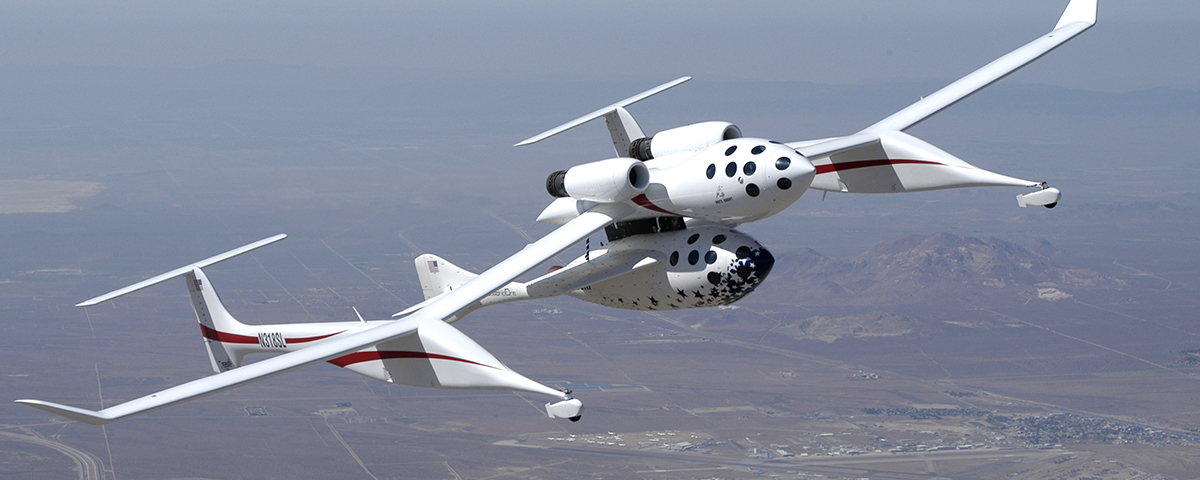
Three decades earlier, this same Burt Rutan had been a lone entrepreneur selling plans from which hobbyists could build tiny foam-and-fiberglass airplanes in their garages. Today, by the force of his ambition, a messianic personality and the brilliant originality of his engineering, he had cast himself as an upstart rival to NASA. His tiny hotrod SpaceShipOne, consisting essentially of an airtight cabin glued—literally—to the front end of a homemade rocket motor, had gone to space. And this had been accomplished for a piddling $25 million or so, less than the price of one or two of sponsor Paul Allen’s private jets.
Under the distorting stream of hype, which flowed as freely as champagne, the outlines of what had actually been accomplished were briefly indistinct. But this was unquestionably the first private manned space flight, if you accepted—as the FAA did when it ceremonially pinned its first civil astronaut’s wings on Melvill—that a few seconds spent coasting above 100 kilometers belongs in the realm of “space flight.” Rutan’s populist hostility to the slowness, the myopia and the timid and self-serving bureaucracies of “big government” was on display, and fed the zeal of his admirers. He fanned the flames with funny stories of the absurd obstacles with which the FAA’s new office of commercial space transportation littered his way, including the demand that he ensure that no desert tortoise would be harmed by SpaceShipOne’s flight. Presumably, none was.
Likening the day’s events to Wilbur Wright’s 1908 demonstrations of his Flyer in France, Rutan looked ahead to a future—not far off, he implied, now that the energies of private enterprise had finally been uncorked—when ordinary people would spend their vacation nest eggs on hops outside the atmosphere, and ride “transfer vans” to unwind in orbiting hotels.
Burt Rutan was born in 1943 near Portland, Ore., but he grew up in Dinuba, a farm town in California’s San Joaquin Valley. His real name is Elbert. He used to take some pleasure in noting that E. Rutan is Nature spelled backwards, but the dorkiness of Elbert bothered him, and by persistent misspelling he has become Burt (as in Reynolds)—not Bert (as with Ernie). His father George, a dentist who had been a schoolmate of Richard Nixon’s in Whittier, and mother Irene, who died a few years ago at 84, had two boys and a girl. Burt was the youngest. His sister Nell was an American Airlines flight attendant. His brother Dick, a Vietnam-era F-100 pilot and part-time adventurer who once ran for Congress (he lost to a professional politician), has been sufficiently newsworthy for people occasionally to confuse him with Burt. Dick, who most likely considers global warming a liberal hoax, once made the papers when an airplane in which he was traveling landed at the North Pole, broke through unexpectedly thin ice and sank.
As a kid, Burt was entranced by airplanes. He built models, competed in contests, regularly won. He married at 19, had two children, and at 20 started building his first full-size aircraft in his garage. He found the airplane project more absorbing than his family—a not uncommon hazard of aircraft homebuilding—and his marriage ended after eight years. He used to say that when it came to choosing between his wife and the plane, “There was no doubt in my mind which I wanted to keep.” But one forgets; he married again two years later.
Burt Rutan is a solitary enfant terrible in a field—aerospace engineering—where sober, mature, methodical plodders and committee decisions are the rule. Designers of airplanes and spacecraft seldom make the papers; to ordinary mortals their work is incomprehensible sorcery, to be practiced in obscurity. Rutan, on the other hand, gets his name in the papers sufficiently often to be suspected of liking it. In fact, one or two of his detractors have suggested that his sometimes fantastic designs are motivated more by a desire to attract attention than by careful analysis or painstaking optimization. Rutan denies it; each design, he says, is optimal for its intended use.
Rutan does like publicity, but his credentials are no less sound for that. After graduating from California Polytechnic Institute at San Luis Obispo, he went to work at Edwards Air Force Base analyzing the aerodynamics of McDonnell Douglas F-4 Phantom fighters, which were crashing in Vietnam from in-flight loss of control more often than from enemy fire. He won the prestigious Air Medal for his work.
From Edwards Rutan jumped, in 1972, into a completely different world, moving to Newton, Kan., to become chief engineer of Bede Aircraft. James R. Bede, an aeronautical engineer who sometimes let his enthusiasm get the better of him, had promoted a kit airplane, the BD-5, with claims of fantastic performance coupled with an extremely low price and dizzying ease and rapidity of construction. Thanks to a great deal of uncritical publicity, including a spread in Playboy, Bede had sold thousands of delivery positions, and had turned cash deposits into a prototype that flew reluctantly when it flew at all. Bede hired Rutan to make a usable airplane out of the BD-5, and, to the extent it was possible, he did.
In the meantime, Rutan had gotten his own homemade airplane flying, testing models with a “wind tunnel” on the roof of his 1966 Dodge Dart. Its unusual configuration was based on that of a Swedish fighter, the Saab Viggen. Whereas most airplanes have a principal lifting wing somewhere around the middle of the body and a smaller stabilizing surface behind, the Viggen reversed the pattern, placing the main wing in the rear and the smaller surface in the front. The arrangement is called a “canard” because, like a duck’s (canard means duck in French), its nose sticks out far ahead of its wing. The canard arrangement did not originate with the Viggen; it had been used from time to time, beginning with the Wright brothers, with mixed success. Making it work properly required the right distribution of weight and lifting characteristics between the front and rear wings. Once that was achieved, the canard worked as well as the conventional layout in most respects. In some ways it was better; in others, worse. Most aeronautical engineers had concluded that, all in all, the conventional arrangement possessed one or two decisive advantages.
Rutan was not most engineers, however, and he saw two things in the canard arrangement that attracted him. One was safety: It could be made resistant to stalling (a loss of lift due to flow breakdown over the wings that has nothing to do with the engines). The other thing was its look. Engineer or not, Rutan was as susceptible to a cool look as the next guy. He would make this one his trademark.
The airplane that Rutan based on the Viggen—he called it the VariViggen—flew well and looked cool, and he sold several hundred sets of plans to amateur builders. He and his wife Carolyn left Kansas and Bede in 1974 and moved to California, setting up shop in a disused Army barracks at the Mojave airport. Mojave had been a training field during World War II, but in 1974 it was a hot, windswept wasteland whose main recommendations were its cheap rents, usually cloudless flying weather and long runways. Burt and Carolyn styled themselves the Rutan Aircraft Factory and handed out business cards bearing the motto “Proud Birds for your Pleasure.”
Mindful of the millions of dollars that had flowed into Bede’s coffers, Rutan had already been dreaming up a new project of his own. It would be smaller than the BD-5, would seat two people rather than one and would be powered by a cheap Volkswagen engine readily available from automobile wrecking yards. He called this one the VariEze, a name that combined a nod to the VariViggen with a hint that the airplane would be very easy to build. After starting to construct it in aluminum out of modified BD-5 parts, he abandoned that material and switched to a surfboard-like combination of plastic foam and fiberglass. The new construction medium was light and strong, could be easily sculpted into streamlined shapes and, most important, allowed for very quick fabrication of simple structures.
The VariEze made Rutan’s name. He sold thousands of sets of plans—not conventional blueprints, but a sort of comic-book-style narrative of construction. The slender, sweptwing VariEze and a slightly larger successor called the Long-EZ became the vanguard of a new era of innovation in aircraft homebuilding. It sparked an interest in canards that took 20 years to cool to ambient temperature. Soon “canard guru Burt Rutan” became a stock phrase in the aviation press, requiring no further explanation.
Rutan moved fast. During the late ’70s he produced one design after another, building them of plastic foam and fiberglass at an incredible rate. Almost all were canards. There was an STOL airplane, the Grizzly; a sailplane, Solitaire; an 18-hp single-seat runabout, Quickie; and a racing biplane. On the side he experimented with windmills and solar collectors. He and Carolyn eventually divorced. Except for the cost of the settlement, he didn’t mind; he was rising, rising meteorically. He built a couple of prototypes under contract to other firms, then secured half a million in venture capital and set up a new company he called SCALED, an acronym of Scaled Composites: Advanced Link to Efficient Design. The business plan was to use the rapid foam-and-fiberglass construction techniques to build reduced-size prototypes of new designs. The idea caught on, and SCALED had soon built a jet trainer for Fairchild and a scissor-wing proof-of-concept vehicle for NASA.
SCALED got a huge break in 1982 when Beech Aircraft Company, a subsidiary of defense behemoth Raytheon, became so enamored of the VariEze/Long-EZ look that it hired Rutan to build a five-eighths-scale prototype for a 10-seat, 350-mph canard with two 1,000-hp turboprop engines. The Starship, as the new project was called—normally staid Beech had cast stodginess to the winds—looked just like a huge Long-EZ. Rutan, suddenly scaling dizzying corporate heights, became a Beech vice president, married the daughter of a Beech executive and took up golf.
The whole Starship affair—except the golf—was a disaster. Hundreds of millions were spent on certifying and tooling up for the new airplane, which was built not of the traditional aluminum alloys but of epoxy-stabilized carbon fiber, like a fancy fishing pole or golf club. By the time it had been scaled up and the certification demands of the FAA had been met, its performance fell below expectations. Beech engineers privately blamed the debacle on Rutan, and Rutan blamed it on the FAA. Beech sold or leased only 24 of the airplanes, and eventually bought most of them back from their owners in order to sever the “liability tail” that might otherwise wag the company dog for years to come.
The marriage, Rutan’s third, hardly fared better, lasting 20 months. The relationship with Beech continued for several years and produced, besides the ill-fated Starship, a prototype of a small twin jet with engines mounted above the wings—a very light jet (VLJ) before its time—called Triumph. But the independent-minded Rutan was not made to be a vice president of somebody else’s company. In 1988 he left Beech, taking his company, which he now simply called Scaled Composites, with him. The Triumph project did not get beyond the proof-of-concept prototype, which ended up impaled on a pylon outside the Scaled office at Mojave.
Until he turned his attention to spaceflight, Rutan’s most famous accomplishment was Voyager, the first airplane to fly nonstop around the world without refueling. His brother Dick, along with Dick’s inamorata, Jeana Yeager (no relation to right-stuff-embodying Chuck), and an unsung craftsman named Bruce Evans hand-built the huge airplane—its wingspan was that of a medium-sized airliner—in a hangar at Mojave. Late in 1986 Dick and Jeana, who by that time were barely on speaking terms, rode in the cramped cabin for nine days to accomplish the feat. (Small world footnotes: The original scheme for a nonstop round-the-world flight came from Burt’s old boss Jim Bede; and before coming to Mojave Jeana had worked for a retired Navy captain, Robert Truax, on a project to shoot fun-loving people into suborbital space on surplus rockets.)
In the early 1990s Rutan created two asymmetrical airplanes. One, ARES (Agile Responsive Effective Support), was a single-engine ground attack jet with its engine air intake on one side and a Gatling gun on the other. The other, Boomerang, was a remarkable five-seat twin powered by two 200-hp Lycoming engines. With its lopsided, forward-swept wing and one-fuselage/one-boom design, the Boomerang resembled nothing else that had ever flown. The right-hand body contained a pressurized cabin and one engine in the nose. The left boom carried the other engine, plus fuel and baggage. The two engines, closely spaced laterally to prevent thrust-asymmetry problems in case of an engine failure, were staggered, the left one five feet behind the right. At the ends of the two body/booms were two vertical tails and a horizontal stabilizer that stopped at the boom on the left but extended several feet beyond the fuselage on the right.
The Boomerang was a remarkable performer with docile engine-out characteristics, but ironically it was in that airplane that Rutan came closest to being killed by one of his creations. The unconventional twin appropriately had little conventional instrumentation; an Apple laptop served as its instrument panel. Rutan and one of his engineers, John Karkow, took off from Montrose, Colo., in marginal weather, became disoriented and recovered from a dive at what Rutan later guessed was 400 mph, breaking the landing gear out of its up-locks from the sheer force of the pull-out.
An abortive attempt was made to turn the Boomerang into a production airplane (a similar effort had been made, years earlier, on Rutan’s tandem-engine Defiant). The ill-fated Starship remains the only Rutan design to achieve certification and series production.
By the 1990s Rutan had severed his ties to the amateur airplane builders who had been his original votaries and increasingly focused his attention on space. Scaled Composites had been building wingsets and payload supports for Orbital Sciences Corporation, which was sending small satellites into orbit with a rocket plane launched from beneath a modified Lockheed L-1011 airliner. Late in the decade, Rutan designed and built Proteus, a big dragonfly-like tandem-wing airplane originally intended as a sort of atmospheric communications satellite—a plane that would circle in one place for long periods, relaying telephone calls or broadcasts. The communications application never materialized, but the single prototype has gone on to a remarkably successful career as a high-altitude research aircraft.
The announcement in 1996 of the $10 million X Prize competition set Rutan to thinking about how to achieve a minimalist extra-atmospheric flight. Rival contenders for the prize proposed various methods, including simple vertical-takeoff rockets and rockoons (rocket/balloon combinations) and more exotic mongrel aircraft incorporating both jet and rocket propulsion. But Rutan saw that the energetics of the problem pointed to the same solution that NASA had used in the X-15 program: air launch of a rocket plane at an altitude of nine or 10 miles from a jet-propelled mother ship, followed by a zoom climb, a ballistic ascent into space and an unpowered glide back to the airport. Besides avoiding extreme performance demands on either vehicle, this approach had the advantage of limiting the design uncertainties to the portion of the flight between airdrop and the completion of reentry.
Not that those problems were minor. The propulsive energy expended in lifting the spaceplane out of the atmosphere would have to be dissipated—that is, turned into heat—during reentry. This was always the great problem for the space shuttle, and, although an X Prize flight involved much lower altitudes and velocities, the problem of using atmospheric friction to slow a fast-moving object without burning it up remained the same. In one respect it was worse: Rutan’s vehicle would be built of composite materials having a much lower resistance to heat than any metal.
Rutan’s solution exemplified the ingenuity that he has brought to many design challenges. Returning—without, he later said, consciously thinking about it—to a technique familiar from his teenage modeling experience, he tested variations on the principle of a “dethermalizer”—a mechanism, operated by a timer or a radio signal, that flips the horizontal stabilizer of a model glider upward, stalling the wing and holding the craft in a stable, slow descent. He built several large balsa and mylar models that he dropped from a tower in order to assess the stability of various “feathered” configurations. All were as stable as shuttlecocks at low speed; only one, however, would be stable at supersonic speed—a critical determination for which Rutan was obliged to rely on a computer simulation, because no practical testing method was available.
I spoke with Rutan recently. He had a heart attack several years ago and a close brush with death from another heart problem, constrictive pericarditis, in 2008. At the urging of his wife Tonya, he has cut down on the time he spends at Scaled Composites and upped the time he spends on the golf course. I asked him which milestone, in a career cluttered with them, stood out in his memory as the most satisfying. With visible emotion he said, “It has to be SpaceShipOne.” That, he went on, had been an extraordinarily efficient and successful program, one that, after verifying flying qualities with several gliding flights, had progressed from subsonic to supersonic flight and on to space in just six powered flights. Talking about it, he radiated amazement afresh. His close friend and chief test pilot Mike Melvill had risked his life in SpaceShipOne and, in spite of some harrowing moments, had come through safely. Thinking about the project—the spaceplane is now in the Smithsonian—Burt Rutan seemed in awe of his own good fortune. It was a reaction that he might forgivably have had to his entire career.
Engineers come in various types, but if they were to be divided into only two, a few would be creators and the rest executors. Executors design, often with great skill, new iterations of existing ideas. Creators do what executors do, but something else as well: They design things that don’t already exist. Rutan is a creator. Dreamer, designer, builder, pilot and salesman, he has always been able to weigh all aspects of engineering choices—to exploit synergies among seemingly unrelated features of an aircraft, to see how one part can be made to do the work of two or three and to instinctively sense how a small loss in one place can lead to a large gain in another. In the VariEze, driven to the complication of a retractable nose wheel by the empty airplane’s unconventional weight distribution, Rutan found in the nose-down parking attitude a convenient alternative to chocks. The exaggerated anhedral of the Quickie’s foreplane allowed him to dispense with landing gear legs. By copying the cabin of SpaceShipOne into its carrier airplane, White Knight (named, by the way, after a couple of X-15 pilots), he turned the mother ship into a training simulator.
Melvill, who has worked with Rutan for more than 30 years and has test-flown most of his designs, speaks of his uncanny insight into aircraft behavior. “Before a first flight,” he said, “the engineers would brief me. Then Burt would take me aside and tell me what would really happen. ‘You’ll notice this as you accelerate, watch out for that…’ And he was always right! He just knew intuitively everything the airplane would do, before it had flown.”
Although Rutan has cut back on his work at Scaled, he has not quit entirely. It’s hard to imagine that he ever would. He plays his cards close to the vest—our lunchtime conversation was punctuated with “This is not for publication”—but Burt Rutan still has some surprises up his sleeve. The most famous aeronautical engineer of his time, he will never allow himself to fade quietly away.
Peter Garrison is a Los Angeles–based freelance writer, airplane designer, software engineer, pilot and longtime columnist for Flying magazine. To learn more about Scaled Composites, visit scaled.com. For more on the Rutan Aircraft Factory’s products, see the collection of 1974-2002 Canard Pusher newsletters at cozybuilders.org.
This feature originally appeared in the November 2009 issue of Aviation History.