
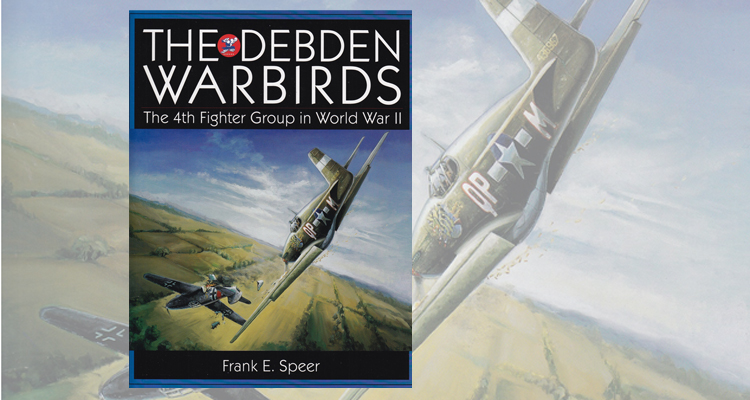
The Debden Warbirds: The Fourth Fighter Group in World War II, by Frank E. Speer, Schiffer Publishing, Ltd., Atglen, Pa., 1999, $45.
While other units of the Eighth Air Force were arriving in England, the 4th Fighter Group was created right there, by the direct transfer of three Royal Air Force (RAF) “Eagle” squadrons, composed of American volunteers, directly into the U.S. Army Air Forces. Thus, on September 12, 1942, Nos. 71, 121 and 133 squadrons, RAF, became the 334th, 335th and 336th Fighter squadrons. Soon afterward the group traded its Supermarine Spitfires for Republic P-47C Thunderbolts and became the first unit to fly that new fighter in combat, claiming three Focke Wulf Fw-190As on April 15, 1943, but losing three planes and two pilots.
The group’s pilots eventually got the measure of their German opponents while flying the new and improved P-47D. But when the first North American P-51B Mustangs began to arrive in February 1944, the 4th began carrying the war to the Third Reich in earnest. By the time World War II was over on May 8, 1945, 4th Group planes and pilots had destroyed 1,042 German aircraft in the air or on the ground–an overall record for the Eighth Air Force.
There have been histories written about the 4th Fighter Group in the past, but The Debden Warbirds: The Fourth Fighter Group in World War II offers a perspective that many World War II aviation buffs will find especially interesting. Its author, Frank E. Speer, had contributed six enemy planes to the unit’s record before he was shot down during a strafing attack in Poland on May 29, 1944. Speer was making his way across northern Germany when he was taken prisoner.
Speer’s approach to recounting the group’s record is about as straightforward as possible–a collection of combat reports, personal accounts and as many relevant diary entries as he could compile from pilots and ground crewmen alike, presented as a day-by-day chronology. All that is combined with a wealth of photographs, many of them never before published, and a selection of nose art for various group aircraft–including Turnip Termite, the author’s own P-51C–in both photographs and accompanying color reconstructions by artist Don Allen. The result is a worthy addition to Schiffer Publishing Ltd.’s growing collection of unit histories.
Jon Guttman