The noise first reached the Bolshevik cavalry as an intense, insectlike droning in the sky while the horsemen were riding across southern Russia’s sunburned steppes, featureless plains that scarcely afford cover for a rabbit. Their objective was the strategically important city of Tsaritsyn (later Stalingrad) on the Volga River, where they anticipated an easy victory over the White Russian anti-Bolshevik defenders. A brutal orgy of rapine and torture would follow against any enemies of the revolution who survived the first assault—for terror was the signature of Red cavalry leader Boris Dumenko’s 5,000-strong force.
As the droning grew louder, the cavalrymen exchanged uneasy glances. It sounded like enemy aircraft, but where? The huge vault of the sky above them seemed empty. Then someone yelled out, jabbing his hand urgently into the air. All eyes turned in the direction indicated, squinting at four tiny dots that quickly became airplanes, flying straight toward them. Officers shouted, pointing and gesticulating, but gave no orders. Then the horses, sensing the confusion and spooked by the noise of the approaching engines, began to whinny and rear.
Soon the planes were nearly above them. The cavalry started to break ranks and fired a few aimless shots into the sky. Suddenly, like a gigantic bird of prey, one of the planes detached itself from the others and plunged down at them, engine screaming, in a near vertical dive. Briefly the Reds glimpsed the pilot’s helmeted head. In a terrifying crescendo of sound the other planes followed, aiming at the wheeling mass of horsemen in what seemed like an act of collective suicide. Just before crashing into the unyielding steppe, each plane pulled out of its dive and released four small bombs. Sixteen detonations wreaked bloody carnage, as men and horses were blown apart.
The terrified survivors scattered across the plain, vainly attempting to escape from an attack against which they had no adequate defense. The swooping planes were not done with them yet. Climbing back into the sky, they cartwheeled down again to scythe the panic-stricken men and horses with lethal bursts from their twin machine guns. Time after time, through the stupefying roar of engines, came the vicious stammer of the machine guns until it seemed there could not be a man or beast left alive or unwounded.
The planes left as suddenly as they had appeared, waggling their wings as they growled off in the direction from which they had come. Dumenko’s force was utterly broken, its dazed survivors strewn over the steppe. Even then for many there was no reprieve: They were hunted down and slaughtered by their rivals, the White Cossacks. Tsaritsyn was saved for the moment. On the killing ground, the Cossacks counted 1,600 Bolshevik dead. No wounded survived.
The perpetrators of this devastating piece of aerial warfare were four Sopwith Camels of B Flight, No. 47 Squadron, Royal Air Force, part of the British interventionist force in south Russia during the Russian Civil War. The squadron was acting in support of the anti-Bolshevik White Russian forces, otherwise known as the Volunteer Army, under General Anton Ivanovich Denikin.
Allied intervention in Russia had started in early 1918, after the fall of the Romanovs and the collapse of Aleksandr Kerensky’s provisional government, when the subsequent peace agreement between the Bolsheviks and the Central Powers threatened to release hundreds of thousands of German soldiers to reinforce the Western Front. There were also concerns about the submarine bases at Archangel and Murmansk and access to the vast resources of Siberia. Britain and France hastily pledged assistance to any Russian forces willing to go on fighting the Central Powers, leading directly to Allied support of various anti-Bolshevik groups around the periphery of Russia. Ultimately this brought about well-intentioned but ill-coordinated Allied involvement with the United States and Japan (which pursued its own colonial agenda in the Far East) over four years in several parts of Russia—actions that would result in the utter defeat of anti-Bolshevism and the humiliation of the Allies. Allied intervention in that conflict imbued Soviet leaders with a mistrust of the Western powers that has persisted even past the end of the Cold War.
The four Camel pilots of B Flight were a remarkable bunch. Their 22-year-old commander was South African Flight Lt. (Captain) Samuel Marcus “Kink” Kinkead, a leading ace of the Royal Naval Air Service with 32 confirmed victories and holder of the Distinguished Service Cross (DSC) and bar as well as the Distinguished Flying Cross (DFC) and bar. Next in seniority were 21-year-old Flying Officer Rowan Daly (DSC), an ex-RNAS flier with three WWI victories, and Flying Officer William Burns Thomson, a former Royal Flying Corps sergeant pilot. Last was Flying Officer Marion Hughes Aten, son of a Texas Ranger and the only American in the squadron. The oldest member of the flight at 25, Aten was also the least experienced. Although he joined the RFC as a cadet pilot in Canada in November 1917, injuries suffered during training prevented him from qualifying until November 12, 1918, one day after the Armistice. Aten later co-authored Last Train Over Rostov Bridge, a vivid though chronologically unreliable account of his experiences in south Russia.
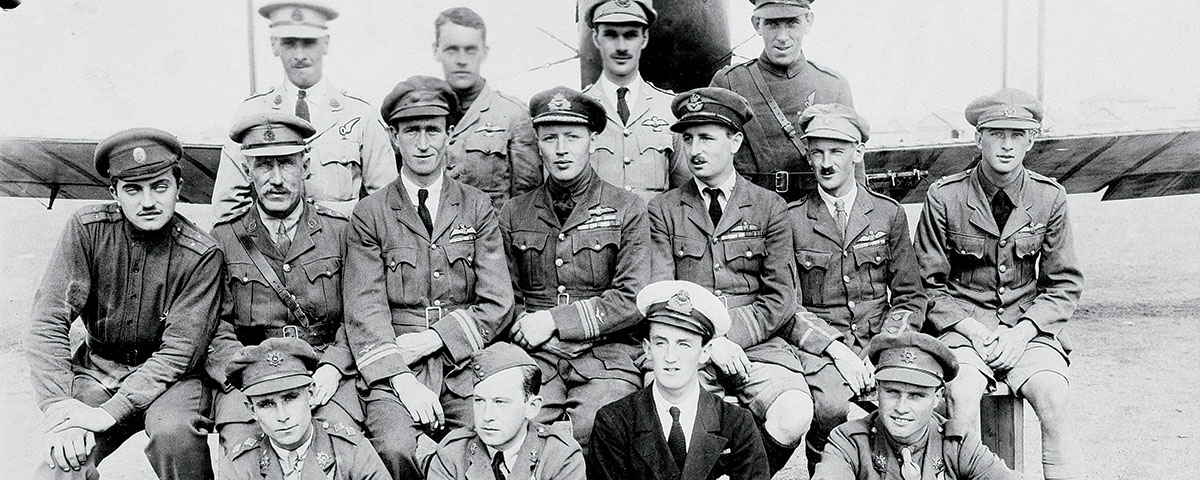
The B Flight Camels were just one component of 47 Squadron and the last to become operational. The squadron’s original de Havilland D.H.9-equipped cadre had moved to south Russia from its wartime base in Salonika in April 1919. Disembarked at the Black Sea port of Novorossisk, it established itself at the muddy airfield of Ekaterinodar under the temporary command of Captain S.G. Frogley. Administratively the squadron formed part of Lt. Col. A.C. Maund’s RAF Training Mission at Taganrog, a unit with the unenviable task of teaching White Russian pilots of very mixed ability to fly the Royal Aircraft Factory’s ungainly Reconnaissance Experimental R.E.8, or “Harry Tate.” The mission in turn was part of a British military training contingent headed by Maj. Gen. Hubert C. Holman that included elements of the Tank Corps.
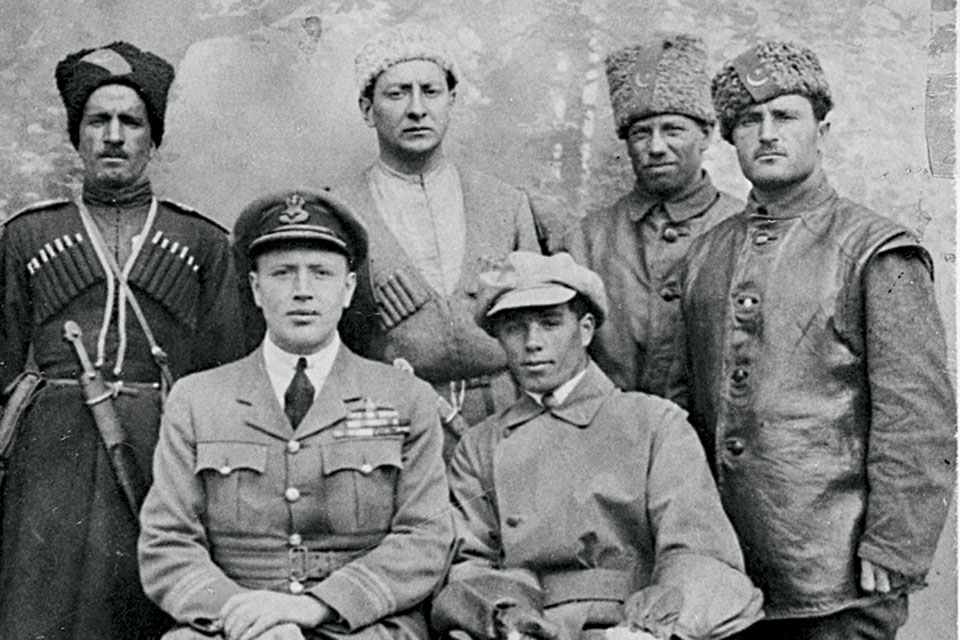
Number 47 Squadron was commanded by the redoubtable 28-year-old Canadian Major (later Squadron Leader) Raymond Collishaw (DSO, DSC, DFC), the third-ranking British WWI ace, with 60 victories. Collishaw arrived in Novorossisk in early June 1919 with a volunteer group of 10 officers and 255 airmen. He officially assumed command on June 13, only three days after the squadron’s newly formed C Flight had departed on the 180-mile rail journey from Ekaterinodar to Velikoknyazheskaya to bolster the Whites on the Volga front.
C Flight traveled on one of the specially equipped trains that were a unique feature of this extraordinary campaign. Eventually there would be trains for A, B and C flights, plus a separate train for Collishaw’s headquarters staff. Each train was a self-contained accommodation and maintenance unit, with special wagons for munitions and gasoline plus flatcars to transport the partially disassembled aircraft. In a campaign fought mainly on flat, open ground and with massed cavalry dominating much of the fighting, the trains acted as mobile bases that enabled the airmen to keep pace with the advances and withdrawals of the opposing forces. When they arrived near the front, the trains would be pulled into sidings and the aircraft unloaded and then flown into action from improvised airfields. In practice, with the railway system frequently blocked by refugee trains, this was often easier said than done.
The squadron’s initial operation took place on June 23, when three C Flight D.H.9s bombed a railway station and military barges near Tsaritsyn. This was the first of many similar operations that helped Denikin to expel the Reds from the city by July. During one notable raid, a 112-pound bomb demolished a building in which the local soviet had just convened, killing all but two of the 41 Red commissars inside.
Early in July, C Flight moved up to Beketova, 12 miles south of Tsaritsyn. Soon after, while bombing the railway station and gunboats at Kamychin, two of its D.H.9s were attacked by a Nieuport scout. Notching up the squadron’s first victory over the Red air force, observer Lieutenant H.E. Simons quickly shot it down with a burst from his Lewis gun.
On July 30, squadron members participated in what the unit history later referred to, with masterly understatement, as a “very gallant piece of work.” That afternoon three D.H.9s took off from Beketova to bomb and strafe river barges and cavalry concentrations at Tcherni-Yar on the Volga. Their objective accomplished, the aircraft piloted by Lieutenant Walter F. Anderson, with Lieutenant John Mitchell as observer, started photographing the area. Escorting them was a D.H.9 crewed by Captain William Elliot and Lieutenant H.S. Laidlaw. Both planes soon encountered heavy machine gun fire from the ground. Anderson’s machine sustained several hits in the starboard fuel tank, which began to leak. Mitchell clambered out onto the wing and, while holding on with one hand, plugged the leaks with the fingers of the other. Just as they were setting course for home Anderson saw that Elliot’s machine had also taken hits and was going down with a dead engine. Worse, Red cavalrymen had seen the D.H.9’s descent and were spurring toward it.
Mindful of Bolshevik threats to crucify, castrate or disembowel all captured foreign aviators, and with Mitchell still out on the wing, Anderson set his D.H.9 down close to Elliot’s crippled machine. Then, while the two observers held off the cavalry, Elliot set fire to his damaged aircraft. Seconds later he and Laidlaw sprinted over to Anderson’s machine, cramming themselves into the observer’s cockpit just vacated by Mitchell, who returned to the perforated wing. An agonizingly slow takeoff across rutted ground was accomplished in true Hollywood style just ahead of the flashing sabers of the Red cavalry.
The return flight took 50 minutes. If this seemed long to Anderson, struggling with his unwieldy plane, it must have been an eternity to poor Mitchell as he rode the wing with the fingers of one hand wedged in the fuel tank bullet holes. Worse, because he was wearing shorts, he suffered serious burns to his legs from the engine exhaust gases. Anderson and Mitchell both received DSOs, although Collishaw felt they deserved Victoria Crosses.
A confirmed believer in leading from the front, Collishaw was soon in action himself, bombing a Red gunboat on the Volga and literally blowing it out of the water. Shortly after, two of the squadron’s D.H.9s, one flown by Anderson, caused havoc during a raid on the Red seaplane base and airfield at Dubovka. Having bombed a barge carrying eight F.B.A. (Franco-British Aviation) flying boats, they attacked a Nieuport parked on the airfield. Finally, they went in low to rake the area with machine gun fire, leaving behind, as Collishaw noted approvingly, a scene of flames and destruction.
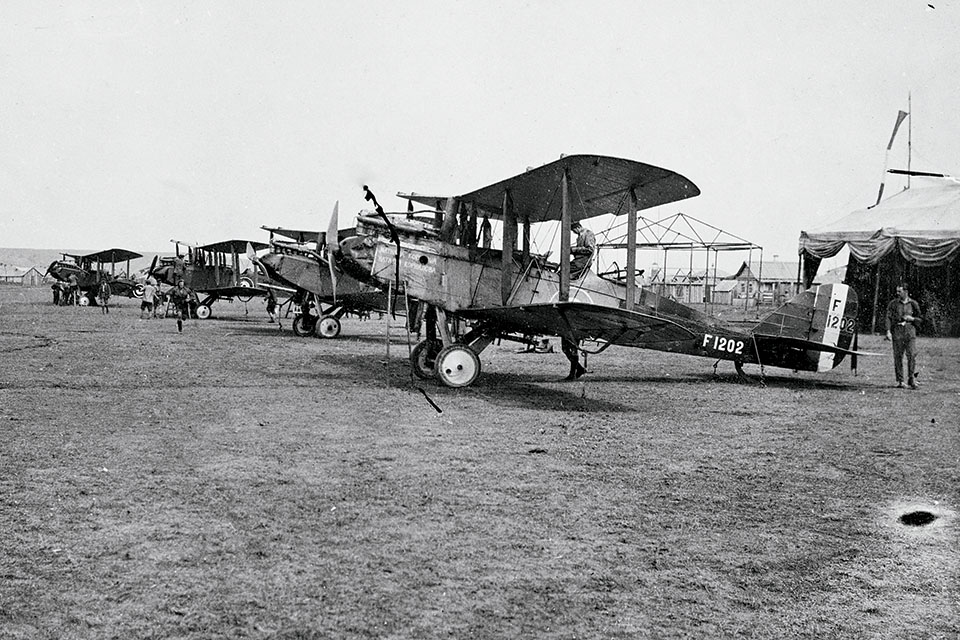
Marion Aten disembarked in south Russia on August 18, 1919, one of the last 47 Squadron pilots to arrive. He joined the squadron just as it received its first Camels, hard-used examples from the former RNAS base at Mudros in the Aegean. The need to overhaul the scouts meant that it was not until September 27 that B (Camel) Flight set out in its special train for Beketova and the Volga front.
Two days later, while escorting some D.H.9s, Kinkead scored B Flight’s first victory by shooting down a Red Nieuport into the Volga. Combat with the Red air force, however, was not a primary objective for Kinkead’s pilots. The squadron’s official history relates: “This flight operated with great success in direct contact with the front-line troops and in attacking formations along and behind the enemy front. Perhaps the most significant work done by the flight was the cooperation with General [Piotr N.] Wrangel’s cavalry corps, led by the big-hearted Cossack General Ulayai. Flight Lieutenant Kinkead and his companions would descend and bomb and machine-gun the enemy, causing great disorder amounting sometimes to panic. Then General Ulayai would attack with his cavalry, to complete the confusion.” The bombing method perfected by the Camel pilots was to dive until the target was framed in the Aldis sight and then release their bombs—a technique that culminated in the massacre of Dumenko’s column outside Tsaritsyn.
Aten described a typical ground attack sortie: “We formed an endless chain of attack. Dive. Shoot. Zoom. Cartwheel. The Red cavalry was helpless. We came so fast they had no chance to defend themselves. A few raised rifles from pony backs. Some stampeded both forward and back, but Kink concentrated the attack at both ends of the column, and the narrow gulley was choked with horses and men at entrance and exit. On my third trip round I saw an officer whipping his horse up the steep side of the gully towards the steppe….I pulled my stick back a fraction and the dust spurts travelled closer and closer in an ineluctable geometry of line until the horse reared and the man flung his arms upward and fell….I felt neither elation nor guilt but only a knifesharp sense of concentration. In the air a man is in a different element of action and response…he is himself and at the same time he is not quite human.”
Collishaw, among the greatest exponents of the Camel, often flew with B Flight. Later he recalled how, after the Camels had bombed and strafed the enemy, Ulayai’s Cossacks, their battle-flags streaming, would “then follow up with a wild cavalry charge, sabres flashing….
Watching one of these cavalry charges from the cockpit of a Camel was an exhilarating but odd sensation, almost as if one had suddenly turned the controls of some Wellsian time machine and was watching a battle that had taken place a hundred years or more before.”
Political expediency touched 47 Squadron on October 1, 1919, when, owing to disquiet at home over the active involvement of a regular RAF squadron in support of the Whites, it was renamed A Squadron of the RAF’s Training Mission. The change was entirely cosmetic. The unit carried on with its unremitting attacks on Bolshevik troop concentrations, armored trains and river transportation. Keeping up the attrition of the Red air force, Kinkead sent a Nieuport down out of control on October 7. Two days later Collishaw destroyed an Albatros D.V. Other victories soon followed.
Next came a combined operation involving all three flights against ships of the Bolsheviks’ Caspian Fleet on the Volga. Although the Reds had already suffered heavy losses in river craft, they managed to assemble 40 vessels nearby, some mounting 9.2-inch howitzers intended to bombard Tsaritsyn as cover for a ground assault. Over two days the D.H.9s and D.H.9As of C and A flights, operating against intense anti-aircraft fire from both the vessels and the shore, dropped 20-pound, 112-pound and 230-pound bombs on the Red flotilla. B Flight’s Camels joined in by dropping 20-pound bombs and then sweeping the decks of the enemy vessels with their twin Vickers machine guns. After two days of intensive air attack, 11 Red vessels had been sunk. The survivors, all badly damaged, retreated up the Volga. Never again did the Bolshevik flotilla pose a serious threat. The squadron’s history noted, “Indeed prisoners taken some time later stated that when the fleet was ordered to attack again in December there were minor mutinies because (the sailors said) ‘it was murder to come within reach of the English aeroplanes.’”
B Flight often drew the unpopular duty of escorting the “Wanderers,” as its men called D.H.9s of the Beketova-based White Russian bomber squadron. Aten wrote despairingly of these comrades in arms: “They were not merely incompetent, they were feckless, and sometimes they endangered our own skins. Incapable of keeping formation, their planes would wander off in all directions, and we would have to shepherd them in like a flock of stupid sheep. In a fight the guns of their observers were likely to jam, and even if they didn’t jam, they missed. Sometimes their planes disappeared altogether, and on several occasions we had landed to find them neatly hangared, with their Russians on their third glass of vodka.”
During one escort mission against an enemy airfield, the Reds attacked the White D.H.9s and British Camels with what Aten described as “their grab-bag of captured Allied and German ships—Nieuports, Spads, an Albatros, a Sopwith one-and-a-half strutter….I had a glance at the goggled faces as we passed. One with a white streamer flying from his helmet, the squadron leader, flew with style, and I wondered if he was a German flying for pay, a bloodthirsty Turk, or an idealistic Bolshevik.” After firing on a Nieuport, Aten had to take evasive action to avoid a stricken White D.H.9, its pilot slumped in his cockpit. “I pulled the Camel into a vertical turn and swerved as the flaming mass plummeted past. As I watched, the observer jumped, tumbling down to the river like a trapezist who had missed his grab for the bar.” The D.H.9 had been shot down by a black Fokker, whose pilot then lined up his sights on an already engaged Kinkead. He raked the flight commander’s Camel with a long burst, narrowly missing the pilot. A Red Spad then moved in to finish off Kinkead, but was shot down by a vengeful Bill Daly. Aten recounted what happened next: “Kink, his motor dead, landed safely on the riverbank, and Bill followed him down. I circled over them protectively while Kink struck a match to his Camel, then squeezed himself beneath the small center section atop Bill’s guns.” Kinkead’s return flight must have been only marginally less uncomfortable than Mitchell’s.
All too soon for the gung-ho pilots of B Flight, their glory days in Russia were over. After advancing northward to Oryol on the Kharkov front, 200 miles from Moscow, the White offensive collapsed. Starving and critically weakened by desertions, Denikin’s overextended Volunteer Army had lost the support of the peasantry, which turned against the Whites and cut their supply lines. As a result, on October 20, he ordered a retreat.
Collishaw, meanwhile, had come down with typhus. When he resumed command of the squadron at Beketova on November 27, he found B Flight’s train about to depart on the long journey into the Ukraine and the crumbling Kharkov front. It arrived on December 5. Collishaw and A Flight followed three days later, leaving C Flight, recently reequipped with R.E.8s, on the Volga front to support General Wrangel’s forces.
Another unusual RAF unit had also been making its way to the Kharkov front. Comprised of volunteers from the Training Mission at Taganrog, Z Flight was an R.E.8 unit commanded by Squadron Leader J.O. Archer. Somehow it acquired its own train. This unit’s achievements were closely linked to those of Collishaw’s squadron. While based northeast of Kharkov, Z Flight almost achieved immortality in December 1919 when Archer sought permission for his R.E.8s to bomb Moscow. Holman curtly turned him down.
Six days after its arrival on the Kharkov front, and after only a few sorties against the Reds, B Flight was withdrawn to Taganrog to reequip. Its war-weary Camels had become more dangerous to their pilots than to the enemy and badly needed replacing. Once reequipped, B Flight was to return to the Kharkov front. In so doing, it ran into what Collishaw called a series of disasters, specifically an unexpectedly rapid Bolshevik advance that, coupled with the onset of the Russian winter, forced the airmen to abandon their new planes and equipment at Taganrog and escape to Ekaterinodar.
Aten described some of the dangers along the route: “Hundreds of trains had joined the hegira from stations along the way; on long stretches of track the trains were piled up cowcatcher to caboose. Guerrilla bands began raiding on the second day out and Kink inaugurated a system of standbys and alerts that kept us in uniform around the clock. The outlaw bands would most often attack at night, riding in close to the coaches on their fast ponies, sending up an assortment of vari-coloured flares they had captured in their depot raids and trying to pick us off through the windows.” Their fire did not go unreturned by the airmen. Aten wrote: “Usually after a skirmish we would count ten to fifteen bodies in the snow; our own casualties would be nil or at most one or two superficially wounded, from ricochets….Others though were less fortunate. We passed several trains tipped over, looted and burned, with only a few charred corpses to show that refugees had met their deaths there. What had happened to the hundreds of men, women and children who had been on these trains we never found out.”
Eventually B Flight reached the port of Novorossisk, where again it was supposed to reequip and rejoin the conflict. But once more British plans were thwarted by the pace of the Bolshevik advance. Then came a final indignity. “We hauled the Camels from the flatcars to the nearest dock,” Aten recorded. “There a tank lumbered over them, reducing the fuselages to torn fabric, splintered spruce and tangled wires, and the engines to twisted scrap.” Next to be destroyed were 40 new D.H.9s, still in their packing cases. “Then the tank, in turn, with controls set and engine running, was sent waddling over the dock into the bay.”
Meanwhile Collishaw, with A and Z flights, had been conducting a fighting retreat from the Kharkov front, moving toward Rostov. Z Flight’s train with Holman aboard made it across Rostov bridge. But when A Flight with Collishaw tried to follow, they found the Red cavalry had cut the rail lines. This forced them to head southwest to the Crimea, with a Red armored train in hot pursuit. At one fuel stop the Reds sent an unmanned locomotive hurtling into the rear of Collishaw’s train, destroying eight wagons but miraculously causing no casualties. A Flight’s nightmare journey ended when it reached the Crimea on January 4, 1920.
From a new base at Djankoi, Collishaw and his D.H.9As flew on in support of Denikin’s retreating forces. In late February, during a raid on an armored train, Collishaw’s D.H.9A was hit by groundfire and he was forced to land. With a sputtering engine, he and his observer taxied 20 miles across the snow to Djankoi. Later, between leading bombing and strafing sorties, Collishaw dropped supplies to an ice-bound White vessel in the Sea of Azov. On March 29, he landed after what turned out to be the squadron’s last raid to find orders to hand over its aircraft to the Whites and proceed to Theodosia for evacuation to Constantinople.
B and C flights had sailed from Novorossisk a few days earlier amid harrowing scenes, as terrified White refugees sought to escape the vengeance of the fast-approaching Bolsheviks. “The waterfront was black with human beings,” Aten wrote. “A solid mass of people covered the shore, the quay, the piers, the mole and the breakwater. As we left the train and started towards the ship the refugees pressed around us, shrieking, begging, imploring….A mob of desperate refugees suddenly rushed the steamer gangplank and machine guns on the deck cut loose. Ten men and women fell, twenty, thirty, and I could watch no more.”
Among those who did get away by sea was General Denikin. He was succeeded as commander in chief by Wrangel, who fought doggedly on in the Crimea until October 1920. So ended what British War Minister Winston Churchill called “a war with little valour and no mercy.”
For his gallantry in south Russia Aten received the DFC. The Russians awarded him the St. George’s Cross 4th Class and the Order of St. Vladimir 4th Class with Swords. In July 1920, having signed up for another seven years in the RAF, he went directly from Constantinople to No. 70 Squadron in Egypt, flying Vickers Vimy bomber-transports. After a flying instructor’s course in England, in late 1921 he returned to the Middle East for a second stint with 70 Squadron, piloting Vimys and later Vernons in Iraq. Aten was mentioned in dispatches in June 1924 for distinguished service in Kurdistan. After a tour with No. 12 (Bomber) Squadron in England, he left the RAF on November 25, 1927. Aten then returned to the United States, where he lived until his death in May 1961.
The other members of B Flight were less fortunate. Burns Thomson died in a flying accident in Egypt in November 1922, as did Daly in England in June 1924. Kinkead, who received a DSO for his leadership in Russia, was killed at Calshot on March 12, 1928, during a world speed record attempt in the Supermarine S5 floatplane N221. Only the seemingly indestructible Collishaw went on to greater glory, as an air vice marshal in the Middle East during World War II and later into a vigorous old age.
Derek O’Connor, who writes from the United Kingdom, is a former RAF pilot who has authored numerous aviation articles. Further reading: Air Command: A Fighter Pilot’s Story, by Raymond Collishaw; and Last Train Over Rostov Bridge, by Marion Aten and Arthur Orrmont.
This article was originally published in the September 2007 issue of Aviation History Magazine. For more great articles, subscribe to Aviation History today!