On May 5, 1775, a packet ship arrived in Philadelphia after a six-week passage across the Atlantic from England. This was a common enough occurrence, since the city’s bustling waterfront along the Delaware River usually teemed with ships carrying passengers and merchandise from all over the world. The ship nestled beside a waiting dock, its gangplank enabling the weary human cargo to plant their feet on dry land.
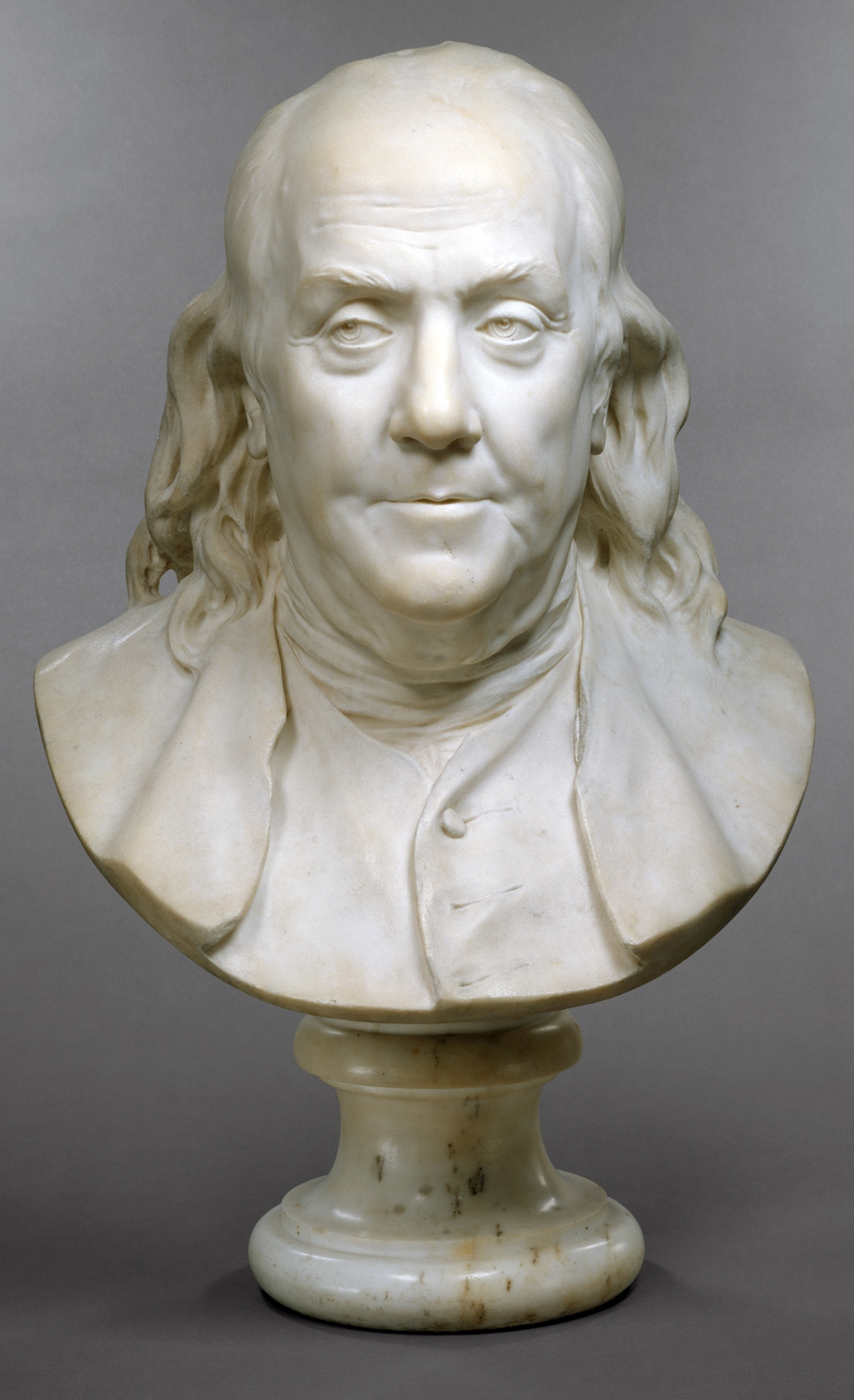
One of the passengers was an old man accompanied by his teenage grandson. The old man’s face was distinctive, though not yet the icon it was later to become. A large oval face was framed by a fringe of long gray hair that fell unbound to his shoulders. Slightly hooded blue-gray eyes peered over rectangular glasses, and a well-shaped nose hovered above a thin slash of a mouth, just now pursed in concentration as he carefully walked down the swaying gangplank.
Benjamin Franklin was coming home to his adopted city after an absence of about a decade. He was the most famous man in colonial America, honored for his many inventions and his contributions to science. Franklin was also a public figure, comfortable in the world of politics and letters. Dr. Franklin—he held an honorary degree from Scotland’s prestigious University of St. Andrews—had been an agent representing colonial interests in Great Britain.
Franklin’s homecoming was bittersweet. There was a growing rift between Britain and its 13 American colonies, and Franklin had devoted months of time and effort trying to repair the breach and effect reconciliation. In truth, the good doctor was a very reluctant revolutionary, at least in the beginning. He loved Britain, and harbored dreams of ‘that fine and noble China vase the British Empire’ growing ever greater in wealth and power.
The dream was becoming a nightmare, however, and the ‘noble China vase’ was teetering on the edge of a precipice. One more gust of political turmoil and it would fall and smash into pieces. The last couple of years in England had not been happy ones for Franklin; in fact, they had transformed him slowly from ardent Anglophile to committed revolutionary.
Franklin had once been blindly in love with Britain; now the scales fell from his eyes. His efforts at reconciliation were spurned, a British minister characterizing Franklin as ‘one of the bitterest and most mischievous enemies this country [Britain] had ever known.’ Having heard the term ‘American’ spat out like some loathsome obscenity, Franklin, his patience ended, decided to go home. He also decided that complete independence from Britain was the best course of action.
When Franklin arrived in Philadelphia, he could not be sure of his reception. Years before, he had written to a friend that there was a possibility he would be looked on ‘in England of being too much an American, and in America of being too much an Englishman.’ Those worries evaporated the moment Franklin and his 15-year-old grandson, Temple, touched shore. People shouted his name, and there were spontaneous cheers to mark his progress. As the word spread, church bells even pealed in welcome.But the colonies were in turmoil. The First Continental Congress denied that the British Parliament had any authority to tax the colonies. That, the first Congress insisted, was exclusively the right of their own colonial assemblies. Rhetoric soon turned to bloodshed, when fighting broke out between Massachusetts farmers and British troops at Lexington and Concord.
A few days after Franklin’s arrival, the Second Continental Congress met in Philadelphia in the Pennsylvania statehouse (now Independence Hall) on Chestnut Street to discuss the issues and plan a course of action. The birth of the United States was not an easy one, and it ultimately involved a long, painful and exceedingly slow gestation. In fact, it took a year, from the spring of 1775 to the summer of 1776, for a majority of congressmen to finally accept the reality of independence.
Benjamin Franklin was chosen to be one of Pennsylvania’s congressional representatives only a day after his return from England. He accepted the post, but made sure that he did not reveal his true feelings on the touchy issue of independence. In the meantime, he served on several congressional committees, keeping up a pace that would have exhausted a 30-year-old, much less a man who had recently passed his 69th birthday.
Congress created a Continental Army for mutual defense and appointed George Washington, a distinguished Virginian, as its commander in chief. British troops in Boston were already besieged by American forces, and an expedition was soon organized to invade and capture Canada for the rebel cause.
While Congress deliberated, argued and occasionally dithered, questions began to arise in the minds of many members—should America seek foreign aid; would the United Colonies be better off if they entered into a foreign alliance; or should they go it alone, trusting in God and the righteousness of their cause?
Franklin, prescient as usual, foresaw the need of foreign aid. He wrote to a friend in July 1775 that Americans ‘have not yet applied to any foreign power for assistance, nor have we offered our commerce for friendship. Perhaps we never may; it is natural to think of it, if we are pressed.’
These musings, which many felt but dared not speak aloud, took more concrete form after August 23, 1775, when King George III declared the colonies to be in open rebellion. While the majority of Congress still hesitated to make the final, irrevocable break with the mother country, it was deemed prudent to prepare for the worst.
To this end a Committee of Secret Correspondence was formed on November 29, 1775, with the mission of ‘corresponding with our friends in Great Britain, Ireland and other parts of the world.’ The last part of the sentence, ‘other parts of the world,’ seems to have been added casually, and made purposely unclear, perhaps to allay the fears of those members of Congress who still hoped for reconciliation. In reality, ‘other parts of the world’ could only mean the rest of Europe, including Britain’s hereditary enemies France and Spain.
The Committee of Secret Correspondence was, in fact, an embryonic State Department. (Its title was changed to Committee for Foreign Affairs in April 1777, once the need for secrecy had been obviated by the Declaration of Independence.) The committee’s distinguished members included Franklin, Virginian Benjamin Harrison, John Jay of New York, Marylander Thomas Johnson and Pennsylvanian John Dickinson.
Benjamin Franklin quickly became the committee’s most prominent member. He had many connections in Europe, and his fame abroad might open doors otherwise closed to America. Among intellectuals, he was celebrated as the ‘man who dared the lightning’ and a true apostle of the Enlightenment. His famous experiment in the 1750s had proven beyond a doubt that lightning was indeed electricity. Franklin also created one of the first batteries, and even coined the use of the words ‘positive’ and ‘negative’ to describe electric charges.
Franklin immediately took up his quill, writing a flurry of letters to his still-wide circle of European friends. He entered the murky world of diplomacy and espionage literally at the stroke of a pen. Philadelphia was as yet unoccupied by British troops, but it was almost certainly occupied by British spies, so Franklin had to exercise caution.Where to begin? Charles Guillaume-Frederic Dumas was an intellectual, by some accounts a Swiss, who was living in The Hague. The Netherlands was no longer a great power, but its strategic location assured that it was a major ‘listening post’ of European politics. In his December 9, 1775, missive, Franklin made Dumas an agent of the Committee of Secret Correspondence.
Acting as the committee’s spokesman, Franklin told Dumas that America might find it necessary ‘to ask the aid of some foreign power.’ The latter’s task was clear: ‘As you are situated at The Hague, where ambassadors from all the courts reside, you should make use of the opportunity… discovering, if possible, the disposition of the several courts to such assistance or alliance.’
Franklin’s hope of foreign aid was not as far-fetched as it may have seemed at the time. When King Louis XVI came to the throne in 1774, he appointed Charles Gravier, comte de Vergennes, as his new foreign minister. Vergennes was a career diplomat with a lifetime’s worth of experience. A monarchist to the core, he did not understand the complex issues of taxation and self-government that were threatening to tear the British empire completely asunder. Vergennes was certain of only one thing—Britain’s troubles might provide France with a golden opportunity for revenge.
France’s defeat in the Seven Years’ War was a national humiliation, and to suffer that defeat at the hands of the British only added to the disgrace. When the war ended, France was forced to surrender Canada and its vast holdings along the Mississippi River drainage. Only two small fishing islands off the south coast of Newfoundland, Saint-Pierre and Miquelon, remained of what was once a great French empire in North America.
Late in 1774 Vergennes wrote: ‘The quarrel between the colonies and the British government seems to grow more serious every day….It may prove the most fatal blow to the authority of the metropolis [London].’ The foreign minister wanted to help the struggling Americansby Eric Niderostprovided, of course, that they proved themselves capable of winning. The French were not going to throw away money and possibly lives on a losing proposition.
But Vergennes needed to base his decisions on solid, reliable intelligence. Reports from America were often fragmentary and sometimes contradictory. Vergennes knew that ultimately the American revolt would be decided on the battlefield. Could an American ‘army of peasants’ stand up to trained British regulars?
Adrien-Louis de Bonnieres de Sousastre, comte de Guines, was the French ambassador to the Court of St. James’s. Though posted in England, he disliked the island kingdom and agreed with Vergennes that America could be helped and encouraged. Guines wrote, ‘I think it might be advantageous to us…to have among them [the Americans] a capable man who could judge the situation from the political and military standpoint, could foresee the course of events, and send reports by each merchant ship.’
In fact, Guines had someone in mind for this mission, and lost no time sending a letter to Vergennes that lavishly praised the candidate. Chevalier Julien-Alexandre Achard de Bonvouloir was a retired officer of the elite Régiment du Cap who had recently returned from America, where he had established many solid contacts. Guines admitted that Bonvouloir had a handicap—he was lame—but that he was intelligent and fully capable.
Guines also noted that Bonvouloir was cost effective, willing to undertake the secret mission for 200 louis d’or. ‘If nothing is accomplished,’ explained the French ambassador, clinching his argument, ‘it is only the loss of 200 louis.’ The comte de Guines exaggerated many of his young protégé’s attributes. Bonvouloir, 26, was the black sheep of an old Norman family who had squandered much of his inheritance. He had served in the Régiment du Cap, but only as a volunteer.
Bonvouloir was a ‘prodigal son’ who desperately wished to get back into his family’s good graces. He also hoped to become a commissioned army officer, and carve out a brilliant military career. Bonvouloir mainly wanted recognition, not money, for his efforts, and this was his golden opportunity to prove himself on the world stage. He was determined to succeed at any cost.
Vergennes was convinced, and a short time later Bonvouloir was given the assignment. Nobody cared that the young French noble had no espionage experience and did not even speak English. Vergennes did give the fledgling spy a detailed set of instructions, an oblique acknowledgment of his inexperience. He was to carry no written instructions, nothing that would incriminate him or the French government. Bonvouloir was to keep his eyes and ears open, recording his impressions in minute detail. Vergennes stressed that he was not to represent himself as an official agent of France, but merely as an ‘Antwerp merchant’ with vaguely powerful ‘friends’ back in Europe.
In keeping with his ‘Antwerp merchant’ guise, letters would have to be full of routine business details. This was a cover, in case the missives were intercepted by British agents. The secret portions were to be written in a kind of invisible ink made of milk, which could be developed and read only when heated with a hot shovel.
Bonvouloir was not to make any commitments, but nevertheless assure the Americans of French sympathy and best wishes. As a further expression of goodwill, Bonvouloir was to tell the Americans the French had no designs on Canada. The memory of the Seven Years’ War, with its devastating French and Indian raids along the frontier, was still fresh in most American minds. Americans had spent blood and treasure evicting France from Canada in the late war, and did not wish to see the French flag rising once again over Montreal and Quebec.
Once American fears were assuaged on that score, Bonvouloir was to move on, hinting that French ports would be open to trade once independence was declared. Vergennes was well aware that many Americans hesitated to break with Britain; veiled offers of French trade and assistance might tip the scales for independence.
Vergennes made it clear that the first person he wanted Bonvouloir to contact was Benjamin Franklin. Franklin’s scientific writings were well known in France, and the doctor himself had visited Paris in the 1760s. Franklin was a man of influence, tact and intelligence, and also sat on several important congressional committees. The Philadelphia printer would be the perfect conduit to express France’s encouragement to a vacillating Congress.
Bonvouloir set sail for America on September 8, 1775. Unfortunately his ship was buffeted by autumnal gales, storms so severe the journey took twice as long as usual. ‘I had a frightful passage,’ he wrote. ‘I had one hundred days at sea, twenty times I thought I should perish; I was reduced to two biscuits a day…a little salt beef and stale water.’
Once ashore, Bonvouloir’s next question was how to make contact with Benjamin Franklin. Franklin was a great man, and busier than usual during those hectic and tumultuous times. Bonvouloir had no credentials, no official status. He did not even have a letter of introduction, which was a common way of meeting well-known figures in those days. The chevalier did have one friend—really, just an acquaintance—who might provide the access to Franklin that Bonvouloir desperately needed.
Francis Daymon was a merchant who had been born in Paris and immigrated to Philadelphia, where he married an American woman. He spoke English well, and supplemented his income by tutoring people in French. Above all he was a part-time librarian with Franklin’s Library Company. Franklin had hired Daymon, and some accounts say the Frenchman also helped Franklin brush up on his French.
The Library Company, founded by Franklin and a group of friends in 1731, was the first circulating library in America. Books were costly in the colonial period; a single tome could cost an average man a month’s salary. The Library Company allowed subscribers to pool their money and buy books for the benefit of all. By 1770 the library boasted some 2,033 volumes, and the number grew every day.
Space was at a premium, so the Library Company moved into the second floor of Carpenter’s Hall by 1774. Carpenter’s Hall was a classic specimen of Georgian architecture, formed in the shape of a Greek cross and crowned by a shining white cupola. It had been the site of the First Continental Congress, and many delegates had borrowed books from the Library Company’s upstairs holdings. Daymon took care of the collection, recorded who took out the books and who returned them, and did shelving and other related chores.
Bonvouloir contacted Daymon and dropped enough hints to give the librarian some idea—however vague—of his mission. Daymon told Bonvouloir he would do what he could, and he proved a man of his word. When the librarian told Franklin about the encounter, the latter was naturally suspicious. Bonvouloir might well prove a double agent, or even an out-and-out British spy. Traitors to the Crown were hanged. If Franklin and the Secret Committee spoke too freely to this man, they might end up with a noose around their necks. With all the danger involved, it was ironic that the name Bonvouloir meant ‘goodwill’ in English.
Franklin, after some further deliberation, felt the potential benefits more than justified the risks. It was clear that next year’s campaign was going to be crucial for the American cause. Help was needed, and needed soon. In spite of Bonvouloir’s fervent disavowals, it was clear he was acting on the orders of the French government. The French may have been slow, tentative and perhaps even irritating, but they were finally showing signs of abandoning their official neutrality. Bonvouloir’s mission was a significant first step in that direction.
It was agreed that members of the Committee of Secret Correspondence would meet with Bonvouloir, but only under conditions of utmost discretion. Carpenter’s Hall was chosen for the nighttime rendezvous. The meeting would involve only four men: Franklin, fellow committee member Jay, Francis Daymon and the mysterious Frenchman. It was best to keep participants to an absolute minimum; a larger group would only attract unwanted attention.
Daymon was needed to act as an interpreter. Franklin knew how to read French, having taught himself the rudiments of the language as early as the 1730s. He also knew how to speak a little French, but he was far from fluent at the time, and it was important that no misunderstandings arise due to mistranslation.
As things turned out, there were three long meetings with the French agent, all occurring between December 18 and 27, 1775.
The first meeting set the pattern for the rest. One chilly night Franklin slipped on a cloak and walked to Carpenter’s Hall. It was agreed that each participant would go to the rendezvous separately, using different routes, and strictly under the cover of darkness.
Franklin’s great brick house on High Street was only about a block from the hall, so he didn’t have far to go. It was ironic that, thanks to Franklin, Philadelphia boasted the best lighted streets in the country. Four-sided lamps, designed by Franklin himself, hung suspended from tall poles and gave out a strong glow. Under those street lamps, his bulky silhouette easily could be seen as he trudged through the frigid streets.
Once Franklin showed up—the last to arrive by some accounts—Daymon led the party up the stairs to the second floor by the light of a flickering candle. He had already made sure that the building’s shutters were tightly fastened, lest any telltale beam of light betray the fact that Carpenter’s Hall was not empty. The stairs bore an uncanny resemblance to the kind seen on scaffolds. For all these men knew, this might be a dress rehearsal for a climb of a more sinister kind.
The second floor of Carpenter’s Hall was divided into two large rooms. The east room housed the Library Company’s books, while the west room was home to its many scientific devices and equipment. In 1774 the west room was described as a ‘handsome Appartment [sic]’ where ‘apparatus is deposited and directors meet.’ Cluttered as the west room was with telescopes, air pumps and electrical devices, the east room was a logical place to conduct the secret talks. It was, after all, where the library directors met.
John Jay later recalled Bonvouloir as an ‘elderly, lame gentleman, having the appearance of an old, wounded French officer.’ It’s a curious description, because the chevalier was in his mid-20s at the time. He did have a game leg, but nothing else fits. Jay’s story does conjure up yet another intriguing possibility—that Bonvouloir was in disguise.
The chevalier de Bonvouloir rigidly adhered to his instructions. ‘I made them no offer,’ he proudly recalled later, ‘absolutely none.’ But Franklin and Jay assumed—correctly—that he was a French agent, and acted accordingly. Apparently Franklin took the lead in the discussions, and though the tone was friendly, Bonvouloir was put on the defensive.
‘These affairs are so delicate,’ he admitted, ‘that with all the goodwill possible, I tremble as I advance.’ Franklin and Jay cut to the chase. They wanted to know if France would aid America, and at what price. The chevalier said that yes, France might come to the rebels’ aid, but he did not know what the condition would be.
Franklin apparently asked if France was favorable to the American cause. Bonvouloir pleaded ignorance, explaining he was only a ‘private citizen.’ When pressed, the chevalier opined that France did wish them well. Benjamin Franklin knew that few American officers had training in European warfare. When the Frenchman was asked if his country might supply two good military engineers, Bonvouloir was evasive, but promised to forward the request to friends back home.
America was rich in a variety of natural resources, but poor in gold or silver specie to pay for arms. Franklin queried Bonvouloir about the possibility of obtaining arms and munitions in exchange for American commercial goods. Once again the chevalier gave a conditional assent, but stressed the French government would not take part in such transactions. Instead, business would be conducted by private French merchants.
The meetings concluded on an upbeat note. In spite of Bonvouloir’s attempts at evasion, it was clear that France was indeed interested in helping the American cause. This was encouraging to Franklin and Jay.
As soon as the last session was over, the chevalier quickly sent messages back to France as instructed. On December 28, Bonvouloir penned an account of both the clandestine encounters at Carpenter’s Hall and his impressions of the general situation. Many of his statements are exaggerations, the narrative peppered with facts that sound plausible but are ultimately false. There is no deliberate attempt to deceive his superiors; it’s obvious from the tone that Bonvouloir believes what he is saying. Much of the report is a product of a fevered imagination desperate to achieve success.
The evidence is circumstantial, but Franklin’s own ‘fingerprints’ seemed to be all over Bonvouloir’s report. Ben Franklin was a skilled propagandist, and it looks as if he filled the Frenchman’s head with facts and figures to suggest America was in a better position than it really was. Some of Bonvouloir’s statements bear suspicious similarities to some of Franklin’s own letters to foreign friends that year.
Bonvouloir saw the budding Revolution in a favorable light, as when he boldly states, ‘The Confederates [Americans] are preparing themselves extensively for the coming spring.’ This sounds much like Franklin’s letter of December 9, 1775, when the printer speaks glowingly of how ‘our artificers are also every where busy in fabricating small arms, casting cannon, etc.’
The French emissary reported: ‘Everyone here is a soldier, the troops are well clothed, well paid and well armed. They have more than 50,000 regular soldiers and an even larger number of volunteers who do not wish to be paid….Nothing shocks or frightens them, you can count on that. Independency is a certainty for 1776.’
This, of course, was a wild exaggeration. Washington’s Continental Army never had more than 18,000 to 20,000 men at a time, and usually the figures were much lower. The troops were badly paid, often badly clothed, especially in winter, and had to endure periods of sickness and semi-starvation. Ironically, the only one of Bonvouloir’s predictions that proved accurate was that America would declare its independence from Britain.
The Secret Committee of Correspondence was encouraged by the chevalier de Bonvouloir’s clandestine visits, so much so that on March 2, 1776, they appointed Connecticut lawyer and revolutionary leader Silas Deane as a special envoy to negotiate with the French government.
On the French side, Bonvouloir swallowed the committee’s propaganda hook, line and sinker. When his wildly positive report reached France on February 27, 1776, it gave Vergennes more ammunition to persuade King Louis XVI to aid the rebellious colonies. France and Spain were not ready for open hostilities, but it was secretly agreed by both parties that the rebellion must be kept alive as long as possible.
Meanwhile, another pro-American Frenchman was enlisted as a middleman between the two nations. Pierre Augustin Caron de Beaumarchais was a flamboyant man of many talents, author of the play Barber of Seville and later Marriage of Figaro. Among his other accomplishments, he was a French spy, passionately devoted to the American cause. In April 1776, Vergennes wrote to Beaumarchais: ‘We will secretly give you one million livres. We will try to obtain an equal sum from Spain. [He did.] With these two millions you will establish a commercial firm and… supply the Americans with arms, munitions, equipment….’ Once the funds were in hand, a dummy company -—Hortalez & Cie—was set up to funnel arms and supplies to America. While still maintaining a precarious neutrality, France was now fully committed to providing substantial aid to the insurgent Americans.
The chevalier de Bonvouloir soon faded into obscurity. He stayed on in America for about a year, but accomplished little of consequence. After some wrangling he managed to get a commission in the French navy, sailed to India in his ship and died there in 1783.
After independence was declared, Franklin sailed for France on October 27, 1776, as a member of a commission authorized by Congress to negotiate a commercial treaty with Louis XVI’s government. In 1778 Franklin signed a Franco-American Treaty of Alliance. Thus, from those first furtive winter meetings at Carpenter’s Hall in Philadelphia three years earlier, aided by Franklin’s wise guidance and diplomacy, emerged massive French moral, monetary, material and eventually direct military support for the American colonial cause.