When the Battle of the Wilderness ended on May 7, 1864 it left Robert E. Lee marginally the master of the battlefield, but the Confederate general’s first major confrontation with the new commander of the Union Army, Lieutenant General Ulysses S. Grant, was, in fact, very different from Lee’s victory on the same ground at Chancellorsville a year earlier. Then, the Federal Army of the Potomac, under Major General Joseph Hooker, had retreated in disorder. Grant, in contrast, ignored his tactical defeat and ordered the Army of the Potomac, under Major General George Gordon Meade, to resume its advance toward Richmond. Grant’s action served ominous notice to the Confederacy that the Union had a leader who was not at all intimidated by Lee’s legendary reputation-and one who was determined to bring the Civil War to a close by any means necessary.
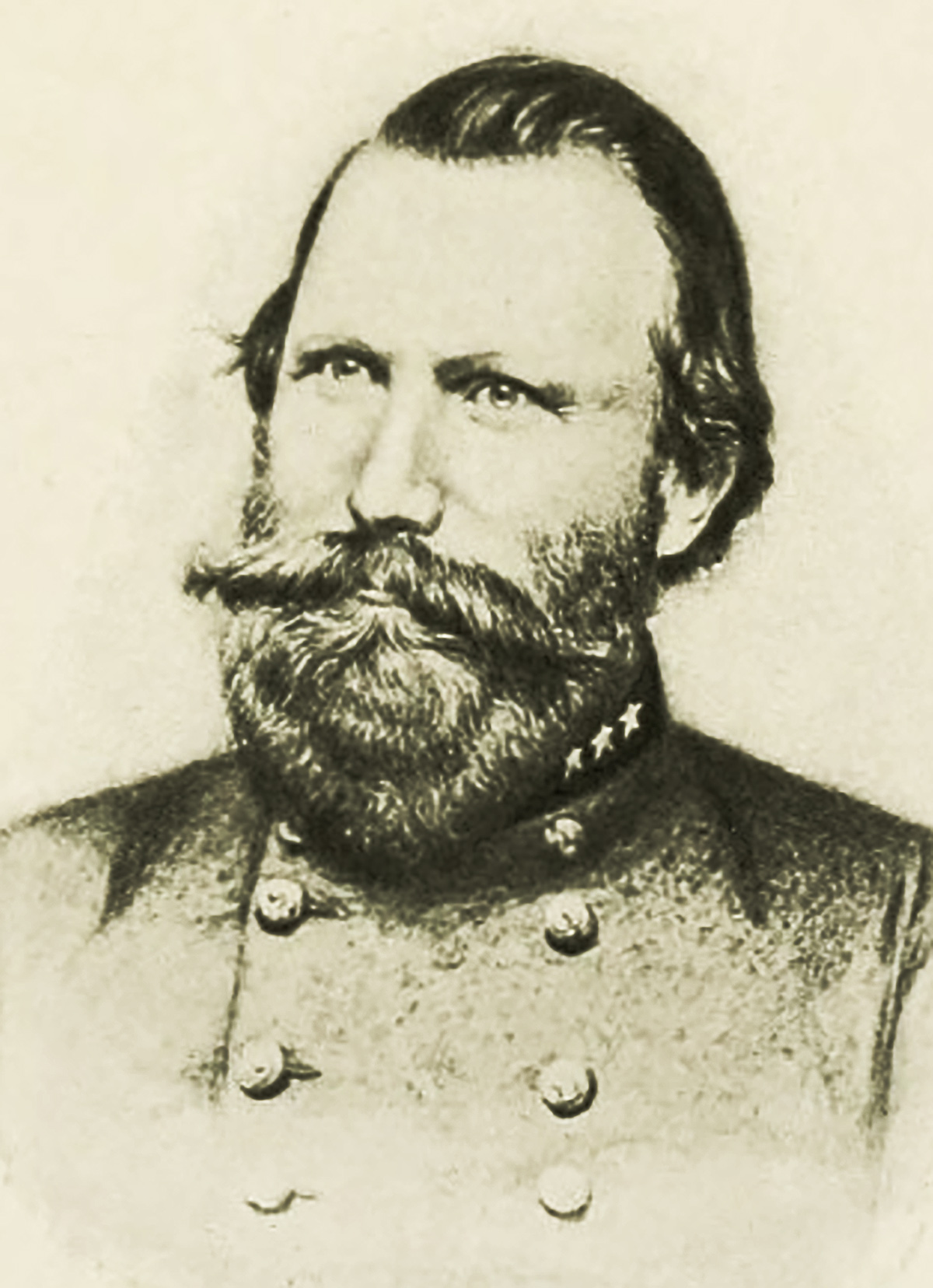
During the Union advance on Spotsylvania, Meade fell into a heated argument with the commander of his cavalry corps, Maj. Gen. Philip H. Sheridan. Meade claimed that Sheridan’s cavalry had impeded the progress of the Union infantry. Underlying the dispute was the issue of control; thus far in the Wilderness campaign, some of Sheridan’s officers had been getting orders from him and some had gotten them directly from Meade. Sheridan thought his cavalry would be more effective if he had more latitude. In the midst of the mutual recriminations between Meade and Sheridan, the name of Sheridan’s Confederate counterpart came up — Maj. Gen. James Ewell Brown Stuart, better known as Jeb Stuart, whose dashing and audacious cavalry exploits had made his name as celebrated as Lee’s. ‘Never mind Stuart, Meade remarked. He will do about as he pleases anyhow.
“Damn Stuart,” snapped Sheridan. “I can thrash hell out of him any day.” Later, when Meade mentioned Sheridan’s remark to Grant, Grant simply replied: “Did Sheridan say that? Well, he generally knows what he’s talking about. Let him start right out and do it.”
Grant was satisfied that Little Phil was not idly boasting. They had served together in the west, where Sheridan had consistently displayed the sort of aggressiveness that Grant favored — the sort that did what had to be done. If Sheridan was as unawed of Stuart as Grant was of Lee, then Grant was eager to give the diminutive but pugnacious Ohioan the chance to put his cavalry where his mouth was-and to demonstrate what he could do with a free hand. On that very night, Grant authorized Sheridan to take his entire corps toward Richmond, skirting the right flank of the Army of Northern Virginia. Sheridan’s principal objective was not to gather intelligence or to take real estate. As one of his officers summarized it, Our move would be a challenge to Stuart for a cavalry duel behind Lee’s lines, in his own country.
Sheridan’s idea was not unprecedented, but Union success in executing such a plan was. Notwithstanding the valor of a number of regiments within its ranks, the history of the Union cavalry corps in Virginia had generally been less than brilliant. Union horse soldiers had never played a key role in a major Union victory in Virginia, although they came close on one occasion–the Battle of Brandy Station on June 9, 1863, a colossal equestrian collision in which the Yankee troopers came within an ace of overrunning Stuart’s headquarters. Almost was not good enough, however; not only did Brandy Station end inconclusively, but in the subsequent skirmishes at Aldie, Middleburg and Upperville, Stuart’s gray knights went on to thwart three attempts by their Federal counterparts to locate the Army of Northern Virginia as it made its way northward on the offensive that would ultimately lead Lee to Gettysburg.
Sheridan was confident that he could do better. For one thing, his Richmond raid was to involve 10,000 cavalrymen against what he knew to be only about half that number of Confederates. More important, he had set a goal and would stick to it, unlike his immediate predecessor, Maj. Gen. Alfred Pleasanton, who had a habit of arbitrarily changing his objective from gathering intelligence to engaging Stuart in decisive battle — and, in consequence, failed to accomplish either.
One of Sheridan’s junior officers, Theophilus F. Rodenbough, described the preparations for the expedition: “The command was stripped of all impediments, such as unserviceable animals, wagons and tents. The necessary ammunition train, two ambulances to a division, a few pack-mules for baggage, three days’ rations and a half-day’s forage carried on the saddle, comprised the outfit.”
At six o’clock on the morning of May 9, Sheridan’s force, accompanied by six batteries of horse artillery, moved south at a carefully measured, energy-conserving pace along Telegraph Road, which led from Fredericksburg to Richmond. Stretching for 13 miles, the Union column was hardly operating incognito. Within two hours of getting underway, first contact was made with the enemy when elements of Brig. Gen. Williams C. Wickham’s Confederate brigade began to make harassing attacks on the rearmost units.
Wickham’s hit-and-run attacks did not even slow Sheridan’s progress. The general himself, when told that his column had come under fire from enemy cavalry, confidently roared out for all to hear: Keep moving, boys. We’re going on through. There isn’t cavalry enough in all the Southern Confederacy to stop us. Meanwhile, the Federal vanguard, Brig. Gen. George Armstrong Custer’s Michigan Brigade from Brig. Gen. Wesley Merritt’s 1st Division, was forging ahead toward Beaver Dam Station, a terminal for the Virginia Central Railroad. As fortune would dictate, Custer’s men arrived just as 400 Union troops, captured by the Confederates in the Battle of the Wilderness, were about to be loaded aboard a train for transport to Richmond. When ordered to march double time the few hundred remaining feet to the station, the prisoners halted and refused to move, even when their Confederate captors threatened to fire on them. Then, seeing their threats to be futile, the Rebel cavalry formed a battle line between the prisoners and Custer’s charging column.
The ensuing clash was short-lived, and few of the Confederates got away. Most ended up prisoners, while their former captives were liberated. One of the Southerners was a squeaky-voiced teenager who, as much to the annoyance of several of his comrades as to the prisoners, had taunted the captive Yankees incessantly, his favorite refrain being, Well, boys, Daddy Lee has got you! One of the Union prisoners, John Urban of the Pennsylvania Reserves, later wrote: After the fight was over, we found our tormentor in the hands of the cavalry, and he was the most frightened man I ever saw. Some of the boys could not help but tease him about the change of affairs. One of them exclaimed: ‘Well, my lad, Daddy Grant has got you!’
In addition to freeing the prisoners, Custer occupied the station, where he found vast stores of pork, cornmeal, fish, sugar, rum, medical supplies and a trainload of flour. Custer then had the station and several adjacent buildings burned. The Union troops took what they could of the Rebel stores, including several barrels of whiskey-until Sheridan rode up and ordered the barrels destroyed. Even so, many troopers managed to get some of the whiskey into their canteens, some scooping it from the ground before it vanished into the soil. Custer’s men also destroyed two locomotives and 100 train cars and tore up 10 miles of adjacent railroad track and telegraph lines before camping for the night.
While Sheridan was beginning his drive on Richmond, Stuart spent May 8 guiding and deploying the men of Lt. Gen. James Longstreet’s corps, now under the command of Maj. Gen. Richard H. Anderson following the wounding of their commander during the Battle of the Wilderness. In a reprise of his activities at Chancellorsville a year earlier, Stuart was commanding infantry as well as dismounted cavalry during the desperate fighting at Spotsylvania when word reached him that Sheridan was on the move.
Stuart’s first reaction was a fateful miscalculation that could only have been the product of misjudging the enemy’s intentions. Apparently expecting only a typically timid Union cavalry raid and not wanting to deprive Lee of the services of his cavalry corps (as he had been accused of doing at Gettysburg), Stuart committed only three of his six brigades — roughly 4,500 horsemen — to the task of opposing Sheridan. Taking Brig. Gen. James Byron Gordon’s brigade of North Carolina cavalry with him, Stuart joined up with the cavalry division of Maj. Gen. Fitzhugh Fitz Lee and set out to intercept the Federal force. He spent the night riding on a westerly circuit toward Beaver Dam Station, arriving there on the morning of May 10. By that time, Sheridan’s force had resumed its march on Richmond and was 30 miles to the south.
If Sheridan wanted a fight with Stuart, he had picked the right place to provoke it. Beaver Dam Station had been the main supply depot for Lee’s army, and Stuart was undoubtedly upset when he surveyed the destruction he had failed to prevent. Moreover, Stuart’s wife and children were staying nearby at Beaver Dam plantation, the home of Edmund Fontaine. Upon arriving at the station, Stuart let his men rest while he and one of his staff officers, Major Andrew Reid Venable, rode the mile and a half to Beaver Dam. There, Stuart met his wife, Flora, who assured him that everyone was safe. Not taking the time to dismount, Stuart exchanged a few words with Flora from the saddle, then kissed her goodbye and left to rejoin his men. During the ride back, the usually ebullient Stuart was at first Silent, and then told Venable that he had never expected to survive the war–a remark he usually made in jest, but this time with a certain seriousness. Stuart added that he would not want to live if the Confederacy lost the war.
Although Sheridan’s route put him in a position to threaten the Richmond, Fredericksburg & Potomac Railroad, Stuart deduced from local residents that the Federal column’s target was the city of Richmond itself. He decided to send Gordon’s brigade down the route taken by Sheridan while he and Fitz Lee led the remaining two brigades along an alternate route that he hoped would place them ahead of the enemy column. In so doing, Stuart took a divided cavalry force that was already less than half the strength of Sheridan’s and subdivided it even further.
Stuart’s main force reached Hanover junction shortly after nightfall, where a courier from Gordon’s brigade informed him that the Union cavalry was camped near Ground Squirrel Bridge on the South Anna River, 20 miles north of Richmond and 10 miles from Stuart’s position. Stuart wanted to continue without delay, but Fitz Lee persuaded him to allow his men and horses, whose energy had been sapped by the hot sun, to eat and rest until one in the morning. Stuart and Venable rode 2 1/2 miles ahead to Taylorsville, where they caught three hours of sleep.
After resuming its movement, Stuart’s column crossed the South Anna at dawn on May 11 and came upon another stretch of railroad track near Ashland that had been destroyed by a detachment from Sheridan’s force. As the Confederates reached Telegraph Road and made their way south along that highway, Stuart’s adjutant, Major Henry B. McClellan, noted, He was more quiet than usual, softer, and more communicative. McClellan, who had been Stuart’s adjutant since May 1863, was the first cousin of George B. McClellan, the Union general around whose army Stuart’s cavalry had famously ridden in June 1862.
Along the way, Stuart received another message from Gordon, who told him that two of Sheridan’s divisions had left Ground Squirrel Bridge and were moving toward Richmond along Mountain Road-ironically, the same road along which Stuart had commenced his audacious circuit of McClellan’s army. By 10 a.m., Stuart’s force had reached the junction where Telegraph and Mountain roads merged into Brook Turnpike, which ran directly into Richmond, six miles to the south. A half-mile south of the intersection lay an abandoned stagecoach inn called Yellow Tavern. Stuart had two choices as to what he could do when the Federals arrived: he could make a stand directly in their path, or he could try to position his force to strike the enemy column in the flank as it advanced. He preferred the second option, but sent McClellan to see General Braxton Bragg, then President Jefferson Davis’ military adviser in Richmond, to make sure that the city’s defenses were sufficient to repulse Sheridan’s force should the flank attack fail.
McClellan had not yet returned when Sheridan’s cavalry approached. The Union commander had already learned of Stuart’s whereabouts and could not have been more pleased his men and mounts were well-rested, whereas he knew Stuart had been urging his horses to the death in order to place his forces ahead of the Federal column. Moreover, Stuart was out of time and low on manpower-with Gordon’s force trailing Sheridan but too far back to coordinate with him, Stuart had only 3,000 effectives against 10,000 Federals. A head-on confrontation was out of the question. Instead, Stuart led his troopers alongside Mountain Road, rather than across it. Although Stuart’s decision to fight dismounted meant that one out of every four men would have to hold the others’ horses, further depleting his numbers, he chose strong defensive positions. Wickham’s troops occupied a ridgeline roughly perpendicular to Telegraph Road, facing south-southwest. Brigadier General Lunsford L. Lomax’s brigade held another ridge parallel to Telegraph Road, facing west, with the 10 guns of Captain William Griffin’s Baltimore Light Artillery emplaced on a hill near the end of Lomax’s line.
Had Sheridan actually been moving on Richmond, he could have passed Stuart’s positions without making a serious fight of it. Stuart then could have linked up with Gordon and fallen on the rear of the Federal column, trapping it against Richmond’s defenses. But Richmond had never been Sheridan’s objective–Stuart was. At about 11 a.m., Colonel Alfred Gibbs’ reserve brigade of Merritt’s lst Division turned south off Mountain Road, made contact with Lomax’s forces and immediately began probing his line. Behind Gibbs’ unit came Colonel Thomas Devin’s brigade, which rode farther south, seeking the Confederates’ left flank. One of Devin’s regiments, the 6th New York, got on the Brooks Turnpike, engaged a small Confederate force and chased it three miles south to the outskirts of Richmond. Another, the 17th Pennsylvania, found the left flank of Stuart’s line and assaulted it, while the 5th and 6th Michigan regiments of Custer’s brigade attacked the 15th Virginia in the Rebel center.
Defending the Confederate left was Colonel Henry Clay Pate’s 5th Virginia Cavalry. Pate had first met Stuart in Kansas in 1856, when Stuart had been in a U.S. Army force that rescued Pate from captivity in the hands of an armed Free-State faction led by John Brown. Later, Stuart had taken sides with Brig. Gen. Thomas Rosser during a feud with Pate that resulted in Pate being court-martialed. Now, Stuart rode up and exhorted him to hold his position at all costs. I will do it, Pate said firmly and extended his hand, which Stuart shook warmly. As promised, the dismounted troopers of the 5th Virginia drove back the Union assault. By that time, however, Lomax’s forces had been pushed back, and Stuart’s entire line lay roughly north to south alongside Telegraph Road. Meanwhile, Henry McClellan rode back from Richmond, only to see his way barred by Union flankers. He took a cross-country detour and finally reached Stuart during a lull in the fighting at 2 p.m. His news was encouraging. Bragg could muster 4,000 troops, counting convalescents pressed into service, to defend Richmond. In addition, he had ordered General P.G.T. Beauregard, at that time holding off a Union offensive up the James River east of Richmond, to detach three brigades to assist against the new threat from the north.
Stuart, sanguine as ever now that battle had been joined, spent an hour reviewing the situation with McClellan and Venable. He dispatched a messenger to Bragg, requesting that he march some of his forces to strike Sheridan from the south while Stuart’s force hung on the Federals’ flank. With Gordon’s brigade closing in from the north, Stuart remarked, I cannot see how they can escape.
Meanwhile, Sheridan was making plans, too, and they had nothing at all to do with escape. First, he shifted Custer’s brigade to the right of the Union line, with Colonel George H. Chapman’s brigade of Brig. Gen. James H. Wilson’s 3rd Division to Custer’s left. Reacting to the threat, dismounted Confederate troopers and the Baltimore Light Artillery began to open fire on Custer’s men. Custer responded in turn by ordering his 5th and 6th Michigan regiments to dismount and drive the Rebels back. Unfortunately, the overeager colonel of the 5th Michigan led his men forward before waiting for the 6th. They had advanced 100 yards when they suddenly came under a murderous crossfire from the woods to their left and rear. Custer rode up and ordered the troops to lie down, although he himself remained in the saddle until the 6th Michigan arrived. After placing the 6th to the left of the bloodied 5th, Custer then led both regiments until they had driven the Confederates back to their main line on the ridge. When the Michiganders reached the edge of the woods, Custer ordered them to stand fast while he reconnoitered.
Custer observed that his two reserve regiments, the 1st and 7th Michigan, were being raked by Griffin’s artillery, which was well screened by trees on its hilltop position. Custer later reported that from a personal examination of the ground I discovered that a successful charge might be made upon the battery of the enemy by keeping well to the right. Custer went to Merritt and told him, “I am going to charge that battery,” to which Merritt, knowing of Custer’s eye for terrain, replied: “Go in, General. I will give you all the support in my power.” Sheridan soon joined Merritt and, when told of Custer’s planned charge, exclaimed, “Bully for Custer! I’ll wait and see it.” Custer chose the Wolverines of his 1st Michigan for the charge and also drew the 1st Vermont Cavalry, a unit that had been part of an earlier command of his, from Chapman’s brigade. Just before 4 p.m., the 5th and 6th Michigan resumed their advance on foot in hopes of drawing Confederate attention. While the Federal horse artillery pounded the enemy battery, Custer placed himself at the head of the 1st Michigan and led it up the hill at a walk while the brigade band played Yankee Doodle. When the Federal column emerged from the cover of trees at a trot, Griffin’s guns turned to face it and commenced firing with ball and canister. Five times Custer’s men paused to remove fences from their route; then they filed, three troopers at a time, across an old bridge over a deep ditch.
Finally, at a distance of 200 yards from the enemy battery, the Wolverines, with swords drawn, broke into a gallop and gave a terrifying yell. Standing gamely by their guns, the Marylanders exacted a heavy toll with double-shotted canister before being overrun, many gunners being sabered where they stood. At the same time, the 7th Michigan and lst Vermont joined in the cavalry charge, while the rest of Merritt’s lst Division cheered them on. Taking the lead, the 7th Michigan drove the Southerners back another 400 yards at the cost of heavy casualties, including Major Henry W. Granger, shot through the head and heart as he led the charge. Meanwhile, Chapman’s brigade renewed its assault on the Confederate center and Wilson led his dismounted troopers against the enemy right.
In the next few minutes, Stuart and his staff seemed to be in several places at once as they rode to rally their beleaguered troops. Seeing Griffin’s battery being overwhelmed, Stuart brought up his only reserves–80 troops of the 1st Virginia Cavalry-and led them at full gallop toward the endangered left flank, shouting, “Charge, Virginians, and save those brave Marylanders!” When nearby Confederate troops firing from behind trees were felled by a barrage of Spencer carbine rounds, Stuart galloped into the open, commenting calmly to his worried aide, “Major Venable, I don’t reckon there is any danger.” The 1st Virginia crashed into Custer’s troopers, and a swirling melee ensued. Heartened by the sight of Stuart’s countercharge, the original defenders of Lomax’s line, who had withdrawn to a creek bed, rallied and staged their own counterattack on foot. Stuart next turned up on Telegraph Road, shouting out to Company G of the lst Virginia Cavalry: “Boys, don’t stop to count fours. Shoot them! Shoot them!”
Cantering on alone, Stuart joined Company K of the 1st Virginia just as the 1st Michigan made another mounted charge. Bully for old K, bellowed Stuart, waving his saber, “Give it to them, boys!” The Rebel line dissolved as the Union cavalrymen broke through, only to fall into confusion themselves. Drawing his nine-shot LeMat revolver, Stuart fired at the Federals as they swept past. Behind him, some of the Virginians rallied and launched another counterattack that managed to drive the disorganized Yankees back once more.
As the fleeing Federals passed by him again, a jubilant Stuart emptied his pistol at them. One dismounted member of the 5th Michigan, a 48-year-old private named John A. Huff, paused long enough to spot the familiar tall, red-bearded Rebel with the plumed hat and the red silk-lined cape, 30 feet away. A former Berdan’s Sharpshooter who had won a prize as that regiment’s best shot, Huff took quick aim with his .44- caliber revolver, squeezed off a round and then resumed his flight. Struck in the right side below the ribs, Stuart reeled, losing his hat but remaining in the saddle. As he clasped his side, one of his troopers shouted, “General, are you hit?”
“I’m afraid I am,” replied Stuart. As men gathered around him, he said, “Go and tell General Lee and Dr. Fontaine to come here.” Captain George W. Dorsey, commanding Company K, tried to lead Stuart’s horse to the rear, but it began to panic. Stuart asked to be taken off his shying mount, and Dorsey propped him against a tree. When Dorsey called for another horse, Stuart told him, “Dorsey, save your men!” Dorsey answered that he would have to refuse that order, insisting that his first duty was to get his commander to safety. Another horse was found, and only after Stuart was led from the field did Dorsey return to his company.
Galloping across the length of the rapidly disintegrating Confederate line, Fitz Lee joined his wounded commander, who ordered him to take command: “Go ahead, Fitz, old fellow, I know you will do what is right!”
Finally, Stuart’s staff surgeon, Dr. John Boursiquot Fontaine, arrived with his ambulance. As Stuart began the difficult journey to Richmond, he noticed Confederate troops leaving the field, and began to cry out desperately: “Go back! Go back and do your duty, as I have done mine, and our country will be safe. Go back! Go back! I had rather die than be whipped.”
For an hour after Stuart was carried from the field, Sheridan kept up the pressure on the Confederate line. While Custer and Chapman continued to drive Lomax’s brigade back, Gibbs and Devin hammered at Wickham’s line. Conceding the hopelessness of the situation, Lee pulled his entire division back four miles, retiring across the north fork of the Chickahominy River to regroup. Brushing aside what remained of Lee’s shattered division, Sheridan led his force southward toward the Mechanicsburg Turnpike and Richmond’s outer line of defense, which he reached that evening. “I could capture Richmond, if I wanted, but I can’t hold it,” he told one of his officers. “It isn’t worth the men it would cost.” Instead, he suddenly wheeled his force eastward. He planned to cross the Chickahominy at Meadow Bridge, placing the river between himself and any Confederate pursuers. After making their way downstream, the Union troops would then recross the river and join Butler’s army at Haxall’s Landing on the James River, four miles south of Richmond. There, they could be resupplied with food and ammunition, both of which were nearly exhausted.
Sheridan’s movement was hindered by Confederate torpedoes (buried artillery shells equipped with tripwires to serve as land mines) laid along his intended route. After suffering several casualties, the Union commander used two dozen Confederate prisoners to locate and disarm the shells. His progress was also slowed by a rainstorm so violent that it toppled the steeple of St. John’s Church in Richmond. The drenched Federals did not reach Meadow Bridge until daylight, by which time they found that both the highway and railroad bridge had been set on fire by Confederates. Although most of the flames had been doused by the previous night’s downpour, the bridge needed some reflooring, which was begun after dismounted troopers from Custer’s brigade dashed across to secure the far bank.
As Sheridan had anticipated, Lee’s and Gordon’s reorganized cavalry and Bragg’s infantry caught up with his force and attacked his flanks and rear. Elements of Brig. Gen. David M. Gregg’s 2nd Division and Wilson’s 3rd Division held them off while troopers from Merritt’s division joined Custer’s men in repairing the bridge. Just as the repairs were being completed, Gordon led another charge against Gregg’s rear guard, but the attack faltered when Gordon was cut down. At that point, Sheridan’s three divisions made their way across the bridge and proceeded without further incident to link up with Butler at Haxall’s Landing. After four days of rest and replenishment, Sheridan’s cavalry set out to rejoin the Army of the Potomac.
Sheridan’s foray had not been without cost-in all, he lost 625 men killed, wounded or missing. But he had done great material damage, recovered nearly 400 Union prisoners and left about 300 Confederate prisoners with Butler. While their respective cavalry corps dueled at Yellow Tavern, the Army of the Potomac and the Army of Northern Virginia were locked in a far bloodier struggle at Spotsylvania Court House. On the night of May 12, as fighting at the Confederate salient called the Mule Shoe reached its peak, General Robert E. Lee received a telegram. For several moments he was speechless, then he said to his staff: “Gentlemen, we have very bad news. General Stuart has been mortally wounded.” Later that night, Lee remarked, “I can scarcely think about him without weeping.”
While Lee wept, Jeb Stuart’s agonizing, six-hour journey ended at the home of his brother-in-law, Dr. Charles Brewer, on Grace Street in Richmond. The telegraph lines out of Richmond had been cut by the Federals, but eventually a message sent via Lynchburg and Gordonsville reached Stuart’s wife at Beaver Dam Station around noon on May 12. Flora Stuart, her children and two male escorts left by private train for Richmond an hour later. Their ride ended at Ashland, where the tracks had been torn up by Sheridan’s men, but some wounded Confederate cavalry officers insisted on putting their ambulance at Flora’s disposal so that she and her party could resume their sad trek. Meanwhile, Stuart was making thorough arrangements with Henry McClelIan as to the disposal of his belongings. Artillery was heard outside the city, and McClellan told Stuart that it was Sheridan moving east down the Chickahominy, with Fitz Lee’s troopers endeavoring to trap him. God grant that they may be successful, said Stuart, but I must be prepared for another world.
As McClellan was leaving, President Davis arrived and asked how Stuart was. “Easy,” replied Stuart, “but willing to die, if God and my country think I have fulfilled my destiny and done my duty.”
As the afternoon wore on, Stuart’s condition worsened. His intestines as well as numerous blood vessels had been severed, and he was probably suffering from internal hemorrhaging and peritonitis. Told by Brewer that he probably would not survive the night, he said: “I am resigned if it be God’s will, but I would like to see my wife …But God’s will be done.”
Just after 7 p.m., the Episcopal Reverend Joshua Peterkin gathered all in the household around Stuart’s bed and led them in prayer, followed by Stuart’s favorite hymn, Rock of Ages. Stuart tried to sing along, but he was too weak. When it was over, he told Brewer, “I am resigned; God’s will be done.” He then fell unconscious and died shortly after, at 7:38-27 hours after being wounded. At about 8 o’clock, Flora Stuart reached the Chickahominy in driving rain-only to find the bridge destroyed. After fording the river about a mile downstream, Flora and her children finally reached her brother’s house at 11:30. The quiet that greeted her was enough to tell her that she had arrived too late. She would wear the black of mourning for the remaining 49 years of her life.
At 5 p.m. on May 13, Reverend Peterkin held a funeral service for Stuart at St. James Church. Eight general officers bore his coffin. From the church, the Confederate cavalier was transported to Holly, wood Cemetery, where Episcopal Reverend Charles Minigerode committed his mortal remains to the earth, near the grave of his daughter, also named Flora, who had been buried there the previous fall. Stuart was not to be the only senior cavalry officer whose further services would be denied to the Confederacy in the wake of Yellow Tavern. Colonel Henry Clay Pate died during the battle while fulfilling his vow to defend Stuart’s left flank. And on May 18, six days after being shot at Meadow Bridge, Brig. Gen. James B. Gordon died of his wound.
Yellow Tavern marked the sad end of a legendary career. Jeb Stuart, who had left the battlefield crying, “I had rather die than be whipped,” had indeed been whipped-and subsequently died as well. Although widely regarded as America’s greatest cavalry commander, the dashing cavalier in gray had blundered throughout his last fight, all of his errors stemming from the fundamental, fatal mistake of failing to gauge his adversary’s intentions. On the other hand, notwithstanding the fact that his troopers had outnumbered their Rebel opponents by more than 3-to-1, Phil Sheridan had made good his impulsive boast to Meade with a convincing and satisfying victory. The 17th Pennsylvania’s historian summed it up: “It was the first opportunity the cavalry of the Army of the Potomac had to show what they could do under an efficient leader. The praises for General Sheridan were on every tip.”
Demoralized by its first clear-cut defeat of the war and by the toss of its illustrious commander, the Army of Northern Virginia’s cavalry corps was down, but far from out. Stuart’s place was taken by Maj. Gen. Wade Hampton, a South Carolinan giant who made up for whatever he lacked of Stuart’s panache with a more practical attitude and a firmer sense of discipline–including self-discipline that would make him a worthy match for Sheridan. Nevertheless, something intangible went out of the cavalry when Stuart died. He was its heart, if not always its brains, and the war seemed more brutish–and increasingly more hopeless–without him.
This article was written by Jon Guttman and originally appeared in the January 2000 issue of America’s Civil War magazine. For more great articles be sure to pick up your copy of America’s Civil War.