
“Last night I dreamed I saw a dragon rising out of the sea,” an unknown Japanese soldier wrote in his diary on February 24, 1943. He was sailing aboard Tosei Maru, a passenger-cargo ship traveling to Rabaul, on New Britain, to deliver soldiers and supplies for transport to New Guinea. The Japanese were preparing to launch a flotilla of eight transport ships and eight destroyers destined for Lae, on the eastern coast of New Guinea, to reinforce the garrisons tenuously defending Japan’s grip on the Southwest Pacific.
A week later, now aboard the 6,896-ton Teiyo Maru, the author of the diary would indeed encounter a fire-breathing foe, but it would emerge from the heavens rather than from the sea. “Discovered by the enemy,” his final journal entry reads. “At night, enemy planes dropped flares and reconnoitered.” The next day, more than one hundred Allied planes swarmed and decimated the Japanese convoy.
Allied soldiers discovered the diary some time later, washed up on the shores of Goodenough Island.
Gen. Douglas MacArthur called the Allied victory in the Bismarck Sea “one of the most complete and annihilating combats of all time.” The three-day battle on March 2–4, 1943, simply stunned the Japanese military and changed the course of the Pacific war. “Japan’s defeat there was unbelievable,” one of the destroyer skippers, Capt. Tameichi Hara, said. “Never was there such a debacle.” Thereafter, the war in New Guinea, New Britain, and the Solomon Islands was a losing fight for Japan. Vice Adm. Gunichi Mikawa, the commander of the Japanese Eighth Fleet at Rabaul, lamented shortly afterward, “It is certain that the success obtained by the American air force in this battle dealt a fatal blow to the South Pacific.”
More than that, the Battle of the Bismarck Sea would become an enduring milestone in modern air power history, a lopsided naval defeat that involved not a single ship on the victorious side.
The battle immediately convinced the Japanese that they could not operate even strongly escorted convoys in areas within range of land-based Allied airplanes. From then on, they were forced to rely on barges, small coastal vessels, and submarines to provide a lifeline to their vital strategic outposts in the archipelago. Aerial attacks continued to exact a dreadful price on Japanese ships, even as they hugged the coasts in desperate attempts to escape detection from above. Submarines met with more success but could not move significant quantities of men and materiel.
Without the necessary supplies or reinforcements, the Japanese shifted to a defensive strategy and never would regain the initiative for the rest of the war. Admiral Mikawa had planned to “carry out lively air operations at the strategic moment” in mid-April by sending four hundred carrier-based planes to Lae, Rabaul, and the Salamaua area but gave up these plans after Bismarck Sea. Because one of the supply ships lost during the battle, Kembu Maru, had carried a large shipment of aviation fuel, the Japanese navy’s ability to conduct offensive operations there was crippled. And the Japanese army never received the reinforcements, artillery pieces, antiaircraft guns, and ammunition it desperately needed. Allied air power decimated the ranks of the Japanese 51st Division and sent the bulk of their equipment to the bottom of the sea, thereby setting the stage for a successful Allied ground campaign.
Yet the Allied victory at the Battle of the Bismarck Sea was far from inevitable and might not have occurred at all were it not for a humiliating failure Allied air forces suffered just a few months earlier. In January, a Japanese convoy of five transports and five destroyers successfully delivered the main body of the 20th Division, almost ten thousand men, to forces fighting in Wewak, on the north coast of New Guinea. This was particularly embarrassing for Maj. Gen. George C. Kenney, commander of the Fifth Air Force, who had personally vowed to cut off and isolate the enemy forces fighting in New Guinea.
The convoy departed Rabaul on January 5 and sailed the shortest route, south to Lae. It was halfway to its goal before it was first spotted by Allied air patrols the morning of January 6. From that point, Allied reconnaissance aircraft demonstrated remarkable persistence and tenacity. In total, thirty-seven separate missions monitored and tracked the convoy. Single planes used squall lines and clouds to conceal their presence and dodge enemy Ki-43 Oscar fighters. Some reconnaissance planes were jumped by as many as nine Oscars but managed to fight off their attackers and escape. Others shot down six enemy fighters and probably destroyed an additional four during these engagements.
But efforts to attack the convoy, despite some remarkable individual feats of airmanship and courage, suffered from a piecemeal approach and disorganization at the top. Army Air Forces squadrons did not coordinate attacks; units were sent out as soon as aircraft were loaded with ordnance. Of the seven missions flown against the convoy on the first day, six were single-plane sorties. The seventh mission was a sixteen-plane formation of P-38s that engaged Japanese fighters covering the convoy. That night, an Australian Catalina, in a virtuoso piece of navigation, dropped flares at the estimated position of the convoy and then managed to score a direct hit that sank the freighter Nichiryu Maru.
The next day, January 7, the Allies launched another series of ragged and uncoordinated attacks. In all, thirteen missions, of one to twenty planes each, went out. They were a hodgepodge of available aircraft, fighters and bombers: A-20, B-17, B-24, B-25, B-26, Beaufighter, P-38, P-40. Although 78 percent of the airplanes reached their primary targets, Allied air power sank only one transport and drove another, Myoko Maru, up on the beach where it was later destroyed. The majority of ships in the Japanese convoy made it to Lae and unloaded their cargo.
Expressing frustration in his personal journal, General Kenney admitted that his units were, up to that point, “taking it on the chin.” Kenney had been a fighter pilot during World War I and had developed a reputation as a problem solver. He immediately set to work figuring out what went wrong.
To improve bombing accuracy, Kenney advocated flying low-level attacks. But attacking ships at masthead height—which meant flying about fifty feet above the water—would require neutralizing shipborne antiaircraft artillery. For that task, Kenney turned to Maj. Paul “Pappy” Gunn, a colorful and innovative maintenance officer.
Gunn was known for being, in the words of an admiring Bell Aircraft factory representative, “exacting in efficiency and ability” and “able to do things with aircraft which others would not attempt.” In the summer of 1942, Gunn had supervised a major modification of the A-20 in his experimental workshop at Eagle Farm airfield in Brisbane, Australia, that equipped the light bomber with nose guns for strafing. The A-20’s success undoubtedly stimulated Kenney’s interest in further developing tactics that emphasized low-level bombing and strafing attacks to overwhelm antiaircraft opposition. Kenney directed Gunn to transform a number of Fifth Air Force B-25s into so-called commerce destroyers. Gunn installed ten .50-caliber machine guns: four in the nose, two on each side, and two more in the top turret. The 81st Air Depot Group in Townsville, Australia, then swung into production. Making only minor modifications to Gunn’s plan, and putting in twelve- to eighteen-hour working days, it produced thirty B-25C-1s in the first three months of 1943.
The B-25C-1 enjoyed a number of advantages over the modified A-20s—a longer range, a heavier bomb load, heavier firepower, and upper-turret protection. Additionally, the B-25C-1 carried a copilot and included instruments for flying in stormy weather or darkness—“extremely comforting factors for the flyers,” noted a Fifth Air Force report at the time. The B-25C-1 was, however, ten to twenty miles per hour slower than the A-20 and less maneuverable. The 2,000 rounds of ammunition for the forward-firing guns made the aircraft nose-heavy, although pilots became accustomed to its unique flight characteristics after a few flights.
Pilots soon hit on a deadly technique: using the rudder to yaw the plane slightly back and forth during a bombing approach to sweep the entire deck of the enemy vessel with machine gun fire. That proved key in making it possible to drop bombs from an altitude that, in Kenney’s words, “rendered a miss unlikely.”
This extreme low-level bombing created new technical problems, however, since the normal bomb fuzes were designed to detonate immediately on impact—which would mean the airplane would be caught in its own bomb blast. Capt. Benjamin Thompson, an officer in the 26th Ordnance Company, altered the inner workings of an M106 fuze and developed a delayed-action version. That version was rushed into production in the field by the men of the 46th Ordnance Company, who had to work continuously for forty-eight hours in order to generate a sufficient quantity.
The rush was ordered because General Kenney knew what was coming: decoded Japanese radio messages had given the Allies almost a full month’s warning of the sailing of another large Japanese convoy to Lae. Aircrews spent weeks carefully rehearsing tactics in preparation for the battle. Kenney canceled a major attack on Rabaul and reduced the number of daily combat sorties, so both maintainers and aircrew would have time to prepare. “Maintenance crews worked like mad getting every airplane in shape so that we could strike with everything we owned when time came,” Kenney said.
Kenney ordered pilots flying the newly modified B-25s to undergo an especially intense training regimen. Most of these pilots were accustomed to medium-altitude bombing with a bombardier. Their new mission involved very low-level attacks in which the pilots themselves controlled the bomb release. Each pilot dropped thirty to forty bombs in practice on a half-submerged ship called the Moresby wreck, learning to use a reference point on the nose of the airplane in place of a bombsight. One bomber and crew were killed when they hit the mast of the wreck and crashed. Despite the loss, Maj. Ed Larner, the commander of the squadron, reported that his B-25C-1 pilots remained a “cocky gang” and promised Kenney that his boys “wouldn’t miss.”
Their training culminated in a series of full-scale rehearsals at the end of February, a last chance to work out any glitches in the split-second timing on which everything depended. Attacking in pairs, B-25s took violent evasive action at full throttle; one plane strafed the vessel from stem to stern, firing continuously from 1,200 yards, while the other plane strafed the vessel as it came in on its beam and bombed it.
The aircrews completed their preparations in time for the convoy’s departure the night of February 28, but one thing the Allies couldn’t control—the weather—almost spoiled everything. Originally, the Japanese planned for the convoy to proceed to Lae along the south side of New Britain, traversing the same route as the January convoy. But at the last minute the convoy was rerouted to the north of the island to take advantage of the cover offered by a storm front that was working its way toward New Guinea along that track. The weather was so bad on March 1 that reconnaissance planes could not locate the convoy for most of the day. At four o’clock in the afternoon, Lt. Walter Higgins, piloting a 321st Bomb Squadron B-24, caught sight of the ships as they attempted to hide under a low cloud deck. Higgins dutifully relayed a report of the convoy’s location to a command post at Port Moresby, New Guinea. It was too late in the day to order sorties for an attack, and the weather favored the Japanese to such an extent that Kenney let the convoy proceed relatively unmolested during the night.
At 8:25 a.m. on March 2, another B-24 reconnaissance plane was able to weave through the clouds and relocate the convoy. Meanwhile, six Royal Australian Air Force A-20s from Port Moresby bombed the airfield at Lae from both medium and “tree-scraping” altitude and liberally strafed the runway and dispersal areas to suppress Japanese fighter protection. They also dropped bombs on planes they found in the open.
Less than two hours later, twenty-nine heavy bombers hit the convoy. It was still too distant for coordinated attacks by all types of aircraft, so the burden of the initial attack rested on the B-17s. The plan called for long-range P-38 fighters from the 9th Fighter Squadron to provide an escort, but the fighters failed to reach the rendezvous point on time, and the first wave of bombers faced fierce enemy fighter attacks without protection. The low cloud deck and intermittent heavy thunderstorms contributed to the confusion. Eventually, the fighters would make it to the fight and repulse the Japanese Oscars, but not before nine of the B-17s were damaged.
Nonetheless, the initial attack achieved some success. B-17 pilots reported seeing the transport Kyokusei Maru breaking in half and sinking. The ship’s cargo hold contained a combustible mix of ammunition and gasoline. Teiyo Maru, the merchant ship that carried the diarist, also suffered damage in the attack. In the afternoon, nine B-17s returned and dropped thirty-one 1,000-pound bombs on the convoy, but weather hampered the observation of the results. Two destroyers, Asagumo and Yukikaze, picked up 820 survivors from Kyokusei Maru, left the convoy in the afternoon, and proceeded to Lae, where they arrived around midnight and unloaded cargo and personnel. The two ships rejoined the convoy the next morning.
In the morning of March 3, the convoy finally arrived within striking distance of the B-25C-1s. The storm had moved east, leaving the convoy in the clear as it traversed the Vitiaz Strait. Kenney ordered the “big brawl” to begin. By 9:30 a.m., all the planes in the strike package reached the assembly area, Cape Ward Hunt southeast of Lae, and were ready for action.
The first Allied planes roared overhead just as the commanding officer aboard Oigawa Maru, Captain Ino, was telling the troops assembled in formation on deck that they should not expect any air raids. Ino knew the Japanese had imminent plans to bomb the airfield at Port Moresby and surmised that all Allied planes would be too busy to muster an attack against the convoy. When Allied planes suddenly appeared from two different directions, “his men wished the CO would cut short his remarks and instructions so they could go below and prepare to leave the ship when it was bombed,” an Allied battle evaluation report later recounted.
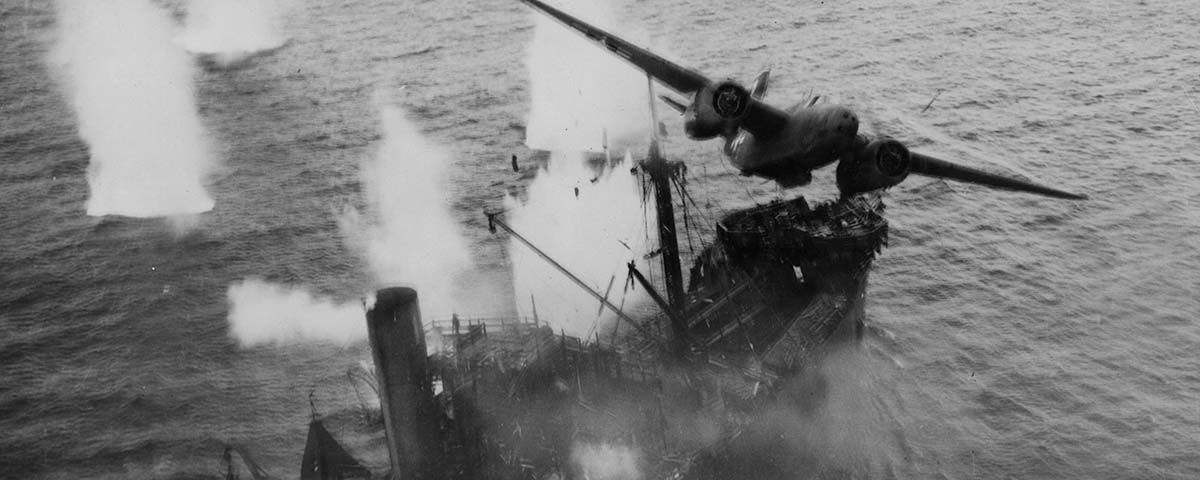
Allied air attacks were so closely timed and heavily concentrated that postmission intelligence reports judged it was impossible to ascertain which airplane or squadron actually sank each ship. B-17s flying at 7,000 feet dropped their bombs first, causing the Japanese vessels to maneuver violently and break up their formation, thereby reducing their concentrated antiaircraft firepower. That left individual ships vulnerable to strafers and masthead bombers. B-25s bombing from 3,000 to 6,000 feet also arrived overhead to drop their load of 500-pound bombs. Crew members reported seeing two burning Japanese ships ram each other while attempting to avoid the bombs. Much of the Japanese antiaircraft fire was focused on the medium-altitude bombers, which left an opening for bombers flying at minimum altitude.
Then thirteen Beaufighters swept in low on the water, strafing the whole length of the convoy. The Japanese destroyers, mistakenly thinking they were torpedo bombers, turned toward the attacking planes to present a smaller target. This left the merchant ships with even less protection. Next Major Larner’s B-25C-1s joined the fray, flying at twenty-five to one hundred feet off the water. They literally blazed a path for their masthead bomb attacks with their forward-firing .50-caliber guns.
“We were indicating about 260 mph when we passed over the target,” Maj. John Henebry described in a postmission report of a broadside attack against one ship. “I fired in as close as I could as the decks were covered with troops and supplies. Just before I pulled up to clear the mast, my co-pilot released two of our three five-hundred pound bombs, one fell short and the other scored a direct hit into the side of the ship, at water line.”
The harrowing flying and devastating outcome of another run were described by 1st Lt. Roy Moore: “During this run I ‘cork screwed’ the airplane by making undulating changes in altitude not varying from 50 to 100 feet, and at the same time skidded the airplane from one side to the other,” he recounted. “These evasive tactics were made to avoid any possible gun fire from the target. When in strafing range, I opened fire with my forward guns. The decks were covered with enemy troops. It is interesting to note that the troops were lined up facing the attacking plane with rifles in hand. However, the forward guns of the airplane outranged their small arms, as I saw hundreds of the troops fall and others go over the side before they could bring their guns to bear.”
Last in line were the A-20s. Most A-20 attacks were made in groups of two or three aircraft, which increased their firepower. This massive volley of bullets had the effect of neutralizing deck gunfire, particularly on relatively underarmed transport vessels.
The attack was beautifully timed. Allied planes arrived just after Japanese navy planes protecting the convoy had departed but before their Japanese army aircraft replacements had arrived. Twenty minutes after the attack started, the majority of ships in the convoy were sunk, sinking, or badly damaged.
That afternoon, Allied air power returned to finish the job. At three o’clock, bombers sighted seven Japanese ships: four transports burning and stationary, one destroyer burning and immobile, another abandoned destroyer drifting low in the water, and a third that was picking up survivors. At 3:15 p.m., the attack recommenced. B-17 bombs found their mark simultaneously as B-25s finished their strafing runs. The day’s carnage ended twenty-one minutes later.
March 3 was a costly day for the Japanese. Eight transports and three destroyers were at the bottom of the Bismarck Sea. The destroyer Tokitsukaze floated helplessly all night and sank at sundown on March 4. Only the destroyers Shikinami, Asagumo, Yukikaze, and Uranami managed to escape. The Allies, in comparison, lost four aircraft: one B-17 and three P-38s. Thirteen American aircrewmen lost their lives: twelve in the four lost planes, plus a gunner on one of Ed Larner’s B-25s when battle damage caused it to collapse upon landing.
On the afternoon of the fourth, the Japanese mounted a retaliatory raid on the Buna area, the site of a base the Allies had captured that January, but their fighters did practically no damage. In his memoir, Kenney smugly wrote that the Japanese reprisal occurred “after the horse had been stolen from the barn.” Regarding his Japanese counterpart, he noted that “it was a good thing that the Nip air commander was stupid. Those hundred airplanes would have made our job awfully hard if they had taken part in the big fight over the convoy on March 3rd.”
For the next several days, American and Australian airmen returned to the sight of the battle, systematically prowling the seas in search of Japanese survivors. As a coup de grâce, Kenney ordered his aircrew to strafe Japanese lifeboats and rafts. He euphemistically called these missions “mopping up” operations. A March 20, 1943, secret report proudly proclaimed, “The slaughter continued till nightfall. If any survivors were permitted to slip by our strafing aircraft, they were a minimum of 30 miles from land, in water thickly infested by man-eating sharks.” Time after time, aircrew reported messages similar to the following: “Sighted, barge consisting of 200 survivors. Have finished attack. No survivors.”
Kenney’s chief of staff, Maj. Gen. Don Wilson, insisted that the Japanese “set the pace for ‘no quarter’ procedures” after an incident involving the only Allied bomber lost in the battle. During the initial assault on the morning of March 3, bullets penetrated the wing and radio compartment of the B-17 piloted by Lt. Woodrow Moore. Fire engulfed the plane and it went into a steep dive. Before the plane disintegrated, seven of the nine-man crew bailed out, but Japanese fighters strafed the airmen as they drifted to the sea six thousand feet below.
Aircrew who witnessed this incident were incensed. Capt. James Murphy recalled, “ I wanted to vent some of my anger and kill every Japanese son of a bitch I could find.” Three P-38 pilots dove their aircraft to engage the Japanese planes that were shooting the B-17 aircrew in their parachutes. All three P-38s were shot down, but not before taking five Japanese fighters with them.
Certainly, some aircrew were motivated by revenge, but most felt that military necessity justified their actions. In fact, Allied aircrews had commenced strafing survivors immediately after the initial attacks—before the loss of Lieutenant Moore’s plane. And aircrews who hadn’t witnessed Japanese fighters fire on the Americans in their parachutes also participated in the strafing of Japanese survivors. A tactical report by 2d Lt. Charles Howe detailing his March 3 attack in B-25-C1 No. 980 is typical: “Considerable time was spent after the release of all my bombs on strafing survivors and supplies which were strewn as far as the eye could see. On one strafing run against a previously damaged destroyer, I caught the survivors in the act of launching lifeboats. After firing for about seven seconds, I ceased firing to find the lifeboats overturned and the crowd of men attempting to gain the lifeboats definitely out of action.”
At the time, strafing Japanese survivors was not controversial. The public’s view was consistent with a comment made by one officer who flew on these missions: “The enemy is out to kill you and you are out to kill the enemy. You can’t be sporting in war.” The public rejoiced after hearing media reports that Japan suffered fifteen thousand casualties at the Battle of the Bismarck Sea. The New York Times and other newspapers ran the story on their front pages, and Life magazine featured General Kenney on its cover.
Enemy documents and diaries subsequently recovered from the convoy’s wreckage revealed that those initial estimates of Japanese losses were exaggerated. One report, compiled from Japanese sources, placed the losses at 2,890. Another, compiled by the Allied Translator & Interpreter Section, suggested the Japanese lost 6,912. Despite this, Kenney and MacArthur steadfastly refused to revise their claims. Kenney threatened “action against those responsible” for questioning his assessment of the battle. A Fifth Air Force intelligence officer accused Kenney of ordering that reports and evidence suggesting lower Japanese losses be burned. MacArthur said at the time that he thought “the navy was trying to belittle the whole thing because they weren’t in on it.…It’s against the rules for land-based airplanes to sink ships, especially naval vessels. It’s bad enough for them to sink merchant vessels. They ought to be sunk by battleship gunfire or by submarines. But for airplanes to do it, especially if they aren’t naval airplanes, it’s all wrong.”
Regardless of the exact number of soldiers who perished and ships that were sunk, the Battle of the Bismarck Sea was a complete and decisive victory for Allied air power. Only 820 Japanese soldiers, minus their equipment, supplies, and weapons, made it to Lae. Kenney’s congratulatory message to his staff summed up the effort well: “Air Power has written some important history in the past three days,” he wrote. “Tell the whole gang that I am so proud of them I am about to blow a fuze.”
This article was written by Lawrence Spinetta and originally published in the November 2007 issue of World War II Magazine. For more great articles, subscribe to World War II magazine today!