Stalingrad — Stalin’s City — the industrial center on the Volga River, attracted German and Soviet divisions in the latter part of 1942 like a magnet draws metal shavings. During the heady days of that summer, the men of General der Panzertruppe Friedrich von Paulus‘ vaunted Sixth Army had sensed nothing but victory in the air. As summer dwindled into fall, however, their air of confidence was replaced by a growing sense of uncertainty and futility.
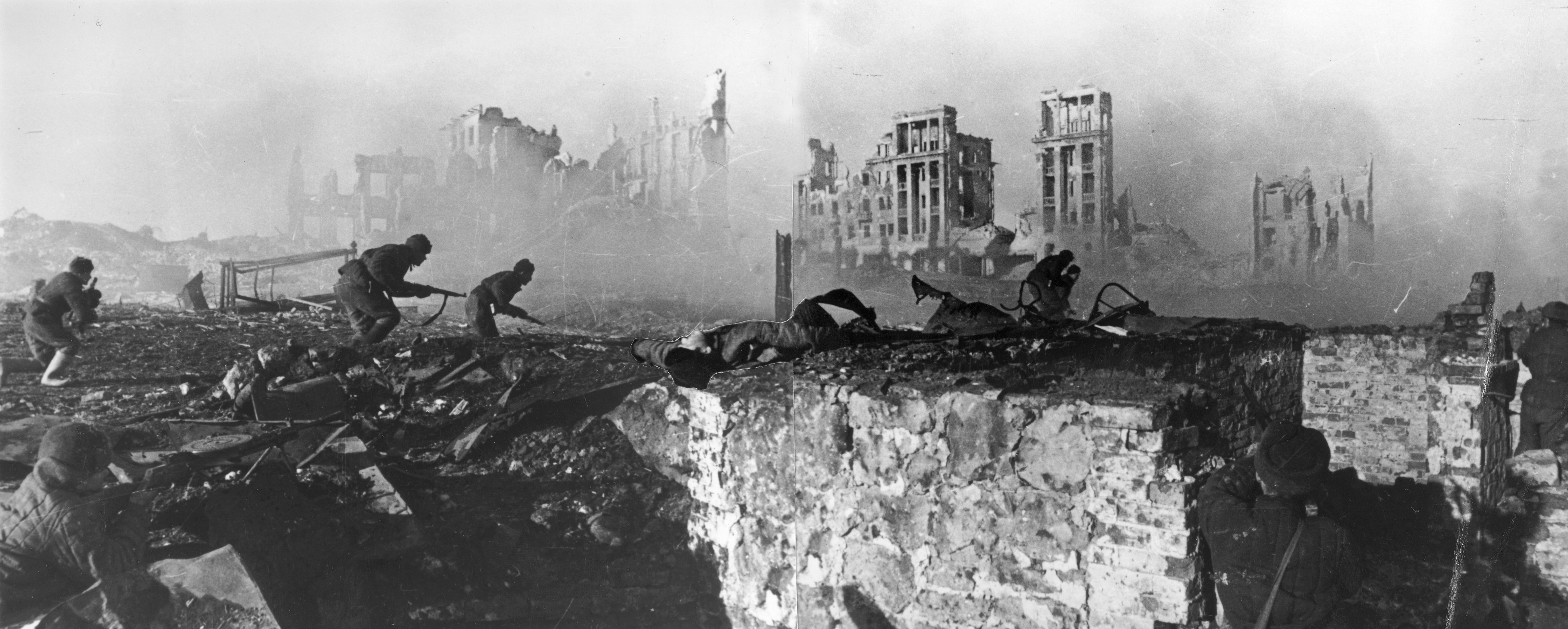
Grim hand-to-hand fighting had erupted in Stalingrad in September, and no relief was in sight. The once-powerful divisions of the Sixth Army had been severely mauled during savage house-to-house combat within the city. By early November, the great city was like a twisted, stinking corpse, full of smoldering ruins and unburied dead. Tens of thousands had already died in Stalingrad. There was little left standing to fight for, and those buildings still intact were under constant fire. Still, the Germans had orders to take the city, while the Russians had strict orders to prevent its capture. As winter approached, many of the Germans — and Soviets as well — must have been asking themselves why they were fighting and dying for such a worthless piece of real estate.
The answer was quite simple. They were dying to fuel the egos of two men — Adolf Hitler and Joseph Stalin. Hitler, who had originally planned a vast breakthrough into the oil-rich Caucasus, had become fascinated with the possibility of capturing the city that bore Stalin’s name. All the operational plans so carefully made for the German offensive in southern Russia in 1942 had been drastically altered by the Führer‘s obsession. Stalin also saw the battle for the city as a matter of honor. The Germans, he decided, would be stopped and defeated at the city that bore his name.
Once the Sixth Army reached Stalingrad, the battle had developed into small-unit actions that pitted the professionalism of the Germans against the tenacity of the Soviets. Paulus had two panzer divisions, two motorized divisions and 17 infantry divisions under his command as he approached the city in August 1942. By mid-September, however, the battle for the city proper had begun, and the German armored and mechanized units proved to be totally unfit for the street fighting that followed. Special engineer formations had to be called in to help eliminate pockets of enemy resistance within the city. The engineers suffered heavy casualties, but they gradually helped the German infantry take control of most of Stalingrad. The Soviets, however, always managed to ferry enough troops across the Volga to prevent a total takeover of the city.
Paul Böttcher, a member of the 24th Panzer Division, described his feelings during that fall: ‘We were the victors and, as we headed towards Stalingrad, we thought that we would capture the city in a few days. That was a mistake. The Russians that defended the city were brave, dogged and tough. We had heavy losses in men and equipment. The Russians had half-finished tanks, which they dug into the ground to fire at us. They fought us to the last man.’
With winter fast approaching, the Sixth Army’s parent formation, Army Group B, was dangerously overstretched. The German commanders were forced to call upon their Italian and Romanian allies to fill the gaps, especially to the northwest and southeast of Stalingrad. The troop shortage had been caused by Hitler’s all-or-nothing policy of capturing both the Caucasus oil fields and Stalingrad, which soon became a recipe for disaster.
The Red Army had learned much in the 1 1/2 years since Hitler had first sent his armies thundering into the Soviet Union. Incompetent Soviet generals had, for the most part, been replaced by cool professionals. The situation in and around Stalingrad presented those men with their first opportunity to show that they were able to level the playing field against the German invaders.
On November 19, while Soviet forces of the Southwest Front army group inside Stalingrad, under General Nikolai F. Vatutin, held onto their tenuous bridgeheads on the western bank of the Volga, troops of the Don Front, commanded by General Konstantin K. Rokossovsky, attacked the Third Romanian and Eighth Italian armies, which were in a defensive posture on the Don River, northwest of Stalingrad. A day later, General Andrei I. Yeremenko’s forces of the Stalingrad Front opened an offensive against the Fourth Romanian Army, stationed south of Stalingrad.
The assault was brilliant in both planning and execution. The Romanian divisions, many of them poorly led and poorly equipped, melted away under the Soviet onslaught. During the first four days of the attack, the Third Romanian Army lost approximately 75,000 men and almost all of its heavy equipment. The Fourth Romanian Army fared little better.
Josef Bannert was a member of the German 62nd Infantry Division, which was attached to the Eighth Italian Army. ‘When the first Russian attack began from the west bank of the River Don,’ he wrote 43 years later, ‘ the Romanian and Italian units remained in their positions for only a little time. The Russian forces advanced on the left and the right of the German units, which were used as ‘corsets’ between the Italians and the Romanians. As our allies disintegrated, we were also forced to retreat or be surrounded.’
By November 23, Yeremenko’s IV Mechanized Corps had linked up with Vatutin’s IV Tank Corps near Kalach, forming an iron ring around the Sixth Army and parts of the Fourth Panzer Army that had not been quick enough to escape the encirclement. Thus began perhaps the most critical period in the battle for Stalingrad.
Although the Soviets had succeeded in encircling the city, they still needed time to consolidate their position. An inner ring had to be formed to put pressure on the trapped enemy forces, and an outer ring was also needed–to thwart any rescue attempt. German sources generally agree that during the last week of November the Sixth Army had the ability to break through the encircling Soviet divisions. Indeed, the commander of Army Group B, Col. Gen. Maximilian Freiherr von Weichs, urged Paulus to attempt such a breakout.
Upon hearing of the encirclement, Hitler was inclined to issue an order for the Sixth Army to fight its way through to the rest of Army Group B. In fact, Paulus had requested permission to abandon Stalingrad on November 20. Unfortunately for the German soldiers fighting in Stalingrad, Reichsmarschall Hermann Göring was able to convince Hitler that his Luftwaffe could provide the supplies–about 550 tons per day–necessary to keep the Sixth Army a viable fighting force. That assurance, which would later result in the decimation of the Luftwaffe transport command, was enough to convince Hitler to order Paulus to stand and fight. Stalingrad was declared a ‘fortress,’ and the garrison was expected to defend the city to the death. Thus, instead of attempting to pierce the Soviet ring of steel, the Sixth Army began to form a defensive position, allowing the Red Army time to consolidate its gains and reinforce both the inner and outer rings around Stalingrad.
After the war there were many who questioned Paulus’ actions and strict obedience to Hitler’s orders. Lieutenant General Carl Rodenburg, commander of the encircled 76th Infantry Division, wrote: ‘During the period from 20-28 November, my division, with its left flank on the Don, was engaged in heavy fighting. At this time, the leadership of the army and the leadership of the Army Group were in agreement about the breakout. The Chief of the General Staff, General [Kurt] Zeitzler, proposed this to the highest leadership [i.e., Hitler] and attempted to get Hitler’s agreement. However, after Göring’s speech concerning his ability to supply the army, Hitler would hear no more about it [a breakout].
‘As for the claim that von Paulus must have had a similar resolve,’ Rodenburg continued, ‘there was a memorandum from the LI Armee Korps [a unit of the Sixth Army] saying that the Luftwaffe supply would not work and that a breakout, against orders, was demanded. This memo also said that the army commander [Paulus] and his chief-of-staff did not have the same resolve to go against orders.’
Field Marshal Erich von Manstein, the man who would oversee the planned rescue of the Stalingrad garrison, also questioned Paulus’ motives. ‘The only possibility would have been to present Hitler with the fait accompli of the army’s departure from Stalingrad,’ Manstein later speculated, ‘especially if the supreme command shrouded itself in silence for 36 hours, as in fact happened. It is of course possible that such a course of action would have cost Paulus, among others, his head. One can assume, however, that it was not worry over such an outcome that prevented Paulus from doing unilaterally what he saw as correct. Rather it was his loyalty to Hitler that led him to seek permission for the army to break out.’
Immediately after word of the Soviet attack reached the Oberkommando der Wehrmacht (OKW), or German high command, orders were sent to Manstein, the conqueror of Sevastopol, to take command of the Stalingrad sector. Manstein had been engaged in the siege of Leningrad until a few weeks before, and his headquarters was now located in Vitebsk. Because of inclement weather, he was forced to travel south by train.
Manstein’s new command, designated Army Group Don, was composed of the Sixth Army, Army Group Hoth (the VI and VII Romanian Army Corps, LVII Panzer Corps and XLVIII Panzer Corps), the battered Third Romanian Army, and Army Detachment Hollidt, which consisted of one panzer division, one Romanian tank division and three German and four Romanian infantry divisions. Army Detachment Hollidt was holding a tenuous line on the Chir River, some 60 kilometers from Stalingrad.
General Karl Hollidt’s forces were the nearest to Stalingrad, but he could do little to help the entrapped Sixth Army. Hollidt later recalled his position: ‘A success was not possible, at that moment, for a relief of Stalingrad because there were not enough vehicles on hand. Also, Army Detachment Hollidt was itself forced into a defensive position by superior enemy forces, which were attempting to force their way through to Rostov.’
Manstein decided that Army Group Hoth, which was located about 100 kilometers southwest of Stalingrad, would be his main striking force, but he needed time to receive the necessary reinforcements and to prepare for the counterattack. As he considered the Romanian corps all but useless, Manstein had to rely on his German divisions. Reinforcements for the LVII Panzer Corps headquarters arrived in the form of three panzer divisions: the 17th, the 23rd and the 6th. The 11th Panzer Division was also transferred from Army Group Center to reinforce the XLVIII Panzer Corps.
For the approximately 250,000 men trapped inside the Stalingrad pocketS, each day of waiting brought new privations. Rations were cut, and then cut again. Horse meat became a prized commodity. The troops scavenged for extra food, and they began to show signs of physical deterioration. The Soviets were relentless in their attacks, and casualties soon mounted to serious levels. The wounded lay in filthy hallways, and cellars were soon converted into makeshift operating rooms. At that point, however, morale was still fairly good, for the troops knew that Manstein was now in charge of getting them out.
It took 18 days for Manstein to assemble his forces and finalize his plans. He was in constant teletype communication with Paulus, who had been promoted to colonel general on November 30. The relief attempt was code-named ‘Winter Tempest.’ Once the attack began, plans were also made for the Sixth Army to attempt a breakout to link up with the advancing armored columns under the code name ‘Thunderclap.’
Winter Tempest began on December 12, with Manstein sending Hoth’s panzer divisions to smash through a line held by infantry divisions from General N.I. Trufanov’s Fifty-first Army. The weather in southern Russia was still fairly good, as the usually harsh winter had not yet set in. Manstein used the weather to good effect, concentrating air attacks from his meager Luftwaffe support on key Soviet positions.
Hitler had insisted on holding back the 17th Panzer Division, but the 6th and 23rd Panzer divisions made good progress, catching the Soviets by surprise. Soviet units were forced to retreat to the northern bank of the Askai River, where they were ordered to hold at all costs. Yeremenko sent off a series of worried communiqués to Stalin, asking for assistance. His main concern was that the panzer spearheads would penetrate the rear areas of General Fedor I. Tolbukhin’s Fifty-seventh Army, which occupied the southwest sector of the Stalingrad pocket, and that Paulus would then launch a breakout attempt of his own to meet the advancing German armor.
Stalin replied in no uncertain terms. The panzers must be stopped. He told Yeremenko that the Second Guards Army was on its way but, until it arrived, every available unit was to be thrown before the Germans. Yeremenko used the last of his reserves, the 235th Tank Brigade and the 87th Rifle Division, as well as a tank corps from the Stalingrad sector, to try to hold the Askai line. The Germans had already succeeded in establishing fairly strong bridgeheads on the northern bank, however, and were bringing more men and equipment across every hour.
For the next five days a desperate battle was fought in the hills and valleys between the Askai and Mishkova rivers. The seesaw affair broke down into individual unit combat actions. Soviet infantry companies, supported by dug-in T-34 tanks, lay in wait throughout the rugged countryside, and it was up to platoons and companies of panzergrenadiers to overcome them. Massed Soviet armor also assaulted the panzer divisions as they pushed forward. On December 14, Panzer Regiment 11 of the 6th Panzer Division reported that it had fought off an attack of some 80 Soviet tanks, destroying 43 of them in the process.
The battle finally swung in favor of the Germans when Hitler released the 17th Panzer Division. Under the weight of three German armored divisions, the Soviet defenses began to buckle. By December 18, Hoth’s tanks were advancing rapidly to the Mishkova River, fighting off enemy attacks from the flanks as they drove forward.
It was the 6th Panzer that took the lead, with the 23rd Panzer covering the right flank and the 17th Panzer covering the left. In the early hours of December 20, the 6th Panzer’s armored group, commanded by Colonel Walther von Hünersdorff, reached the Mishkova near the town of Gromoslavka. There, the Germans ran into lead elements of the Second Guards Army, which had been streaming south to stop the attack.
By then, Hünersdorff’s tanks were running low on fuel and were faced by a numerically superior enemy. Nevertheless, while waiting for his supply columns to arrive, he deployed his tanks to engage the Soviets. As the panzers blazed away at the Soviet tank and anti-tank positions, the 1st Battalion/Panzergrenadier Regiment 114, commanded by a Major Hauschildt, crossed the river and secured a bridgehead after a bitter fight. Hünersdorff immediately sent reinforcements across and was able to expand the German hold to a 3-kilometer perimeter. Stalingrad was now only 48 kilometers away.
That was later seen as the high-water mark of Winter Tempest. The battered panzer divisions ran into a stone wall in the form of the Second Guards Army after they crossed the Mishkova, and there were ominous signs that the Soviets were ready to open a new attack against Army Group Hollidt and the XLVIII Panzer Corps, which held the Chir River line.
It was time for Thunderclap to commence. If the Sixth Army could begin its breakout, it would certainly take pressure off the panzer divisions at the Mishkova River and possibly allow them to continue their offensive. However, confusion and indecision were rampant in the highest ranks of the entrapped army.
On the 18th Manstein had sent an officer from his staff, a Major Eismann, into the Stalingrad pocket to discuss Thunderclap with Paulus. In his memoirs, Manstein says that he gave the order for Thunderclap to begin on the 19th and that Paulus replied that he would need four to six days to initiate the breakout. Hitler, however, still demanded that Stalingrad be held, so Paulus had to decide whom to obey, Army Group Don or the Führer.
One of Paulus’ immediate concerns was his supply of fuel for the panzers needed to spearhead Thunderclap. He had approximately 100 serviceable tanks, but his supply records show that there was only enough fuel for a 30-kilometer advance. That would put his forces 18 kilometers short of the LVII Panzer Corps’ position.
There is, however, another factor that must be taken into account in evaluating Paulus’ response. In dealing with the harsh realities of the Eastern Front, German supply personnel soon realized that if their particular unit was in better shape than another unit, excess men, equipment and supplies would soon be siphoned off to the needier formations. Therefore, the amount of fuel and other supplies on hand was often, in reality, more than was officially reported. Since supply officers at each level–company, battalion, regiment and division–hedged their estimates, the difference between reported amounts and actual amounts of supplies could be substantial. Hence, it is possible that there may really have been sufficient fuel supplies on hand to make the linkup with the LVII Panzer Corps.
Paulus used the fuel issue, coupled with Hitler’s order to hold Stalingrad at all costs, to delay a decision concerning Thunderclap. As the days slipped away, the LVII Panzer Corps’ hold on the Mishkova bridgehead became more precarious. At Stalingrad, heavy Soviet attacks forced Paulus to use some of his precious tanks to seal what could have been dangerous penetrations. In the end, Paulus decided not to initiate Thunderclap, thus sealing the fate of the Sixth Army.
Winter Tempest was over, but the agony of the Sixth Army was to continue for more than a month. Soviet pressure finally forced the LVII Panzer Corps out of the Mishkova bridgehead. By the end of December, the Soviets had driven the panzer divisions back to their original Winter Tempest jumping-off positions. That effectively negated any chance for another attempt to free the German forces at Stalingrad.
Winter had now set in, adding snow and freezing winds to the already appalling conditions in the city. Soviet advances west of the city had also caused severe hardships. The nearby airfields, which had been used as hubs for the Stalingrad supply operation, had been overrun, forcing the Luftwaffe to use installations farther west. That, in turn, cut the tonnage of materials that each aircraft could carry, since more fuel would be needed for each flight.
Losses through combat during the final days of December were severe. Karl-Heinz Niemeyer of the 94th Infantry Division wrote: ‘The 94th was so heavily decimated during December that the remaining men were combined with the remainders of the 16th and 24th Panzer Divisions to form a Kampfgruppe [battle group].’ A new problem had also appeared. German soldiers were dying at their posts for no apparent reason. Autopsies on the bodies showed that the men were dying from malnutrition and physical exhaustion.
On January 9, thousands of leaflets were dropped over the German lines. General Rokossovsky offered surrender terms to the Sixth Army, and every man inside the pocket could read for himself what kind of provisions were included in the offer. The wounded and sick would receive immediate medical attention, and all those surrendering would be well fed. Prisoners were also promised a safe return to Germany after the war. There was also a warning: Anyone who offered resistance would be killed without mercy.
Receiving no reply, Rokossovsky resumed his offensive on January 10, unleashing a 7,000-gun barrage on the German positions. A combined armored and infantry attack followed, hitting the Germans and pushing them back. Local commanders hurriedly deployed 88mm guns from the 9th Flak Division to try to blunt the attack. The big guns destroyed more than 100 tanks, but the Soviets still kept advancing.
On January 14, the Soviets captured the Pitomnik airfield, leaving Gumrak as the only serviceable airstrip available to the Sixth Army. The capture of Pitomnik effectively ended the German aerial defense over Stalingrad. Only one German aircraft managed to escape, its pilot flying westward to safety. The following day, Paulus reported to OKW that several artillery pieces had been destroyed and abandoned because they no longer had any ammunition.
As Rokossovsky’s attack continued, losses mounted on both sides. German wounded lay unattended because of a lack of medical supplies, and morale inside the pocket rapidly began to plummet. During the final week of January, the carnage reached new heights as the pocket was steadily reduced. Soviet shells rained down everywhere within the pocket, forcing the starving defenders to seek shelter in the cellars of the ruins that were once Stalingrad.
The final blow for the Sixth Army came on January 25, when Gumrak airfield was lost. With the fall of Gumrak, the Sixth Army was completely isolated, and supplies would have to be airdropped. Making matters worse, there were now more than 20,000 wounded inside the pocket, with an equal number of men too sick or malnourished to bear arms. A sense of hopelessness now pervaded the highest levels in the entrapped army.
On January 26, the Sixty-second and Twenty-first Soviet armies linked up to split the pocket in two. The XI Army Corps, under General der Infanterie Karl Strecker, anchored itself around the tractor works in the northern part of the city. A larger pocket, consisting of the Sixth Army headquarters, the VII and LI Army Corps and the XIV Panzer Corps, was centered in an area around the railroad station. Another formation, the IV Army Corps, had been destroyed earlier in the day.
By now, some commanders were taking it upon themselves to end the killing. General der Infanterie Walter von Seydlitz-Kurzbach, commander of the LI Army Corps, repeatedly asked for Paulus’ permission to surrender during the last week of January. When his pleas were refused, he ordered his troops to expend all of their ammunition, making any further resistance impossible.
January 29 saw the Soviet forces destroy the XIV Panzer Corps and further reduce the German pocket. By now, the meager rations of the Sixth Army were being given only to those capable of fighting, leaving nothing to sustain the wounded, and the command structure within the pocket had almost completely collapsed.
At midday on January 30, the newly appointed Field Marshal Paulus was taken prisoner. His sense of duty still held firm; taken before Maj. Gen. Laskin, chief of staff of the Sixty-fourth Army, Paulus surrendered only his immediate staff. He was then driven away to a lengthy captivity. He was held under house arrest in Moscow until 1953.
The commanders of the VIII Army Corps, Generals Seydlitz-Kurzbach and Walther Heitz, surrendered their commands on January 31, but Strecker’s XI Army Corps still held out in the northern pocket. Finally, Strecker’s division commanders convinced him of the futility of further resistance. On February 2, Strecker surrendered with 33,000 men. The XI Army Corps had begun the battle for Stalingrad with 80,000 troops.
On December 18, there had been approximately 249,000 officers and men inside the Stalingrad pocket. Of that number, 42,000 sick, wounded and specialists were flown out before the last airfield fell. Another 85,000 lay dead on the battlefield, leaving about 122,000 German soldiers, and their Italian and Romanian allies, to surrender. Only about 6,000 men ever returned home. The rest lay buried somewhere in the Soviet Union.
After the war, Paulus reflected on his decisions at Stalingrad: ‘What convincing and solid arguments could have been brought forward by the Commander-in-Chief of the Sixth Army for his conduct contrary to orders in the face of the enemy, especially when he had no way of knowing the eventual outcome?…Does the prospect of one’s own death or probable destruction or the capture of one’s troops relieve one of the responsibility of soldierly obedience?…Before the troops and officers of the Sixth Army as well as before the German nation I bear the responsibility that I carried out the orders to hold on issued by the supreme command until the collapse.’
This article was written by Pat McTaggart and originally appeared in the November 1997 issue of World War II magazine. For more great articles subscribe to World War II magazine today!