

Information about the Battle Of Shiloh, a major Civil War Battle of the Western Theater during the American Civil War
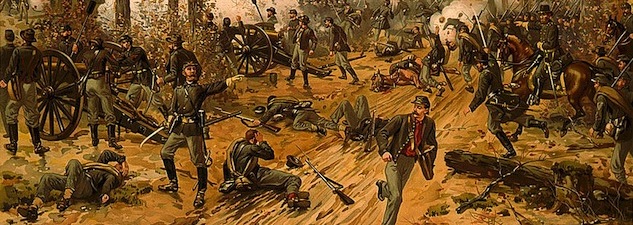
Battle Of Shiloh Summary: The Battle of Shiloh (aka Battle of Pittsburg Landing) was fought on April 6–7, 1862, in southwestern Tennessee not far from Corinth, Mississippi. General Albert Sidney Johnston, commander of Confederate forces in the Western Theater, hoped to defeat Union major general Ulysses S. Grant’s Army of the Tennessee before it could be reinforced by Maj. Gen. Don Carlos Buell’s Army of the Ohio, which was marching from Nashville.
Battle Of Shiloh Facts
Location
Location: Pittsburg Landing. Hardin County, Tennessee
Dates
Dates: April 6-7, 1862
Generals
Union:
Ulysses S. Grant, Army of the Tennessee, 47,700
Don Carlos Buell, Army of the Ohio, 18,000
Confederate:
Albert Sidney Johnston, Army of the Mississippi, 45,000
P.G.T. Beauregard (following Johnston’s death)
Soldiers Engaged
Union: 66,000
Confederate: 44,700
Important Events & Figures
Hornet’s Nest
Sunken Road
Peach Orchard
Ruggles’s Battery
Defense of Pittsburg Landing
Outcome
Outcome: Union Victory
Battle Of Shiloh Casualties
Union: 13,000
Confederate: 10,700
Battle Of Shiloh Pictures
Battle Of Shiloh Images, Pictures and Photos
Battle Of Shiloh Maps
Battle Of Shiloh Articles
Explore articles from the History Net archives about the Battle Of Shiloh
» See all Battle Of Shiloh Articles
The Battle of Shiloh Begins
Johnston initiated a surprise attack on Grant’s camps around Shiloh Church and drove the Federal forces back to a defensive perimeter on the heights above Pittsburg Landing on the Tennessee River. During the afternoon, Johnston was wounded in the leg and bled to death. He was replaced by Gen. Pierre Gustave Toutant Beauregard, commander of the Army of the Mississippi. As darkness fell, Beauregard called a halt to the fighting and pulled his weary soldiers back from the landing, where they were being shelled by two gunboats, USS Lexington and USS Tyler. He believed Grant’s army was beaten and that Buell’s army was miles away.
Buell’s men arrived and ferried across the Tennessee River during the night, and a "lost" division of Grant’s army under Maj. Gen. Lewis "Lew" Wallace, the future author of Ben Hur, finally arrived on the field. These two new arrivals added 23,000 troops to the fight. Shortly after 5:00 the next morning, Grant and Buell’s combined forces moved out, slowly but surely forcing the Confederates back until, by dark, they had retaken all the ground lost the previous day. Beauregard’s battered army withdrew to Corinth.
The Hornet’s Nest
The Hornet’s Nest was a name given to the area of the Shiloh battlefield where Confederate troops made repeated attacks against Union positions along a small, little-used farm road on the first day of the battle, April 6, 1862. Southern soldiers said the zipping bullets sounded like angry hornets; according to tradition, one man said, "It’s a hornet’s nest in there." Though long considered to have been the key to holding back the Confederate onslaught during the Battle of Shiloh long enough for Major General Ulysses S. Grant to organize a defense and receive reinforcements, historians have begun to question how significant the Hornet’s Nest was.
The narrow farm road ambles generally southeast from its junction with the Eastern Corinth Road (Corinth-Pittsburgh Road). Fairly level toward its northwest end, it makes a rather sharp climb up a hill near its center, descending again near the William Manse George cabin and the Peach Orchard. That hill, where Brigadier General Benjamin Prentiss commanded an ad hoc group of regiments, comprises the area of the Hornet’s Nest. To Wallace’s right was a division of Federals under Brig. Gen. W.H. L. Wallace, and to his left was another division under Brig. Gen. Stephen Hurlbut.
Wallace held a position stretching along the farm road from the Eastern Cornith Road and up the slope to where Prentiss’s line began. Wallace’s men were in a deep ravine on the east side of the farm road; that area is now known as the Sunken Road. Often, but erroneously, the positions of Wallace and Prentiss are lumped together as the Hornet’s Nest. Confusing matters further is the fact that as the farm road passes over the hill where Prentiss had his command, it is sunken for a portion of its 600-yard length there.
Unlike the Sunken Road (Bloody Lane) at the Battle of Antietam or the Confederate position at the base of Marye’s Heights during the Battle of Fredericksburg, the slight depression of the road along Prentiss’ position is not deep. The true defensive strength of the Hornet’s Nest position lay in the fact that the attacking Confederates had to charge uphill through obstructions of blackberry bushes and undergrowth, making it impossible for them to maintain their formations.
As dawn broke on the morning of April 6, Prentiss commanded a division of some 5,400 men. By mid-morning, it was down to about a tenth of that strength. When the Confederate battlelines had emerged from the woods to begin their attack in earnest, after initially being slowed by skirmishers, they came on "like a Kansas hurricane," in the words of a member of the Union’s 21st Missouri Regiment. Prentiss’ men routed or were captured; the few who remained gave him a small force with which to establish his hilltop position—remnants of the 18th and 21st Missouri, 12th Michigan and 18th Wisconsin.
Reinforcements came in the form of the 23rd Missouri, newly arrived at the Union camps, and the 8th Iowa, loaned to Prentiss from W. H. L. Wallace’s division. The 15th Iowa was also sent to his aid, its men warned by those fleeing to the rear not to go up there, "You’ll catch hell."
Around 10 a.m., Maj. Gen. Ulysses S. Grant, commander of the Army of the Tennessee, arrived to inspect the hilltop defensive line and ordered Prentiss to hold at all hazards. At the Hornet’s Nest, the Federals repulsed a series of Confederate charges throughout the day. The exact number is disputed, with eight as the most commonly accepted. Exploding artillery rounds and sparks falling from the flames shooting out of the muzzles of muskets reportedly started fires in the woods and some badly wounded Confederates who could not escape burned to death.
The Confederate Attacks on the Hornet’s Nest
The first Confederates to attack a portion of the Hornet’s Nest area were from the extreme right flank of Major General Benjamin Cheatham’s brigade; most of the brigade attacked Wallace in the Sunken Road area, unsuccessfully. Next came the 4th, 13th, and 19th Louisiana and 1st Arkansas of Colonel Randall Gibson’s Division, which took fire from so many different angles that Col. James Fagan of the 1st Alabama thought he must be receiving fire from other Confederates. Over the course of three charges, Gibson’s brigade was decimated. Appeals to his superior, Maj. Gen. Braxton Bragg, to make flank attacks instead of frontal assaults were rejected. Piecemeal attacks continued throughout the afternoon; Bragg failed to coordinate the assaults.
Ruggle’s Battery
Around 4:00 p.m. Confederate brigadier general Daniel Ruggles assembled the largest grand battery of artillery ever seen on the North American continent up to that time and began hurling shot and shell into the areas of the Sunken Road and the Hornet’s Nest. Despite its terrifying cacophony, the shelling inflicted few actual casualties, but events elsewhere on the field were signaling the end for the Hornet’s Nest defenders. On either flank, Federal commands were giving way after hours of intense fighting. More Confederate troops began moving to the sound of the guns in the center of the Federal line, the positions of Prentiss and Wallace.
Soon, both commanders discovered themselves outflanked by a double envelopment, albeit it an uncoordinated one. Their regiments broke for the rear, but many men were scooped up by Confederates who had gotten behind them.
Wallace was mortally wounded and left for dead on the field. Prentiss was captured—which allowed him to later write the accounts of what happened. He, of course, emphasized the defense of the Hornet’s Nest as the key to holding back the Rebel tide long enough for Grant to organize a defensive line on the bluffs above Pittsburgh Landing. Prentiss’ version was strengthened decades after the battle when a member of the 12th Missouri, who had fought at the Hornet’s Nest, was chosen as the official historian for the Shiloh battlefield. Recent research has raised many questions about that version of events, based in part on the number of bodies found on the right and left sides of the battlefield, compared with the smaller number in the center where the Hornet’s Nest lay.
The Carnage of Shiloh
Two days of fierce fighting resulted in nearly 24,000 dead, wounded or missing, and made the nation realize that The Civil War would not end quickly or without a high price in human lives. It is said that after Shiloh, the South never smiled again.
Banner image Battle of Shiloh, created by Thure de Thulstrup, Library of Congress.
Articles Featuring Battle Of Shiloh From History Net Magazines
Shiloh Article
Battle of Shiloh: Shattering Myths
The Battle of Shiloh, which took place on April 6-7, 1862, is one of the Civil War’s most momentous fights, but perhaps one of the least understood. The standard story of the engagement reads that Union troops were surprised in their camps at dawn on April 6. Defeat seemed certain, but Union Brigadier General Benjamin M. Prentiss saved the day by holding a sunken road some 3 feet deep. Thanks to the tenacious fighting in that area, it came to be known as the Hornet’s Nest.
Prentiss eventually capitulated, leaving Rebel commander General Albert Sidney Johnston in a position to drive on to victory. General Johnston, however, was soon mortally wounded and replaced by General P.G.T. Beauregard, which cost the Confederates vital momentum. Beauregard made the inept decision to call off the Confederate attacks, and the next day Union counterattacks dealt Rebel hopes a crushing blow.
This standard account of Shiloh, however, is more myth than fact. No less an authority than Ulysses S. Grant, the Union commander at the fight, wrote after the war that Shiloh ‘has been perhaps less understood, or, to state the case more accurately, more persistently misunderstood, than any other engagement…during the entire rebellion. Preeminent Shiloh authority and historian David W. Reed, the first superintendent of the battlefield park, wrote in 1912 that occasionally…some one thinks that his unaided memory of the events of 50 years ago is superior to the official reports of officers which were made at [the] time of the battle. It seems hard for them to realize that oft-repeated campfire stories, added to and enlarged, become impressed on the memory as real facts.
Unfortunately, such misunderstandings and oft-repeated campfire stories have over the years become for many the truth about Shiloh, distorting the actual facts and painting an altered picture of the momentous events of those April days. One has to look no further than the legend of Johnny Clem, the supposed Drummer Boy of Shiloh, to realize that tall tales surround the battle. Clem’s 22nd Michigan Infantry was not even organized until after Shiloh took place. Similarly, the notorious Bloody Pond, today a battlefield landmark, could be myth. There is no contemporary evidence that indicates the pond became bloodstained. In fact, there is no contemporary evidence that there was even a pond on the spot. The sole account came from a local citizen who years later told of walking by a pond a few days after the battle and seeing it stained with blood.
The long-held belief that Grant arrived at Pittsburg Landing only to be greeted by thousands upon thousands of Union stragglers is also a myth. The frontline divisions of Prentiss and Brig. Gen. William T. Sherman did not break until after 9 a.m., the latest time that Grant could have arrived at the landing. It is hard to imagine Prentiss’ troops running over two miles in less than 30 seconds, even though, by all accounts, they were pretty scared.
Cynicism aside, there is a real need to correct such errors. A newspaper columnist recently criticized the Shiloh National Military Park for removing the rotten and crumbling tree under which Johnston supposedly died, saying, So what if Johnston wasn’t exactly at that exact tree. Such an ambivalent attitude toward facts, continued and perpetuated through the years, not only produces false history but also diminishes the record of what actually happened. The most boring fact is always worth more than the most glamorous myth. In an effort to correct historical errors and analyze the myths, here is a brief analysis of several myths about the Battle of Shiloh.
The opening Confederate attack caught the Union totally by surprise.
The matter of surprise is a major topic of discussion among military historians and enthusiasts. It is one of the modern American Army’s nine principles of war that guide military plans, movements and actions. Of course, most military tactics are common sense. When fighting either a bully or an army, who would not want to sneak up on an opponent and get in the first punch?
One of the most famous of all surprises in military history is Pearl Harbor, where Japanese planes attacked the U.S. Pacific Fleet based in Hawaii. The attack on December 7, 1941, was indeed a surprise, with bombs dropping out of a clear blue sky. Shiloh is another well-known example of a supposed surprise attack. On the morning of April 6, 1862, the Confederate Army of the Mississippi under Johnston launched an attack on Maj. Gen. Grant’s Army of the Tennessee near Pittsburg Landing. One author has even gone so far as to call it the Pearl Harbor of the Civil War. In actuality, Shiloh was not all that much of a surprise.
The assertion of surprise came initially from contemporary newspaper columns that described Union soldiers being bayoneted in their tents as they slept. The most famous account came from Whitelaw Reid, a newspaper correspondent for the Cincinnati Gazette. But Reid was nowhere near Shiloh when the Confederates attacked, and he actually penned his nearly 15,000-word opus from miles away.
The idea that Reid perpetuated and that is still commonly believed today is that the Federals had no idea that the enemy was so near. Nothing could be further from the truth. For days before April 6, minor skirmishing took place. Both sides routinely took prisoners in the days leading up to the battle. The rank and file in the Union army knew Confederates were out there — they just did not know in what strength.
The problem lay with the Federal commanders. Ordered not to bring on an engagement and convinced they would have to march to Corinth, Miss., to fight the bulk of the Confederate army, the Union leadership did not properly utilize the intelligence gained from the common soldiers on the front lines. Grant was not about to go looking for a fight in early April, certainly not before reinforcements arrived from Nashville in the form of the Army of the Ohio, and certainly not without orders from his superior, Maj. Gen. Henry W. Halleck.
Thus Grant ordered his frontline division commanders Sherman and Prentiss not to spark a fight, and they made sure their soldiers understood that directive. They sent orders reinforcing Grant’s concern down the line and refused to act on intelligence coming up through the ranks.
As a result, not wanting to prematurely begin a battle, Federal skirmishers and pickets continually withdrew as the Confederates probed forward. Perhaps Sherman said it best when he noted in his report, On Saturday the enemy’s cavalry was again very bold, coming well down to our front, yet I did not believe that he designed anything but a strong demonstration.
The lower echelon leadership was not all that convinced the fight would take place at Corinth, however. For days, brigade and regimental commanders had witnessed Confederates near their camps. Several patrols even went forward, but no major Confederate units were encountered.
Finally, on the night of April 5, one Union brigade commander took matters into his own hands. Sending out a patrol without authorization, Colonel Everett Peabody located the Confederate army at dawn on April 6. His tiny reconnaissance found the advance skirmishers of the Southern force less than a mile from the Union front. The Confederates promptly attacked, and the Battle of Shiloh began.
Because of Peabody’s patrol, however, the Confederate advance was unmasked earlier than intended and farther out from the Union camps than projected. The resulting delay in the Confederate assault on the Union camps allowed the Army of the Tennessee to mobilize. Because of the warning, every single Union unit on the field met the Confederate assault coming from Corinth south, or in advance of, their camps. Peabody’s patrol warned the army and thus prevented total tactical surprise at Shiloh.
Benjamin Prentiss was the hero of Shiloh.
For decades after the battle, Prentiss was hailed as the Federal officer who took it upon himself to send out a patrol that eventually uncovered the Confederate advance and gave early warning of the attack. Likewise, Prentiss was seen as the commander who, ordered by Grant to hold at all hazards, defended the Sunken Road and Hornet’s Nest against numerous Confederate assaults. Prentiss withdrew only after the Confederates brought up 62 pieces of artillery that were organized as Ruggles’ Battery. Finding himself surrounded, however, Prentiss surrendered the noble and brave remnants of his division. Before modern scholarship began to look at new sources and examine the facts, Prentiss’ reputation grew until it reached icon status.
Prentiss’ after-action report was glowing in terms of his own accomplishments. Historians through the years then accepted that report at face value, one even labeling a photo of Prentiss as the Hero of Shiloh. Shiloh National Military Park’s long-running film Shiloh: Portrait of a Battle dramatically paints Prentiss as the chief defender the Union army had on April 6.
In actuality, Prentiss was not as involved as legend has it. He did not send out the patrol on the morning of April 6. As mentioned earlier, one of his brigade commanders, Colonel Peabody, did so in defiance of Prentiss’ orders. Prentiss rode to Peabody’s headquarters when he heard the firing and demanded to know what Peabody had done. When he found out, Prentiss told his subordinate he would hold him personally responsible for bringing on a battle and rode off in a huff.
Likewise, Prentiss was not the key defender of the Hornet’s Nest, as the area adjacent to the Sunken Road came to be called. His division began the day with roughly 5,400 men, only to dwindle to 500 by 9:45 that morning. When Prentiss took his position in the Sunken Road, his numbers were nearly doubled by an arriving regiment, the 23rd Missouri. Prentiss had lost almost his entire division, and could not have held his second line without the veteran brigades of Brig. Gen. W.H.L. Wallace’s division. It was primarily Wallace’s troops who held the Hornet’s Nest.
Prentiss was in an advantageous position to become a hero after the battle, however. Although he remained a prisoner for six months, he was able to tell his story. Peabody and Wallace were both dead from wounds received at Shiloh. Thus Prentiss took credit for their actions and became the hero of the fight. Prentiss never even mentioned Peabody in his report, except to say that he commanded one of his brigades. Likewise, Wallace was not around to set the record straight as to whose troops actually defended the Sunken Road and Hornet’s Nest. Prentiss, the only Federal officer who could get his own record out, thus benefited from public exposure. In the process, he became the hero of Shiloh.
Major General Don Carlos Buell’s arrival saved Grant from defeat on April 6.
Many historians have argued that Grant’s beaten army was saved only by the timely arrival of Maj. Gen. Don Carlos Buell’s Army of the Ohio near sundown on April 6. The common conception is that Grant’s men had been driven back to the landing and were about to be defeated when the lead elements of Buell’s army arrived, deployed in line and repelled the last Confederate assaults of the day.
The veterans of the various armies vehemently argued their cases after the war. Members of the Society of the Army of the Tennessee maintained that they had the battle under control at nightfall that first day, while their counterparts in the Society of the Army of the Cumberland (the successor to Buell’s Army of the Ohio) argued with equal vigor that they had saved the day. Even Grant and Buell entered the fight when they wrote opposing articles for Century magazine in the 1880s.
Grant claimed his army was in a strong position with heavy lines of infantry supporting massed artillery. His effort to trade space for time throughout the day of April 6 had worked; Grant had spent so much time in successive defensive positions that daylight was fading by the time the last Confederate assaults began, and he was convinced that his army could handle those attacks.
Buell, on the other hand, painted a picture of a dilapidated Army of the Tennessee on the brink of defeat. Only his arrival with fresh columns of Army of the Ohio troops won the day. The lead brigade, commanded by Colonel Jacob Ammen, deployed on the ridge south of the landing and met the Confederate advance. In Buell’s mind, Grant’s troops could not have held without his army.
In reality, the Confederates probably had little hope of breaking Grant’s last line. Situated on a tall ridge overlooking streams known as the Dill and Tilghman branches, Grant’s forces, battered though they were, still had enough fight in them to hold their extremely strong position, especially since they had over 50 pieces of artillery in line. Likewise, the troops were massed in compact positions. Good interior lines of defense also helped, and two Federal gunboats fired on the Confederates from the river. Grant poured heavy fire into the Confederates from the front, flank and rear.
The Confederates never actually assaulted the Federal line, further damaging Buell’s assertion. Only elements of four disorganized and exhausted Confederate brigades crossed the backwater in the Dill Branch ravine as gunboat shells flew through the air. Only two of those brigades undertook an assault, one without ammunition. The Confederates topped the rise and faced a withering fire. They were convinced. Orders from Beauregard to withdraw did not have to be repeated.
In fact, only 12 companies of Buell’s army crossed in time to deploy and become engaged. Grant had the situation well under control and could have fended off much larger numbers than he actually encountered. While Buell’s arrival did provide a morale boost and allowed Grant to take the offensive the next morning, Grant had the battle situation under control by the time Buell arrived.
The South would have won had Beauregard not called off the assaults.
For many years after the battle, former Confederates castigated General Beauregard for his actions at Shiloh. Their main complaint was that the army commander, having taken charge of the Confederate forces after Johnston’s death, called off the final Confederate assaults on the evening of April 6. Many argued that the Confederates had victory within their grasp and needed only one last effort to destroy Grant’s army. Beauregard, however, called off his Southern boys and thus threw away a victory. In fact, nothing could be further from the truth.
The controversy had its beginnings while the war still raged. Corps commanders Maj. Gens. William J. Hardee and Braxton Bragg later pounced on Beauregard for calling off the attacks, even though their immediate post-battle correspondence said nothing de-rogatory about their commander. After the war ended, Southerners began to argue that being outnumbered and outproduced industrially were reasons for their defeat, and also blamed the battle deaths of leaders like Johnston and Stonewall Jackson. Another key element in their argument, however, was poor leadership on the part of certain generals such as James Longstreet at Gettysburg (of course it did not help that Longstreet turned his back on the solidly Democratic South and went Republican after the war) and Beauregard at Shiloh. The sum of all those parts became known as the Lost Cause.
Hardee, Bragg and thousands of other former Confederates argued after the war that Beauregard threw away the victory. Beauregard does bear some blame, but not for making the wrong decision to end the attacks. He made the right decision, but for all the wrong reasons. The general made his decision far behind his front lines, an area completely awash with stragglers and wounded. No wonder Beauregard argued that his army was so disorganized that he needed to call a halt.
Similarly, Beauregard acted on faulty intelligence. He received word that Buell’s reinforcements were not arriving at Pittsburg Landing. One of Buell’s divisions was in Alabama, but unfortunately for Beauregard, five were actually en route to Pittsburg Landing. Based on such spotty intelligence, Beauregard thought he could finish Grant the next morning.
In the end, the decision to call a halt was the right thing to do. Taking into account the terrain, Union reinforcements and Confederate tactical ability at the time, the Confederates probably would not have broken Grant’s final line of defense, much less destroyed the Union army. The castigated Creole did not throw away a victory, he merely put himself in a position to be blamed for the defeat already transpiring.
The South would have won the battle had Johnston lived.
Another Lost Cause myth of Shiloh is that Johnston would have been victorious had not a stray bullet clipped an artery in his leg and caused him to bleed to death. According to legend, Johnston’s death caused a lull in the battle on the critical Confederate right, which slowed progress toward Pittsburg Landing. Just as important, Johnston’s death placed Beauregard in command, who ultimately called off the attacks. The result of both cause and effect situations led to Confederate defeat. To drive the point home, the United Daughters of the Confederacy placed an elaborate memorial at Shiloh in 1917, with Johnston as the centerpiece and death symbolically taking the laurel wreath of victory away from the South. Even modern scholars have sometimes taken this line of reasoning. Johnston biographer Charles Roland has argued in two different books that Johnston would have succeeded and won the battle had he lived. Roland claims that just because Beauregard failed did not mean Johnston would have. His superior leadership qualities, Roland concludes, could have allowed Johnston to spur the tired Confederate troops onward to victory.
Such a theory of certain victory fails to take many factors into account. First, there was no lull in the battle on the Confederate right because Johnston fell. A continuous rate of fire was not sustainable for several reasons, mostly logistics; ordnance departments could not keep thousands of soldiers supplied to fire constantly. Most Civil War battles were stop-and-go actions, with assaults, retreats and counterattacks.
Shiloh’s wooded terrain and choppy hills and valleys gave the soldiers plenty of cover to re-form lines of battle out of the enemy’s sight. The result was that the fighting at Shiloh did not rage continuously for hours at any one time or place. Instead it was a complicated series of many different actions throughout the day at many different points.
There were many lulls on the battlefield, some for as much as an hour’s duration. Some historians point out that a lull occurred when Johnston died, but that was more a result of the natural flow of the battle than Johnston’s death.
Second, the argument that Johnston would have won when Beauregard did not is also faulty. Johnston could probably have pressed the attack no faster than the surviving Confederate commanders on the right did.
In all likelihood, Johnston would also have been preoccupied with capturing the Hornet’s Nest, as happened after his death. Thus Johnston at best would not have been in a position to attack near Pittsburg Landing until hours after Grant had stabilized his last line of defense. As stated above, the heavy guns, lines of infantry, gunboats, exhaustion, disorganization, terrain and arriving reinforcements all were factors — some more than others — in defeating the last Confederate attempts of the day.
The myth that the Confederates would have certainly won the battle had Johnston lived is thus false. By 6 p.m., it is highly doubtful Shiloh could have been a Confederate victory even with Napoleon Bonaparte in command.
The Sunken Road was, in fact, sunken.
Coupled with the Hornet’s Nest, the Sunken Road has become the major emphasis of the fighting at Shiloh. Visitors want to see the Sunken Road and Hornet’s Nest more than any other attraction at the park. While some important fighting did take place at the Sunken Road, the entire story is predicated on the myth of the road being worn below the surrounding terrain and thus providing a natural defensive trench for the Federal soldiers. In fact, there is no contemporary evidence that the Sunken Road was sunken at all.
The road was not a major avenue of travel. The two major routes in the area were the Corinth-Pittsburg Landing Road and the Eastern Corinth Road. What became known as the Sunken Road was a mere farm road used by Joseph Duncan to get to various points on his property. As it had limited use, the road would not have been worn down as many people believe. At most, it might have had ruts several inches deep at various times during wet seasons. Post-battle photos of the road show a mere path, not a sunken trace.
Not one single report in the Official Records mentions the road as being sunken. Likewise, no soldiers’ letters or diaries exist that refer to it as sunken. Many buffs quote Thomas Chinn Robertson of the 4th Louisiana in Colonel Randall L. Gibson’s Brigade as describing the road as 3 feet deep. In reality, that soldier was in no position to see the road. Gibson’s Brigade never reached the Sunken Road and fell back in confusion. Robertson described a tangle of undergrowth that blocked his view, and even remarked that corps commander Bragg stated he would lead them to where they could see the enemy. The unit thereafter moved forward to the right, thus never allowing the quoted soldier to view how deep the road actually was. In all likelihood, the Louisianan was describing the Eastern Corinth Road or possibly even the main Corinth Road, both of which were heavily traveled thoroughfares and thus would have been eroded. Federal regiments were aligned on both roads at times during the battle.
Although the Hornet’s Nest was a wartime term, the expression Sunken Road did not appear until the 1881 publication of Manning Force’s From Fort Henry to Corinth. Thereafter, veterans began to embellish the story. The Iowa units manning the position formed a veterans organization that emphasized the Sunken Road. When the national park was established in 1894, the Sunken Road became a major tourist attraction as the park commission began to highlight certain areas to attract attention and visitation. At the same time, the proliferation of veterans memoirs in the 1890s and early 1900s keyed on the growing popularity of this location, which grew deeper with each passing volume, ultimately reaching a depth of several feet. As time passed and more publications appeared, the myth became reality. Today it is one of the best known Civil War icons that never existed.
Over the years, a variety of myths and legends about the battle have crept into American culture, and today are viewed by many as the truth. Several factors account for these falsehoods. The veterans did not establish the park until 30 years after the battle. By that time, memories had become clouded and events shrouded in uncertainty.
Likewise, the original Shiloh National Military Park commission that initially developed the interpretation of the site may have let pride affect its documentation of the Shiloh story. One of the best examples is the heightened importance of the Hornet’s Nest, which was promoted by first park historian David Reed, who had fought in the 12th Iowa in the Hornet’s Nest. Finally, the Lost Cause mentality so prevalent in the postwar South provoked antagonism against Beauregard and laments for Johnston’s death, as well as the idea that the Confederates were simply outnumbered.
Buffs and even some historians who are not very knowledgeable about Shiloh’s history have perpetuated rumors and stories that are not actually based on fact. It is regrettable that over the years the truth about the battle has become distorted. Fortunately, however, today’s historians are looking at the battle from a different perspective. Hopefully, as more research is published, the oft-repeated campfire stories will be phased out and replaced by the reality of Shiloh, which in itself is much grander and more honorable than any of the myths that have grown up about the battle. After all, truth is often stranger than fiction.
This article is adapted from a chapter in Timothy B. Smith’s forthcoming book The Untold Story of Shiloh: The Battle and the Battlefield, to be published by the University of Tennessee Press, and originally appeared in the May 2006 issue of America’s Civil War magazine.
For more great articles be sure to subscribe to America’s Civil War magazine today!
Shiloh Article 2
Eyewitness Account: The Battle of Shiloh
‘A Rebel Batery Unlimbered and Opened on Us’
Union Lieutenant William M. Reid recounts the Battle of Shiloh
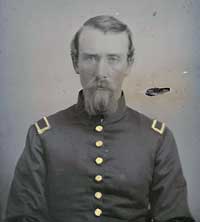 On April 6, 1862, the first day of the Battle of Shiloh, William M. Reid of the 15th Illinois Infantry scrawled in his diary: “All day we fought the Rebels but had to give way; we disputed every inch of ground. Lost four killed and sixteen wounded out of company….” The entry gave little hint of what the second lieutenant had seen during one of the war’s great bloodbaths. Reid’s regiment had rushed to shore up the Union right flank collapsing under the pressure of a Confederate surprise attack. His regiment was constantly on the move for hours as the battle roared through the woodlots and hollows along the Tennessee River. Reid saw his regimental commanders, Lieutenant Colonel Edward Eliis and Major William Goddard, killed along with dozens of his comrades. During the desperate fighting, he picked up a musket and fought as a private. After the war, while his memory was still fresh, Reid detailed his harrowing wartime experiences in a journal now preserved along with his diary at the National Civil War Museum in Harrisburg, Pennsylvania. His account of Shiloh follows with minimal editing and added paragraph breaks. Spelling has been corrected in some places for clarity.
On the way up the Tenesee River we passed the ruins of the Louisville & Nashville RR. Bridge, also that of a steamer the rebels burned after the surrender of Ft. Henry….many places we saw where the gunboats had battered down log houses, or cut off trees, undoubtedly when confederates had fired on our boats—We were truely in Dixie and geting where confederates lived.
As we aproached the landing at Pitsburg, the gunboats shelled the woods, and took every precaution against masked batteries. Then our regiment landed, and soon found ourselves in a densly wooded country interspersed with ravens, and scattered cotton fields; and small log houses here and there.
We marched about half a mile from the landing and pitched our tents, and made ourselves at home; others soon was destined to be one of the hotest battles of the war. I was, and had been for quite a time in command of the company.
Rogers being at St. Louis and Pratt being home sick. We drew new Sibly tents here, and were very comfortable.
From the time we landed on the 17th of March 1862 our cavalry were more or less engaged with the enemy and scarcely a day passed without some fatalities.
Troops continually arive and hospitals are being put in order; drill occur diely [daily], and all indication point to some important occurance in the near future—Andso the time drifted along until Friday the 4th of April, when our attack was made on a reconoitcing party, and we were sent to its support—But the enemy evidently only wanted to find out our strength, and where we were, and fell back after a slight skirmish.
The morning of April 6th Sunday, Dawned like a day in June at home. The trees were nearly in full leaf, and the woods were full of spring flowers. We had just got our breakfast, when our attention was atracted to a distant roar like the lake in a stormy November day. Knowing that we would be called on soon, our band struck up the long roll, and the companies fell into line in their company quarters, and marched out to the regimental line, and stood ready for orders; it came soon as an aid come riding with orders for Lt. Col. Ellis commanding.
We took the road behind Waterhouse’s Chicago Battery—and away we went to the front, where the roar of the action was now at its highth—Our brigade [Col. James C. Veatch commanding] had been sent to the support of Sherman, and to fill a breach on his right. Soon we got to our place across the main road to Corinth; the batery unlimbered; our regiment put on their bayonets, and laid down on their faces behind the battery. We had not long to wait; the battery in our front opened, firing over a raise, and to the front often varying their aim to the right or left, as they saw troops massing; soon the batery-men began to fall, shot by riflemen from the front.
A rebel batery apeared on their from the right and front, and shell and shot, flew over head like hail—It seemed to me as if the batery was being all cut to pieces, when sudenly four horses hitched to a cason [caisson] ran away and came down the road straight for my company. I spoke to the men and told them to give them the bayonet; they rose up presented the still [steel], and the frightened horses went around the right of the regiment. By this time too, batery had all gone to pieces, the men mostly killed. Then a regiment on our right broke and ran; this let the enemy into a space on our right; still the men laid firm. Mini[é] balls now began to come thick and fast, Lt. Col. Ellis fell, dead Major Goddard took his place to fall killed that moment as soon—Capt. Wapin went the same way. The confederates came over the brow of the bluffs about fifteen rods in our advanse, and planted their flag between two of the guns left by the baterymen.
Then we opened on them, we were firing them buck shot and an ounce ball to a charge, and at that short range proved very effectual. The southern men disappeared from our front, but those coming in on our right now began a cross fire, and soon the ground was covered with dead and dying.
One of our sargents got a ball in the forehead, and the blood flew all over me; he and I thought him dead, and did not know but that he was until I saw him some half hour afterwards, with a handkerchief around his head, fighting with the rest of the men—Seeing that we could no longer hold this ground, our officers commanded a retreat, and every man jumped for a tree. The firing now was something fearful, one could not see a rod away or hear eaven [even] a fiew [few] feet from ones his face. I got about eight of my men, and the U.S. Flag, and helping the wounded as much as I could got out of range. Some half a mile in the rear I found a line forming for another stand, and fell in with some men of the 17th and other regiments—Soon a rebel batery unlimbered and opened on us.
And here I must pause to describe one of the finest artilery duels I ever saw—This confederate batery was a long range rifle one, and rang like a crash of lightening every time it went off at the far end of the cotton field. Near us was a plain looking smooth bore twelve pound Union battery of all Germans. An aid came and ordered this Dutchman to silence the rebel batery. Does the local know I have only smooth bore guns? Asked the Dutchman. That is your orders said the aid, “Pal” said the Dutchie. I do the best I can. Then turning to his men he spoke German for about a moment.
Two guns of the German batery took each side of the field keeping close to the fence, while we infantrymen took the woods on either side to support them. Away went Dutchie’s at a galope, and soon were close onto the rebel batery, which had made so much smock [smoke] they did not see the Dutchman coming. Whirling his guns into position and double-shooting them with canisters he opened on the confederates; and in about four rounds each had completely torn the rebel batery to pieces. It seemed to me that there was not a man or horse left. Then limbering up the guns he flew back up the cotton lots, which we kept the infantry from following him. I have seen many fights since, but nothing to beat this.
All day long, on that eventful Sunday, did we fall back from our line to another, until we found ourselves, a mere squad in what is known as the hornets nest, when all the afternoon we was in the smock of the battle, hungry, thirsty, and tired almost to death.
How often they charged our position! How often we repulsed them! Until Albert Sidney Johnson fell late on Sunday afternoon; then [Union General W.H.L.] Wallace fell and his brave Iowa boys, (and they were mostly boys) fell back, until at five o’clock we were but a mere remnant around Webster’s heavy guns at the river bank, near when we were camped in the morning. During the day I had been allmost the entire length of the line, and often in no command at all. I had seen colonels of cavalry, and Majors of Artilery, fighting as privates in infantry, with muskets and bayonets. I had myself, in the early forenoon picked up a Springfield rifle and cartridge box, and used it through the entire fight afterwards. Right closed with a desperate charge of the New Orleans Guard, and some assisting regiments, through our former camp they advansed with our flag, and being clothed in dark colors, got near our line before they threw down our flag and raised their own. The big guns opened on them, and the flanking infantry and they were repulsed, with fearful loss. In the malee our new sibley tents were completely ruined; being in the midst of this attack. They looked like sives after the fight. So closed the Sunday’s battle—
On Monday Buell took the advanse, and though we were often under fire, did not get into a very hot time, until Monday afternoon when Sherman’s regulars, had failed to dislodge the enemy from a position on our right. Gen. Grant seeing the repulse of the regulars headed a charge of the 14th & 15th and we carried the position—But I anticipate, with the close of Sunday’s fighting, and the coming of night
I crawled into a vacant tent, and got some sleep. The rain fell in torents; and came through the bullet holes in the tent, and I changed often to keep partly dry. The ground around the landing was filled covered with wounded, who had accumulated during the day, faster than the surgeon could attend to them; and their moaning caused many a tired soul to lay awake in sympathy. Our field officers had all been killed the day before; and so we had Lt. Col. Lealin of the 14th assigned to command us, and he did so all day on Monday. The confederates…by Monday night were in full retreat. I think I saw nearly the last of them about four o’clock Monday—I was out with a skirmish squad, and a man on a white horse, commanding a detachment of rear guard of the confederates was retreating up a long cotton field—I heard him give his commands, as plainly as our own officers—forward guide center march, we crowded to the fense and began firing at him; his artilery unlimbered, and gave us canister; when that did not stop us, he sent his cavalry after us. We rallied by sections and repulsed the cavalry, under cover of this movement the whole command of confederates disappeared into the woods. And so ended the great battle of Shiloh, great in its results; great in casulties of my regiment the regt. lost 255 killed 8 wounded and company. In our company we lost 6 killed and sixteen wounded, some of the wounded were terably so. We had fifty men in the morning of Sunday, and lost 22 killed or wounded. Among the officers of the regiment we only had 2 captains and four lieutenants capable of duty—Both the Capt’s had bullet wounds holes through their caps. We remained on the field until after dark on Monday, and then went back to camp—to find it full of dead and wounded confederates, left from the fatal charge they made on Sunday afternoon. We managed to get them out of the way so we could lay down, and slept quite well with the dead and wounded all around—I thought I had seen shocking sights at Donaldson [Donelson]; but it did not compare with that of Shiloh. The ground in many places for half a mile was so thick with dead men one could walk the entire distance and step from one to another. On Tuesday morning we gathered our dead together and buried them in a long trench close to the camp, Col. Ellis at the head; after him the officers according to rank, and the men in regimental order; just as they had marched out to battle that glorious Sunday morning only a fiew days before. I was detailed on Wednesday to take charge of a burial party to take care of the confederates, and it was a big job. We were not quite so careful of them—A long trench about twelve feet wide and five or six feet deep was dug; government waggons were hauling them to the place, while some men were packing them into the trench, until nearly full, then the dirt was rounded over them. The dead horses was next looked after; and there were hundreds of them. Wood was piled on them, and set fire; if a horse was pretty fat he would burn; but if lean he would only half burn. The balance would lay them, and soon, the whole country smelled like a tan yard.
I was glad when after a week or ten days we were ordered to move to the front on toward Corinth. One had but little idea of the amount, of wreckage there is left on a battle field. It took a week to pick up the abandoned arms, and cannons left at Shiloh, and I don’t know how many boats to take it north, we recaptured almost all the guns they got of us Sunday, and many of their own. I saw many cannons marked, captured from Army of Potomac at this or that battle—Also one that belonged to the Washington Artilery of it a captured by this organization them from Mexicans at Monte Ray [Monterrey]….You can immagine they would never have left it if possible to save it.
I want to say one word here as to the attack at Shiloh being a surprise. It might not have been so to the Generals; but it certainly was to the men whom I saw running to the landing carrying their pants in their hands; and many others in various disable condition, as late as when we were going out to take our place at the front—now began the advanse on Corinth. Every day there was fighting at the front; often amounting to small battles. That at Monte Ray being quite severe. Gen. Hallock had assumed command, and adopted a conservation policy, and made the men throw up fortification in the heavy timber at every move; and get up every morning before daylight, and stand to arms until he was satisfied the rebels was not going to attack him. all this time the Johnnie’s are falling back on Corinth and fooling the old men of the mountains. so we proceeded until we got where we could see that they were evacuating the place, and hear the whistle of the engines on the Memphis & Charleston RR. Pope was stationed on the left and could see the movement, and we could hear the thunder of his big guns, as he tried to stop the movement. It came to a day when I was out to the front with skirmishers, and lost a man from Company “B.” The confederates were very active, and seemed to have an extra amount of men at the front 15. The next day all had left the works, and I went into Corinth without opposition—Our old man Hallock had been outwited and Beauregard had gone back to fight in the eastern army. I don’t know of so punile a campaign as that from the Landing to Corinth. If they had let Grant alone, or given Sherman the command the confederate army under Beauregard never would have gone back east again. As it was Pope followed the remnants of the army south a ways, and then came back to look at one another."
For another Union perspective, click here.
For a Confederate perspective, click here.
Article originally published in the April 2012 Civil War Times.
Shiloh Article 3
Survivors Remember Shiloh
7 Lives Altered by Shiloh: Two Fateful Days That Made Reputations, Shattered Families, and Shaped Destinies
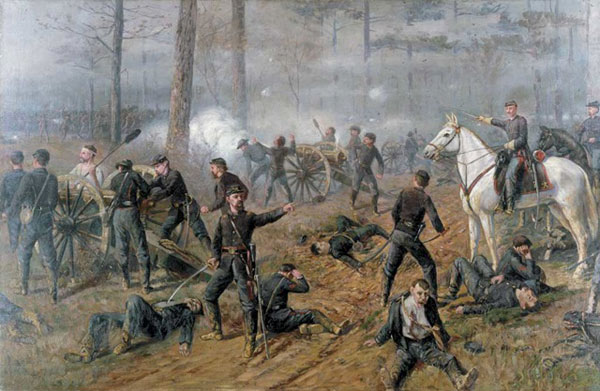
The Battle of Shiloh in April 1862 dashed any hope the war might end quickly. “From that hour,” wrote Captain L.B. Crooker of the 55th Illinois, “all sentimental talk of an easy conquest ceased upon both sides.” The Tennessee battle, which resulted in more than 23,000 casualties, changed the fortunes of many; here are just a few.
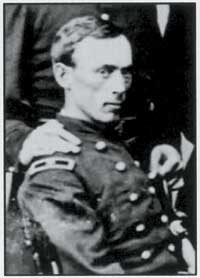 1 – Captain Andrew Hickenlooper: When fighting broke out April 6 near little Shiloh church, this unheralded commander of the 5th Ohio Battery stepped up to the challenge. As the Confederates pounded the Union position, Hickenlooper’s guns held off the attackers for more than six hours at what became known as the “Hornets’ Nest.” Recognized for gallantry after this battle, Hickenlooper was promoted to artillery commandant and would be critical to the Union victory at Vicksburg in 1863. Artist Thomas Corwin Lindsay immortalized Hickenlooper (shown directing his battery from his horse) in this 1895 painting of the Hornets’ Nest.
2 – Major General Ulysses S. Grant: Grant’s star rose dramatically with a string of victories in early 1862 that brought the Federals all the way to the Tennessee–Mississippi border. Shiloh, however, was a personal setback. Allowing his 49,000 troops to camp haphazardly around Pittsburg Landing, Grant seemed oblivious to the possibility of a Confederate attack. He did not order his men to entrench as he waited for reinforcements and was caught off-guard by the Rebels’ onslaught.
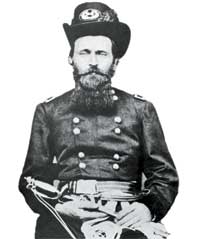 The Federals spent much of the battle’s first day waging a fighting retreat to the landing. Reinforcing Grant overnight, Maj. Gen. Don Carlos Buell and his Army of the Ohio received a great deal of credit for reversing the Federals’ fortunes the next day. Grant was heavily criticized in the press, and even temporarily demoted. Dispirited, he contemplated resigning. But after a pep talk from his friend William T. Sherman he reconsidered, and two months later, after the Federals had advanced into Mississippi, Grant was restored to command.
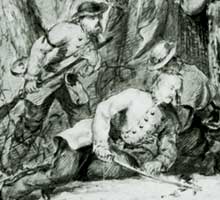 3 – General Albert Sidney Johnston: Johnston was widely considered the Confederacy’s top general until his Western armies blundered badly in Kentucky and northern Tennessee in early 1862. He hoped to restore his reputation by forcing a showdown near the railroad town of Corinth, Miss. Johnston was confident he could defeat Grant at Pittsburg Landing before Union reinforcements arrived. But the general was shot during the fighting near the Peach Orchard, suffering a wound behind the knee that might have been treatable with a simple tourniquet. Oblivious to his injury, Johnston fought until he bled to death—becoming the highest-ranking battle casualty of the entire war. President Jefferson Davis later claimed Johnston’s death marked “the turning point of our fate,” and Southerners would long ponder one of Shiloh’s great “what-ifs.”
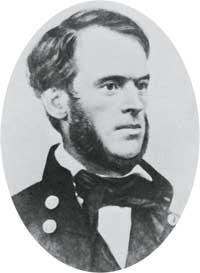 4 – Brigadier General William T. Sherman: Sherman was publicly humiliated when removed from command in late 1861, but the Battle of Shiloh proved to be his great redemption. Serving as a division commander under his friend Ulysses S. Grant, Sherman was a beacon of calm for the Union on the battle’s chaotic first day. Although he had three horses shot out from under him and was wounded twice, Sherman remained “in the thickest of the fighting.” His division held firm against the Confederates’ early onslaught, inflicting hundreds of casualties before retiring, and he helped organize the Union’s final defensive line near Pittsburg Landing that evening. “I noticed that when…death stared us all in the face, my seniors in rank leaned on me,” he recalled. On May 1, Sherman was promoted to major general. By the end of the war, his name would be cursed by Southerners everywhere.
5 – Ann Dickey Wallace: The wife of Union Brig. Gen. William H.L. Wallace traveled to Pittsburg Landing in early April 1862 intending to surprise her husband, the temporary commander of the Army of the Tennessee’s 2nd Division. Instead she arrived mid-battle. Word came that William had been killed, but he was found alive the next day. Ann rushed to her husband’s side and nursed him for three days until he succumbed to a head wound. The widow Wallace resumed life in Ottawa, Ill., with daughter Isabel, where they memorialized their beloved William with a photo of his horse, flag and portrait. She never remarried.
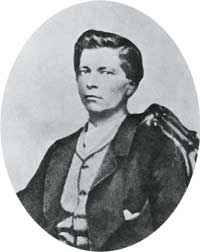 6 – Private Henry Stanley: While living in New Orleans in 1861, the 21-year-old Briton, an inveterate adventurer, was caught up in war fever and joined the Confederate Army. Stanley’s baptism by fire came with the 6th Arkansas Infantry at Shiloh. “I can never forget the impression those wide-open dead eyes had on me,” he later wrote of seeing slain comrades on the field. Stanley was taken prisoner on April 7. Feeling no particular loyalty to the Confederacy, he pledged allegiance to the Union and switched uniforms. But he’d had his fill of battle at Shiloh and soon deserted. Stanley’s Civil War adventure proved to be but one colorful episode in a life filled with many. He became a renowned journalist and African explorer. His remark upon tracking down a missing missionary in modern-day Tanzania—“Dr. Livingstone, I presume?”—made him a household name.
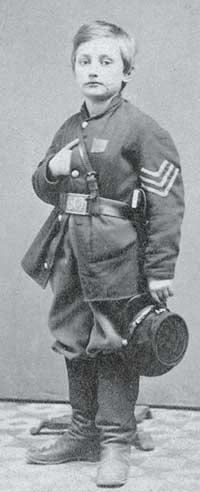 7 – Johnny Clem: Clem was only 10 when news of his exploits at Shiloh made him a hero in the Northern press. “The drummer boy of Shiloh” never panicked, the story went, even after a Confederate shell destroyed the drum he was playing. His legend grew further in September 1863 when he allegedly shot and killed a Rebel colonel at Chickamauga. “Johnny Shiloh” was celebrated in song and popular prints, although modern historians doubt the Union Army’s most famous drummer boy was even at his namesake battle. Clem wasn’t responsible for creating the myth, but he wasn’t shy about capitalizing on it. When he failed to get into West Point in 1871, he used his celebrity status to get a commission from President Grant. He retired as a major general at age 65, the last Civil War veteran still on duty with the U.S. Army. The Johnny Shiloh legend endured long after Clem’s death; a film version of the tale aired on The Wonderful World of Disney in 1963.
Shiloh Links
Links 2
Links 3