‘We are devising such measures, as I hope, if they succeed, will add as much or more to the distress of the enemy than their defeat at Trenton, and I promise myself the greatest advantages from having engaged a number of the Eastern troops to stay six weeks beyond their time of enlistment, upon giving a bounty of ten dollars.’ So wrote Major General George Washington to Robert Morris, George Clymer and George Walton in a letter from his headquarters on New Year’s Day, 1777. Washington was intent on following up his victory over the British army’s Hessian contingent at Trenton on December 26, 1776. But time was against him. The enlistments of most of his men had expired at midnight on December 31, and it would take money, morale building and all Washington’s dignity to keep them any longer.
Before the victory at Trenton, Washington’s Continental Army had been on the verge of disintegration. Washington himself remembered the humiliation of having his men pushed off Harlem Heights while a British bugler played a fox hunting call. (‘It seemed to crown our disgrace,’ noted one of his aides.) Following his calculated gamble of doubling back across the Delaware River to surprise the Hessians at Trenton the day after Christmas, Washington felt that the cards were in his hand. But it takes money to play the game, and Washington’s troops were starving. There was a rumor that a chest with 70,000 pounds sterling in it resided on the British side of the river. Washington was not about to discourage such a rumor, with the proviso that it would be better if such a chest were in American hands.
Washington had already ordered that ‘the sum that is lodged at Ticonderoga’ be brought down from the Northern Department. But that would take time–something he did not have, especially if he was to land a crushing blow. He had told Congress–and would tell it again–of his need for food and supplies, but it could not provide them. In a last-ditch effort, he had called upon the personal fortunes of friends for much-needed pay and provisions. The two parcels of money (for both his soldiers and his spies) from Morris, Clymer and Walton had arrived just in time.
‘At this trying time,’ a sergeant in his camp recalled, ‘General Washington, having now but a handful of men and many of them new recruits in which he could place but little confidence, ordered our regiment to be paraded and personally addressed us, urging that we should stay a month longer. He alluded to our recent victory at Trenton, told us that our services were greatly needed, and that we could now do more for our country than we ever could at any future period, and in the most affectionate manner entreated us to stay. The drums beat for volunteers, but not a man turned out. The soldiers worn down from fatigue and privations, had their hearts fixed on home and the comforts of the domestic circle, and it was hard to forego the anticipated pleasures of the society of our dearest friends.
‘The General wheeled his horse about, rode in front of the regiment, and addressing us again said, ‘My brave fellows, you have done all I asked you to do and more than could be reasonably expected. But your country is at stake, your wives, your houses, and all that you hold dear.
”You have worn yourself out with fatigues and hardships, but we know not how to spare you. If you will consent to stay only one month longer, you will render that service to the cause of liberty and to your country which you probably never can do under any other circumstances. The present is emphatically the crisis which is to decide our destiny.’
‘The drums beat the second time. The soldiers felt the force of the appeal. One said to another, ‘I will remain if you will.’
‘Others remarked, ‘We cannot go home under such circumstances.’
‘A few stepped forth, and their example was immediately followed by nearly all who were fit for duty in the regiment, amounting to about two hundred volunteers.’
Together with a 1,600-man Pennsylvanian brigade commanded by Brig. Gen. Thomas Mifflin, and 600 Pennsylvania militia under Colonel John Cadwalader, Washington had managed to muster about 5,200 men, though many of them were poorly trained. Cadwalader, in fact, had arrived too late to take part in the Battle of Trenton but occupied the town after Washington had pulled out. Not wishing to discourage the newly arrived reinforcements, Washington crossed the Delaware for the fourth time to join Cadwalader, then retired to the south bank of Assunpink Creek.
To the north, the overall British commander, Lt. Gen. William Howe, remained cautious, for which his subordinates criticized him. Some might even have questioned his loyalty to King George III, as Howe understood and even sympathized with the rebel cause in the American colonies. He had opposed the Coercive Acts and at one time even declared that he would refuse an American command if it were offered to him. When the call came, however, Howe accepted, citing his duty to’serve my country in distress,’ and saying, ‘A man’s private feelings ought to give way to the service of the public at all times.’
After expelling Washington from New York, Howe consolidated his victory and rested his men instead of pressing home the final, fatal blow. He had always considered his army more of an occupation force, and was certain that time and starvation would be his ultimate allies against Washington. And so, after fortifying Trenton, Bordentown, Burlington and various other posts around New Jersey, Howe had left his New Brunswick headquarters for New York, to wait out the winter. Then, however, Washington achieved his stunning victory at Trenton, killing or capturing 970 Hessian troops. It was an embarrassment that Howe could not allow to happen again.
Howe had granted Lt. Gen. Charles Cornwallis leave to tend to his ailing wife in England. Cornwallis was moments from boarding his ship when news of the Trenton disaster arrived, along with orders from Howe to deal with Washington’s army once and for all. Journeying 50 miles through harsh weather, Cornwallis quickly organized British forces in southern New Jersey and plotted to strike back at the man who had kept him from returning home. Having left 1,400 troops at Princeton under Lt. Col. Charles Mawhood and 1,200 at Maidenhead (now Lawrenceville) under Brigadier Alexander Leslie, Cornwallis had a total of 5,500 to 6,000 Redcoats with him.
On January 1, 1777, Cornwallis led his main force toward Trenton, but his progress was delayed by a series of attacks, ambushes and fighting retreats orchestrated by rebel Colonel Edward Hand. The British did not reach Assunpink Creek until 5 p.m. on the 2nd, and Washington’s troops repulsed three attacks before Cornwallis camped for the night. ‘We’ve got the old fox safe now,’ the still-confident Cornwallis is said to have remarked. ‘We’ll go over and bag him in the morning.’
While Cornwallis watched across the way, fires sparkled by the rebel tents through the night; men could be heard moving back and forth, perhaps preparing their sparse artillery for the next day’s desperate engagement. As the sun came up on January 3, Cornwallis rose and gazed across at the enemy lines. Except there was no enemy there. The rebels were gone.While Cornwallis slept, Washington had put his own plan into action. Leaving only 400 of his men to maintain a semblance of nocturnal activity in his camp, he had withdrawn his baggage and heavy artillery, with their wheels wrapped in rags to muffle the sound, south to Burlington. At 1 a.m., the bulk of his army had departed on an audacious march around Cornwallis’ force to strike at the detachment the Briton had left behind at Princeton. To cut Princeton off from reinforcements, Washington detached 350 troops under Brig. Gen. Hugh Mercer to destroy the Stony Brook Bridge.
Hugh Mercer had been labeled a rebel long before the American Colonies’ insurrection. As a young man, he had taken part in a failed coup aimed at placing Prince Charles Edward Stuart on the throne that his grandfather, James II, had lost in 1688. The last of ‘Bonnie Prince Charlie’s’ Scottish followers were crushed at the Battle of Culloden in 1746, and Mercer became a fugitive. Moving to America, he fought for Britain during the French and Indian War, during which he met and came to admire Washington. After that war, Mercer moved to Fredericksburg, Va., where he bought Washington’s boyhood home, Ferry Farm–though he would never actually live there–and even acted as a physician for Washington’s mother. When the Colonists rose against the mother country in 1775, Mercer joined the Patriots’ cause and was immediately made a colonel. He had distinguished himself again at Trenton, and it is likely that Washington had Mercer in mind when he wrote to John Hancock that the behavior of his officers ‘reflect[ed] the highest honor.’
Now it was General Mercer’s job to cut off Cornwallis’ route to Princeton and on to New Brunswick across the Stony Brook Bridge. Unknown to him, however, another British force was also on its way to the bridge.
After leaving the 40th Regiment of Foot to garrison Princeton, Colonel Mawhood had set out with 800 soldiers of the 17th and 55th regiments to join Cornwallis at Trenton. There were 276 troops of the 17th Foot with him when he reached Stony Brook Bridge at about 8 a.m.; the rest trailed a mile behind. Mawhood had expected an unimpeded march to Trenton, but he looked back and noticed what seemed to be a patrol of between 350 and 400 men who were not his own. A moment of fear and panic set in–how did they get behind him? Quickly he turned his troops around and ordered them back across the bridge. The high ground, not Trenton, was now his primary objective.
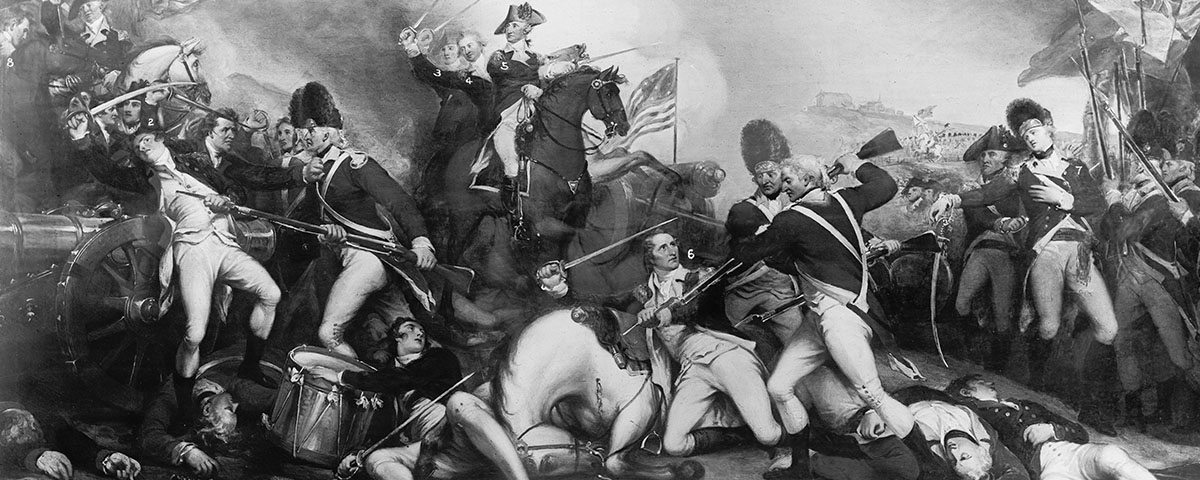
Mercer, too, realized the hill’s importance and led his men there. The race turned into a confused melee as the two forces confronted one another at Clark’s Orchard. In the first exchange of gunfire, 26-year-old Captain William Leslie, nephew of General Leslie, was struck in the left breast and side while leading a company of the 17th Foot. He died moments later in the arms of his servant, Peter MacDonald, who hastily put his body in a baggage wagon.
After several more volleys, the 17th Foot fixed bayonets. Only about 20 of Mercer’s militiamen carried muskets that mounted bayonets, and most had rifles that were slower to load than smoothbore muskets. In consequence, they fell back before the intimidating British rush. ‘No,’ Mercer ordered. ‘Forward! Forward!’ A bayonet pierced his chest, then another and another. A dozen blows or more, and the general slumped down near the hill that would later bear his name.
At that point, some of Colonel Cadwalader’s troops came up over Orchard Hill, but the more experienced British pushed them back too, leaving bayonet-pierced bodies in their wake. A rout of the Americans seemed to be in the offing, but then their commander suddenly appeared on the scene. While Maj. Gen. Nathanael Greene rallied and reorganized his troops, Washington advanced to within 30 yards of the British line. A round was fired, and suddenly the Redcoats loosed a full volley of musket balls. When the smoke cleared, however, still atop his fine horse was the tall, lean figure of General Washington. ‘Charge!’ he ordered, ‘Charge them! Pull up! Pull up!’
The Patriots regrouped, and soon it was the Redcoats who fell back. Remembering the enemy bugler’s call on Harlem Heights, Washington pressed forward, crying out, ‘It’s a fine fox hunt, boys!’
Just to the north, Maj. Gen. John B. Sullivan was busy engaging the British 40th and 55th regiments of Foot. After successfully outflanking their defenses with two regiments of his own at Frog Hollow, he managed to push the Redcoats back toward Princeton, where they took cover in and around Nassau Hall, part of the College of New Jersey (now Princeton University). Captain Alexander Hamilton led the firing upon the hall, which was bombarded with artillery. One cannonball tore the head off a picture of King George II. At that point, the British surrendered, and 194 Redcoats became American prisoners.
Mawhood realized that his only chance was to break through to Trenton. With bravado still admired in England to this day, the colonel led the 17th Foot in a bold charge in defiance of the numbers against him and managed to escape. Washington followed him closely for a time, capturing several more prisoners, but he knew it was only a matter of time before Cornwallis would show up with fresh Regulars. Wisely, he had his men destroy Stony Brook Bridge–and none too soon, for Cornwallis arrived just as the Continental rear guard was marching out.
‘My original plan when I set out from Trenton was to have pushed on to Brunswick,’ Washington later explained to Hancock, ‘but the harassed state of our own troops (many of them having had no rest for two nights and a day) and the danger of losing the advantage we had gained by aiming at too much, induced me, by the advice of my officers, to relinquish the attempt. But in my judgment, six or eight hundred fresh troops upon a forced march would have destroyed all their stores and magazines, taken (as we have since learned) their military chest containing 70,000 pounds, and put an end to the war.’ The truth of that supposition will never be known for certain.
On January 4, Washington marched his weary soldiers north to Kingston, then up the east side of the Millstone River to Somerset Court House (now Millstone). At Pluckemin, someone discovered the body of Captain Leslie in a captured baggage wagon, along with a letter to him from Continental Army surgeon Dr. Benjamin Rush, who had been a friend of the Leslies while studying medicine at Edinburgh, Scotland. Willie Leslie was buried with full military honors at Pluckemin churchyard, and after the war Dr. Rush paid for a suitable headstone.
On January 5, the Continental Army completed a 70-mile trek as its first units reached Morristown, where Washington established winter quarters on the 6th. From there, with the Watchung Mountains protecting his eastern flank, Washington effectively controlled most of New Jersey for the time being. Cornwallis pursued him only as far as Kingston, then retired to New Brunswick, his only secure base in New Jersey other than Amboy.
In his assessment of the Battle of Princeton, Washington reported that the enemy ‘in killed, wounded and prisoners must have lost near 500 men. Upwards of 100 of them were left dead in the field, and with what I have with me, and what was taken in the pursuit and carried across the Delaware, there are near 300 prisoners, 14 of which are officers, all British.’ He was unable to ascertain his own casualties because of the continued pursuit, but estimated that the’slain in the field was about 30.’
In a letter to the Secretary for the Colonies, Lord George Germain, that was partially reprinted in the London Gazette on March 12, Howe recorded his losses at: ‘1 Captain, 1 sergeant, 16 rank and file, killed; 1 Captain, 2 Lieutenants, 2 Ensigns, 5 sergeants, 48 rank and file, wounded; 1 Captain, 1 Lieutenant, 2 Ensigns, 5 sergeants, 4 drummers, 187 rank and file, missing.’ His total was 276. As for Washington’s men, Howe stated, ‘It has not come to my knowledge how much the enemy has suffered, but it is certain there were many killed and wounded, and among the former a General Mercer, from Virginia.’ He also noted that ‘The bravery and conduct of Lieutenant Colonel Mawhood, and the behavior of the regiments under his command, particularly the 17th, are highly comm[e]nded by Lord Cornwallis.’ Even Washington observed that the British regiments had made ‘a gallant resistance.’
Some estimates have Continental Army losses as high as 100 or 150, some as low as 40. By any estimate, the Americans achieved a convincing success in spite of their failure to capture–or even confirm the existence of–the 70,000 pounds. News of their victory at Princeton, coupled with that at Trenton, spread worldwide. In London it brought out ever more criticism within Parliament and among a public already having grave doubts about the war. By February 1778, following the Franco-American treaties, Prime Minister Frederick, Lord North, was making an attempt at peace, but his plan was vague and did not include American independence.
After Princeton the cause of American independence, once regarded as nothing but an ideal, became a distant but obtainable goal. The French, always ready to do whatever damage they could to the British, felt confident enough in the rebellion’s prospects to send supplies to America. After news arrived of an even greater American victory at Saratoga in October 1777, the French would go further, officially recognizing the United States and committing to an alliance.
But that was yet to come. In the meantime, Washington settled his troops in Morristown for a harsh winter. Had Trenton and Princeton not given his men a morale-sustaining taste of victory, the Continental Army very well might have disintegrated. Now Washington began seeing new enlistments. The army, and therefore the cause, was still alive.
As for Howe, his star was fading, but he managed to hold on to his command and even succeeded in capturing Philadelphia, also defeating Washington at the battles of Brandywine Creek in September and Germantown in October. After the capitulation of Lt. Gen. John Burgoyne’s army at Saratoga, however, Howe offered his resignation, fearing that he would be blamed for yet another military disaster. The offer was accepted, and after being replaced by Lt. Gen. Sir Henry Clinton on May 8, 1778, Howe sailed home to England on May 25.
Cornwallis, on the other hand, was somehow able to steer clear of most of the criticism. His next action would occur in April of that year, when he defeated Brig. Gen. Benjamin Lincoln’s men in a small skirmish at Bound Brook that he and his supporters blew out of proportion in their reports. Cornwallis would later distinguish himself at Brandywine and march into Philadelphia alongside Howe. After returning from a trip to England to bury his wife, Cornwallis assisted General Clinton in securing the surrender of Charleston in 1780, handing the Americans their worst defeat of the war. He was then entrusted with the entire southern command. In a letter to Lord Germain, dated January 8, 1777, Cornwallis had dismissed Washington’s Princeton gambit as a desperate effort and assured him that if Washington were to attempt another campaign, ‘the march alone [would] destroy his army.’ His perspective seems to have changed, however, after surrendering his army to Washington at Yorktown on October 19, 1781. At that time, Cornwallis reminded Washington of the nine-days’ wonder that had pulled the Continental Army from the brink of extinction at the start of 1777, and declared that ‘When the illustrious part that your Excellency had borne in this long and arduous contest becomes a matter of history, fame will gather your brightest laurels rather from the banks of the Delaware than from those of the Chesapeake.’