The 1832 rendezvous was in full swing. Once again, mountain men had come together from all across the Rockies to do their trading and sow a few wild oats. For a little while, at least, they left behind the hardship and mortal danger of the high mountains for the peace and quiet of a jewel-like valley of deep grass and plentiful game.
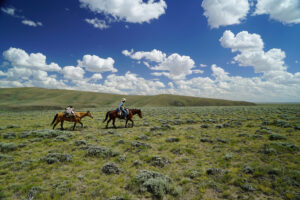
The valley was called Pierre’s Hole. It lay west of the Teton Range and was about 20 miles long and perhaps two miles wide (in present-day Teton County, Idaho). Through its lush mountain meadows, flanked by stands of timber, ran the south fork of the Teton River, headed north for its own rendezvous with the Snake River. For a few days each year, the mountain men could enjoy plenty of raw whiskey and compliant Indian women and, as the saying went,’sleep with both eyes shut.’ The valley might be full of rattlesnakes, but no Indian war party would dare disturb so many armed men.
To the west and southwest, the valley was sheltered by the Big Hole Mountains; to the south loomed the Palisade Range. Through a gap in the Palisades a trappers’ trail wound into the valley, branching up from the well-used route between the Green River and the Snake.
Across the guardian peaks of the Tetons, through Teton Pass, lay a similar oasis, Jackson’s Hole, named, like Pierre’s, for an early trapper. Pierre, in this case, was one ‘le grand Pierre’ Tivanitagon, who flourished in this wild country until the implacable Blackfeet cut him down in the winter of 1828.
Beginning in late June, the trappers rested and waited to commence trading, told tales of isolation and hardship and comrades dead in last season’s Indian fights. At noon on the 8th of July, the popping of rifle shots announced the arrival of the 180-mule supply caravan of the Rocky Mountain Fur Company. At the column’s head was its ‘booshway’ (bourgeois, or boss), the veteran trapper-turned-trader, scar-faced Bill Sublette, followed by more than 100 men.
Tagging along for safety was a party of 17 Eastern tenderfeet, led by Nathaniel Wyeth of Cambridge, Mass. Wyeth was a tough-minded Yankee entrepreneur, a former ice merchant with a nose for opportunity. He had his eyes fixed on Oregon, on what he perceived as a golden opportunity for trade in furs and salmon.
Wyeth had started west with his men and a conglomeration of trade goods and equipment. He even dragged along three incredibly clumsy boats on wheels, the better to ford western rivers. Some of his men lost heart and turned back, and Wyeth dumped the boats in St. Louis, but with the remainder of his goods and men he was still westbound, his enthusiasm unabated.
Sublette had won the race against his archcompetitor, the American Fur Company, some 1,800 miles of tough trail from St. Louis. American’s caravan, led by Lucien Fontenelle, was still far to the north, in the Big Horn Valley. Sublette’s column traveled military-style, camping in a hollow-square formation, changing their guards every four hours, standing-to before dawn each morning. Even so, it had not been an easy trip.
First, they had repulsed a Blackfoot nighttime horse raid in the Wind River country. They lost 10 horses, but the raiders did not charge home, and nobody was hurt on either side. Next, famous trapper Thomas ‘Broken Hand’ Fitzpatrick, sent from Pierre’s Hole to hurry them on, had been cut off by Blackfeet on the return trip, losing his horses, his weapons, and nearly his hair. After days alone on foot, he at last fell in with two friendly Iroquois and was brought safely to Pierre’s Hole. Exhausted, emaciated and with prematurely snow-white hair, he was a grim reminder of the death that lurked everywhere in the primeval wilderness.
Sublette’s column had brought the necessary supplies, and now both celebration and trading could begin. Sublette would have first crack at the bales of fine fur brought in by his own men, by unaffiliated trappers, and by the several hundred Indians in the basin: some Flatheads, about 120 lodges of Nez Perce, and a handful of Iroquois and Delaware. Altogether, counting men from the American and Rocky Mountain companies, the free trappers, the Indians, and some men recently employed by a bankrupt fur company, there were almost 1,000 men at the rendezvous.
The trading and roistering went on for more than a week. The trappers exchanged their precious beaver pelts for powder and ball, knives, hatchets, kettles, blankets, and the bright trade goods beloved by Indian women. They traded for fresh horses as well. The Nez Perce bred a particularly fine pony called the palouse horse, ancestor of today’s Appaloosa.
The mountain men did not seem to mind that everything was marked up as much as 2,000 percent over St. Louis prices. Life in the mountains was an uncertain thing at best. They could not know that this was the last great harvest of the beaver trade, but they did know that it was better to take life as it came, enjoying it while they could.
The trappers and Indians partook copiously of Sublette’s little square kegs of pure alcohol. Because it was unlawful to give or sell liquor to Indians, Sublette had gotten a ‘passport’ in St. Louis to carry up to 450 gallons of whiskey ‘for the special use of his boatmen.’ That was purest nonsense, of course, since Sublette came overland and had no boatmen. At the rendezvous, nobody cared how the alcohol got to Pierre’s Hole. Most of the men present simply enjoyed it, got gloriously drunk and found cooperative Indian women.
Then, whiskey drunk and their furs gone, the mountain men began to pack for the high country and the beaver streams, for the Green, the Yellowstone, the Snake and the Humboldt rivers. The rendezvous began to break up on July 17, as Sublette’s brother Milton led 13 of his men southwestward out of Pierre’s Hole.
With them were Wyeth and 10 of his people, the rest having decided that western adventure was not for them. Wyeth intended to accompany Milton Sublette to the lower Snake until he cleared Blackfoot country, then strike out for the Columbia. Also with Sublette were 15 free trappers under veteran Alexander Sinclair. A few Flathead braves tagged along; there was safety in numbers in this perilous land.
They did not get far, perhaps from too much celebration, and camped a mere eight miles south of Pierre’s Hole. Perhaps they were just cautious, wary from the horse raid on Bill Sublette’s column and from Broken Hand’s terrible experience. It was well that they were careful, for trouble was not far away.
Next morning, while they were breaking camp, the remains of their holiday mood vanished, and they reached for their long rifles. Dropping down from the Palisade Range to the south wound a long column of Indians, perhaps as many as 200 of them, displaying a British flag. The mountain men sent a couple of trappers clattering back to the rendezvous for reinforcements, looked to their priming, made a barricade of their packs, and waited. Now, as the trappers watched, most of the Indian women and children returned to the mountains, an ominous sign. The braves came on, and the trappers thumbed back their hammers, for these were Gros Ventre Indians.
All mountain men knew the Big Bellies, so-called for their insatiable appetites, capable of wearing out anybody’s hospitality. Even their kinsmen, the Arapaho, called them’spongers.’ American trappers simply called them ‘Blackfeet,’ lumping them together with that much-stronger nation whose language they often spoke, and with whom they often allied against the white man. The Gros Ventre were, however, a distinct tribe, not only acquisitive but also very tough.
This group was returning from a visit to the Arapaho, a vacation taken at least in part to escape the wrath of the British Hudson’s Bay Company, to whom the Big Bellies had been a perpetual plague and menace. In fact, this Gros Ventre party had stolen their British colors from a Hudson’s Bay Company party they had recently ambushed.
Perhaps as a ruse, perhaps sincerely, the Gros Ventre sent forward an unarmed war chief, Baihoh. He carried a red blanket and medicine pipe, a holy article with a green soapstone bowl and long, decorated wooden stem. It may be that Baihoh thought he was dealing with Fontenelle’s men, whom he knew should be in that area; the Gros Ventre were then at peace with the American Fur Company. As the Arapaho said later, Baihoh would never have advanced alone and unarmed if he knew he was dealing with his enemies, the Rocky Mountain Company men.
Milton Sublette was too old a dog to wholly trust the Big Belly envoy, but he was willing to parley. He chose, however, the wrong men to talk peace. He sent a mixed-breed Iroquois named Antoine Godin, one of the men who had rescued Broken Hand. Beside him rode a Flathead, whose tribe had been repeatedly savaged by both Blackfoot and Gros Ventre war parties.
Godin had cause to detest the Blackfeet, for they had killed his father up on Big Lost River two years before. And this chief, in Godin’s eyes, was just another Blackfoot. So, as the Gros Ventre extended his hand, Godin gripped it hard and shouted to the Flathead, ‘Fire!’ The Flathead’s rifle roared, Baihoh toppled from his horse, and before the Gros Ventre could react, Godin and the Flathead were galloping back to the trappers’ barricade, whooping and waving the red blanket–and the chief’s scalp.
A roar of rage erupted from the Gros Ventre, and the fight was on. The Big Bellies quickly took cover in a wooded, swampy area, fortifying their refuge with logs, branches and trenches dug furiously by some of their women. Both sides filled the air with lead, but there was little movement until Bill Sublette arrived with white and Indian reinforcements.
He had brought, by frontier standards, a whole army. Behind him rode some 200 white trappers, plus about 200 Flatheads and 300 Nez Perce warriors, all eager to fall on the hated Big Bellies. Taking command, Sublette got Wyeth’s greenhorns out of the line of fire, then led a force of some 60 volunteers into the willow-shaded swamp. With Sublette was veteran frontiersman Robert Campbell, with whom Sublette exchanged oral wills as they moved into combat.
The fighting soon turned into a murderous point-blank hail of arrows and rifle balls, and the Indian barricade proved a tough nut to crack. The veteran trapper Sinclair went down, mortally wounded, and was carried out of the line of fire. Sublette nailed one Gros Ventre brave peering through a chink in his barricade, but it was difficult for the besiegers to get a clear shot.
The Big Bellies were shooting well–veteran trapper Henry Fraeb lost a lock of hair to a well-aimed ball. Even under such circumstances, the Sublettes and others pressed ahead into the fire.
Bill Sublette, standing behind a tree reloading, was hit in the shoulder by a ball that went on to strike another trapper in the head. Although Sublette remained in command for a time, the shoulder was broken, and he was losing blood. He finally collapsed and was carried back to safety.
Other trappers and Indian allies fell under the Big Bellies’ accurate fire. One boozy white man wobbled into the open, climbed onto the logs of the Indian barricade, and promptly took two bullets in the head. There was considerable confusion, and the attackers recoiled. A flanking party led by Milton Sublette also failed to gain any ground from the Gros Ventre.
Even the bravest of the trappers were glad to fall back. One of them, the indestructible Zenas Leonard, later wrote that he was delighted to carry away a wounded trapper. It gave him a chance to fall back without anybody questioning his courage, and he lost no time in packing his companion out of the fight.
The trappers had now managed to cover two sides of the Gros Ventre’s position, but in doing so, they were shooting at each other as well as their enemies. It was desperate work at close quarters, and some of the trappers began to lose any enthusiasm they might have had. Wyeth, in the thick of the fight, observed dryly, ‘The idea of a barbed arrow sticking in a man’s body, as we had observed it in the deer and other animals, was appalling to us all, and it is no wonder that some of our men recoiled from it.’ Nevertheless, the attackers worked in closer and closer to the Gros Ventre line, both sides screaming insults at one another.
As the day wore on, however, ammunition began to run low–so low, in fact, that after the fight the trappers would have to return to the battlefield to dig lead from the trees. Finally, the attackers decided to burn the Big Bellies out and began to gather dry wood and brush. The Indian allies were not happy with the idea–fire would destroy the booty they hoped to gain–but they need not have worried.
Before any fire was laid, the Gros Ventre shouted that they would be avenged, that 400 lodges of their tribe were near and would exterminate the white men utterly. Somehow this threat got mistranslated into a warning that a multitude of Gros Ventre were even now plundering the trappers’ main camp back at the rendezvous. Leaving only a small guard to watch the Gros Ventre, most of the trappers immediately raced off north to save their possessions.
Other besiegers heard only ‘Blackfeet comin’, heap Blackfeet, heap big fight!’ This was enough to convince them that unseen Gros Ventre reinforcements were about to attack them directly, and many of them ran for their lives. It did not take them long to realize that no hostile reinforcements were nearby, and some returned to continue the siege of the Big Belly breastworks.
The trappers who had raced off to defend their camp did not return until after dark. They had found their possessions intact; no Gros Ventre warriors had even come near the camp. Now they waited out the long night and with the dawn began again to close in on the Gros Ventre stronghold. Closer and closer they crept, and no shot was fired. Finally, they mounted a charge, up and over the logs and branches, to find…nothing.
Sometime during the darkness, the Gros Ventre had skillfully withdrawn, taking their wounded with them. Inside their defensive position lay 20 or 30 dead horses, but only nine Indian corpses. A few more Gros Ventre bodies turned up as the trappers fruitlessly followed blood trails into the woods. The trappers also found a few forgotten white men, a wounded mountain man who soon died, and a wounded Gros Ventre squaw whom the Flatheads murdered forthwith.
The fight was over. As Wyeth somewhat melodramatically wrote, ‘The din of arms was now changed into the noise of the vulture and the howling of masterless dogs.’ That was all, except to bury the dead and collect the booty. There was lots of that, blankets and other personal possessions and a herd of several dozen horses, including the treasured pony Broken Hand had lost during his escape from the Blackfeet.
The Gros Ventre body count rose to 16, and the Big Bellies later admitted that 26 of their people had been killed. Since Indians customarily understated their losses, this was probably substantially below their actual casualties. Of the fur company men, five were dead and six wounded. Seven friendly Indians had been killed and seven more hurt.
The Gros Ventre had fought well, against great odds. Leonard honestly wrote that the Big Bellies had shown themselves to be both smarter and braver than their attackers. They had, he thought, deserved to win.
There would be more trouble to come. Although the trappers returned to Pierre’s Hole for a few days, giving Sublette time to heal a little, there were beavers to trap and miles to cover, and the mountain men began to filter off toward the far rivers. Almost immediately, one small party lost three dead to the Gros Ventre on the slopes of Jackson’s Hole. Others were picked off by ones and twos that year and later, in the merciless wilderness. Ironically, a veteran leader of the unoffending American Fur Company trappers was among those ambushed and murdered by the Gros Ventre before the year was out.
Bill Sublette, on his way east with 168 packs of precious beaver, ran head-on into the main Gros Ventre body, angry and painted for war. But the Indians were short of powder, and from long experience they were a little reluctant to tangle with ‘Cutface,’ as they called Sublette. Sublette avoided a fight, mixing a judicious combination of ready rifles and a gift of 25 pounds of tobacco. He could afford the present; his pelts were worth $85,000.
Sublette came out of the high country safely, his animals laden with the last great beaver harvest. Washington Irving, out on the frontier with a government commission, watched Sublette lead his men home: ‘Their long cavalcade stretched in single file for nearly half a mile. Sublette still wore his arm in a sling. The mountaineers in their rude hunting dresses armed with rifles and roughly mounted. . . looked like banditti returning with plunder.’
Bad as Pierre’s Hole had been for the defeated Gros Ventre, the worst was yet to come. Continuing their travel home, they now moved east of the Continental Divide, into the Absaroka Range, heartland of their bitter hereditary enemies, the Crow. At least 40 Big Bellies left their bones in Crow country, and many of those who did get home did not survive long. Only a few years after the Pierre’s Hole fight, deadly smallpox swept through the Gros Ventre, killing many members of the bands who had fought so well against Sublette’s men. It was the beginning of a sad end for a tough, proud people.
This article was written by Robert Barr Smith and originally appeared in the April 1999 issue of Wild West.
For more great articles be sure to subscribe to Wild West magazine today!