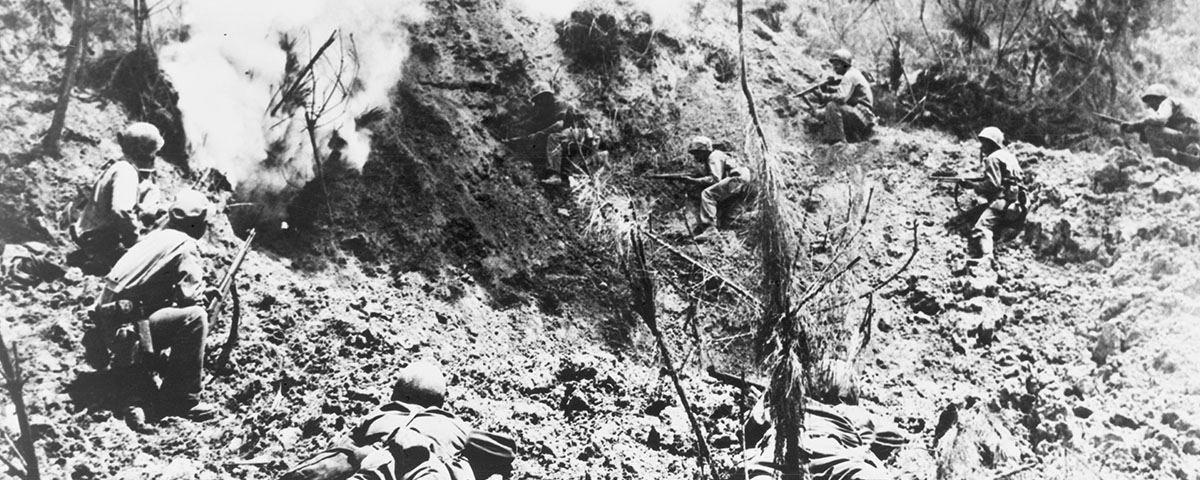
Private First Class Eugene B. Sledge of the 1st Marine Division had been fighting in 1945 on the miserable island of Okinawa for six weeks. Continuous rain transformed the terrain into a sea of mud that clutched soldiers’ boots and stalled large vehicles, while Japanese mortar and artillery shells poured down in a violent fury that mangled bodies and twisted weapons.
The island, according to Sledge, was ‘the most ghastly corner of hell I had ever witnessed….Every crater was half full of water, and many of them held a Marine corpse. The bodies lay pathetically just as they had been killed, half submerged in muck and water, rusting weapons still in hand. Swarms of big flies hovered about them.’ Wherever he looked, Sledge saw ‘maggots and decay. Men struggled and fought and bled in an environment so degrading I believed we had been flung into hell’s own cesspool.’
For almost three months, Army and Marine divisions battled to wrest the island from Japan’s tenacious grasp, and when the final shot had been fired, more men had fallen there than at any other Pacific battleground. Army and Marine troops would long retain haunting memories of that island only 360 miles southwest of Japan. It was called Okinawa.
The U.S. military wanted Okinawa for three reasons. American medium bombers could reach the Japanese home islands from Okinawa, its seizure would sever the remaining southwest supply lines to resource-hungry Japan, and Okinawa could be used as a support base for the scheduled November invasion of Japan proper.
A huge assemblage of American forces from both Admiral Chester W. Nimitz’s Central Pacific drive and General Douglas MacArthur’s Southwest Pacific thrust converged on Okinawa. Army Lt. Gen. Simon Bolivar Buckner commanded more than 180,000 troops from four Army divisions (the 7th, 27th, 77th and 96th) under Maj. Gen. John Hodge and three Marine divisions (the 1st, 2nd and 6th) led by Maj. Gen. Roy S. Geiger.
They would need every man, for more than 100,000 Japanese troops of Lt. Gen. Mitsuru Ushijima’s Thirty-Second Army patiently waited in hidden bunkers and on fortified ridges for the Americans to land. Ushijima, who stationed the bulk of his strength in Okinawa’s hilly southern region rather than its flat northern area, planned to let the Americans rush ashore uncontested before commencing his defense from an intricate system of two concentric defense lines constructed in and among a favorable series of hills, ridges and draws–the Machinato Line and, behind it, the even more fortified Shuri Line. Tokyo needed time to prepare for the expected American invasion of the home islands, so Ushijima wanted to make his adversary wrench each hill and ridge from his well-armed men.
American troops secured two positions before the actual assault of Okinawa began on L-day, which was designated as Easter Sunday, April 1. Five battalions of the Army’s 77th Infantry Division stormed ashore on five islands of the Kerama Retto group on March 26. Within three days, the 1,000 Japanese defenders had been routed, and all eight islands had been secured. Happily for the forces about to hit Okinawa, the invaders also destroyed more than 350 suicide boats, called renraku tei. The Japanese had planned to run those boats, measuring 18 feet long and 5 feet wide, alongside American ships and explode them–and hopefully the American vessels–by detonating charges.
One day before L-day, soldiers from the 77th Division seized Keise Shima, a smaller group of islets six miles off Okinawa’s southwest coast. Large artillery placed on Keise Shima would add invaluable punch to the coming offensive against General Ushijima’s force.
Everyone anticipated a bloodbath on L-day. One briefing officer told Marines, ‘This is expected to be the costliest amphibious campaign of the war’ and added that they should count on ’80 to 85 percent casualties on the beach.’ A pre-invasion bombardment would hopefully dampen the Japanese opposition, but assault troops entered the landing craft with ominous feelings. The fact that L-day also happened to be April Fool’s Day did not reassure anyone.
Surprisingly, Marines and GIs could have waded ashore in leisurely fashion, since Ushijima bided his time behind the devilish defense lines to the south. While the 2nd Marine Division feinted toward the southeast coast, Marine and Army units headed for beaches on Okinawa’s west coast, near the village of Hagushi. Rather than scrapping for each yard, elated troops jumped off their landing craft and quickly moved inland toward key airfields at Yontan and Kadena. Within three hours, Marines from the 6th Division had secured Yontan, while soldiers of the 7th Infantry Division advanced beyond Kadena–locations which strategists had figured would take three days to seize. By day’s end, 75,000 troops had established a beachhead nine miles wide and three miles deep against sporadic opposition at the cost of 28 dead and 104 wounded.
‘The carnage that is almost inevitable on an invasion was wonderfully and beautifully not there,’ wrote America’s beloved war correspondent Ernie Pyle. Troops raced eastward in an attempt to reach the eastern coast and split the island in half. In four days of rapid advance, American forces seized what planners had assumed would take three weeks. ‘I’ve already lived longer than I thought I would,’ uttered a relieved infantryman from the 7th Division.
Marines of the 6th Division who headed into Okinawa’s northern two-thirds continued to encounter light opposition. By April 13 they had advanced 40 miles and reached the island’s northern tip at Hedo Misaki. Only at the Motobu Peninsula along the western coast, where 2,000 well-entrenched Japanese battled the Marines for 12 days, was significant resistance encountered, especially on precipitous Mount Yaetake. In a preview of the ghastly fighting to occur in the south, Marines finally secured Motobu on April 20, at the cost of 213 killed or missing and 757 wounded.
While the Marines hammered their way through Motobu, starting on April 9 Army forces encountered stiff resistance from Ushijima’s first defensive positions in southern Okinawa–the Machinato Line. This line–anchored on the Machinato Inlet and a series of fortified ridges, particularly Kakazu Ridge, which blocked movement along the west coast–stretched from one side of Okinawa to the other. The bloody fighting required to neutralize each emplacement made GIs yearn for the relatively peaceful first week on the island.
For the next 2 1/2 months a seemingly endless succession of heavily defended ridges, draws, cliffs and caves stalemated Buckner’s drive. A typical ridge had Japanese machine-gun nests on the forward slope and on nearby rises that intersected each trail, while deadly mortar shells from invisible positions on the reverse slope rained on advancing GIs. Artillery, located on higher elevations to the rear, produced a terrifying carnage that swelled the death toll and sent large numbers of shellshocked troops to aid stations with neuropsychiatric conditions.
Buckner threw two divisions against this first line. While the 7th Infantry Division tried to punch through on Okinawa’s east side, the 96th Infantry Division assaulted Ushijima’s western half. At first, neither met with any success in the face of opposition from ridges that bristled with Japanese.
Typical was the 96th’s attack against Kakazu Ridge, a 280-foot elevation that housed 1,200 defenders and controlled movement along Ushijima’s western flank. On April 9, Colonel Edwin T. May’s 383rd Regiment assaulted the ridge. Hoping to catch the Japanese by surprise, May launched the attack without artillery preparation and sent his men without tank support because of a deep gorge that guarded the approaches to Kakazu. GIs scurried to the ridge’s crest in the pre-dawn charge against little opposition, but at daylight a tremendous artillery and mortar barrage smacked into May’s units. Japanese troops attacked headlong through their own fire to drive the Americans off the 25-yard-wide crest. Private First Class Edward J. Moskala of Company C miraculously silenced two machine guns by rushing straight at them from 40 yards. As the Japanese closed in, he and a small group served as a rear guard while others pulled back down the slope. Firing his weapon nonstop, Moskala ran forward to drag a wounded comrade to safety. While attempting to retrieve a second soldier, Moskala was hit by Japanese fire and killed. For his stirring actions, in which he killed 25 Japanese while protecting other Americans troops, Moskala was posthumously awarded the Medal of Honor.
In spite of heroic actions like Moskala’s, May’s units had to withdraw from Kakazu’s crest late that afternoon after absorbing horrendous casualties. Only 3 of 89 men in Company L avoided death or injury; the regiment lost 23 killed, 47 missing, and 256 wounded in that single day. The Americans had learned a costly lesson–it was suicidal to launch an attack on frontal slopes when mortars placed on reverse slopes could create such destruction. The only way to get at those damaging mortars, however, was to neutralize the frontal positions. Army units could do little else but attack frontal slopes and hope for the best.
The next day, American artillery combined with naval guns to inundate Kakazu Ridge before the next American attack jumped off. Two regiments of the 96th charged up the ridge with high expectations of holding the crest, but Japanese emerged unhurt from reverse slope positions and laid down a withering blanket of fire that stopped the advance.
All along the Machinato Line, Ushijima’s men repelled practically every attempt by the 96th Division in the west and the 7th Division in the east to seize a ridge or hill in that bloody second week of April. On April 14 General Buckner came ashore and told his commanding officers in no uncertain terms that he expected the American line to advance immediately. To speed up the offensive, he brought in the 27th Infantry Division to handle the Machinato Line’s western segment, shifted the 96th toward the middle, and retained the 7th along the east coast.
After the most concentrated artillery bombardment of the Pacific War ended–19,000 shells fell on Japanese positions–the three divisions moved out on April 19 but failed to gain much terrain by nightfall. Defenders on Kakazu Ridge mauled the 27th Division and knocked out 22 of its 30 tanks, while other Japanese soldiers halted similar drives by the 96th at the UrasoeMura escarpment and the 7th in hellish ‘Rocky Craggs.’ The first ray of hope for the Americans emerged the next day, when elements of the 27th crossed the Machinato Inlet and dashed five miles south, in effect flanking the Machinato Line.
The Army’s slow progress worried Navy leaders. Admiral Chester Nimitz, commander in chief of the Pacific Fleet, flew to Okinawa to share his branch’s concerns with General Buckner about keeping combatant and supply vessels off Okinawa to aid the stalled land drive. Each day on station subjected the ships and crews to kamikaze attacks. Nimitz suggested that an amphibious assault behind enemy lines might break the logjam, but Buckner believed his method of attacking straight at the objective was more practical. Nimitz reluctantly agreed, but reminded his subordinate: ‘I’m losing a ship and a half a day. So if this line isn’t moving within five days, we’ll get someone here to move it so we can all get out from under these stupid air attacks.’
Constant pressure against Japanese positions finally split open the Machinato Line in late April. Elements of the 7th Division seized Kochi Ridge and other key positions. The 27th snared Item pocket, and the 96th cleared the Maeda escarpment. In one attack against the Maeda escarpment, Pfc Desmond Doss earned the Medal of Honor without firing a weapon. A conscientious objector whose beliefs precluded the use of arms, Doss focused on patching up the wounded and comforting the dying. In the midst of heavy fire, Doss crawled from wounded to wounded, dressing their injuries and dragging them to the cliff’s edge, where they could be lowered to medics below. Hit by grenade fragments during one night attack, Doss refused to endanger another medic and dressed his own wounds. He continued to help those in need, even when a Japanese tank approached. When another enemy bullet shattered his arm, Doss patched it up and crawled 300 yards through enemy fire and explosions rather than expose anyone else to further danger.
American forces could now move on toward Ushijima’s main defense line–the Shuri Line, a veritable bastion of guns, shells, bullets and men that would subject GIs and Marines to a new level of horror. In preparation, Buckner rearranged his front lines. Since the Motobu Peninsula was fairly secure, he brought the 6th Marine Division down from the north to face Ushijima’s western flank and replaced the weary 27th Infantry Division with the 1st Marine Division. In the eastern half, the 77th Infantry Division moved in to give the 96th some rest, while the 7th remained on the western flank. In effect, Buckner divided Okinawa into two combat zones–the western half assigned to two Marine units and the eastern half given to two Army divisions.
Ushijima unleashed a surprise assault on the new American lines on May 3. He sent two regiments of engineers around the eastern and western flanks in amphibious assaults aimed at landing behind the American front and distracting the invaders while a third force charged straight at the American line. Disaster plagued the entire Japanese operation. American naval units off the eastern coast spotted the assault barges and demolished the hapless craft, killing most of the engineers. Other barges landed Ushijima’s western arm directly against the 1st Marine Division rather than behind it. Marine machine guns and mortars so routed this Japanese force that one Marine released the sole survivor–a carrier pigeon–with the message: ‘We are returning your pigeon. Sorry we cannot return your demolition engineers.’ The dawn attack by Ushijima’s third unit failed miserably when almost 2,000 Japanese infantry, delayed in getting to their jump-off positions, were cut down by American artillery.
The counterattack forced Ushijima to withdraw to the Shuri Line, an eight-mile path stretching from Yonabaru on the east coast, through tortuous ridges near ‘Shuri Castle,’ and on into the port of Naha on Okinawa’s west coast. Buckner began a May 11 offensive against the Shuri Line with his rearranged forces, which must have pleased Nimitz.
Army forces in the east again encountered stiff resistance from Ushijima at a number of ridges, caves and draws. Closer to the east coast, the 96th Infantry Division bogged down for two days at a key elevation called Conical Hill before gaining a foothold on its crest. After withstanding fierce counterattacks for three days, the GIs expanded their perimeter until, by May 21, they had cleared both Conical Hill and nearby Sugar Loaf Hill, which opened a seam in the eastern edge of the Shuri Line.
Along the 96th Division’s western flank, the 77th Infantry Division battled through its own hell, particularly at Ishimmi Ridge, a 350-foot rise one-third of a mile in front of Shuri. Before dawn on May 17, Lieutenant Theodore S. Bell led 204 men of the 307th Regiment to its crest, then waited for the enemy barrage that would inevitably come once daylight arrived. The Japanese delivered a deafening response, as mortar and artillery fire mixed with unbelievably thick machine-gun fire from both flanks and the nearby heights at Shuri. By 10 a.m., all but one of the regiment’s 60mm mortars had been destroyed, and most of its radios had been knocked out.
All day long the regiment withstood heavy fire as supplies rapidly diminished. By nightfall, the isolated unit pulled back to its command post in a last-ditch stand to hold onto the ridge, hoping that reinforcements would arrive before the Japanese overran their positions. One relief force tried to reach the beleaguered men, but had to turn back before gaining the crest because of stiff Japanese resistance.
Fighting continued the next morning. When soldiers exhausted their supplies of grenades or bullets, they crawled to the bodies of fallen comrades to retrieve whatever ammunition they could find there. Some wounded men asked their buddies to prop them up and put a weapon in their hands so they could help fight, but by late afternoon only six reinforcements–one officer and five men–had been able to battle through the Japanese to reach the perimeter. Later that day a few more men arrived with fresh supplies, but the situation for the 307th looked bleak.
Help finally arrived late on the third day, when men from the 306th Regiment punched a corridor through to the surrounded men. As each fresh soldier checked in, an exhausted GI from the 307th was able to leave his position and stumble down to rear areas for much-needed rest. The regiment paid dearly for Ishimmi Ridge. Of the 204 men who charged up on May 17, only 48 returned on May 20 without serious injury.
Marines fighting along the western half of Buckner’s line faced an equally tough task in eliminating the stronghold at Shuri and thus dissolving Ushijima’s line. Four locations in particular tested Marine valor–Dakeshi Ridge, Wana Ridge, Wana Draw and, above all, Sugar Loaf. To sweep into Shuri, Marines had to clear both Dakeshi and Wana ridges while under enfilading fire from their flank, then enter the 400-yard mouth of Wana Draw and advance 800 yards along its ever-narrowing path toward Shuri Heights and Shuri Castle, dodging machine-gun bullets and mortar shells from the hundreds of Japanese weapons emplaced on either side. Ushijima’s artillery on Shuri Heights could direct horrendous barrages on Marines below.
The 1st Marine Division jumped off toward Dakeshi Ridge on May 11 but gained little ground against an enemy dug in on both slopes. The Marines would move forward a bit, constantly exposed, then be driven back by deadly artillery or machine-gun blasts. Sergeant Neil Van Riper recalled: ‘I’d be flat on the ground and notice an ant or a bug and think, ‘I wish I was that small.’ There was never a time when you weren’t afraid.’ While buddies laid down thick covering fire, a solitary Marine would cautiously crawl toward an enemy machine-gun nest or cave and toss in a satchel charge or grenade. Finally, after three days of arduous combat, Dakeshi Ridge fell.
Wana Ridge and Wana Draw took longer. Marines first entered Wana Draw on May 14 but could not advance against the thick fire emerging from hundreds of positions. One Marine tank crew pumped six phosphorus smoke shells into a single cave entrance, then watched in astonishment as smoke billowed forth from more than 30 other entrances. A Marine could knock out one location only to come under fire from three other hidden nests. The Japanese were so thoroughly dug in that even heavy artillery bombardment failed to shake them. Maj. Gen. Wilburt S. Brown, commander of the 11th Regiment, watched his artillery pulverize ridge tops and thought that ‘nothing could possibly be living in that churning mass where the shells were falling and roaring, but when we next advanced, the [Japanese] would still be there, and even madder than they had been before.’
The incessant shelling from both sides, combined with torrential rains that commenced on May 21, transformed Wana Ridge and Wana Draw into stark landscapes denuded of any beauty. Bodies of fallen Marines and dead Japanese infiltrators frequently had to be left where they lay, since retrieving them only further exposed more men to the artillery placed on Shuri Heights. Decaying forms, teeming with fattened maggots, slowly rotted in the muck or were blown to tiny bits by subsequent shells. Sledge recalled, ‘It is too preposterous to think that men could actually live and fight for days and nights on end under such terrible conditions and not be driven insane.’
Cold rain caused the soldiers’ skin to shrivel and whiten from exposure, while infiltrators ensured that few Marines ever caught more than a moment of rest. Incidences of combat fatigue soared. Sledge, who had survived grisly combat at Peleliu, concluded that Wana Draw ‘was the most awful place conceivable for a man to be hurt or to die.’
Ushijima started pulling his troops out of Wana Draw and the Shuri Line near the end of May, which allowed Marines to pour into Shuri. Short on men and supplies, the Japanese commander could no longer hold back the better-equipped foe. And more Marines had swung over to Shuri after securing another of hell’s corners–Sugar Loaf.
Upon getting his first look at Sugar Loaf, one Marine described it as a ‘pimple of a hill.’ Sparsely dotted with trees and shrubs, the rise’s 300 yards of frontage rose to only about 75 feet before leveling off into a thin crest. Beneath its serene veneer, however, 2,000 Japanese defenders patiently waited to deliver deadly blows. Combined with Horseshoe Hill to its south and Half Moon Hill to its southeast, Sugar Loaf formed the point of a lethal arrowhead pointing from Shuri directly at approaching Marines.
Company G of the 22nd Regiment’s 2nd Battalion, 6th Division, commanded by Captain Owen T. Stebbins, commenced a week-long pattern of rushing to Sugar Loaf’s crest, briefly holding on in the face of enormous opposition, then abandoning the slopes. On May 12 Stebbins guided three platoons up Sugar Loaf’s slopes, but enemy gunfire quickly pinned down two of the three platoons. Stebbins and Lieutenant Dale W. Bair led 40 men of the third platoon in a charge toward the crest, but within 100 yards, 28 had fallen. After a horrifying ordeal at the summit, the harassed survivors had to pull back. The next day, repeated assaults to gain the top failed. In the afternoon, 44 Marines were stranded on Sugar Loaf’s slopes by punishing fire that had already killed or wounded 106 Marines. The battalion’s executive officer, Major Henry A. Courtney, Jr., figured he was in one of those situations where he was too weak to defend his position, so he might as well attack.
Courtney barked, ‘Men, if we don’t take the top of this hill tonight, the [Japanese] will be down here to drive us away in the morning.’ He explained that when they reached the summit, he wanted them to toss every grenade they had at the enemy, then dig in. He asked for volunteers. ‘When we go up there, some of us are never going to come down again,’ Courtney continued. ‘You all know what hell it is on the top, but that hill’s got to be taken, and we’re going to do it. I’m going up to the top of Sugar Loaf Hill. Who’s coming along?’
All 44 followed their determined leader, reached the summit, and repelled a banzai attack. Sadly, the mortar and artillery bombardment gradually depleted the small group, who had to withdraw from Sugar Loaf the next morning. Unfortunately, Courtney did not return with them, as a Japanese hand grenade inflicted a mortal gash in his neck. For his stirring words and actions, Courtney was posthumously awarded the Medal of Honor.
May 16 brought the fifth straight day of ebb and flow combat when four separate charges to the crest failed, each one leaving behind more grim reminders of war’s toll. Correspondent Elvis Lane stared at the carnage and wrote: ‘Corpses litter the gray, muddy landscape. There are numerous severed arms and legs. And an occasional head….Some of the corpses seem to be grinning. The flesh has rotted away from the skull and the teeth are bared. I am afraid that if I stare, one of these grinning dead might ask: ‘Don’t you belong with us?”
A breakthrough finally occurred on May 17, when a battalion seized a large portion of Half Moon Hill, which meant the Marines could count on increased fire support for another attempt up Sugar Loaf the next day. Since Japanese artillery on Wana Ridge was gradually being reduced by the 1st Division to the east, Marines looked ahead to a speedy conclusion.
Two diversionary attacks on May 18, one against Half Moon and Horseshoe hills and the other toward Sugar Loaf’s right end, succeeded in drawing much of the enemy’s fire. This allowed a force of tanks and infantry to rush around the hill’s left flank, attack Sugar Loaf from the rear, and rout the remaining defenders.
At last, Sugar Loaf fell silent. Seven maddening days of assaults cost the 6th Division 2,662 killed or wounded and another 1,289 to exhaustion or combat fatigue. Correspondent Lane summarized how most who fought at Sugar Loaf must have felt: ‘Thank God there are no signs, none whatsoever, that the enemy is again rushing troops forth to try and recapture this hill. I’ve lost count of how many times Sugar Loaf was seized by us, by them, and how many days we’ve been here. The silence convinces us that Sugar Loaf really does belong to the [Marines].’
Successful actions all along the Shuri Line forced Ushijima to withdraw south to his last-ditch perimeter near the end of May. Ushijima set up his final command post in a cave near the sea and waited for the end.
Army and Marine assaults in June further weakened Ushijima’s hold on Okinawa. Marines cleared the Oroku Peninsula in the west, while Army infantry shattered Ushijima’s eastern flank by routing Japanese defenders at Yaeju-dake. Ushijima’s men had nowhere to go now–either death or surrender stared them in the face.
On June 18, General Buckner was felled by enemy shellfire while observing the activity of a new unit at a forward post. Major General Roy S. Geiger succeeded Buckner, who became the highest-ranking American killed in action in World War II.
Buckner’s counterpart across the lines fared no better. On June 20, 7th Infantry Division troops reached the top of Hill 89, which housed Ushijima’s headquarters. When a Japanese prisoner of war shouted a surrender offer into the cave, a huge demolition charge blew shut the cave entrance. Two days later, as American forces entered the cave’s upper levels, the Japanese commander stepped onto a small ledge overlooking the sea, knelt down on a white sheet, then thrust a knife into his abdomen a split second before an aide’s sword lopped off his head.
Ushijima’s chief of staff, Lt. Gen. Isamu Cho, penned a final message moments prior to taking his own life: ‘Our strategy, tactics, and techniques were all used to the utmost. We fought valiantly, but it was as nothing before the material strength of the enemy.’
Okinawa became the bloodiest battle of the Pacific War. More than 100,000 Japanese died, a frightening number matched only by the tally of unfortunate Okinawan citizens who perished in the fighting. Army casualties of more than 4,600 dead and 18,000 wounded were almost equaled by 3,200 Marines dead and 13,700 wounded. Even the Navy, which avoided the horrendous ground combat, lost almost 5,000 dead and 4,900 wounded to kamikaze attacks. Ironically, though Okinawa was a victory for the United States, its extremely large toll shocked military strategists. If Okinawa produced such carnage, what might happen when American forces stepped onto Japanese home soil? That dreadful thought hung over every Pacific battler, and lessened opposition among high government and military figures to using the atomic bomb in hopes of ending the war.