The Japanese defending Iwo Jima on D-day displayed superb tactical discipline. As Lieutenant Colonel Justus M. “Jumpin’ Joe” Chambers led his 3rd Battalion, 25th Marines, across the first terrace on the right flank of the landing beaches, he encountered interlocking bands of automatic-weapons fire unlike anything he had faced in Tulagi or Saipan. “You could’ve held up a cigarette and lit it on the stuff going by,” he recalled. “I knew immediately we were in for one hell of a time.”
The Battle of Iwo Jima represented to the Americans the pinnacle of forcible entry from the sea. This particular amphibious assault was the ultimate “storm landing,” the Japanese phrase describing the American propensity for concentrating overwhelming force at the point of attack. The huge striking force was more experienced, better armed and more powerfully supported than any other offensive campaign to date in the Pacific War. Vice Admiral Raymond A. Spruance‘s Fifth Fleet enjoyed total domination of air and sea around the small, sulfuric island, and the 74,000 Marines in the landing force would muster a healthy 3-to-1 preponderance over the garrison. Seizing Iwo Jima would be tough, planners admitted, but the operation should be over in a week, maybe less.
By all logic, the force invading Iwo Jima should have prevailed, quickly and violently. But the Japanese had also benefited from the prolonged island campaigns in the Pacific. Lieutenant General Tadamichi Kuribayashi commanded the 21,000 troops on the island. Formerly a cavalry officer, Kuribayashi was a savvy fighter, one who could glean realistic lessons from previous combat disasters. He decided to junk the defensive tactics used by his predecessors in the ill-fated campaigns in the Gilberts, Marshalls and Marianas. Significantly, Japanese forces on Iwo Jima would defend the island in depth—from hidden interior positions, not at the water’s edge—and they would eschew the massive, suicidal banzai attacks. Kuribayashi figured if the garrison could maintain camouflage and fire discipline, husband its resources and exact disproportionate losses on the invaders, maybe the Americans would lose heart. His senior subordinates may have grumbled at this departure from tradition, but Kuribayashi’s plan made intelligent use of Iwo’s forbidding terrain and his troops’ fighting skills.
Two well-armed antagonists had thereby set the stage for a violent confrontation close to Japan’s home waters. The ensuing battle produced memorable results:
1.) Thirty-six days of unremitting hell on a small, wretched, reeking island.
2.) The only major battle in the Pacific War in which the U.S. Marines suffered greater casualties than they inflicted on the Japanese defenders.
3.) Lingering controversies over the high costs and disputed dividends of the Pyrrhic victory.
4.) An enduring tribute—now embodied in the world’s largest bronze sculpture–to the fortitude of young Americans of all services who surpassed themselves under conditions we today can hardly imagine.
Iwo Jima means “Sulfur Island” in Japanese. It is one of the Volcano Islands that extend east of Okinawa and roughly south of Japan itself. The island is about eight square miles, larger than Tarawa, but much smaller than Saipan or Guam. Hilly, rocky, and generally barren, the island did not figure in the grand strategy of the Pacific for the first several years of the war. Formosa was the longtime goal of the Americans’ Central Pacific drive, once General Douglas MacArthur had recaptured the Philippines. But Formosa was huge, stoutly defended, and still a long stretch for bombing runs against the empire. Meanwhile, the Japanese built airstrips for their own bombers and fighters on previously unoccupied Iwo Jima. Planners on both sides could see the geographic reality. Iwo Jima was almost exactly halfway between the Marianas and the Japanese home island of Honshu.
Operational airfields represented valuable rungs in the strategic ladder leading to Tokyo. The American seizure of the Marianas in mid-1944 brought the main Japanese home islands within range of the newly developed Boeing B-29 Superfortress of the Army Air Forces. B-29s based in Saipan and Tinian began striking targets in Japan in late 1944, but the strikes were not yet truly effective. The thorn in the side was Iwo Jima.
Since no American fighters had the “leg”‘ to escort the Superfortresses to and from Japan, the B-29s were often at the mercy of fighter interceptors launched from Iwo’s airstrips. And Japanese bombers based on Iwo were an even graver threat. In fact, the Twentieth Air Force lost more B-29s to enemy bomber raids from Iwo Jima than it did on any of its long-range forays over the Japanese homeland. The absence of an emergency landing or refueling field for B-29s along the return route from Tokyo was yet another problem for strategic planners. In American hands, Iwo Jima would provide fighter escorts and a suitable divert base; the threat from Japanese bombers would be erased. These were compelling reasons to seize the island. On October 3, 1944, the Joint Chiefs of Staff (JCS) ordered Admiral Chester W. Nimitz, Commander in Chief Pacific, to prepare for the seizure of Iwo Jima early in the coming year.
The JCS orders contained a contingency clause: Nimitz must continue providing covering and support forces for General MacArthur’s liberation of Luzon. Japanese defense of the Philippines proved tougher than anticipated, and the Iwo Jima invasion slipped a month. General Kuribayashi took maximum advantage of this grace period. The Japanese army’s general staff sent Japan’s best fortifications engineers, men with combat experience in China and Manchuria. Iwo Jima’s soft rock lent itself to swift digging. Japanese artillery pieces and command centers moved underground. A labyrinth of tunnels connected many positions, especially in the north. Engineers and laborers built five levels of underground defenses within some hills.
Mount Suribachi, dominating the island at 556 feet, eventually contained a seven-story interior structure. Kuribayashi had plenty of weapons, ammunition, radios, fuel and rations—everything but fresh water, always at a premium on that sulfuric rock. Indeed, American intelligence experts concluded that the island could support no more than 13,000 defenders because of the acute water shortage. Kuribayashi had many more men than that, but all of them were on half-rations of water for weeks before the invasion even began.
Admiral Spruance picked veterans of amphibious operations to command the major subordinate forces of the Fifth Fleet for the seizure of Iwo Jima. Vice Admiral Richmond Kelly Turner commanded Task Force 51, the joint expeditionary force, which included nearly 500 ships. Rear Admiral Harry Hill commanded Task Force 53, the attack force. Marine Major General Harry Schmidt commanded the V Amphibious Corps, comprised principally of the 3rd, 4th and 5th Marine divisions. Operation Detachment, the codename for the invasion of Iwo Jima, would be the largest combat employment of U.S. Marines in history. Spruance and Turner asked the old warhorse Lieutenant General Holland M. “Howlin’ Mad” Smith, U.S. Marine Corps, to come along as commander of expeditionary troops. This was a contrived billet. Unlike the preceding operations in the Central Pacific, Operation Detachment would focus on a single island. General Smith, the amphibious pioneer, had enough strength of character to keep out of Harry Schmidt’s way.
Roughly half the Marines in the three assault divisions had experienced previous combat. Some, like Gunnery Sergeant “Manila John” Basilone, were veterans of the first offensive, years earlier, at Guadalcanal. Basilone had received the Medal of Honor for his actions as a machine-gunner on “Starvation Island,” but he had since refused a commission and volunteered to return to the Pacific for more action. Other veterans were younger. Private First Class Anthony Muscarella had joined the Corps illegally at age 14. Two years later, a veteran of heavy fighting in the Marianas, he was one of the best machine-gunners in the 4th Marine Division.
General Schmidt planned to land on Iwo Jima’s southeast beaches with two divisions abreast, the 4th Division on the right and the 5th on the left, next to Mount Suribachi. Schmidt kept the 3rd Marine Division in reserve initially. The amphibious assault of Iwo was a classic in its own right, favorably reflecting the lessons learned at such high cost starting with Tarawa 14 months earlier. The preliminary naval and aerial bombardment, however, disappointed most Marines. By D-day, the Americans had hit the island with 6,800 tons of bombs and 22,000 Naval shells. But the issue was accuracy, not volume. General Kuribayashi’s well-built, artfully camouflaged gun positions were hardly affected by the bombardment.
Some of Kuribayashi’s subordinate commanders lacked his iron will. When American underwater demolition teams approached the landing beaches in lightly armed LCIs (landing craft, infantry) during a daring daylight reconnaissance on D-minus-2, the defenders hiding in prepared positions along the slopes of Mount Suribachi were unable to resist opening fire. The frogmen and landing craft took grievous casualties but accomplished the job, finding no mines or underwater obstacles offshore. More important, many of the Japanese gun positions on Suribachi were revealed for the first time to Navy spotters. The fire-support ships had a field day.
D-day for the assault on Iwo Jima was February 19, 1945. The ship-to-shore movement worked to perfection. Sixty-eight armored LVT (landing vehicle, tracked) amphibians led the way, firing their snub-nosed 75mm howitzers from the moment they crossed the line of departure. Hundreds of troop-carrying LVT-4s and LVT-2s carried the assault waves ashore. Admiral Turner carefully orchestrated naval gunfire support, adjusting it just ahead of the first waves and then creating a rolling barrage further inland. Carrier-based fighters, including two squadrons of Marine Corps Vought F4U Corsairs, swooped in low, “dragging their bellies on the beach.” And for once, there was no barrier coral reef, no killer neap tide to worry about. Eight thousand troops stormed ashore on their designated beaches right at H-hour. Light enemy fire gave fleeting hopes of a cakewalk. Then things became difficult.
The first opponent was not the Japanese but the beach itself. A volcanic island, Iwo Jima has few beaches worthy of the name; all of them are extremely steep. With deep water so close to shore, the surf zone is narrow but violent. The soft black sand immobilized all wheeled vehicles and bellied up some of the tracked amphibians. In short order, a succession of towering waves hit the stalled vehicles before they could completely unload, filling their sterns with water and sand and broaching them broadside. The beach soon resembled a salvage yard. And once the beaches were choked with landing craft and the steep terraces clogged with infantry, Kuribayashi fired signal flares. At that point, the Japanese opened up with their heavy ordnance—hidden mortars and artillery batteries—executing a masterful rolling barrage of their own.
Survivors of this rain of steel marveled that the entire landing force was not knocked out. “I just didn’t see how anybody could live through such heavy fire barrages,” recalled one veteran. Navy fire-support ships moved in closer, notably the battleship Nevada and the cruiser Santa Fe, which took out some of the nearest Japanese firing positions with deadly accuracy.
Despite the counterbattery fire, Japanese gunners ensured no Americans crossed the terraces with impunity. Sergeant Basilone tried to rally his shocked mortar platoon, yelling, “Come on, you bastards, we’ve got to get these mortars off the beach!” An exploding shell killed him instantly. The troops moved on. Private Muscarella survived the initial dash to the first airfield, then looked back. “The beach was a pile of wreckage,” he recalled. “Tanks and amtracs were stuck in the heavy sand everywhere. Some had been flipped over on their backs by exploding mines and shells.”
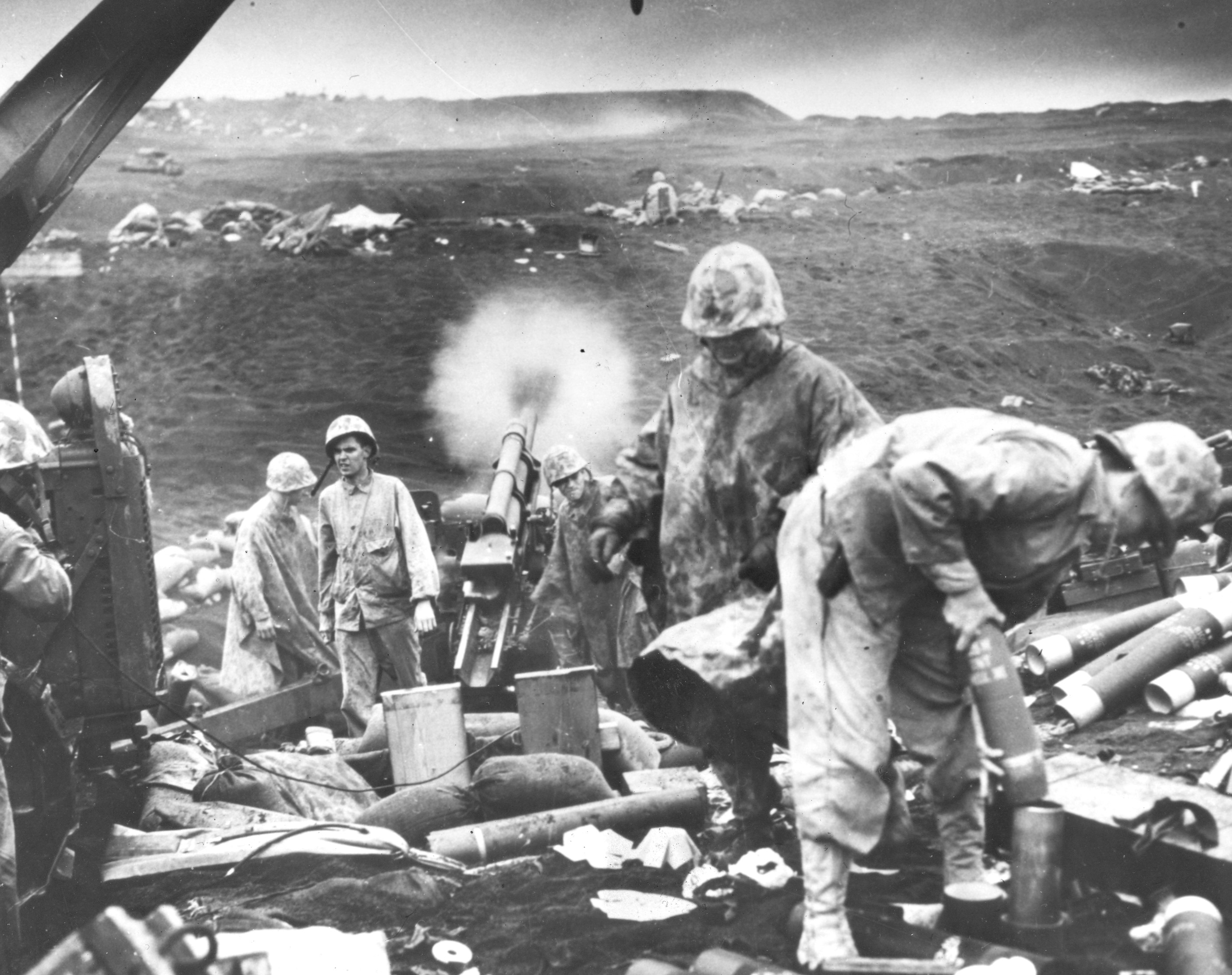
The Marines suffered and bled but kept moving forward. Enterprising troops organized LVTs to haul heavy equipment off the beach. More Sherman tanks hustled ashore. Beachmasters landed early to establish order. Engineers blew up wrecked boats and LVTs to clear lanes for subsequent waves. Communications remained surprisingly good. Offloading continued, despite the slaughter and destruction. Thirty thousand combat troops had landed by nightfall, the assault elements of six regimental landing teams. Each team brought ashore an assigned artillery battalion. The cannoneers caught hell moving their 75mm and 105mm howitzers across the soft beaches under fire, and casualties were substantial. By dusk, however, both division commanders could report that their organic artillery was in place and delivering close fire support.
The news was enough to give Admiral Turner and General Schmidt grounds for cautious optimism the night of D-day. True, the beach gradient had been an unpleasant shock and Japanese artillery fire had been uncommonly effective, but even with 2,400 casualties the landing force was still proportionally better off than it had been at the end of the first day on Tarawa or Saipan.
Both officers expected Kuribayashi to launch a major banzai attack that night, which would afford the opportunity to cut down several thousand of the empire’s most ardent warriors. Then, it would be a matter of simply mopping up. But Kuribayashi foiled this logic, refusing to allow any of his subordinates to make vainglorious final charges. Some small-scale banzai attacks occurred later in the battle, but for the most part the Americans never really had a target. Each night, small parties of Japanese would conduct intelligence probes, seeking gaps between units, and quietly exacting a toll on American outposts. By day, they hunkered down and waited for the invaders to enter their pre-registered killing zones. Such enforced discipline made the battle both prolonged and costly. Before long, the Americans knew that this battle was different; this enemy commander was resourceful, crafty.
Mount Suribachi, its defenses fatally weakened by the fire-support ships during the early stages of the assault, fell early to elements of the 28th Marines on D+4. Associated Press photographer Joe Rosenthal captured the achievement with his classic photo of the second flag raising—truly a magical moment—but the battle still had a bloody month to run. The troops in their attack positions down below cheered when they saw the Stars and Stripes, then continued their swing to the north. General Schmidt ordered the 3rd Marine Division ashore and into line.
The fight for the northern half of the embattled island was a toe-to-toe slugging match, with the Americans possessing the advantage of superior firepower and the Japanese using their prepared positions and good concealment to their advantage. General “Howlin’ Mad” Smith came ashore a couple of times to see for himself just how ugly the fight was. “It was the most savage and the most costly battle in the history of the Marine Corps,” he would later state. An artillery officer on the staff of the 4th Marine Division could only shake his head in despair: “We still didn’t have an effective method of either destroying or neutralizing the defenders in a very restricted area, so it fell to the thin green line to get in there and dig them out in hand-to-hand combat. There must be a better way.”
The convoluted ravines in the north made flat-trajectory naval gunfire less effective. Worse, Admiral Spruance deployed the fast carriers north for a series of strikes around Tokyo, removing eight Marine fighter squadrons trained in close air support operations. Navy fighters flying off the remaining escort carriers tried to pick up the slack, but they could not carry large bombs, nor were they allowed to descend below 1,500 feet. The Americans used some napalm bombs, but those were disappointing. At that stage of the war, the ‘bombs’ were still primitive—old wing tanks with improvised detonators. Half did not explode. Nor did the troops appreciate such area weapons being dropped from high altitudes.
Marianas-based Consolidated B-24 Liberator bombers of the Seventh Air Force continued to pound the island daily. Some of the best close air support, after the initial week, came from a squadron of Army Air Force North American P-51 Mustangs that flew into the first captured airfield below Suribachi. It was not at all a dive bomber squadron, but the pilots were good at glide bombing, plus they were enthusiastic. Marine Colonel Vernon E. McGee, commanding the experimental Landing Force Air Support Control Unit ashore, instructed the pilots to arm their 1,000-pound bombs with 12-second fuzes, and directed them against the cliffs and bluffs along the flanks of the attacking Marines. Sometimes those bombs achieved spectacular results, dropping a cliff face into the sea, exposing the tunnel system, and causing smoke to roll out of hidden entrances. The Marines loved this improvised support.
Both sides unveiled new weapons for the close-in fighting. The Japanese had enormous 320mm “spigot” mortars, firing shells bigger than most Marines had ever seen. Kuribayashi also used aerial bombs lofted from crude rocket launchers. These were grossly inaccurate, but their psychological effect was awesome. No American who survived Iwo has ever forgotten the sight of those huge bombs, the size of a 55-gallon drum, tumbling end over end, seemingly headed right for the viewer’s foxhole. For their part, the Americans introduced the Mark I flamethrower built into the Sherman M4A3 medium tank. The days of using thin-skinned light tanks or LVTs for assaulting fortified positions were finally over. The Mark I system could spew burning napalm at a range of 150 yards with a duration of more than a minute. Unfortunately, despite the deployment of three tank battalions ashore, the Marines could only muster eight vehicles equipped with the Mark I for Iwo Jima. These were in constant demand.
Not surprisingly, most casualties in the first three weeks of the battle resulted from high explosives—mortars, artillery, mines, grenades and the hellacious rocket bombs. Time magazine combat correspondent Robert Sherrod, a veteran of earlier landings in the Aleutians, Gilberts and Marianas, reported that the dead at Iwo Jima, whether Japanese or American, had one thing in common: “They all died with the greatest possible violence. Nowhere in the Pacific war had I seen such badly mangled bodies. Many were cut squarely in half.”
“Jumpin’ Joe” Chambers exclamation on D-day had been prophetic. Landing Team 3/25 was indeed “in for one hell of a time.” Chambers’ mission was to seize the rock quarries on the right flank, then act as a hinge as the entire expedition swung around to the north. The team accomplished this at staggering cost. Chambers reported the loss of 22 officers and 500 men in the first day alone. Three days later, a Japanese machine-gunner shot Chambers through the chest. The battalion surgeon pulled him out of the line of fire at great risk and saved his life. Chambers’ war was over. He received the Medal of Honor, one of 24 Marines and attached Navy corpsmen to be so recognized for courage “above and beyond” during the battle for Iwo Jima.
Including Colonel Chambers, 14 of the 24 Marine infantry battalion commanders engaged on Iwo Jima were killed or wounded. Higher losses occurred among company and platoon commanders. One company commander who miraculously survived unscathed reported 100 percent casualties in his unit–every man in the outfit had been hit at least once. Japanese gunners destroyed one-third of the Sherman tanks and one-fourth of the LVTs. More LVTs sank in the rough seas while shuttling casualties out to ships or delivering ammunition ashore.
During the pre-dawn hours of D-plus-16, maneuver elements of the 3rd Marine Division executed one of the few battalion-size night attacks in the Pacific War. At 5 a.m., the 3rd Battalion, 9th Marines, moved silently across the line of departure, foregoing the telltale artillery barrage, and advanced toward Hill 362C, a particularly vexing objective 500 yards away. Surprise was complete. The battalion moved gingerly across open ground for 35 minutes before attracting a few rounds from startled Japanese sentries. By the time stiff resistance materialized, the Marines seemed to be on the hill. Then it was the Americans’ turn to be surprised. In the darkness they had seized the wrong hill. Their real objective lay another 250 yards away, and now it was fully daylight. But such was the momentum of its surprise attack that the battalion pressed on, reaching the crest by early afternoon. “Although nearly all the basic dope was bad,” the commander reported, “the strategy proved very sound.” In a battle marked by painstakingly slow progress, this advance was a real breakthrough.
On March 4, two weeks after D-day, a shot-up B-29 made an emergency landing on the captured bomber strip while the fighting still raged. Thirty-five more crippled Superfortresses made emergency landings on Iwo Jima during the battle. The troops had almost daily reminders of what the fighting was all about. On March 16, Schmidt declared the island secure. His salty veterans snickered at this premature euphemism and continued dueling die-hard Japanese soldiers. Finally, advance elements reached Kitano Point on the north coast. Kuribayashi and his chief of staff died at the end, either in a final charge or by suicide. On March 26, a full 34 days after the landing, Schmidt announced that the operation was over. Yet just a few hours earlier, a well-armed force of 350 Japanese had infiltrated Marine lines and fallen upon a rear encampment of support troops, inflicting 200 casualties in the confusion of darkness before being overwhelmed and snuffed out. Schmidt turned the island over to Army garrison forces of the 147th Infantry and began reembarkation. It was time to start thinking about the next assault landing.
The Marines and their multiservice supporting arms killed about 20,000 Japanese on the island during the battle, and the troops captured nearly 1,100 prisoners. That success came at an appalling cost to the Marines. Altogether, the V Amphibious Corps sustained 24,053 casualties in the fight. More than 6,000 men died. The total casualty count represented the equivalent loss of two standard divisions. The overall casualty rate was about 30 percent of forces employed, but many rifle battalions surpassed 75 percent. As Private Muscarella recalled, “There were no good days, and we lost a hell of a lot of people. Hell, I didn’t know who the company skipper was, or who the battalion commander was.” By D-plus-35, few Marines did.
News of the casualties and savagery of Iwo Jima shocked the American public. The Hearst newspapers demanded that Nimitz and Spruance be replaced by General MacArthur, “a general who looks after his troops.” But there was hardly time to indulge in recrimination. The invasion of Okinawa began four days after Iwo Jima fell. That campaign was equally bloody and savage. Ahead, presumably, lay the assault on the Japanese home islands themselves. The long, bloody road to Tokyo looked costlier than ever.
Seizing Iwo Jima achieved all the strategic goals desired by the Joint Chiefs of Staff. American B-29s could henceforth fly with less reserve fuel and a greater bomb payload, knowing Iwo Jima would be available as an emergency field. Iwo-based fighters escorted the Superfortresses to and from Honshu. For the first time, all the Japanese islands were within bomber range, including Hokkaido. Was all this worth the cost? One surviving Marine Corps officer thinks the question is still moot: ‘We saved a lot of airplanes, but whether it was worth the Marine lives to save Air Force planes, I don’t know.’
The 2,400 Army Air Force pilots who were forced to land at Iwo Jima between its capture and V-J Day had no doubts. Said one, “Whenever I land on this island, I thank God and the men who fought for it.”
This article was written by Colonel Joseph Alexander and originally appeared in the February 2000 issue of World War II. Colonel Alexander wrote the 50th Anniversary history of Iwo Jima for the U.S. Marine Corps. For further reading, he suggests: Iwo Jima by Richard F. Newcomb; and Iwo Jima: Amphibious Epic by Whitman S. Bartley.
For more great articles subscribe to World War II magazine today!