Hürtgen. If a single word can cause a U.S. Army veteran of the European theater to shudder, it would be that. The foreboding image of dark forests, steep hills, voracious mud, pillboxes, constant rain and shells bursting in treetops immediately comes to mind. It was the sort of battlefield where soldiers walked a few feet from their foxholes and were never seen again.
It is not surprising, therefore, that the GIs who endured that hell on earth would prefer to push such awful memories out of their minds and may explain why, in the years since, the story of the Hürtgen Forest battles remains a historical stepchild of more glorious encounters such as D-Day and the Battle of the Bulge. What little has been done on Hürtgen has often focused on the November 1944 battles involving the 28th Infantry Division and has ignored the horrible prelude to the “Bloody Bucket’s” mauling, which occurred over 10 days in October.
The struggle for the 50 square miles of heavily wooded and hilly terrain south of Aachen actually began in mid-September. With their supply line stretched to the breaking point, the Allies’ rapid advance through France had finally slowed down at the Siegfried Line, the formidable defensive belt that blocked Germany’s western border and guarded the entrance to the Ruhr Valley. Hoping to seize Aachen and establish a firm breach in the Siegfried Line before winter’s onset, Maj. Gen. J. Lawton Collins, commanding VII Corps, ordered Maj. Gen. Louis A. Craig’s 9th Infantry Division to seize the villages of Hürtgen and Kleinhau. After some initial progress, the American drive stalled when two of Craig’s regiments were diverted north to assist the 3rd Armored Division, which was embroiled in a brutal battle at the Aachen suburb of Stolberg.
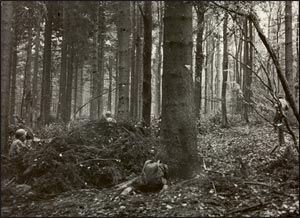
In early October, Craig was ordered to resume his attack in the Hürtgen Forest. Now, however, he would have to do so minus his 47th Infantry Regiment, which remained in support of the 3rd Armored, and with understrength units sent from the fighting around Aachen. To further complicate matters, Collins made it clear that the 9th Division’s effort was regarded only as secondary — supporting the Allies’ main attack at Aachen. That meant Craig would be at the bottom of the list for reinforcements, artillery or air support, though the general took some comfort knowing he was not expected to begin his assault until three days after VII Corps began its renewed push toward Aachen.
The villages of Germeter and Vossenack, as well as the crossroads settlement of Reichelskaul, were designated as the 9th Division’s initial objectives. Lieutenant Colonel Van H. Bond’s 39th Infantry Regiment would attack on the left. Once it had occupied Germeter, the 39th would seize Vossenack while guarding against an enemy counterattack from the north. Meanwhile, after capturing Reichelskaul, Colonel John G. Van Houten’s 60th Infantry Regiment would reorient itself to the south to guard against a German counterthrust from the direction of Monschau. The division would then push on against the town of Schmidt. Jump-off time was originally set for October 5 but was later postponed for 24 hours.
The initial thrust would be conducted by four battalions. In addition to support from two regimental cannon companies, Craig had four divisional howitzer battalions along with three battalions of reinforcing artillery, for a grand total of 96 pieces. A company of 4.2-inch mortars was attached to each regiment, along with a company each from supporting tank (746th) and tank destroyer (899th) battalions.
Against this small force were the Landsers of Maj. Gen. Hans Schmidt’s 275th Infantry Division, which had briefly fought north of Aachen before being transferred to the Hürtgen in late September to fill a gap between the 12th Volksgrenadier Division and the 353rd Infantry Division. On October 1, LXXIV Army Corps directed Schmidt to take over the entire Hürtgen sector, including the area occupied by the 353rd. As the 353rd’s headquarters and service units departed, its combat units were absorbed by the 275th. Schmidt also received the 353rd’s artillery component, giving him a total of 25 pieces, as well as six assault guns from Sturmgeschütz Brigade 902.
Schmidt’s division had originally consisted of a pair of grenadier (mechanized infantry) regiments: GR 983 led by a Colonel Schmitz and GR 984 commanded by Colonel Joachim Heintz. Schmidt deployed Schmitz’s men in reserve while assigning the northern sector to Heintz. The center was allocated to one of the 353rd’s former units, Lt. Col. Friedrich Tröster’s GR 942, while the southern sector was the responsibility of Colonel Feind’s GR Replacement and Training Battalion 253. Feind commanded 1,000 men and was placed along the weakest portion of the line.
The Americans knew few of these details when they began their attack at 1000 hours on October 6. Craig opened with fighter-bombers striking at otherwise invisible targets that U.S. artillery units had marked with columns of red smoke. Once the planes departed, there was a five-minute preparatory artillery barrage, then the U.S. foot soldiers began surging forward.
Assaulting the extreme northern end of the line held by GR 253, the 1st and 3rd battalions of Colonel Bond’s 39th Infantry gained 1,000 yards while suffering 29 casualties. Lieutenant Colonel Oscar H. Thompson’s 1st Battalion attacked with A and B companies in the lead, trailed by C Company. Captain Jack Dunlap’s B Company drew first blood when it overran an outpost and killed or captured 30 men. Crossing a creek, Dunlap’s men pushed on until they encountered several pillboxes, whereupon he decided to hold up for the night. Thompson then brought his other companies on line and waited for daylight.
On the 1st Battalion’s northern flank, Lt. Col. Richard H. Stumpf’s 3rd Battalion of the 39th Infantry advanced with L Company on the left and K Company on the right, with I Company in reserve. For the first 1,000 yards, the lead companies met only sniper and small-arms fire, but by late afternoon, heavier resistance had begun to build. Although L Company reduced an enemy strongpoint without too much delay, K Company was pinned down by accurate fire from a position southeast of the battalion sector. As evening approached, Stumpf decided to hold in place until darkness to allow K Company to safely disengage. General Schmidt was sufficiently alarmed by American progress in this sector to order Captain Riedel’s Fusilier Battalion 275 to launch a counterattack against the Americans the next morning.
Colonel Van Houten’s 60th Infantry attacked enemy defenses southwest of Reichelskaul. On the left, Major Lawrence Decker’s 2nd Battalion moved forward 500 yards before its lead platoons were pinned down. Every attempt to advance ended in failure and heavy losses. By the time the attack petered out, 130 of Decker’s officers and men had become casualties.
To the right, Van Houten’s 3rd Battalion of the 60th soon encountered difficulties of its own. After a short eastward advance, the battalion ran into a pillbox which, together with heavy mortar fire and a strong enemy response on the left flank, occupied the attention of two of Van Houten’s companies for the remainder of the day. By nightfall, however, K Company was able to move about 1,000 yards to the southeast. At 1600 hours, the colonel directed that his 1st Battalion, commanded by Lt. Col. Lee Chatfield, move north until it linked with the 39th Infantry. At daybreak Chatfield would launch an attack to the east in order to outflank the Germans, barring Decker’s advance.
Both sides were prepared to launch their own attacks at almost the same time. Fusilier Battalion 275 went forward only to encounter Americans who had been expecting some sort of reaction to their previous day’s advance. Captain Riedel was wounded and the survivors of his unit pinned down. Captain Dunlap took advantage of the situation by infiltrating GIs into the woods just west of Germeter, but Colonel Thompson would not let him enter the village for fear it would expose his B Company to counterattacking panzers.
By noon the 1st Battalion had succeeded in bypassing II/GR 942. Schmidt reacted by deploying Landesschützen Battalion I/9 to the rear of II/GR 942. The American success also convinced him that “the southernmost elements of GR 253 defending a line of West Wall bunkers were thus in danger of being enveloped from the rear.” Schmidt ordered Colonel Feind to block off the threat of a further enemy penetration in that sector. In response, U.S. Engineer Battalions 16 and 275 occupied positions between Reichelskaul and Raffelsbrand while three companies of Engineer Battalion 73 dug in along the Hürtgen-Germeter road.
During the night of October 7-8, Colonel Schmitz sent reinforcements to the aid of GR 253. Fortress Infantry Battalion 1412 and Luftwaffe Fortress Battalion 5 were also dispatched by LXXIV Army Corps to reinforce the 275th. In addition Schmidt received two companies of civilian police from Düren, hurriedly issued with army uniforms and rifles. He combined the police into an ad hoc formation named Battalion Hennecke (after its commander). Several howitzer batteries from the 89th Infantry Division, an anti-aircraft artillery regiment and elements of an artillery corps were ordered to occupy positions where they could augment the fire of Major Sturm’s Artillery Regiment 275.
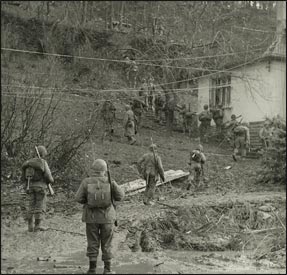
The 39th Infantry planned to renew its advance at 0800 hours, but a heavy barrage began falling on its lead battalions an hour before the attack was to begin. The 3rd Battalion suffered a serious setback when its L Company commander was killed and casualties disorganized his unit. Immediately following the barrage, a German force of 150 to 200 men counterattacked the 1st Battalion but was repelled by Captain Ralph Edgar’s A Company. The Germans then shifted their efforts farther north, hitting L and I companies. Colonel Bond sent G Company from the 2nd Battalion, which quickly overran three enemy machine guns. The loss of the automatic weapons seemed to take the fight out of the Germans, who retired to the east. Thirty German soldiers were killed during the engagement, and 27 others, including a wounded company commander, were captured.With fresh troops and additional artillery, Feind planned to launch a coordinated counterthrust at dawn, using I/GR 983 and Engineer Battalion 275. His intended target was Colonel Chatfield’s 1st Battalion, 60th Infantry, now located just west of Reichelskaul. Advancing northwest from Simonskall, the German counterattack crumbled when it came under intense mortar, artillery and small-arms fire.
After thwarting the enemy counterattack, Bond ordered his lead elements to resume their advance at 1100 hours. Bolstered by the arrival of supporting tanks, L and I companies moved forward. By 1215 hours, L Company had gained 200 yards and captured three pillboxes. The 3rd Battalion’s progress slowed and finally came to a halt shortly before 1800 hours. Still lacking supporting tanks, Thompson’s 1st Battalion did not attempt to advance across the open ground surrounding Germeter.
The 1st Battalion, 60th Infantry, launched its own attack against the Reichelskaul road junction at 1100 hours and was met by intense artillery and mortar fire. B Company, accompanied by several tanks, was able to detour north into the 39th’s zone of operations before veering back east again. This small force pushed to within sight of the crossroads before holding up for the night. The 2nd Battalion, however, was unsuccessful in overcoming the enemy to its front. Although the Germans had been pushed back, two days into the attack the Americans had yet to defeat the 275th, which continued to maintain an unbroken line of resistance. The bloodletting would continue.
During the night, Van Houten made plans to push eastward now that supporting tanks and tank destroyers had linked with his leading elements. Led by a platoon of M4 Shermans from the 746th Tank Battalion, Van Houten’s 1st Battalion pushed out into open ground south of Germeter at daybreak.
The 39th joined the attack at 0700 hours, but without artillery preparation. This time, supporting tanks were available and actively engaged. The 1st Battalion made a short advance to the edge of the clearing surrounding Germeter before being brought to a halt. C Company suffered particularly heavy casualties when it attempted to breach a barbed wire entanglement. Only the tanks attached to B Company were in position to place effective fire on the enemy defenders. By 1900 hours, a platoon from C Company finally succeeded in working several men close enough to the outskirts of Germeter to begin exchanging hand grenades with the Germans. Unable to support them however, at nightfall Thompson ordered them to pull back.
The 3rd Battalion moved out 45 minutes behind the 1st. As it advanced, the sound of tracked vehicles could be heard near Wittscheidt, and for the rest of the afternoon occasional high-velocity rounds exploded in treetops throughout the battalion’s sector. Despite enemy sniper fire, I Company was able to occupy Wittscheidt by 1615 hours. With darkness approaching, Colonel Stumpf decided to halt his advance. To forestall the possibility of an armored counterattack from the direction of Hürtgen, he directed I Company to mine the road leading to Wittscheidt and to register artillery on all likely enemy routes of approach.
Any plan to resume the advance the next day was forestalled by a dawn counterattack by Battalion Hennecke that overwhelmed two platoons from I Company, capturing 41 men. The German success meant that Bond would have to spend the rest of the day just trying to retake the ground he had lost. The 1st Battalion likewise did not attack as planned. Each time Thompson’s men tried to move forward they received accurate small-arms fire as well as direct fire from German self-propelled guns.
Things went somewhat better for the 60th Infantry. The 1st Battalion pushed off at noon to seize the Raffelsbrand road junction south of Germeter. In what seemed to be a nightmarish repetition of the opening days of the attack, the thinned ranks of hungry and bone-weary GIs trudged forward while steadily losing men to incoming fire. The situation changed dramatically when one of the lead companies overcame a German pillbox covering the road between Reichelskaul and Raffelsbrand. Buoyed by success, the Americans pushed southward, collecting 100 prisoners and securing their objective by nightfall. With Raffelsbrand in American hands, Van Houten ordered the 3rd Battalion to redeploy to Reichelskaul to protect Chatfield’s rear and maintain pressure on German units massing southeast of Germeter.
The loss of the road junction persuaded Schmidt that he needed additional troops. LXXIV Army Corps agreed to loan two rifle companies from the 89th Infantry Division, provided they were used only along the threatened southern flank. The reinforcements would not arrive until dawn on October 11, however, and in the meantime Schmidt sent a company each from GR 983 and GR 984 to strengthen Colonel Feind’s GR 253.
The Americans’ position was also somewhat precarious. With no reserves available, Van Houten had nothing to send to Chatfield’s aid. To the east, the 2nd Battalion, 60th Infantry, was still being held back by the stubborn defenders of II/GR 942. To the north, the 39th Infantry remained stalled outside Wittscheidt and Germeter.
October 11 brought success and failure for both sides. American attempts to exploit success at Raffelsbrand produced nothing but longer casualty lists. A German counterattack struck Chatfield’s men before daylight, and though beaten back, Chatfield reported that “the enemy maintained pressure here for the rest of the day and crowned it before dark with a bayonet charge.” When the Americans tried to bring up reinforcements, they were pinned down by several pillboxes along the Reichelskaul-Raffelsbrand road that they had bypassed the previous day.
The 1st Battalion, 39th Infantry, was finally able to enter Germeter but found that its defenders had abandoned their positions during the night. Hoping to seize more ground, Thompson ordered Captain Edgar’s A Company, supported by Lieutenant Robert Sherwood’s 1st Platoon of C/746th Tank Battalion, to probe eastward toward Vossenack. The column had only covered 500 or so yards when a Panzerschreck knocked out the lead tank, and the remaining American armor and infantry withdrew. A subsequent advance by A Company under cover of smoke ended with the destruction of two more Shermans.
The Americans had some success to the north and west of Germeter. Leaving I Company behind to protect the northern approaches to the town, K and L companies encountered little resistance as they moved eastward from Wittscheidt. By late afternoon, Stumpf’s battalion had advanced nearly a mile and was preparing to attack Vossenack from a ridge northeast of the village. The 2nd Battalion was also able to advance.
Craig’s men had at least been gradually moving forward, but ominous events had occurred during the night that would soon threaten what little progress they had made. Accompanied by the LXXIV Corps commander, Lt. Gen. Erich Straube, Seventh Army commander Lt. Gen. Erich Brandenburger visited Schmidt’s command post. After hearing a candid assessment of the situation, Brandenburger promised to send Regiment Wegelein, a unit composed of well-trained and well-equipped troops to the front. Numbering 161 officers and 1,639 enlisted/officer cadets, the force was organized with three battalions of three companies each and a regimental heavy-weapons company. Its commander, Colonel Helmuth Wegelein, was an experienced leader.
Schmidt and Wegelein quickly agreed that a counterattack against the northern flank of the Americans had the best chance of producing favorable results. Wegelein would launch his assault from an assembly area near Hürtgen, advancing southwest until he isolated the American battalions near Germeter.
Following a brief but concentrated artillery preparation, Wegelein’s men advanced from their positions just before dawn, moving purposefully along the wooded plateau paralleling the Germeter-Hürtgen road. A platoon of dismounted armor crewmen from 746th Tank Battalion, securing a roadblock along the left flank of 2nd Battalion, 39th Infantry, was the first to encounter this new threat and was quickly scattered. By 0700 hours, Wegelein had succeeded in isolating several of Lt. Col. Gunn’s rifle companies. As testament to the isolation caused by the densely wooded terrain, the 39th’s 3rd Battalion was completely unaware that the nearby 1st Battalion was being cut to pieces.
Lacking reserves to blunt the enemy thrust, Colonel Bond requested help from General Craig, who directed elements of the divisional reconnaissance troop — augmented by a platoon of light tanks — to assist the embattled 39th Infantry. As the situation grew more serious, Craig ordered the 47th Infantry at Schevenhütte to dispatch two rifle companies and a company of medium tanks from the 3rd Armored Division to reinforce Bond. Rushed to the point of greatest crisis, these reinforcements were finally able to halt the German advance when it reached the road leading west out of Germeter.
The abortive counterattack cost the Germans nearly 500 casualties, with little to show in return. The failed operation, however, produced at least one positive result for the Germans: Surprised by the strength and intensity of their assault, Bond ordered Stumpf’s battalion to abandon its plans to attack Vossenack in order to reduce the salient Wegelein had created.
Schmidt planned on renewing the counterattack on October 13, but orders from LXXIV Army Corps directed the immediate removal of all officer candidates from the combat zone, which cut in half what remained of Wegelein’s unit and forced him to spend badly needed time reorganizing his remaining personnel. While he was doing so, the 3rd Battalion, 39th Infantry, launched an attack of its own against Wegelein’s troops. K Company led the effort, trailed by L Company. As the latter moved up on line, both of its leading platoons were ambushed and wiped out. K Company maneuvered to attack the enemy facing L Company while the 1st Battalion sent B and C companies into the fight. Another counterattack inflicted heavy losses on the right platoon of Dunlap’s company, but the American advance continued.
At 1730 hours, a German bearing a white flag approached B Company and requested a brief cease-fire while his unit prepared to surrender. Dunlap sent the man back with a message that he would hold his fire for five minutes. When the German emissary did not reappear within the stated time, B Company resumed its advance, only to run into a torrent of small-arms fire. It was now almost dark, and the enemy seemed to be on all sides. Fearing that his exhausted company was losing its cohesion, Dunlap ordered his men to fall back a short distance and dig in.
Facing four enemy battalions at Raffelsbrand, the 1st Battalion, 60th Infantry, was experiencing its own difficulties. Just before dawn, a surprise German attack seized a pillbox occupied by C Company. Although the seven GIs inside were able to escape, a counterattack by 30 men was unable to regain the position. Three Sherman tanks and two infantry companies eventually arrived to lend a hand, but even with those reinforcements, a heavy crossfire from several machine guns prevented the Americans from making any progress. One of the tanks was hit by an antitank rocket that wounded several men and forced the crew to evacuate the vehicle. A daring German soldier then ran out to the tank and drove it behind a nearby pillbox before the Americans could react. With this, the Americans lost all momentum, and at 1730 hours they began to fall back, suffering heavy casualties from enemy artillery and mortar fire.
That evening Wegelein went to Schmidt’s headquarters to protest orders for a renewed advance on the morning of October 14, stating that communications to his battalions and companies were so poor there was a risk that all units might not receive a regimental order. Schmidt replied that he would accuse Wege-lein of cowardice if he did not resume his attacks.
Determined to show that he was no coward, Wegelein spent a busy night personally delivering the orders to his units. He still had more visits to make as the sun rose on the 14th. At 0800 hours, however, the colonel was shot and killed by a sergeant from the U.S. 39th Infantry, and his regimental adjutant was captured moments later.
The fighting sputtered on and off for two more days, but it was clear that both sides were too exhausted to achieve significant results. At a cost of 4,410 casualties, the Americans succeeded in pushing their front line an average of 3,500 yards to the east. Nonbattle losses (sickness, injury, etc.) for American units totaled nearly 1,000. The toll for the defenders was also high — approximately 2,000 killed or wounded and 1,308 prisoners.
After breaking off the offensive, Collins made the questionable claim that the sacrifices of Craig’s men had drawn off German units that could have been thrown into the battle for Aachen. Although it is true that 19 German infantry and engineer battalions opposed six American infantry battalions, many of the defending units were much smaller than their counterparts. In any case, though the Hürtgen fighting might have prevented some German units from being sent to Aachen, their redeployment would not have altered that city’s eventual fate.
More important, given the experience of the 9th Division during the opening phase of the battle, the larger question is why senior American leaders such as Generals Courtney Hodges, Omar Bradley and Dwight D. Eisenhower chose in November 1944 to send division after division into the dark and foreboding woods right until the start of the German Ardennes offensive that December. By the time major combat operations in the area finally ceased, six U.S. divisions had been fed into the meat grinder and some 33,000 soldiers had become casualties without achieving a breach in the Siegfried Line.
According to the U.S. Army’s official history, “The real winner appeared to be the vast, undulating blackish-green sea that virtually negated American superiority in air, artillery, and armor to reduce warfare to its lowest common denominator.” Given the terrible cost, it seems clear that Maj. Gen. James Gavin might have been more correct when he said, “For us the Hürtgen was one of the most costly, most unproductive, and most ill-advised battles that our army has ever fought.”
Mark Reardon is a historian at the U.S. Army Center of Military History. This article originally appeared in the December 2006 issue of World War II magazine. For more great articles subscribe to World War II magazine today!