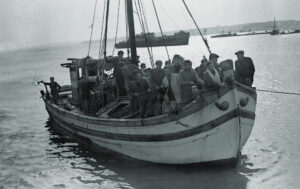
By autumn of 1944 some Allied commanders began to realize that the situation on the battlefield had changed. They did not fully understand exactly how it had changed, nor were they really quite sure what to do about it. Following the American breakout at St. Lô, the crushing defeat of the German Seventh Army in the Falaise pocket and the race across France, it seemed that the mighty German Wehrmacht was in a state of final collapse. There was even talk of the war being over by Christmas.
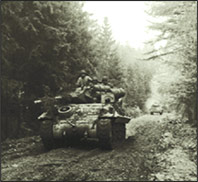 U.S. Army |
| Unfortunately for the members of the 893rd Tank Destroyer Battalion, the narrow, muddy trails through the Hürtgen made their mission of supporting the 112th Infantry Regiment’s attack on the town of Schmidt a nightmare. |
But as Allied forces closed on Germany’s western border, the tyranny of logistics started to impose the weight of its inflexible laws on operations. The German army, too, now acted differently. Instead of fighting in occupied France, the Landseren were now defending their home soil. The headlong drive of Lt. Gen. George S. Patton, Jr.’s Third Army started to bog down in the Lorraine region of western France. To his north, Lt. Gen. Courtney H. Hodges’ First Army hit the West Wall defenses, which the Allies (but not the Germans) called the Siegfried Line. South of Aachen, Hodges’ VII and V corps ran up against the toughest section of the West Wall as they entered the dark and foreboding Hürtgen Forest.
Through August and into September 1944, General Dwight D. Eisenhower and his principal subordinates debated among themselves the relative merits of a broad-front versus a narrow-front strategy. Eisenhower favored the broad front, placing steady pressure against the Germans all along the Reich’s western frontier and exploiting breaks wherever they occurred. Eisenhower’s two most flamboyant subordinates, Patton and Field Marshal Sir Bernard L. Montgomery, both favored the narrow front–a dagger thrust into Germany’s vital regions. The only difference was that each of those Allied commanders thought he was the one who should lead such an attack. After much wrangling, Eisenhower finally approved Montgomery’s plan for what became Operation Market-Garden, the combined airborne and ground attack to seize the Rhine River bridge at Arnhem. When that operation ended in disaster in late September, the broad front seemed the only logistically supportable alternative left to Allied commanders seeking a quick end to the war.
Throughout most of October, Hodges’ forces battered away at Aachen, finally capturing the city on the 21st. After punching through the West Wall at Aachen, Hodges intended to break out of the high ground east of the city, cross the Rhine River plain and advance to the river itself at the city of Cologne. As part of this plan, Hodges wanted his forces to clear the Hürtgen to secure his southern flank.
Even before the start of Operation Market-Garden, the veteran 9th Infantry Division attacked on September 14, advancing into the southern reaches of the forest to secure the town of Lammersdorf and the high ground around it. Lammersdorf, and especially Hill 554, dominated a natural axis of advance through the forest known as the Monschau Corridor. After 15 days of fierce fighting, the 39th Infantry Regiment finally took Hill 554. On October 6, the 9th resumed its attack to secure the Monschau Corridor. Its objective was Schmidt, a small town on the far side of the Kall River valley that sat astride the major road junctions in that part of the forest. After 10 more days of bloody fighting, the 9th Division had managed to push only about three kilometers into the woods.
The 9th suffered some 4,500 casualties in little more than 30 days of fighting. In late October the ‘Old Reliables’ were relieved by the 28th Infantry Division, commanded by Maj. Gen. Norman ‘Dutch’ Cota. The division, originally a Pennsylvania National Guard unit, wore a shoulder patch in the form of a red keystone, the symbol of Pennsylvania. The Germans had their own name for the patch. They called it der blutiger Eimer–the Bloody Bucket.
The First Army prepared to renew the attack to secure the Hürtgen Forest in November. The new plan called for Maj. Gen. J. Lawton Collins’ VII Corps to make the main effort in the northern part of the Hürtgen through the Stolberg Corridor, the other major route through the forest. The main attack was scheduled to begin on November 5. To the south of VII Corps, Maj. Gen. Leonard T. Gerow’s V Corps would mount a supporting attack with the 28th Division, starting on November 2. The 28th’s objective was to secure Schmidt and draw off German reserves from Collins’ advance.
If the desert is a textbook example of an attacker’s ideal terrain, then the Hürtgen Forest is nearly perfect defender’s ground. It is impossible to understand this battle without understanding the complex and tortuous ground that almost totally dominated the tactical action. The area between Stolberg in the north and Monschau in the south consists of high, bald ridgelines and deep, heavily forested valleys. The dominating ridgeline runs in a nearly straight fashion from Lammersdorf in the southwest corner of the forest through the villages of Germeter and Hürtgen to Düren at the northeast corner. Another ridgeline about three kilometers to the east runs from the south, partially parallel to the Germeter-Hürtgen ridge, ending at about the level of Germeter. Schmidt sits near the end of that ridge, with the village of Kommerscheidt slightly more than half a kilometer away at the very end. Between these two ridges the Kall River runs through a deep gorge.
Several large spur ridges branch off the Germeter-Hürtgen ridge. From Germeter, the Vossenack ridge runs east and slightly north for about a kilometer, pointing right at Kommerscheidt, until it drops off into the Kall gorge. Immediately north of the village of Hürtgen another spur, called the Brandenberg-Bergstein ridge, runs southwest, converging toward the Vossenack ridge. The ends of the Schmidt-Kommerscheidt, Vossenack and Brandenberg-Bergstein ridges almost meet, but they are separated by the Kall gorge. At the end of the Brandenberg-Bergstein ridge sits Hill 400, a huge knob of dominating high ground that forms an ideal observation post. The Germans held both the Brandenberg-Bergstein ridge and Hill 400 throughout the 28th’s attack.
To seize Schmidt, the division would use the area around Germeter as its central line of departure. Cota was ordered to use an entire regiment to push northeast, farther up the ridge to Hürtgen to secure the right flank of VII Corps’ attack. Since the 28th would require a direct line of supply into the Monschau Corridor once Schmidt was taken, Cota also was ordered to attack with another regiment to the southeast, directly into the Kall gorge toward Simonskall, to secure the secondary roads in the corridor. That left only one regiment to make the main attack, east into the gorge and up the other side, through Kommerscheidt and into Schmidt. The plan provided for no significant division reserve and no opportunity to exercise initiative. Even worse, instead of all the division’s combat power converging on a single objective, the three regimental attacks diverged, dissipating their ability to provide mutual support. Cota protested the plan to V Corps, but to little avail.
Anyone looking at the 28th’s plan of attack is struck immediately by its serious flaws, which should have been obvious to the greenest lieutenant. In fact Cota had very little say in the plan. This recipe for disaster was largely dictated to him by Gerow and his staff, who apparently believed that since the Americans faced German units made up mostly of old men and young boys, one more good, hard push would be sufficient to end the war.
The 28th assigned the thrust toward Hürtgen to the 109th Infantry Regiment. The 110th Infantry drew the mission of attacking toward Simonskall. That left the 112th Infantry, commanded by Lt. Col. Carl Peterson, to make the main attack. But in making that attack, the 112th also had to secure the spur ridge to Vossenack. Peterson allocated one battalion to take Vossenack, initially held one battalion in reserve, and decided to send one battalion into the gorge through the low ground immediately south of the Vossenack ridge. This, then, was the 28th’s main attack.
Making matters worse, the 112th Infantry’s main route of advance was along a very narrow, steep forest trail that had drop-offs to one side as it descended into and climbed out of the Kall gorge. At the bottom of the gorge, a small stone bridge near the Mestrenger Mühle (mill) was the only way to get vehicles across the Kall. The river was narrow and shallow, but it had steep banks. Although the trail showed on maps, the dense forest made it impossible to verify actual conditions through aerial reconnaissance. The operations planners knew they would need extensive engineer assets to keep the trail open, but before the attack they sent out no patrols. The Americans did not even know for sure if the bridge was still standing.
Gerow did provide the 28th with reinforcement from corps units. These included the 1171st Combat Engineer Group of three battalions, three artillery battalions attached to the division, three corps artillery groups firing in general support, a 4.2-inch mortar battalion and a detachment of 47 M-29 Weasels–light-tracked, unarmed cargo vehicles. The division also had the tank and self-propelled tank destroyer battalions that V Corps had attached to it on an almost permanent basis. Three companies of the 707th Tank Battalion, equipped with M-4A1 Sherman medium tanks, and the 893rd Tank Destroyer Battalion, armed with the M-10 tank destroyer, would also support the attack. Elements of both battalions would play a major role in the upcoming battle.
For a variety of reasons, VII Corps could not get ready to launch its main attack by November 5. Hodges therefore postponed the VII Corps attack, first until the 10th, and then until the 16th. Unfortunately, no one with the First Army or VII Corps thought to postpone the 28th Division’s attack as well. Thus when Cota’s division jumped off on the originally scheduled date of November 2, it was conducting the only Allied assault along a 160-mile stretch of front. The 28th had the complete and undivided attention of the German army.
The attack ran into trouble almost immediately. The 109th Infantry, pushing hard up the main road toward Hürtgen, ran into minefields and German counterattacks. The 110th Infantry, attacking through the heavy woods into the gorge, ran into a buzz saw of heavily defended log bunkers reinforced with barbed wire and mines. By the second day of the attack, both regiments had taken heavy casualties and were down to little more than a single battalion each in effective strength. Neither regiment had taken its assigned objectives.
On November 2, the 2nd Battalion, 112th Infantry, supported by elements of the 707th Tank Battalion, attacked at 0900 down the Vossenack ridge. At 1200 the 1st Battalion launched the divisional main attack, straight into the gorge. The 2nd Battalion took heavy fire from the Germans on Brandenberg-Bergstein ridge, but the Americans cleared and occupied Vossenack by the end of the day. The 1st Battalion was not as successful. Its lead company got pinned down as soon as it entered the woods. Peterson failed to press the attack and it stalled. But with the Vossenack ridge now under his control, the 112th’s commander decided that he would resume the attack the following day by passing his forces through Vossenack and then into the Kall gorge.
The Germans followed the American moves very closely. In one of the great coincidences of the war, most of the senior commanders of Field Marshal Walter Model’s Army Group B were at his headquarters near Cologne when the attack started. They were there to conduct a map exercise, based on the scenario of an American attack toward Schmidt. When word of the actual attack came through, Model ordered the exercise to continue, substituting real data for the hypothetical exercise data. Model, who probably was the best defensive commander the Germans had, ordered a few of his key commanders to return to the scene to take charge of operations. He also ordered the 116th Panzer Division to start moving toward Schmidt from the north and the 89th Infantry Division to start moving up from the south.
Just before dawn on November 3, Peterson’s 3rd and 1st battalions advanced through Vossenack in column. They crossed the open ground outside the town and descended into the gorge through the woods. At 0900, Company K forded the Kall just north of the mill. The weather was overcast and slightly above freezing. By 1300 the company had scrambled up into Kommerscheidt, and by 1430 it reached Schmidt. At that point, however, no one at division headquarters knew for sure if the Kall bridge was standing. The 20th Engineers had only started reconnaissance of the trail at noon.
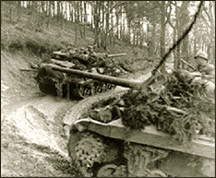 U.S. Army |
| Two M-10 tank destroyers advance along a narrow trail through the Hrtgen Forest. By November 5, nine tank destroyers from the 893rd Tank Destroyer Battalion were able to reach the beleaguered members of the 112th Infantry trapped in Kommerscheidt. |
At 1600, the engineers reported the trail open. An hour later, Company A of the 707th Tank Battalion tried to take tanks down the trail. As Captain Bruce M. Hostrup, the company commander, took his tank into the gorge, it almost slid off the trail and down the steep slope. Company A backed up and reported the trail impassable to tanks. The 707th’s commander, Lt. Col. Richard Ripple, immediately ordered the engineers to improve the trail. He intended to send tanks through to Schmidt at dawn.
By 2300 hours on November 3, Peterson reported to division headquarters that he had his 3rd Battalion in Schmidt and his 1st Battalion (minus one company) in Kommerscheidt. A little after midnight, three Weasels managed to negotiate the entire Kall trail and rolled into Schmidt with rations, ammunition and 60 anti-tank mines. Overcome with the exertions of earlier that day, the exhausted GIs in Schmidt did not dig in the mines, they just laid them on the roads in the dark. Nor did they send out any reconnaissance patrols. Instead, they sat in their defensive positions effectively blind. Meanwhile, division and corps commanders up and down the line phoned Cota to congratulate him on taking Schmidt.
German mortar and artillery fire that night hammered the area near Vossenack. Hostrup’s men dared not leave their tanks. Some of the engineers working on the trail headed back to Vossenack to escape the fire. They later returned, but brought only mine detectors and hand tools with them. The only piece of heavy equipment to arrive in those critical hours was a bulldozer that broke down shortly after it began work. In the confusion nobody determined exactly who was supposed to provide security for the engineers. As a result, neither the 112th Infantry nor the engineers took on the mission, and German troops operated virtually unhindered in the Kall gorge.
Hostrup, meanwhile, knew he had to get his tanks into Schmidt. At about 0500 on November 4, he ordered Lieutenant Raymond E. Fleig to take his 1st Platoon down the trail. As he started the descent, Flieg’s tank hit a mine and rolled to a stop, partially blocking the trail. No one was injured. Hostrup told Fleig to get the tank out of the way even if he had to have another tank push it into the gorge. Staff Sergeant Anthony J. Spooner, however, had a plan. Spooner directed his own tank to the left rear of Fleig’s damaged tank. The crew attached their 20-foot-long steel tow cable to the towing shackle on the right front of their tank and to the left rear of Fleig’s, which became an anchor. Spooner guided his tank along the strip of muddy trail between the right side of Fleig’s tank and the steep wall along the trail. When the tanks were parallel, the crews switched the cable to the right rear of Spooner’s operable tank and to the right front corner of the disabled tank. Fleig then boarded Spooner’s Sherman and radioed Hostrup that he was moving on to Schmidt. Spooner remained behind to direct the effort to get the platoon’s three remaining serviceable tanks down the trail.
Near the stone bridge across the Kall, Fleig encountered a series of sharp turns that he could not negotiate. Ignoring the possibility of mines, he dismounted and guided the driver along a path perpendicular to the main trail to bypass the turns. A few hours later Spooner had the remaining tanks in the platoon past the damaged one. But more problems occurred. Halfway down the gorge one Sherman nearly slipped off the left shoulder of the trail, tearing up the fragile path in the process. Another threw a track near the bridge. And there were still more problems. The engineers were unable to blow a huge rocky outcropping near the mine-damaged Sherman before Lieutenant John J. Clark’s 2nd Platoon, Company A, reached the trail. One of Clark’s tanks nearly rolled into the gorge when it tried to pass Fleig’s disabled tank. Artillery fire killed the tank commander and wounded Clark. Two of the four tanks in Clark’s platoon maneuvered around Fleig’s, but both threw their tracks before they reached the stone bridge.
Fleig pulled into Kommerscheidt around 0900 on November 4. He could hear the roar of tank and artillery fire, and saw several infantrymen drifting toward him. Major Robert T. Hazlett, commander of the 1st Battalion, 112th Infantry, ran up and yelled that Germans with panzers had counterattacked the 3rd Battalion in Schmidt. He told Fleig to ‘get out there and stop those tanks.’ An infantryman pointed in the direction of Schmidt and said there were ‘lots of Germans with tanks over that hill.’
The German force had hit Schmidt hard and fast from three directions. An infantry NCO said that the enemy artillery was powerful, loud and continuous. Mortar fire did not stop the German tanks. Neither did artillery.
Allied fighter-bombers were operating over the area, but they did little damage. Instead, the panzers rolled to a halt just yards from the GIs’ foxholes and poured fire into them. One soldier said that the tanks’smashed through the two forward company positions and broke them all to hell…the situation was bad.’ Some GIs simply disappeared in the shell bursts; others died under grinding panzer treads. Tracer rounds snapped over the heads of the men who tried to escape from near certain death.
Knowing that Schmidt was lost, Peterson decided to try to hold Kommerscheidt. Fleig had Sergeant Spooner position the two tanks with him in hull-down positions where they could fire into Schmidt. Minutes later, at about 1100, some 10 tanks and 100 infantrymen from the 116th Panzer Division began their attack on Kommerscheidt. Fleig’s crew knocked out two tanks, and Spooner accounted for another. Fleig’s gunner, Richard Herkowitz, reported seeing some GIs starting to pull back from Kommerscheidt. Fleig then spotted a Panther tank churning through the mud toward the village. Its long 75mm gun barrel was pointed away from Fleig’s tank.
Fleig commanded, ‘Gunner, shot, tank, two hundred!’
The loader shoved a 75mm round into the breech of the cannon and stepped back from the recoil path.
Herkowitz reported that he had the panzer identified.
Fleig commanded, ‘Fire!’
‘On the way,’ announced Herkowitz, a moment before he hit the trigger.
A flash erupted on the side of the panzer. The loader chambered another round and Fleig told Herkowitz to fire again.Crack! The Sherman jerked back. Another hit–but something was wrong. The rounds were highly explosive. They had not penetrated the panzer’s tough armor, but the frightened Germans abandoned their tank anyway.
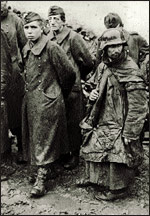 U.S. Army |
| German prisoners taken at the end of the difficult fighting in the hotly contested Hürtgen Forest. Although many of their units consisted of old men and boys, the Germans had mounted a fierce defense of the area around Schmidt and managed to retain control of the town until February 1945. |
Fleig’s armor-piercing rounds were stored in hull racks below the turret. Herkowitz traversed the turret to allow the loader access to the rounds. As the loader obtained the rounds, Fleig saw the Germans climb back aboard their tank. There was a flash from the muzzle of the Panther’s cannon, and Fleig thought he could see yellow smoke corkscrew from the shell as it flew by his tank. Fleig’s loader slammed an armor-piercing round into the breech. Fleig later recalled: ‘We scored four hits. The first one cut off the barrel of his gun. The other tore open the entire left side of the hull of the German tank and set it afire. None of that crew escaped.’ The entire engagement lasted about three minutes.
That night, Brig. Gen. George Davis, the 28th’s assistant division commander, made it up into Kommerscheidt for a personal reconnaissance. He met with the infantry commanders and told Fleig to keep his three Shermans in Kommerscheidt. Davis did not want to withdraw them under any circumstances. He feared the American infantry would abandon the village if they thought the tanks were leaving. ‘The night was, however, free from counterattack, but we received almost continuous artillery and mortar fire from several directions,’ Fleig later recalled.
Hostrup, meanwhile, was still stuck on the Kall trail. He radioed Ripple that if more tanks were to get through to Kommerscheidt he needed more engineers. A few minutes later, Hostrup received a message from General Cota stating that the Kall trail must ‘be open by daybreak [November 5]. If necessary, you will roll your immobilized tanks down the slope and into the draw.’
Nothing went right. Hostrup’s men reattached the thrown track on one tank but watched helplessly when the track jumped off the road wheels and damaged the left idler (rear) wheel. The damage, unfortunately, was beyond the capabilities of the mechanics, who arrived around dark. Without the proper tools they were unable to make a permanent repair. All they could do was replace the wheel and try to move the tank again. When they did, the shoulder of the trail crumbled some more, the tank slid to its left and the track again jumped off the road wheels.
Finally, around 0230 on the dark morning of November 5, Hostrup managed to move his disabled tank back up the trail enough to permit jeeps and Weasels to get around. The 707th’s supply officer led a convoy of Weasels carrying ammunition, rations, water and gasoline for Fleig’s tanks into Kommerscheidt, reaching the village at about 0430. Around the same time the Weasels reached the village, the engineers were finally able to blast the rocky outcropping, which enabled them to widen and reinforce the crumbling trail. Meanwhile, German forces moving into the gorge from both directions cut the trail near the stone bridge. For the remainder of the battle, control of the gorge passed back and forth between the Germans and Americans.
The GIs in Kommerscheidt held on. Six more Shermans and nine M-10 tank destroyers from the 893rd Tank Destroyer Battalion reached the town on November 5. These included Hostrup’s 3rd Platoon, commanded by Lieutenant Richard H. Payne. Hostrup’s own tank developed engine trouble, and he did not reach Kommerscheidt until that afternoon. Fleig took command of the tanks in Kommerscheidt until he arrived. Fleig and Hostrup then went to the forward command post of the 112th Infantry Regiment. Colonel Peterson told Hostrup to keep his tank near the command post because Peterson needed its radio. He told Fleig and Payne to keep their tanks in fighting positions in the village. Doing so, however, meant they were exposed to direct observation and constantly had to reposition the tanks to keep German artillery from registering on them.
Midday on November 5, Cota ordered the creation of a task force under Ripple, commander of the 707th Tank Battalion, to cross the Kall gorge and retake Schmidt–not to reinforce Kommerscheidt! That Cota would consider this under the circumstances reflects the influence of the false situation reports he was receiving from the staff of the 112th Infantry. The regiment consistently reported its fighting capability was ‘excellent’ even while its rifle companies were being destroyed by German artillery, mines, armor and infantry. Ripple said, ‘I was informed by General Cota that I was to take a task force…and drive through the 112th Infantry in Kommerscheidt to take and hold the town of Schmidt until the balance of the 112th could come up to help me consolidate the position.’ But all Ripple had to accomplish the mission was a battered battalion from the 110th Infantry with about 200 effectives, some of his remaining armor in Vossenack, plus his tanks and the tank destroyers already in Kommerscheidt.
How Ripple, the commander of a tank battalion not even assigned to the 28th, ended up in command of such a mission is simple: Dutch Cota had no one else to rely on. His own unit commanders were absorbed in fighting for their lives, General Davis was running the battle for Schmidt and Vossenack, and Cota had to salvage a rapidly deteriorating operation. Two of the 112th’s three battalion commanders were suffering from combat exhaustion and could not take command of anything.’Task Force Ripple’ brought no relief to Kommerscheidt. German troops continued to operate at will in the Kall gorge between Vossenack and Kommerscheidt, forcing Ripple to leave his additional armor at the head of the trail and infiltrate his infantry through the woods. The infantry reinforcements came under heavy German fire and did not reach Kommerscheidt until almost midday on November 6. Ripple could not call forward his company of light tanks or any of the remaining tank destroyers because there was no infantry available to protect them. In Kommerscheidt, Fleig heard rumors that a task force was ‘being sent up to relieve us.’ Peterson verified the story and told him to expect the arrival of Task Force Ripple that evening.
German mortar and artillery fire, meanwhile, hit Kommerscheidt throughout November 5. Fleig’s tanks were in the western part of the village, where his crew scored seven direct hits on a Panther. All day long the Germans attacked regularly, about every four hours. That day Fleig also met with Lieutenant Turney W. Leonard, of Company C, 893rd Battalion, to discuss the employment of Leonard’s four tank destroyers.
The situation continued to deteriorate on November 6. Bad weather prevented accurate close air and artillery support. The thinly armored U.S. tanks and tank destroyers were no match for Panthers and were barely comparable to the older German Mark IV tanks. The GIs knew it. Fleig recalled: ‘The mere sound of a German tank starting its motor, caused a few [infantrymen] to leave their foxholes and run to the rear. One infantry sergeant came running toward my position. I stopped him and asked him why he was running. He mouthed the answer, `A German tank.’ I held him there, talking to him to steady him, asked him if he hadn’t learned in training that a tank cannot depress its guns to hit a man on the ground when it has come within 35 yards….He replied, `Yessir, but I can’t stand it any more.’ This sergeant was not an isolated case. The infantry were in a very exposed position…exposed to direct fire from the higher ground….In addition, the Germans had begun to make considerable use of air bursts with their artillery. This was becoming increasingly effective against both the infantry and the TDs [tank destroyers], whose open turrets provided little protection against artillery.’Peterson ordered Fleig and Leonard to fire on the Germans in Schmidt and outside Kommerscheidt. Fleig and Leonard made their plan: ‘I [Fleig] was to take my tanks up to the crest of the hill just in the rear (north) of Kommerscheidt to draw the fire of the enemy tanks. [Leonard] and his platoon maneuvered to the right in an attempt to get behind the enemy armor.’
Fleig’s tanks moved on schedule and drew the German fire. Leonard’s M-10s did not make it. The 24-year-old Leonard had already been wounded while leading some riflemen against a German machine-gun position. Despite the wound, he ran constantly between threatened positions to help the infantry and direct their fire. Fleig saw him dismount from his M-10 under German fire more than once to direct it into position. Unfortunately, his tank destroyer eventually bellied on a tree stump or rocks and would not budge.
By now the German guns had found the range. Explosions crashed down around the American vehicles. Mud and debris flew everywhere. Crewmen in the open-topped tank destroyers crouched inside the turrets and wished they could crawl completely into their helmets. A shell fragment took off part of Leonard’s arm. The young lieutenant fell to the ground, removed his belt and wound it tightly around the bloody stump. This was the last time Fleig saw him alive. Some of Leonard’s men jumped to the ground under fire and helped him walk a few yards to a temporary collecting point for the wounded. It was not an aid station, only a deep crater. The aid station had already been hit by enemy fire. All the medics could do was lay him down and give him a shot of morphine. By then, two of Fleig’s tanks were damaged and could not traverse their turrets. His platoon destroyed another German tank, then came under concentrated fire and pulled back to the protection of a shallow draw north of Kommerscheidt. After dark, his two operable tanks returned to the buildings in the village.
Artillery, mortar and tank fire swept Kommerscheidt from end to end for half an hour on the morning of November 7. Fires burned everywhere. What was left of the buildings exploded and collapsed. One infantry officer later said that he counted the explosions as fast as he could, ‘and at one point, they put down about 50 rounds in one and a half minutes.’ About 30 panzers and several hundred infantry from the 89th Infantry Division’s 1055th Regiment followed close behind the artillery. The tanks took up positions out of bazooka range and fired into the American foxholes. Some of the American infantrymen broke and headed for the woods at the edge of the gorge.
A rifle company commander took out one German tank with a bazooka. Lieutenant Payne pulled his tank over the crest of a draw, where he saw a German tank in the rubble of Kommerscheidt. Another Sherman, commanded by Staff Sgt. Andrew Lipe, pulled up and put a round into the panzer. Lipe then took another German tank under fire, but seconds later he lost his own tank. The sergeant then ran to a tank destroyer and operated from it until it, too, was knocked out. Artillery or anti-tank fire knocked out another of Payne’s tanks about the same time. Payne then headed for the woods at the edge of the gorge. There he saw Ripple, who told him they ‘would have to stay with [their] tanks and slug it out.’ Fleig’s tank and two tank destroyers managed to reach the woods. Ripple also told him to hold there and to cover the infantrymen still trying to escape from the German attack.
Colonel Peterson told Captain Marion Pugh, Leonard’s company commander, that ‘the situation was worse than `snafued.’ Communications were bad, out almost all the time and even as far forward as his CP was, information did not funnel back [to division].’ Pugh radioed his battalion commander that’something [tank destroyers] had to get through [the Kall gorge] to Kommerscheidt.’ In response, four M-10s headed across the open ground from Vossenack toward the entrance to the Kall trail. German artillery hit two, and the other two lost traction in the sodden earth not far from the head of the trail and slid out of control.
Peterson, meanwhile, had received a written transcription of a radio message ordering him to return to division headquarters, located several miles away. Peterson did not question the order, and he wanted to get an accurate story of the events to Cota. He turned command of the remnants of his 1st and 3rd battalions, plus the TDs, over to Ripple. Ripple’s first order was for a rifle company then in the wooded draw outside Kommerscheidt to go back to the town. According to Ripple, the company commander and his men ‘were in an absolute daze incapable of carrying out that order.’ He told them to stay where they were and defend the woods.
Cota was not ready to abandon Kommerscheidt. Despite the situation there on November 7, he put General Davis in charge of yet another task force, again with the mission of retaking Schmidt. But no unit of Task Force Davis was anywhere near full strength, and the attack never got off the ground. Confronted with this reality, Ripple’s assessment of the situation and Peterson’s appearance at the division command post, Cota finally asked Gerow for permission to withdraw back across the Kall.
‘About 1730, we received orders to destroy the remaining tank and TDs,’ Fleig told an interviewer a week after the battle. Tank and tank destroyer crewmen removed firing pins, breechblocks and bolts from the cannons and machine guns. They contaminated the fuel, smashed the gun sights and removed the batteries. Volunteers prepared the wounded for the treacherous journey. It was snowy, misty and muddy when Colonel Justin M. Nelson arrived in Kommerscheidt from division headquarters on November 8 to take command of what was left of the 112th Infantry. He and Ripple organized the surviving infantrymen for the trek back across the gorge. Several medics volunteered to remain with the wounded who were too badly injured to move.
Fleig’s group headed into the Kall River gorge at about 1830. Mortar fire broke up the column and scattered it into several smaller groups. ‘We went through the woods,’ recalled one 707th officer, ‘trying to maintain a human chain, hand in hand. But the bank was so steep that we were unable to maintain this hand to hand contact and the column became spread out in the darkness. You couldn’t see more than three or four yards.’ Some men got lost and did not reach safety for several days. Others were killed or remain missing to this day. Fleig and six exhausted GIs reached Vossenack around midnight on November 8-9. He later recalled, ‘It was right at the freezing point and raining, darker than the inside of your hat.’
By the time the last survivors limped back across the Kall River and up into Vossenack, the 112th Infantry had sustained 2,093 battle and nonbattle casualties–a staggering 64 percent of its assigned strength. In the eight days of fighting, the 28th Infantry Division–the Bloody Bucket–lost a total of 6,184 soldiers. The 707th Tank Battalion lost 31 of its 52 Shermans (Company A lost 15 out of 16), and the 893rd Tank Destroyer Battalion lost 16 of its 24 M-10s.
Completely spent, Cota’s division was replaced in the line beginning on November 13 by elements of the 8th Infantry Division. The 28th then moved to a quiet sector in the south to reconstitute. A little more than a month after that, the division again found itself facing the 116th Panzer Division when the Germans launched their massive surprise attack into the Ardennes.
The fight for Schmidt and Kommerscheidt was over, but not the campaign for the Hürtgen Forest. On November 16, VII Corps’ northern attack jumped off as planned. A month later the GIs were still fighting and dying in the thick, dark woods. The Hürtgen Forest campaign came to an abrupt halt on December 16, as all Allied forces reoriented and attempted to react to the Ardennes offensive. The Hürtgen Forest fight essentially had been an economy of force operation for the Germans–and they conducted it brilliantly. Schmidt and Kommerscheidt remained in German hands until early February 1945. From mid-September to mid-December the Germans had stopped the U.S. First Army cold, inflicting more than 28,000 casualties on V and VII corps. It was one of the greatest defeats the U.S. Army ever suffered.
The bitter and chaotic fighting at Kommerscheidt saw countless unrecorded and unheralded acts of heroism–on both sides. Two of the greatest known heroes of the battle undoubtedly were Turney Leonard and Raymond Fleig. On September 1, 1945, War Department General Order No. 74 awarded Leonard the Medal of Honor. His body was not recovered and identified until the early 1950s. At his mother’s request, it was returned to Dallas, Texas.
On January 1, 1945, Fleig received the Silver Star for his actions at Kommerscheidt. Captain Hostrup, Lieutenant Payne, and Sergeants Spooner and Lipe also received well-deserved Silver Stars. Many soldiers and historians believe Fleig deserved greater recognition for his heroism. After World War II, Ray Fleig remained in the U.S. Army. He retired as a lieutenant colonel in 1967, and then went on to a second career as a teacher.
This article was written by Edward G. Miller and David T. Zabecki, and originally appeared in the November 2000 issue of World War II. For more great articles subscribe to World War II magazine today!