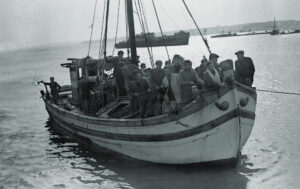

The 25-ton barque was hopelessly off course. Since its departure from the Seine River in France, its crew had set sail for the Isle of Lewis off the west coast of Scotland, via the Orkney Islands. Now, after being blown by a steady easterly wind through St. George’s Channel, the small boat was bobbing in the waters off Ireland as a darkened British man-of-war bore down on it. The occupants of the smaller vessel held their breath; the warship was carrying troops from Ireland to the British mainland in anticipation of a new Jacobite invasion, little knowing that the threat had already been snuffed out by one of the ‘Protestant storms that have meteorologically protected the British coastline throughout history.
Now the only invasion was from a small diversionary force to be led by the clan chiefs cowering aboard the small boat, including James Keith, the 22-year-old younger brother of George Keith, the 10th Earl of Marischal, Ranald MacDonald of Clanranald and John Cameron of Locheil, chief of the Camerons. Determined to restore a Stuart king to the British throne, they had expected considerable support from Spain, which was to invade England while they rebelled in Scotland. There had been two attempts before, leading to wars named after the years in which they began. Because of poor planning and bad leadership, however, this latest effort seemed doomed to fizzle out.
The impetus behind the conflict that would be known as the Little Rebellion began in 1688, when James II was deposed by Dutch-born Duke Willem of Orange — crowned King William III — in the Glorious Revolution of 1688. Supporters of the exiled Stuart king, taking their name from Jacobus, the Latin form of James, believed in the principle of hereditary succession and the divine right of kings. The Stuart dynasty had become unpopular because of its poor leadership and adherence to the Catholic faith — and the Jacobite Rebellion of 1689 ended in bloody failure.
When James II died in exile in 1701, his son, James Francis Edward Stuart, was recognized as James III by the French and Spanish courts. An abortive invasion was attempted in 1708, but the first serious rebellion occurred after the death of Queen Anne in 1714 and the accession of the unpopular Hanoverian Protestant King George I. Although James, known as the Old Pretender, was brave and honorable, the rebellion of 1715 was ineffectual largely because of the incompetent leadership of John Erskine, the sixth Earl of Mar, whose bad luck earned him the nickname Old Mr. Misfortune. James returned to exile in France, but Philippe II, duc d’Orléans, acting as regent for the infant King Louis XV, wished, in part for personal reasons, to reverse previous French policy and foster ties with England. A Jacobite court on French soil hindered the development of that policy, so James was forced to move his court to the papal territory in Avignon.
While the Jacobite court functioned in obscurity and some of its strongest supporters languished in the Tower of London, the English government sent an ultimatum to Pope Clement IX, alluding to the possible bombardment of Civitaveccia if the Jacobites did not move farther away from Britain. In February 1717, James uprooted his court and journeyed over the Alps via Mont Cenis Pass and his mother’s home in Modena to Urbino. There, Pope Clement provided him with an old palace where Jacobite intrigues could continue.
Although France had been removed as a possible ally, James still had strong support from King Charles XII of Sweden. Charles was a warrior-king who would have been James’ brother-in-law had James’ sister, Princess Louise, not died suddenly. Charles had strong motives for revenge against the Hanoverian George I following a territorial dispute over the bishoprics of Bremen and Westphalia. A plot was hatched through the German-born Swedish chief minister, Georg Heinrich, Freiherr von Schiltz Gortz, to finance an invasion of Britain, with Charles leading an army of 12,000 men. Although the plot petered out in the wake of Charles’ death in 1718, it had included the promise of a subsidy from Cardinal Giulio Alberoni, the chief minister of King Philip V of Spain. Cardinal Alberoni was the most powerful man in Spain and was determined to thwart the growth of British power, especially after the capture of Palermo and Messina in Sicily by Sir George Byng, and the defeat of the Spanish fleet off Cape Passaro on August 11, 1718.
The Spanish offer came just as the Jacobites were running out of funds and ideas. On November 5, 1718, James Butler, Duke of Ormonde, the last of the Jacobite leaders in French territory, set off to cross the Pyrenees disguised as a valet. Ormonde met up with Cardinal Alberoni, who promised that Spain would provide five thousand men, of which four thousand are to be foot, a thousand troopers, of which three hundred with their horses, the rest with their arms and accoutrements, and two months pay for them, ten field pieces, and a thousand barrels of powder and fifteen thousand arms for foot, with everything necessary to convey them. The main force was to be commanded by the Earl of Marischal in an invasion of southwest England, but Ormonde insisted on the need to create a diversionary attack in Scotland. Meanwhile the Old Pretender was to travel from Italy to Spain and either join the expedition or follow it at a later date.
James departed Rome under a cloak of secrecy on February 8, 1719. A decoy was arrested in northern Italy while James slipped aboard a small Genoese vessel. He landed in Spain on March 8 and headed for Madrid, where he was afforded a royal welcome. On the same day James arrived in Spain, two frigates carrying arms and 307 Spanish soldiers left San Sebastian. Commanded by Marischal, the force was to stage the diversionary attack in Scotland requested by Ormonde. On March 9, an armada of 29 Spanish ships, 5,000 troops and 30,000 muskets left Cadiz, intending to rendezvous with Ormonde in Corunna, then invade England.
On March 29, a fierce storm scattered the main body of Ormonde’s fleet, and the invasion was officially canceled. Marischal, however, had sailed too early for that news to catch up with him as he proceeded on his mission toward Stornoway on the Isle of Lewis.
Meanwhile, Marischal’s brother, James Keith, prepared to take a small boat with Jacobite leaders from the Seine River on March 19. Blown off course and narrowly avoiding capture by the British man-of-war, Keith’s party eventually arrived on Lewis on April 4. After waiting several days until the two remaining frigates arrived in Stornoway, Keith informed his brother of the disaster that had befallen the Spanish fleet, and also of the factionalism and intrigue that had developed to deprive him of his role as commander of the Scottish invasion. The Jacobites held a council of war and discussed two possible plans of action. They could either wait in the islands for any remnants of Ormonde’s dispersed invasion fleet to arrive, or they could follow Marischal’s suggestion: Proceed to the mainland and capture Inverness, which was garrisoned by only 300 troops.
Although Marischal’s plan was agreed upon, the next day William Murray, the Earl of Tullibardine, showed his hand by announcing his commission as lieutenant general of the invasion force and suggested remaining inactive on Lewis. Upholding a promise he had made to accept the authority of anyone who held a superior commission to his own, Marischal resigned his commission over the soldiers, but retained command of the ships.
Tullibardine fell in with Marischal’s plan, and eventually the force battled through storms and crossed to the mainland at Loch Alsh on April 13. There, they were promised support from disappointingly few local clan chiefs. Most of the chiefs were prudently awaiting news of the landing of Ormonde’s main invasion force in England before they committed their men to the struggle.
The small Scottish invasion force established a base at Eilean Donan Castle, an ancient stronghold of the Mackenzies situated at the point where Loch Alsh branches, forming Loch Long and Loch Duich. Instead of marching on Inverness, the Jacobites wasted time arguing in war councils until the news confirming the disaster to Ormonde’s fleet arrived. The invaders’ already low morale was dented by this news, and Tullibardine considered returning to Spain. Marischal, however, had sent the two ships he controlled out to sea to prevent them from being blocked in or destroyed by enemy men-of-war.
The acrimonious relationship between Tullibardine and Marischal continued, with the two protagonists establishing separate camps some two miles apart. Meanwhile Ormonde reported the invasion’s cancellation and exhorted the leaders to raise the clans in rebellion while he set about supplying arms. The Jacobites struck camp and marched inland to an advance base at Crow of Kintail. They left behind 48 Spanish troops, under the command of a captain and lieutenant, at Eilean Donan to guard their ammunition and provisions.
By then, the Hanoverian forces were reacting to the invasion, reinforcing the garrison at Inverness and dispatching a number of vessels to trap the Jacobites. Three English frigates, Worcester, Enterprise and Flamborough, commanded by Captain Charles Boyle, anchored at the mouth of Loch Alsh. Although they arrived too late to catch the main invading force, on May 10 they set about retaking Eilean Donan. After a short bombardment by Worcester‘s 48 guns and Enterprise‘s 44 guns, the Spanish garrison surrendered, and the 343 barrels of gunpowder and 52 barrels of musket balls that remained in the keep were detonated. Most of the buildings in the castle, as well as a second magazine at the head of the loch, were destroyed. The Spanish captives were loaded aboard Flamborough and sent for detention in Leith, the port of Edinburgh.
Meanwhile, the Jacobite force was marching toward Glenshiel in two contingents via Loch Duich and Loch Long. Some Highland clans began to rally to the cause. Locheil appeared on June 5, having managed to raise only 150 of his Camerons from Lochaber to Kintail. William McKenzie, fifth Earl of Seaforth, brought a more substantial force of 400 to 500 men. They joined a small band of Perthshire men brought by Lord George Murray, the younger brother of Tullibardine. Smaller bands of clansmen probably totaled 1,000 broadswords, including Mackinnons and Mackenzies who were joined by a small contingent of MacGregors, from Stirlingshire and Argyle, led by the legendary Rob Roy MacGregor. MacGregor had also been out during the Fifteen rebellion, taking his clansmen from the field of Sheriffmuir to spare them at a time when the outcome of the battle could have gone either way (in fact it ended in a draw). His clan had since been excluded from the general pardon granted to the rebels under the Act of Grace of 1717. He therefore had little to lose from standing once again in open rebellion against the government. His son joined him in Glenshiel on June 8 with 80 recruits.
When a party of Chisholms appeared, they brought news that a government force commanded by Maj. Gen. Joseph Wightman had already left Inverness on June 5 and passed Fort Augustus. He could be expected at the head of Loch Cluanie by the 9th and in Glenshiel by the following day. Wightman, also a veteran of Sheriffmuir, brought with him a force of about 850 infantry, including a Dutch contingent: 120 dragoons, 200 grenadiers and 130 clansmen from loyal Whig clans, supported by six bronze coehorn mortars.
Now facing the prospect of being surrounded on both land and sea, the Jacobites held another council of war and decided to stand at Glenshiel. By the time the Highlanders began to take up their positions on June 9, Lord Murray’s outposts could detect the government troops four or five miles distant.
The position the Jacobites chose made the most of the available terrain. The valley had a drover’s road that crossed the Shiel River by a stone bridge. At that point the shoulder of a hill jutted into the valley, causing it to narrow into a gorge, the steep sides of which were covered by heather, bracken and birches. The road entered the valley from the flat area above the pass on a shelf on the north side between the river and the hill. The Jacobites sought to strengthen the center of their proposed line by throwing up a series of entrenchments on the contours of the hill to the north of the Shiel. They also erected a barrier across the drover’s road that ran the length of the glen between the river and the entrenched hill. They held a strong position protected on the right by a rivulet and on the left by a ravine. The land in front of the entrenchments was steep and rugged.
On high ground south of the river the right flank of the Jacobite position was held by Lord Murray, tasting his first experience in command at age 14. On his left, entrenched on the north bank of the river, were some 250 of the remaining Spaniards, from Regimento numero 3 La Corona, a marine unit commanded by Don Nicolas Bolano. His troops wore a French-style coat in white without lapels and with blue collar, cuffs and lining, blue waistcoats with white breeches and long white linen gaiters. On their heads they wore tricornes edged with white tape and sporting a red cockade. They positioned themselves in among the assorted clans in the desolate glen under their colors, consisting of a white flag with two golden anchors crossed on a pale blue shield.
On the left of La Corona stood Locheil’s men, then the outlawed Rob Roy MacGregor and his reivers. Then came the Mackenzies under Sir John Mackenzie of Coul, the Campbells of Ormdale and GlenDarul, the Mackintoshes and, on a steep incline on the extreme left of the line, the Earl of Seaforth and his men.
Tullibardine therefore commanded a sizable force totaling 1,600 men in a strong position, making good use of hills and entrenchments that suited the Highlanders’ tactics. His rival, Marischal, who now had nothing to command save for the two departed frigates, stood with Seaforth on the left of the line. The rebel positions were spread out across the valley floor, with steep inclines on either flank. The barricaded road and the river cut through the right of the line between the Spaniards and Murray, with the river crossing via the stone bridge located behind the Spanish lines.
Wightman’s 1,100 troops struck camp at Loch Cluanie on the morning of June 10, and came within sight of the Jacobite entrenchments by 2 p.m. On his extreme right, opposite the Seaforths, he positioned his Highland contingent consisting of MacKays from Sutherland. The main body of Hanoverian troops was split into two wings. The stronger right wing, on the north side of the river and facing the bulk of the rebel forces, was commanded by Lt. Col. Jasper Clayton. It consisted of John, second Duke of Montagu’s Grenadier Regiment, standing downhill from the MacKays, then the 11th and 15th battalions of foot and the regiment of Dutch troops. The flank of the right wing, resting against the road and the river, was held by 150 dismounted dragoons. Across the river, on the south side, was situated the weaker left wing comprised of Clayton’s regiment, augmented by 80 of Captain George Munro of Culcairn’s clansmen and the mortars on the far left flank.
As the government troops were moving into position, hostilities began with the popping of carbines and the driving in of the Jacobite pickets. The battle did not begin in earnest until between 5 and 6 in the afternoon. The six mortars situated on the road began to lob shells toward Murray’s men on the exposed Jacobite right flank. Four platoons of Clayton’s regiment, aided by some of Munro’s Highlanders, advanced up the hill, but were beaten back by Murray.
Munro received a severe wound that disabled him for a time. As the enemy continued to fire on him, he commanded his servant, who had waited for him to retire, to inform his friends and family that he had died honorably. The servant burst into tears and asked how he was supposed to leave his chief in that condition. He spread himself over Munro to protect him from the enemy musket balls, receiving several wounds intended for his master. Both were eventually rescued by a sergeant of Culcairn’s company who had sworn an oath on his dirk that he would do so. The Hanoverians regrouped and were sufficiently reinforced to compel Murray to retire to the safety of the high-sided banks of the burn protecting his flank. Murray was now perched to sweep down on the left wing of the government troops if he received adequate support. None was forthcoming, however, and Murray retired from his exposed position — opening the Jacobite right flank.
Wightman now turned his attention to the left, as Montagu’s regiment carried out a vigorous assault in an attempt to outflank the rebels. Shaken by the brisk firefight, Seaforth requested reinforcements to drive back the government troops. Rob Roy MacGregor and his men hurried to the flank, but its defense had already started to disintegrate, and Seaforth was being removed with a ball in his arm. MacGregor and his men prudently retreated, followed by some of the other clansmen.
With both rebel flanks in disarray, Wightman could now concentrate on the center of the Jacobite line. He trained his mortars on the Spanish marines, who held their ground while the dry heather around them caught fire. Realizing the mortars’ noise belied the danger they posed at such long range, Don Nicolas Bolano gallantly offered to order his men to attack, but by then it was not a practicable strategy.
The battle was now entering its last confusing moments. Tullibardine later claimed that he suggested the remaining Highlanders form up with the Spaniards and march through the highlands to await Ormonde and his reinforcements. In any case Marischal quit the field, and the Spaniards declared that they were in no position to endure a march through the highlands. Tullibardine advised the Spanish to capitulate the best they could, and then he retreated up the mountains through the high pass round the base of Sgurr na Ciste Duibhe, eventually followed by the abandoned Spaniards. The English ceased the fight as darkness approached and the route of pursuit up the hillsides became steeper.
After about three hours, the engagement ended with relatively light casualties on both sides. Most of the government’s losses of 21 men killed and 121 wounded were suffered by Montagu’s regiment during its assault on Seaforth. Jacobite losses were more difficult to ascertain, since many of the Highlanders melted away into the safety of the hills as the tide of battle turned against them. Murray and Seaforth were both wounded and may have lost 20 men each, with the same number wounded.
By morning the Highlanders, low in ammunition and provisions because the English ships had destroyed their bases at Loch Duich, dispersed into the wilderness rather than engage the Hanoverian forces situated below them. Bolano, although keen to renew the attack, was persuaded to surrender his 274 Spanish troops, on condition that they retain their baggage. After a short spell in Inverness, they were moved to Edinburgh. Their plight attracted much sympathy, as the government refused to subsidize them. The Spanish prisoners were in no position to pay for their own food and travel, and the government demanded that they sign an IOU for their repatriation. After a period of wrangling, they eventually returned to Spain in October 1719. Their memorial today is Bealach-na-Spainnteach (the Pass of the Spaniards) overlooking Glenshiel.
Rob Roy MacGregor went into hiding in Glen Shira before eventually returning home to Balquidder. Like MacGregor, the rebel leaders also hid out in the Highlands before they sought asylum on the Continent. Meanwhile an attempt to relaunch the invasion of England fizzled out. Cardinal Alberoni, his reputation dented by the abortive expedition, fell from power in December 1719 and retired to Italy. His co-conspirator, the Duke of Ormonde, was able to remain in Spain under King Philip’s protection.
The men who had provided leadership in Glenshiel had mixed fortunes. After fighting in the last Jacobite rebellion of 1745, Tullibardine was executed in the Tower of London. The Earl of Seaforth was pardoned in 1726 and did not trouble the government again. Both Marischal and his brother, James Keith, served Frederick the Great of Prussia to good effect — the earl became a Prussian ambassador, and Keith attained the rank of marshal, dying in 1758 at the Battle of Hochkirch. Lord George Murray served for several years in the King of Sardinia’s army before his brother intervened with the Hanoverian court to grant him a pardon in 1726. Although he had misgivings over the 1745 rebellion, he was appointed lieutenant general of the Jacobite army. He became the outstanding Jacobite commander in that rebellion, winning victories at Prestonpans and Falkirk and tactfully managing the retreat from Derby. He opposed the strategy leading to the ill-fated Battle of Culloden, where he commanded the right wing and retired in good order following that defeat.
The Battle of Glenshiel had taken place on June 10, the birthday of James Stuart, on whose behalf the invasion and rebellion had been instigated. The Old Pretender was in Madrid when he learned of the invasion. He returned to Italy, and on September 1, 1719, married Clementina Sobieska. The following year she presented him with a son, Charles Edward Louis Philip Sylvester Casimir Maria. In 1745 this Young Pretender journeyed to Scotland by boat and led the clans in a final Jacobite uprising, giving birth to the enduring legend of Bonnie Prince Charlie.
This article was written by David Sharp and originally published in the June 2006 issue of Military History magazine. For more great articles be sure to subscribe to Military History magazine today!