In the fall of 1940, Adolf Hitler was certain that Josef Stalin was preparing to attack him. Word of the Soviet dictator’s paranoid purges of his military’s high command in the late 1930s had been reassuring news to the German Führer in Berlin. But when news reached Hitler in 1940 that the Soviets were busily training an entire new officer corps, the Führer began to worry again and ordered his generals to draw up plans for the invasion of the Soviet Union. His timetable was thrown off, however, by a series of unexpected developments in the south.
Chagrined over his own lack of conquests while Hitler’s forces were overrunning most of Western Europe, Italian dictator Benito Mussolini invaded Greece on October 28, 1940. Undertaken at the wrong time of year, the offensive quickly bogged down in the autumn rains, and when the Greeks counterattacked on November 5, they drove il Duce‘s forces back to their starting point on the Albanian frontier.
British forces were fighting alongside the Greeks, and Hitler was forced to intervene lest his enemies establish a foothold on his southern flank. German armies surged into and subdued the Balkans, saving Mussolini and securing the south — most of it. British Prime Minister Winston Churchill then sent units of the Royal Navy into the eastern portion of the Mediterranean in anticipation of a German invasion of Crete, the largest of the Greek isles, off the southeastern coast of the Greek mainland.
It was a foregone conclusion that the Germans would target the big island next. Britain’s presence there gave the Allies an invaluable base for their air and sea fleets to threaten supplies and reinforcements destined for Axis forces in North Africa. Royal Air Force bombers based on Crete could also reach the vital Romanian oil fields, which fueled the German war machine, and Crete might even provide a staging area for an Allied invasion of Southern Europe.
For the Germans, time was of the essence. Operations in Greece and Crete had to be concluded successfully before the invasion of the Soviet Union could be undertaken with prospects for a speedy victory before winter. The elite airborne forces commanded by General Kurt Student were placed on alert on May 1, 1941. They would have only 20 days to prepare for the assault on this distant, unfamiliar island. Operation Mercury, as it was called, was set in motion.
Because the campaign had to be carried out in great haste, there was little time for preparation on any level. A total of 500 Junkers Ju-52/3m transport planes would be required to convey the airborne troops into battle. The planes had been severely overworked during the recent attacks on Yugoslavia and Greece, however, and their airframes and engines were in need of major servicing. On May 1, the entire fleet flew north to dozens of aircraft maintenance facilities scattered throughout Germany, Austria and Bohemia-Moravia. By May 15, 493 overhauled, rewelded and otherwise repaired Ju-52s were back in Greece. The next problem to be dealt with was locating appropriate staging areas for the airborne armada.
The handful of Greek airfields with paved runaways were already occupied by the German VIII Air Corps’ bomber units. The transports would have to make do with dusty fields and dirt roads. When Colonel Rudiger von Heyking surveyed the runways for his 150 Ju-52s, he reported to his superiors: ‘They are nothing but deserts! Heavy-laden aircraft will sink up to their ankles.’
Heyking’s dismay was warranted. His airfield outside Topolia had been plowed up by its previous commander in an attempt ‘to make it more level.’ The result was that takeoffs and landings raised dense clouds of dust that rose to 3,000 feet and made it impossible for formations to follow each other at intervals of less than 17 minutes. It was a problem that plagued the Germans throughout the developing theater. Transport groups at Dadion, Megara, Corinth and Tanagra were forced to use fields made of shifting, unstable sand.
The Germans also suffered from a severe fuel shortage. The three flights by 493 Junkers to deliver the paratroopers to Crete would require an estimated 650,000 gallons of gasoline. As of May 17, no fuel had arrived. On April 26, British infantry had captured the bridge over the Corinth canal, through which the Germans’ fuel-carrying tanker had to pass en route from Italy. The British blew up the bridge, which fell into the canal and effectively blocked it. By May 17, Kriegsmarine divers had managed to clear the debris sufficiently to permit the tanker to pass, and the next day she docked at the Greek port of Piraeus, where the precious fuel was pumped into 45-gallon barrels and loaded onto trucks for transport to the airfields.
Because of the delayed tanker, the invasion had been postponed from May 15 to the 18th, and finally to May 20. By midnight of May 19-20, some transport squadrons were still waiting for their fuel, and when it finally arrived, time was so short that paratroopers had to help unload the drums, roll them to the planes and then assist as the tanks were slowly filled by hand-cranked pumps. To compensate for the hard night’s work, the soldiers were issued amphetamines to keep them awake through the long days ahead.
The airborne assault commenced at dawn, with fleets of Ju-52s roaring over the Cretan coast, disgorging clouds of tired paratroopers while additional soldiers arrived via glider. The initial airdrops were made by a force of 3,000 men under the command of Maj. Gen. Eugen Meindl near Maleme and Canea on Crete’s northwest coast. These were followed on the afternoon of the 20th by 2,600 soldiers at Heraklion and 1,500 at Rethymnon.
Student’s forces suffered such ghastly casualties that massive reinforcements became necessary to stave off outright defeat. Opposition to the invasion was much stiffer than had been anticipated. More than 40,000 troops, including Greek soldiers evacuated from the mainland and British Commonwealth forces under the command of Maj. Gen. Bernard Freyberg, a New Zealander, fought ferociously.
The primitive conditions and murderous anti-aircraft fire over Crete claimed so many of the crucial Ju-52s during the first two days of the attack that the German high command doubted further airdrops were advisable.
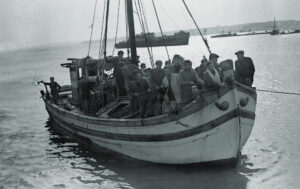
Apart from the heavy losses of Luftwaffe transports, there was the problem of delivering sorely needed artillery, ammunition, tanks and other heavy equipment, all of which were too heavy to be carried by aircraft. The solution was to dispatch a convoy of commandeered Greek fishing and merchant vessels carrying 2,331 soldiers of the 100th Mountain Regiment’s 3rd Battalion, fully armed and equipped, on the evening of May 20. The Germans tried to convince their Italian allies to launch a major naval sortie to the west to draw the Royal Navy away from the convoy, but Mussolini’s admiralty expressed little interest in such a risky ploy. Instead, the Germans hoped to deceive their enemy with false radio signals and make for Crete under cover of darkness.
The problem with that plan was that Luftwaffe air superiority was meaningless at night, and if the Royal Navy was able to locate the sea train, nothing could prevent a massacre. Sure enough, the heavily laden and elderly vessels were slowed by contrary winds and were still far short of their destination at dawn, when Luftwaffe reconnaissance warned them of approaching British warships. The motley fleet reversed direction and returned to its starting point, the coastal island of Menlos.
Six hours later the Germans tried again, hoping that the enemy would not expect another attempt so soon. But by starting so late in the day they forfeited any chance of reaching Crete before dark. Elements of the British Mediterranean Fleet had been patrolling off the north coast of Crete in anticipation of such a move. Just before midnight three cruisers and four destroyers of Admiral Sir Andrew Cunningham’s command tore into the virtually unprotected German convoy.
A survivor of the attack later wrote: ‘To us the searchlights appear like fingers of death. Sharply cut against the darkness they grope here and there over the water. For a moment they touch our mast tips in brilliant light, then wander on. Are we too small to be seen?’ Apparently not, for as the terrified German looked up he saw a destroyer churn out of the blackness. ‘The thing is right in front of us,’ he continued. ‘A dark shadow high as a church tower. The searchlights flash out again, drenching our tiny vessel in light as bright as day. `Everybody overboard!’ As we leap into the water the first salvoes crash into us like a tempest, sending showers of wood and debris about our ears.’
For 2 1/2 hours it was a turkey shoot. Then the warships broke off and retired, leaving the shattered remains of the flotilla dead in the water to drift northward toward Greece. Cunningham estimated that 4,000 Germans had been killed. In fact, just over 800 had died, and at dawn Axis forces mounted a massive rescue effort. A second convoy, carrying the 2nd Battalion of the 85th Mountain Regiment, was sighted that same morning but escaped back to the mainland with a British flotilla hard on its rudders.
Developments along the entire eastern seacoast would soon turn the tide in the bloody battle for Crete. For several days Luftwaffe combat squadrons had been massing at newly captured airfields on islands in the Aegean Sea, at the Peloponnesian cities of Argos, Mycenae and Molae, and to the north in central Greece. The British lost the destroyer Juno to German aircraft on May 21, and on May 22 reconnaissance patrols pinpointed the locations of British naval units throughout the battle zone.
Cunningham was aware of his vulnerability to air attack and had accordingly refrained from drawing too near the combat areas. However, the Luftwaffe bomber units had been so preoccupied with supporting their beleaguered paratroops that they had so far virtually ignored the British fleet. Perhaps this lack of attention deceived the admiral into overconfidence.
On the night of May 21-22, Cunningham sent 14 of his cruisers and destroyers to positions off the island’s north coast to continue the blockade. It was these vessels that the German reconnaissance flights noticed. Soon after first light, hundreds of German bombers and fighters roared into the sky.
The first to lift off were the Junkers Ju-87B dive bombers of Stukageschwader 2, commanded by Lt. Col. Oskar Dinort. Twenty-five miles north of Crete they found targets — two cruisers and two destroyers. Screaming down from 12,000 feet, the Stukas ignored blistering anti-aircraft fire and unloaded on their marks. Under full steam and rudder, the ships zigzagged desperately as heavy bombs exploded so close that their decks were doused with seawater from the blasts.
The light cruisers Gloucester and Fiji were slightly damaged, while destroyers Greyhound and Griffin emerged unscathed. After 90 minutes of virtually fruitless attack, the Stukas returned to their airfields for rearming and refueling while the quartet of British vessels fled to rendezvous with the main fleet 30 miles off Crete’s west coast.
To the east the British were still pursuing the second troop flotilla when they were assaulted by twin-engine Junkers Ju-88 dive bombers. The Allies were already learning to fear these versatile planes, which combined speed, diving ability, bombload and accuracy to a devastating extent. In this attack, however, the initial wall of flak thrown up by the targets apparently so unnerved the German assailants that only two ships, the cruisers Naiad and Carlisle, were moderately damaged before the flotilla scattered and made good its escape to the west.
Cunningham was dismayed by this maneuver. He was convinced his vessels stood a better chance if they closed with the troopships and destroyed them at close quarters while the pilots, who he thought would be fearful of killing their own men, buzzed helplessly overhead. Also, he considered destruction of this reinforcement-carrying convoy worth any price. But by the time his order of ‘Stick to it!’ arrived from Alexandria, his task force had already retired.
By that time 19 British warships had gathered, led by the battleships Valiant and Warspite. They could throw up a withering screen of fire, but much of their ammunition had been expended in the previous day’s action. Furthermore, the commander of the VIII Air Corps, General Wolfram von Richthofen, had at his disposal a massive array of aerial firepower. May 22, 1941, would demonstrate how vulnerable even a powerful naval task force can be when an opponent has complete control of the sky.
At 12:30 p.m., flights of Messerschmitt Me-109s and Dornier Do-17s joined the Stukas chasing the westward-steaming British ships as they linked up with the rest of the fleet. Warspite immediately suffered a direct hit. Seeing her distress, the Me-109s pounced on her, spraying her with machine-gun fire that killed many sailors and knocked out her 4- and 6-inch starboard batteries.
At this point the planes of the refueled and rearmed Stukageschwader 2 arrived. Seeing the vast aerial armada descending upon them, the British turned and fled southwest in a desperate bid to get out of range. In essence they were abandoning their comrades on Crete and conceding defeat. The Germans, however, had no intention of allowing them to escape unmolested.
A couple of hours earlier, Greyhound had been dispatched alone to destroy a caique full of soldiers that had been spotted off Antikythera. The solitary destroyer was caught and quickly sunk by two Stuka bombs. Two other destroyers, Kandahar and Kingston, were ordered by Rear Adm. Edward King to return and pick up survivors while Gloucester and Fiji were to provide anti-aircraft cover. The admiral was unaware that the cruisers were almost out of ammunition, and by the time he was informed of that and radioed for them to return, it was too late.
Gloucester was mortally hit almost instantly. Ablaze along her entire length, she meandered aimlessly until 4 p.m., when she was sunk by an internal explosion. This time King gritted his teeth and left the surviving crew to what he assumed was certain death in the sea. Over the next 24 hours, however, German floatplanes picked up more than 500 British seamen.
Meanwhile, Fiji and her destroyers set course for Alexandria. At 5:45 p.m. she was spotted by a lone Me-109 that was carrying a 550-pound bomb. Although at his extreme range limit, the pilot never wavered in his attack, planting his bomb alongside the ship and buckling her plates. The resultant flooding seriously reduced Fiji‘s speed and caused a severe list. Furthermore, the German pilot radioed his victim’s whereabouts, and when a bomber appeared 30 minutes later, there was little the cruiser could do to defend herself. The plane dropped three 110-pound bombs on the forward boiler room, and at nightfall Fiji turned turtle and sank.
Also at dusk five modern destroyers arrived from Malta and took up position off Crete’s north coast. Two of them, Kelly and Kashmir, shelled German positions at Maleme and torched a couple of troopships, but at dawn they were attacked by a swarm of 24 Stukas and quickly sent to the bottom. Destroyer Kipling rescued 279 survivors, including Kelly‘s captain, Lord Louis Mountbatten. At 7 a.m. on May 23, what was left of the British Mediterranean Fleet limped back to Alexandria.
The previous night a delighted Richthofen had written in his diary: ‘The British take hit after hit; ships burn and sink. Others turn aside to help and are caught by bombs, too. Some limp along with a list, others with a trail of oil, to get out of this hell. Flight units that have flown the whole day, bombed, reloaded with time for naught else, at evening begin to let out triumphant shouts of joy. Results cannot yet be assessed, but I have the solid feeling of a grand and decisive success: Six cruisers and three destroyers are definitely sunk, others so damaged they will sink in the night. We have finally demonstrated that, if weather permits flying, a fleet cannot operate within range of the Luftwaffe.’ Richthofen hurriedly radioed Berlin to send immediate seaborne reinforcements to Crete. However, the high command was still shaken by the mauling of the first troop convoy and could not believe that the Royal Navy had been swept from the arena.
Although the toll on the British was less than Richthofen thought (only two destroyers had actually been sunk at the time of his diary entry), it was still considerable. Three other warships were damaged to the point of uselessness, and more than 1,000 men had been lost. Still, the exultant Luftwaffe general could not prevail on his distant, overly cautious superiors to launch another fleet of troop-carrying boats. Help would continue to arrive with maddening slowness via the depleted squadrons of cargo planes.
If the upper echelons of the Wehrmacht were unconvinced of their own success, the British certainly were not. By retiring to Alexandria, Cunningham was disobeying direct orders from London to retain control of the sea lanes north of Crete at all costs. The rueful admiral could see that control of the sea had passed from surface forces to air power and that his superiors’ notion of war at sea was outmoded. He radioed the chiefs of staff that his losses were too great to justify trying to prevent further attacks on Crete, adding that his men and the vessels they sailed were nearing exhaustion.
‘The operations of the last four days have been nothing short of a test of strength between the Mediterranean Fleet and the German Air Force,’ Cunningham reported on May 23. ‘I am afraid that, in the coastal area, we have to admit defeat and accept the fact that losses are too great to justify us in trying to prevent seaborne attacks on Crete. This is a melancholy conclusion, but it must be faced.’
There would be no landings of seaborne Germans, however, and the battered Ju-52s resolutely continued to land with their human cargo. The 100th Mountain Regiment, some of the men still wet from the previous day’s abortive cruise, was gradually brought up to strength with airlifted new arrivals. The tough, well-equipped veterans began to prevail in this confused campaign so marred by crucial blunders on both sides. The Allies, bereft of air support due to a lack of aircraft carriers or suitable airfields in range of the combat zone, were gradually pushed to the coastal areas of the island’s eastern end, where they awaited evacuation by what remained of the demoralized British fleet.
As late as May 27, Churchill telegraphed General Sir Archibald Wavell, commander in chief of Middle East forces, ‘Victory in Crete essential at this turning-point in the war.’ The same day Wavell despondently replied, ‘Fear we must recognise that Crete is no longer tenable….’
The British evacuation would have been a suicidal venture if Hitler had not already begun withdrawing his air units in preparation for the invasion of the Soviet Union. At Heraklion, however, destroyer Imperial‘s rudder became hopelessly jammed, compelling the British to transfer her crew and troops to destroyer Hotspur, and then scuttle her. A handful of remaining Stukas came across the rescue force on May 29, damaging cruisers Ajax and Orion and several destroyers, sinking the destroyer Hereward, and killing another 800 men.
Although the Luftwaffe‘s neutralization of the Royal Navy’s Mediterranean Fleet made it possible for Germany to conquer Crete, it would be a hollow victory, so costly that Hitler swore off any further large-scale paratroop operations. He did not bother turning his expensive acquisition into a Nazi bastion to dominate the eastern Mediterranean and possibly secure victory in North Africa. Crete proved little more than a cemetery for thousands of wasted German lives — a sacrifice General Julius Ringel, commander of the 5th Mountain Division, said ‘would not have been too great had it meant a beginning, not an end.’
The Royal Navy lost a total of nine ships and 2,000 sailors during the campaign for Crete. On land, 1,700 Allied soldiers were killed and 12,000 captured. A total of 4,000 German soldiers were killed, and 220 of the nearly 500 transport aircraft involved were lost. After the invasion of Crete, Hitler told Student that the day of the paratrooper was over. The German armed forces would never again launch a large-scale airborne assault. The Allies, however, proved Hitler incorrect when they used airborne troops effectively against him during the D-Day operations three years later.
This article was written by Kelly Bell and originally appeared in the May 1999 issue of World War II.
For more great articles be sure to pick up your copy of World War II.