When General Napoleon Bonaparte defeated the Mamelukes at the Battle of the Pyramids on July 21, 1798, he carried out only the first move in a complicated game. He was now the master of Egypt and in a matter of hours would occupy Cairo. That, however, was not the main object of this mission. The central goal was to sever Britain’s communications with the East, destroy her trade and loosen her grip on India. Perhaps even a French occupation of part of Australia would be possible. To the young Corsican-born general, just coming into his stride in the wake of his brilliant campaign in northern Italy, the possibilities seemed to be infinite. ‘This little Europe is too small a field,’ Bonaparte supposedly said before setting out for Alexandria. ‘Great celebrity can be won only in the East.’
Little could Bonaparte have imagined, as he surveyed the beckoning East in the manner of a Roman emperor, that he was about to be all but ruined by the sudden swoop of a British naval flotilla commanded by Vice Adm. Sir Horatio Nelson.
The extraordinary story of the Battle of the Nile, as the action in Aboukir Bay is often incorrectly called, is remarkable for its paradoxes and its revelation of the power of an individual. For a start, the British fleet that fought the French on that first day of August 1798 should not have been fit for battle. Only a year before, much of it had been in a state of mutiny, more dangerous to Britain than to her enemies.
The fleet’s commander, Nelson, disagreed with time-honored tactics and was determined to try a revolutionary new idea in the coming battle. Had he been surrounded by radio and satellite communications, it is likely his superiors in London would not have let him go ahead.
Nelson was a nervous, neurotic genius. He was already immersed in his love affair with Lady Emma Hamilton, wife of the British ambassador in Naples — an example of misbehavior that in later times would have led to his being cashiered. At times Nelson would happily disobey orders — his most celebrated act of disobedience thus far had brought about British victory at Cape St. Vincent on February 14, 1797.
Naval tactics had changed little since Henry VIII of England came up with the idea of firing alternate broadsides. All the cannons on one side of a ship of the line would deliver a shattering volley, then the ship would turn so the first battery of guns could be reloaded and primed, while the guns on the opposite side of the ship fired. The superior maneuvering of the English ships, allowing more broadsides to be fired one after another, was largely responsible for the defeat of the Spanish Armada in 1588. That highly successful 16th-century tactic became unwieldy in the 17th and 18th centuries, and British sea fights against the Dutch and French were usually heavy battering matches in which the two sides hammered each other into exhaustion.
Nelson’s genius produced a better idea — an idea that was so like Napoleon’s schemes of tearing an army to fragments that Nelson should perhaps be known as the Napoleon of the waves. At Cape St. Vincent, Commodore Nelson — not yet an admiral, but one step above a captain — was serving under Sir John Jervis. Jervis was a 61-year-old sea dog straight out of the pages of Tobias Smollett. Brave, devoted to his men, sensible and never foolhardy, he would have been the best kind of soldier’s general had he been in the army. When he had civilians on board, as sometimes happened after rescuing British civilians from territories about to be occupied by the French, he would ask the women to sing duets. Charmed by his good humor, they were always willing to oblige.
When Jervis sighted the Spanish fleet one misty morning, he ordered his ships to sail in a long line for the center of the Spanish line. Seeing the Spanish force divided but with the rearmost ships hastening to close up with the vanguard, Nelson sailed his ship, the 74-gun Captain, out of the British line — against orders — and deliberately placed it between the two divisions of the enemy fleet. So many cannons opened fire on Captain that for a time it vanished in the smoke. But when the smoke cleared Nelson’s ship was still afloat. His reckless gambit held apart the two sections of the Spanish fleet just long enough for the rest of Jervis’ ships, though outnumbered nearly 2-to-1, to concentrate against first one Spanish division and then against the other, with devastating results.
Nelson had also distinguished himself by leading boarding parties onto two larger Spanish ships, San Nicolas and San Joseph, both of which surrendered. As a result of the victory, Jervis became Earl St. Vincent, and his headstrong commodore became Rear Adm. Sir Horatio Nelson. Clearly, Nelson was a dangerous customer, and he would never be satisfied with anything short of total victory.
When the British government decided to send a fleet into the Mediterranean in 1798, they regarded it as merely a showing of the flag to encourage the Mediterranean states, such as the Kingdom of the Two Sicilies, to join yet another coalition against Revolutionary France. ‘When you are apprised,’ First Lord of the Admiralty Earl George John Spencer wrote to Jervis, ‘that the appearance of a British squadron in the Mediterranean is a condition on which the fate of Europe may at this moment be said to depend, you will not be surprised that we are disposed to strain every nerve and incur considerable hazard in effecting it.’ He went on to add that such a squadron might be put under the command of Nelson.
Jervis had already put the plan in motion. American travelers from Italy had reached Cadiz, Spain, and somehow had managed to get word to Jervis’ fleet, which was blockading the port, that an immense French expedition was gathering at Toulon. The Americans said that rumors indicated an attempted landing in England, or, more likely, Ireland, where a full-scale rising against British rule was in progress. Acting on that information, Jervis sent Nelson into the Mediterranean with three ships of the line to find out what was going on. There was no intention of fighting a battle at that point — only to obtain information. After receiving Spencer’s message, however, Jervis, acting on his own initiative, decide to reinforce Nelson by sending another 10 ships of the line to join him.
Jervis had confidence in Nelson. When one of his captains complained about Nelson having disobeyed orders at Cape St. Vincent, Jervis — who, in fact, had planned to bring his whole line about one minute after Nelson did so on his own initiative — retorted roundly, ‘I forgive him, and if you ever break your orders with such a result I’ll forgive you, too.’
Not everyone shared Jervis’ confidence. Some captains in the British fleet were furious that the command in the Mediterranean had been given to a young rear admiral not yet 40 years old. And, indeed, Nelson had no flash of inspiration in the early stages of his search for the French fleet. But he had written to Spencer in June 1798 that if the French passed Sicily he would believe ‘they are going on their scheme of possessing Alexandria and getting troops to India.’
In fact, French engineers, intent on surveying Egypt, had landed at Alexandria in April; however, news of their arrival did not reach London for another three months. Misled by a false report that the French had left Malta on June 16, Nelson set sail for Alexandria, convinced his prey was in front of him. In fact, the French were behind him. Thus, when his lookouts saw sails on the far horizon on June 22, Nelson did not bother to investigate them. If he had, he would have saved himself a lot of trouble, for later it was established that those sails did indeed belong to the French fleet.
Nelson’s fleet sped on. Captain James Saumarez of Orion said that they were going ‘upon the merest conjecture only, and not on any positive information. Some days must now elapse before we can be relieved from our cruel suspense.’
On June 28, Nelson’s fleet came in sight of Alexandria. There was, of course, no sign of the French, and Nelson immediately set off for the coast of the Levant. The very next day, as the British sails dropped over the horizon to the east, the French sails rose on the horizon to the west. Nelson had arrived a day too soon and had left a few hours too soon. The French congratulated themselves, and Bonaparte got on with the business of taking Egypt.
Nelson sailed on to the Gulf of Alexandretta, but not a word of the whereabouts of the French fleet could be obtained. He then battled against westerly winds and arrived at Syracuse on the east coast of Sicily by July 19, lamenting that ‘the Devil’s children have the Devil’s luck!’
In Naples, Sir William Hamilton used his influence to have Syracuse opened to Nelson’s ships so that he could take on fresh water. By July 25, he was ready to resume his search. Meanwhile, gun exercises were carried out every day, and the captains assembled in Nelson’s cabin aboard his flagship, Vanguard, to hear him expound his plans. At last, in the Gulf of Koron on July 28, some Greek fisherman provided the admiral with useful information: A great fleet had been seen heading southeast from Crete.
So it was that Nelson set course back to Alexandria, and just after midday on August 1, the British fleet reached the port again. And again, it was empty.
The disconsolate Nelson ordered dinner to be served, although it was only lunch time. It was a meal almost tearful in its sadness, and slowly the fleet idled along farther to the east. Then, as the tablecloth was being cleared, Saumarez recalled, ‘The officer of the watch came running in saying ‘Sir, a signal is just now made that the enemy is in Aboukir Bay and moored in a line of battle.’ ‘ Cheers broke out. The hunt was over. ‘If we succeed,’ remarked one of Nelson’s captains, ‘what will the world say?’ Nelson replied: ‘There is no if in the case. That we shall succeed is certain; who will live to tell the story is a very different question.’
The French admiral, Franois Paul Brueys d’Aigailliers, had anchored his fleet in a line across the bay. To the west was Bequier Island, surrounded by an extensive shoal. Brueys tucked his van up against the island and the shoal, believing it to be quite safe. In the center of his line he had the gigantic L’Orient, much bigger than any British ship, bristling with 120 guns.
It is often said that Nelson ordered the British fleet to sail between the French ships and the shore, and that this tactic gave him the advantage because the French were not expecting an attack from that side and had not even bothered to clear their gunports. That explanation is misleading, however, and does not take into account the principle that guided Nelson at the Battle of Cape St. Vincent the year before. A close examination of the first 20 minutes of the Battle of Aboukir will make this clear.
Nelson apparently realized that if there was room for each French ship to swing on its anchor with the tide, there must be room for a British ship to pass or to anchor in its turn. Captain Thomas Foley in Goliath sailed right around the leading French ship, Guerrier, and he was followed by Zealous, Orion, Theseus and Audacious. As each ship sailed past Guerrier, Conquerant and Spartiate, a thundering broadside was delivered. Within 20 minutes, or by 6 p.m., the leading three French ships had been silenced. The head of the French line had been blown away, and a gap had been opened through which the British could sail at will.
On the seaward side of the French line, Nelson’s Vanguard led a furious bombardment of the center. Enormous courage was shown by both sides. It is recorded that Captain Dupetit Thouars of Tonant had both arms and a leg shot off, after which he ordered his men to place him in a tub on his quarterdeck, where he died after every gun on his ship had been silenced.
A musket ball struck Nelson on the forehead, tearing a flap of skin, which fell over his one good eye, rendering him temporarily blind. He thought he was dying and was carried below, where he refused the attentions of the surgeon until the other wounded cared for. ‘I will take my turn with my brave fellows,’ he said — the sort of remark that was calculated to endear him to his ‘brave fellows.’
By 8 p.m., the first five ships in the French line had surrendered, and victory was certain. But one more great drama remained to be played out before the battle ended.
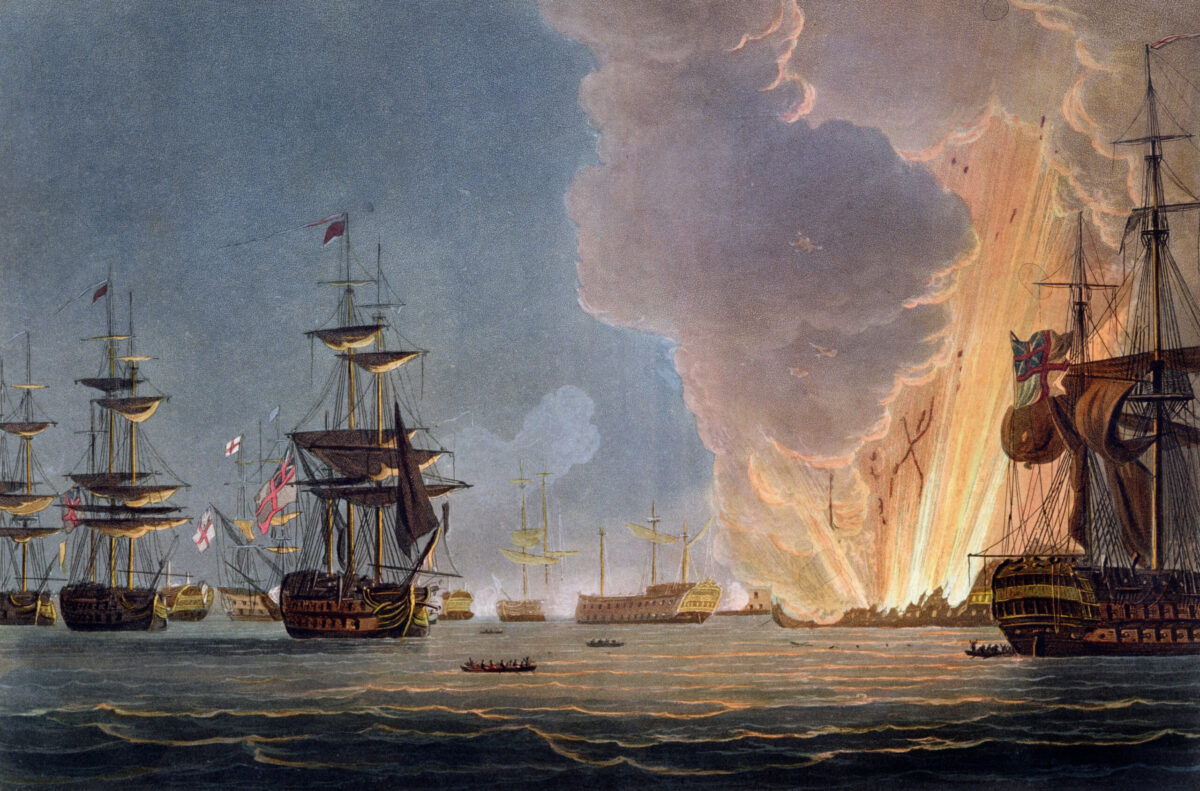
The British ship Bellerophon had had her mast torn off by fire from Orient’s heavy guns and was drifting out of the fight. A Canadian named Benjamin Hallowell was in charge of Swiftsure, and he brought his ship between Bellerophon and her adversary, anchoring just yards from Orient. Swiftsure released a fierce broadside and was joined by Alexander. Orient was soon in difficulty, and at 9 p.m. Hallowell saw flames coming from the French flagship. Her poorly disciplined crew had left buckets of oil and paint around the ship, and these had caught fire. Every British ship whose guns could reach her hammered Orient mercilessly, and soon it became obvious she would blow up as soon as the flames reached her powder magazine. Someone told Nelson of the anticipated explosion, and he insisted on being led up on deck to watch.
At about 9:45 p.m., Orient blew up with a detonation that was heard 10 miles away at Rosetta. The noise temporarily stopped the battle, and for some minutes silenced reigned as if neither fleet dared open fire again. On Goliath, there were several women and boys whose task it was to pass gunpowder up from the magazine to the gunners. Reportedly, they thought their own ship had blown up, and at about that time a tough Scotswoman gave birth to a son.
Nelson ordered Vanguard’s only undamaged boat to pick up what survivors from Orient it could, and about 70 French sailors were saved.
As the guns opened fire again, the moon rose, casting an eerie pall over the destruction of the French fleet. Pierre Charles Jean Baptiste Sylvestre de Villeneuve, who commanded the rear of the French line of battle, was a spectator of that horrific event, and his ships were never able to do anything about it. Long before dawn the firing had stopped, and with the coming of daylight the full extent of the carnage was revealed. ‘Victory is not a name strong enough for such a scene,’ said Nelson.
Three of Villeneuve’s ships cut their cables and ran for the open sea, but one of them, Timoleon, ran aground and was set on fire by her own crew. On the night of August 2, Nelson dined with six French captains in his own cabin, but Brueys had been killed on Orient. More than 3,000 prisoners had been taken, and more than 2,000 men killed. Eleven ships had been captured or burned. It was probably the most complete naval victory to date.
Nelson then sailed for Naples, where he was received with rapture by Lady Emma Hamilton. When the news of the British victory reached England, Nelson was made a viscount, a step lower in the peerage than the earldom given to Sir John Jervis after the victory at Cape St. Vincent, for which Nelson had been largely responsible.
Meanwhile, after an unsuccessful foray into the Levant, Napoleon boarded a ship for France. His dreams of an Eastern empire were over, but he did get himself a Western empire by becoming first consul and then emperor.
Undoubtedly, Nelson had saved England. He had made himself a viscount. And, by forcing the French general to return to France, he had helped make Napoleon an emperor. Not bad for an evening’s work.
For more great articles be sure to subscribe to Military History magazine today!