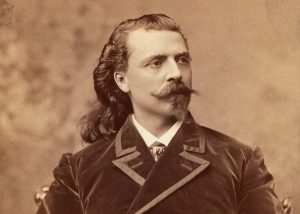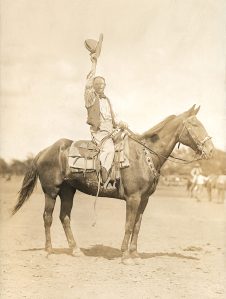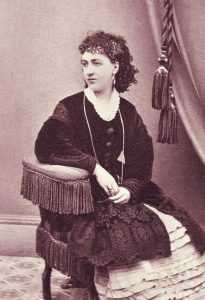

After a century of newspaper and magazine articles, novels and biographies, motion pictures and television dramas, the image of Bat Masterson as fearless Western gunfighter, gambler and lawman is firmly imbedded in the public consciousness. But few today are aware that William Barclay Masterson, better known as Bat, achieved fame in an entirely different field and arena, or that he spent the last 20 years of his life as a boxing authority and newspaper columnist in New York City.
Pugnacious by nature and a gambler by profession, Masterson was drawn to the prize ring during the 1880s, when prizefighting was promoted and controlled by professional gamblers. Over the next 40 years he attended almost every important fistic event held in the country and was involved as manager, ring official, promoter and boxing columnist. In 1893 the National Police Gazette, America’s barber shop bible, hailed him as ‘The King of Western Sporting Men,’ one who ‘backs pugilists, can play any game on the green with a full deck and handles a bowie or a revolver with the determination of a Napoleon.’
Masterson’s first sports columns were written for George’s Weekly, a Denver newspaper. When a boxing promotion partnership with Otto Floto, sports editor of the Denver Post, ended rancorously, Masterson took up the pen to retaliate against vituperation Floto hurled at him in his columns. The word battle led to a street brawl in July 1900. Bat belabored Floto with his cane and sent him running. Many Denverites viewed the feud as a comic affair, but it grew more serious when Floto and his Post employers imported notorious gunman ‘Whispering Jim’ Smith to deal with Masterson. The two gunfighters never met, but in May 1902 Bat, disgusted with Denver, left town.
Accompanied by prominent Chicago gambler Charles E. ‘Parson’ Davies, he went to New York City and booked passage on the ocean liner Lucania, sailing for England on Saturday, June 7. The two sporting men saw an opportunity for lucrative boxing promotions during the celebrations planned for the coronation of the new British king, Edward VII.
But Bat Masterson was not destined to make that trip. The day before he was to sail, two detectives arrested him on a Manhattan street corner, booked him on charges of running a crooked faro game and relieved him of a large pistol. The arrest story filled the front pages of the city’s newspapers. New Yorkers were fascinated by the appearance in their city of a real-life Western man-killer, toting the six-shooter with which he had dispatched two dozen or more badmen.
Oddly enough, the legend of Bat Masterson, gunfighter nonpareil, had its genesis in a wildly exaggerated story about him in a New York newspaper more than 20 years earlier. Titled ‘A Mild Eyed Man Who Killed Twenty-six Persons,’ the largely fictitious account first appeared in the New York Sun in 1881 and was reprinted in papers all over the country. Now, in 1902, the New York papers trotted out the old canards about Masterson’s sanguinary career, the story went out over the news services, and the legend was further reinforced.
Masterson’s arrest was the result of a complaint filed by George H. Snow of Salt Lake City, a Mormon elder who claimed he had been swindled out of $16,000 in a braced faro game. Bat was also charged with carrying a concealed weapon. He was arraigned and released on $2,500 bond, pending a hearing scheduled for the following Monday. When Snow failed to appear at the hearing, the judge dismissed the swindling charge but fined Masterson $10 for carrying a concealed weapon.
The affair caused Bat to miss his ship to England and embarrassed him publicly. He sued Snow for $10,000, claiming false arrest and damage ‘to his good name as a square gambler.’ Snow procured an affidavit, signed by the arresting officers, stating that he had never named Masterson as a party to the fleecing scheme, and the case was settled out of court.
Despite his rather unpleasant welcome to New York, Masterson was captivated by the city. He remained there for the next 20 years, living and working within easy walking distance of Longacre Square (later Times Square), the heart of the sporting and theatrical district, the site of the best restaurants and hotels, and the center of New York night life. It was an environment far different from the dusty streets of Dodge City where he had first achieved renown, but the 49-year-old former frontiersman adapted well to this new milieu. In New York he became one of the ‘Broadway guys’ immortalized by Damon Runyon in his popular short stories. (In the hugely successful stage play and motion picture Guys and Dolls, based on Runyon’s stories, the character Sky Masterson, Colorado gambler, played by Marlon Brando in the movie, is drawn from Runyon’s memory of his close friend Bat Masterson.)
Bat had many friends, but none had a more profound effect on his success in New York than the Lewis brothers, Alfred Henry and William Eugene. Both were journalists who had known him since they worked on Kansas City papers in the 1880s.
Alfred Henry Lewis first gained national attention with the publication in 1897 of his book Wolfville, a collection of Western stories. Over the next 17 years, Lewis published 18 fiction and nonfiction volumes and became the nation’s highest paid magazine writer. Pugnacious and noncomformist, Lewis had much in common with Masterson, for whom he became mentor and benefactor as Bat made the transition from Western frontier sporting man to Eastern metropolis newspaperman and prize ring pundit. Alfred Henry Lewis widely popularized the legend of Bat Masterson, writing highly imaginative articles about him for national magazines and a novel, The Sunset Trail, which appeared in 1905. As editor of a slick monthly magazine called Human Life, Lewis published in 1907-08 a series of Masterson articles on gunfighters Bat had known in the West.
Younger brother William Eugene Lewis sponsored Bat’s journalistic career. As managing editor of the New York Morning Telegraph, W.E. Lewis hired Masterson as a sportswriter and quickly promoted him to columnist and sports editor. As Lewis gained greater control of the Telegraph, rising to general manager and finally president, Bat followed his friend right up the ladder, eventually becoming vice president and company secretary. He worked at the paper until his death in 1921.
The Telegraph was unlike the other dozen or so daily papers published in New York City. News of prominent people, especially if it involved divorce, scandal or suicide, got extensive coverage. The photograph of a beautiful young woman, usually a showgirl, adorned every front page. The lead story on page one was as likely to be a horse race or a prizefight as a presidential election. Sensational crime stories were featured, but attention was given also to financial reports, racetrack betting odds, vaudeville, theater and motion picture news and sports, particularly boxing. The New York Morning Telegraph was a combination of Daily Racing Form, Wall Street Journal, Variety, Sporting News, Billboard and Silver Screen Magazine, with a dash of National Inquirer.
Memorable personalities who worked with Bat on the Telegraph included Sam Taub, Louella Parsons, Stuart N. Lake, John Barrymore and Heywood Broun. Taub, hired as an office boy by Masterson in 1908, later gave blow-by-blow accounts of 7,500 fights over the radio. Louella Parsons went from the paper’s motion picture department to California, where she reigned as the queen of Hollywood gossip. Stuart Lake, as a young reporter on the Telegraph, was captivated by the Wild West stories spun by Masterson, and 20 years later made Wyatt Earp a household name with his classic biography of Bat’s friend. Barrymore worked as a caricaturist on the paper before achieving fame as a stage and screen actor. Broun had a brilliant journalistic career and became the first president of the American Newspaper Guild.
Bat’s columns, headed ‘Masterson’s Views on Timely Topics,’ appeared three times a week. Lengthy commentaries churned out over 18 years, they totaled more than 4 million words. Dealing primarily with the fight game, they often were spiced with outspoken, iconoclastic opinions on war, crime, politics and societal changes. As his renown as a boxing authority grew, his comments were picked up and reprinted in this country and abroad. Occasional quaint aphorisms appeared:
‘There are more ways to kill a dog than by choking him to death with a piece of custard pie.’
‘Every dog, we are told, has his day, unless there are more dogs than days.’
‘When a man is at the racetrack he roars longer and louder over the twenty-five cents he loses through the hole in the bottom of his pocket than he does over the $25 he loses through the hole in the top of his pocket.’
‘There are those who argue that everything breaks even in this old dump of a world of ours. I suppose these ginks who argue that way hold that because the rich man gets ice in the summer and the poor man gets it in the winter things are breaking even for both. Maybe so, but I’ll swear I can’t see it that way.’
What distinguished the Masterson columns were his passion for boxing and his willingness to express his beliefs honestly and with utter fearlessness. ‘I dare and double dare any sports writer of today to say some of the things about managers and boxers that old Bat Masterson used to say in almost every column he produced,’ Damon Runyon wrote in 1933. ‘Bat had no literary style but he had plenty of moxie.’ When Masterson refused to embellish his accounts of ring battles with fanciful embroidery to make dull fights sound more exciting, some critics called him a ‘ham reporter.’ If telling the truth was the qualification, Bat admitted cheerfully, he was ‘a ham of the most pronounced type.’
Masterson was a frequent visitor at the White House during the presidency of Theodore Roosevelt, who was fascinated by Western men of action, particularly the ‘two-gun man.’ As a New Yorker who became a Westerner, Roosevelt had a special interest in Bat Masterson, the Westerner who became a New Yorker. Teddy and Bat shared another bond, the love of prizefighting. Washington papers reported that during his White House sojourns Bat regaled the president with inside stories of early ring battles while statesmen cooled their heels in waiting rooms.
On the recommendation of Alfred Henry Lewis, Roosevelt in early 1905 ordered Masterson’s appointment as deputy U.S. marshal for the southern district of New York. Assigned to the office of the U. S. attorney, Bat held his commission for four years and four months, a singularly lucrative period for him. The duties of the position, which consisted primarily of maintaining security in the grand jury room when that body was in session, did not interfere with his newspaper work, and he reported to his boss, Marshal William Henkel, only on payday. This sweetheart sinecure was worth $2,000 a year. William Howard Taft, who followed Roosevelt to the White House in 1909, ordered Masterson’s job abolished. Bat, a seasoned gambler who knew that no run of luck lasts forever, shrugged, pocketed his winnings and moved on.
In the West, Bat Masterson had warred fiercely with his enemies, firing verbal and written salvos and resorting on occasion to fists, cane and pistol. His battles in New York mostly were confined to published harangues, but there were a few physical clashes. One was with Richard D. Plunkett, a man Bat had known in Creede, Colo., where Plunkett gained some frontier prominence as the lawman who arrested Ed O’Kelley, the man who killed Bob Ford, slayer of Jesse James.
In 1906 Plunkett came to New York and, with a man named Dinklesheets, toured the Broadway watering holes, denouncing the city’s famous Western gunfighter, Bat Masterson, as a fraud and a phony. When this calumny reached Bat, he confronted Plunkett and Dinklesheets in the cafe of the staid Waldorf-Astoria Hotel. After an angry verbal exchange, an inebriated Dinklesheets swung clumsily at Masterson and missed. Bat knocked him down. Thrusting his hand into a side pocket, Masterson then shoved something against Plunkett’s stomach. Somebody yelled: ‘Look out! Bat’s going to flash Betsy!’ and there was a general rush for the exits. Police arrived, separated the combatants, and sent them on their way. No one was arrested. A reporter later cornered Bat and asked to see the gun that had panicked the hotel patrons. Bat smiled and pulled a package of cigarettes from his pocket.
For years Masterson feuded with sports editor and cartoonist Bob Edgren of the New York Evening World. Following some fairly innocuous sparring in their respective columns, Edgren on December 10, 1909, reviled Bat and Wyatt Earp in a column headed, ‘Why Gunfighters Fail as Referees.’ After ridiculing Masterson’s journalistic ability and ring knowledge, Edgren attacked Earp for his controversial referee’s decision in 1896 when he awarded Tom Sharkey a victory over Bob Fitzsimmons on a foul, and repeated the charge that Earp took a bribe to ensure a Sharkey victory. Bat sent the column to Earp, who responded with a letter vehemently denying Edgren’s allegations, including one that Wyatt notched his pistols to mark his murder victims. Earp concluded by saying he would like to cut 12 neatly carved notches on Bob Edgren’s lying tongue.
In 1911 Edgren’s brother Leonard, sportswriter for the New York Globe and Advertiser, included in a column an allegation by fight manager Frank Ufer that Bat’s gunfighter reputation had been gained by shooting drunken Mexicans and Indians in the back. Bat quickly brought suit for $10,000 against Ufer, charging him with false and defamatory remarks. Settlement for an undisclosed amount was reached out of court. Bat also filed suit against the publishers of the paper for $25,000. When that case went to trial in May 1913, Benjamin N. Cardoza, later a justice of the U.S. Supreme Court, represented the newspaper. He grilled Masterson at length regarding his gunfighter reputation. Bat heatedly denied shooting anyone, drunk or sober, in the back. He admitted shooting Indians in battle, but could not say if any were drunk. He said he never shot a Mexican in the front or in the back. The jury agreed that Masterson had been defamed and awarded damages of $3,500, plus court costs. Masterson never reconciled his differences with either Bob Edgren or his old Denver enemy, Otto Floto. When Jack Dempsey came on the ring scene, Edgren was an early votary of the sensational Colorado heavyweight and Bat learned that Floto had once managed Dempsey and reportedly still owned a piece of him. Contempt for his enemies clouded Bat’s judgment, leading him to badly underestimate Dempsey’s remarkable ring prowess.
Bat even disparaged a racehorse who had the misfortune, in his view, of being named Otto Floto. ‘How could a horse win any kind of race,’ he asked, ‘with that sort of a name wished on him?’ But this horse-name business cut two ways. When a nag named Bat Masterson dropped dead one day on the back stretch, Floto wrote a column titled ‘Poetic Justice,’ opining that even an elephant could not bear the weight of both a jockey and a bad name.
Masterson also waged a vendetta against New York boxing commission chairmen he felt were detrimental to the sport and finally succeeded in getting two of them ousted. A new commissioner named Walter Hooke was appointed in 1921. Bat deemed him unqualified and said so in his column. A few nights later as Bat sat at his usual ringside seat at Madison Square Garden, an angry Hooke upbraided him in stentorian, foul-mouthed terms. The reaction of a younger Bat Masterson would have been swift and violent, but at 67, Bat was too old, too tired and too wise. He retaliated instead with his pen, calling the governor’s attention to the commission chairman’s unprofessional behavior and demanding his immediate dismissal. Soon the governor gave Hooke the hook and appointed William Muldoon, one of Bat’s oldest and closest friends, as chairman.
Bat and William S. Hart, the era’s top Western movie star, were longtime friends. Openly in awe of Masterson, Hart told Louella Parsons: ‘I play the hero that Bat Masterson inspired. More than any other man I have ever met I admire and respect him.’ On October 7, 1921, Hart and Masterson were photographed together on the roof of the Morning Telegraph building and also in Bat’s office, with the actor sitting at Bat’s desk, the old Westerner standing behind. Eighteen days later, seated in that chair at that desk, Bat Masterson would breathe his last. On Tuesday morning, October 25, he wrote his final column. When it was finished, he was seized by a sudden heart attack, collapsed over his desk and passed on without a sound. It was, as Damon Runyon put it, ‘a strangely quiet closing to a strangely active career.’
This article was written by R.K. DeArment and originally appeared in the June 2001 issue of Wild West.
For more great articles be sure to subscribe to Wild West magazine today!