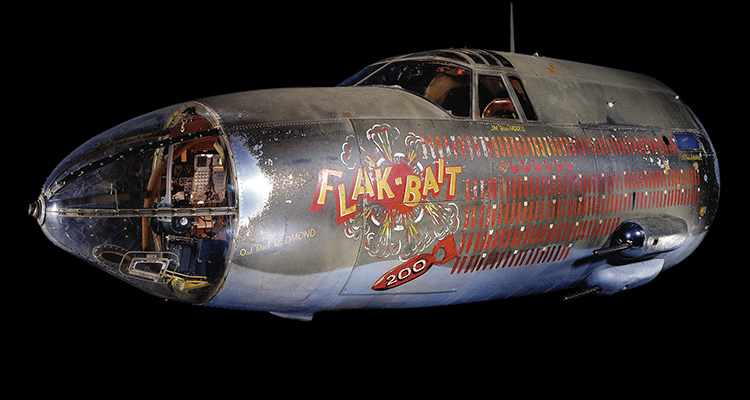
Employees of the Glenn L. Martin Company rolled the B-26B Marauder that would soon be dubbed Flak-Bait off the Baltimore production line on April 26, 1943. Identified as B-26B-25 MA Bureau No. 41-31173, the twin-engine medium bomber then took its place in a long line of identical aircraft on the Martin Company’s airfield awaiting transfer into the U.S. Army Air Forces.
Its olive-drab fuselage was 58 feet 3 inches long and stood 21 feet 6 inches off the concrete. The wings spanned 71 feet and provided a wing area of 658 square feet. From the wings hung two Pratt & Whitney R-2800-43 18-cylinder, air-cooled radial engines with two-speed superchargers that produced 1,920 hp at takeoff and 1,490 hp at 14,300 feet. Each engine turned a Curtiss 13-foot 6-inch four-blade propeller.
After a 3,500-foot takeoff run, the bomber could lift from the runway and climb at 1,200 feet per minute to a service ceiling of 21,700 feet. At 15,000 feet, the Pratt & Whitney engines could take the aircraft to a maximum speed of 282 mph.
The B-26B carried a crew of seven. The pilot and co-pilot sat side by side in armored seats behind an armored bulkhead. The navigator, who also served as the radio operator, worked out of a small compartment behind the pilots. The bombardier sat behind a plexiglass nose cone and — when not preparing to drop the B-26’s bombload — operated a .50-caliber machine gun. Three gunners stationed in the rear of the bomber rounded out the crew.
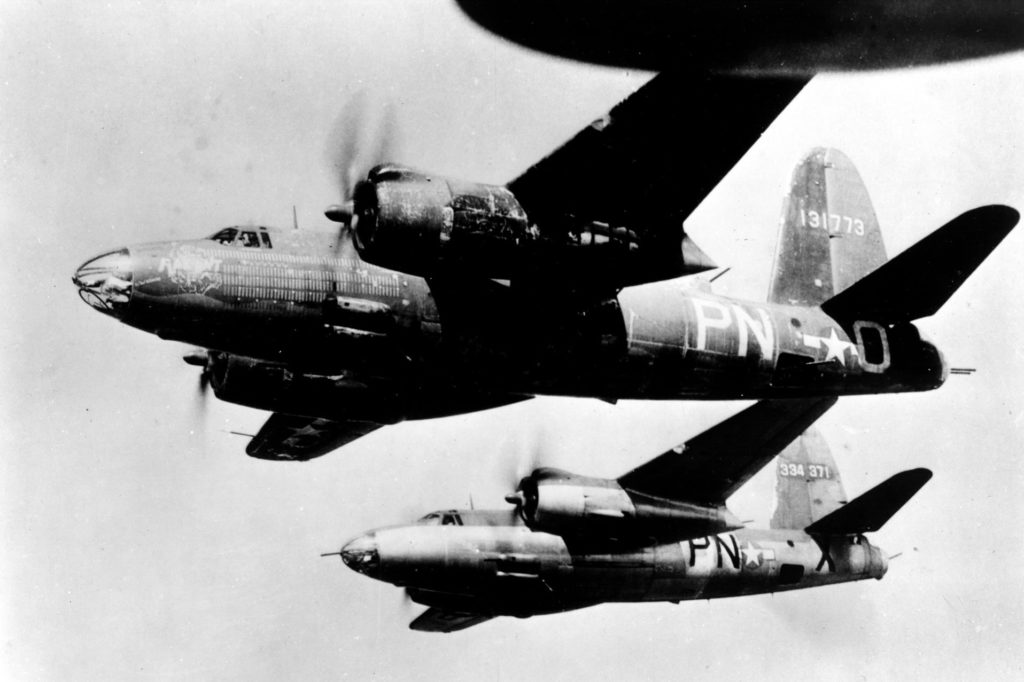
Despite the fact that war raged on two fronts as B-26B-25 MA 41-31173 sat on the Martin airfield, the Army Air Forces had little love for the Marauder. The brass considered the medium bomber an operational dog.
The genesis of the B-26 had grown out of an exchange of letters between aviation pioneer Charles A. Lindbergh and General Henry ‘Hap’ Arnold, chief of what was then the U.S. Army Air Corps. While touring Europe in 1938, Lindbergh pointed out Germany’s aeronautical developments in medium bombers and expressed concern over the United States’ lethargy in aircraft development. Lindbergh emphasized the need to increase the top speed of U.S. combat aircraft. Arnold shared Lindbergh’s concerns.
In 1939 the Army Air Corps called on the U.S. aircraft industry to design a medium bomber able to operate at high speed and carry a large bombload — essentially a bomber with the speed of a fighter. The Glenn L. Martin Company, which won the contract, delivered the first aircraft in record time. The B-26 first flew on November 29, 1940, and the Army Air Corps accepted it into operational service on February 8, 1941 — a feat that led Time magazine to declare the B-26 ‘Martin’s Miracle.’
But the pilots who first flew the B-26 gave the twin-engine, shoulder-wing bomber less flattering names. The high wing loading of the early short-wing model required the pilot to execute immediate and proper responses to an engine loss when flying low, slow and heavy — a situation that often arose during landing or takeoff. The resulting crashes led to the nicknames the Widow-Maker and the Incredible Prostitute (a reference to its wings, which supposedly provided it with no visible means of support).
After the united states entered World War II on December 7, 1941, the 22nd Bombardment Group flew the B-26 against the Japanese in New Guinea and Rabaul in 1942. Both the Japanese and Army Air Forces pilots quickly learned that the rugged B-26 could take anti-aircraft fire and stay aloft. It could defend itself as well. The 60 Marauders of the 22nd Group claimed 94 enemy aircraft in the air in their first 10 months of combat. Due to logistical considerations, however, the Fifth Air Force in the Southwest Pacific chose the North American B-25 Mitchell as its sole medium bomber because it needed less maintenance, could operate from unimproved airfields and enjoyed favorable press following the April 18, 1942, Doolittle Raid on Tokyo.
Meanwhile, in the European and North African theaters, heavy German anti-aircraft fire had taken a grievous toll on American bombers. Recognizing the B-26’s ability to withstand punishment, the Army Air Forces began transferring B-26s and aircrews to North Africa toward the end of 1942.
Even before the B-26 entered combat in North Africa, Material Command personnel began a campaign against the aircraft. The bomber had already survived a special investigation board appointed by General Arnold in March 1942 to determine whether production of the B-26 should continue. Headed by Maj. Gen. Carl Spaatz, the board recommended several changes to the bomber’s design — mainly a larger wing — but stressed continued use of the B-26. Despite the findings of the board, on October 7, 1942, Maj. Gen. Muir S. Fairchild, the director of military requirements, ordered Maj. Gen. O.P. Echols, the commanding general of Material Command, to create plans for ‘pinching out B-26 production and replacing it with some other type which would be of greater utility.’
After the North African campaign, the Twelfth Air Force reported on May 13, 1943, that the B-25 had once again flown more sorties than the B-26, seemingly supporting a decision to terminate B-26 production. War correspondent Lee McCardell came to a different conclusion. He pointed out that the B-26 had a better record of destroying the targets it attacked than any other bomber in the North African theater.
The Pacific theater had rejected the B-26, and the commanders in North Africa and the Mediterranean had given it less than glowing reviews. With no other options, the Army Air Forces sent the B-26 into the toughest combat environment of the war — northern Europe.
B-26B 41-31173 transferred from Martin to the Army Air Forces on April 26, 1943. Three days later, the B-26 was flown to the Martin Modification Center in Omaha, Neb., for the alterations needed to ready it for war service. After modification, the aircraft flew to New Castle Army Airfield, Md., on May 13, 1943, to begin its operational life.
On May 25, 1943, the Marauder took off from Presque Isle Army Airfield, Maine, and started across the Atlantic, headed for the 449th Bombardment Squadron, 322nd Bombardment Group, Eighth Air Force, based in Rougham, England. Lieutenant James J. Farrell, the B-26’s pilot, christened the bomber Flak-Bait. (His brother had nicknamed the family dog Flea Bait.)
Flak-Bait‘s crew arrived to find that the 322nd had stood down. The group had begun combat operations on May 14, 1943, when it launched 12 B-26s for a low-level attack on a power plant in Holland. Attacking coastal areas with medium bombers at low level had worked well in the Pacific, and the Eighth Air Force wanted to try its luck along the European coast. All 12 B-26s returned from the mission.
Just three days later the 322nd dispatched 11 B-26s on a similar mission. One Marauder returned to base because of mechanical problems, and heavy flak and swarms of German fighters brought down all 10 of the remaining planes. As a result, the Eighth Air Force realized that low-level attacks by medium bombers would not work against the heavily defended European coast. The 322nd stood down to retrain for medium-altitude bombing.
Flak-Bait flew bombing missions against airfields, fuel depots and other targets in the effort to win air supremacy over France. After a few such missions, Lieutenant Farrell realized he had either aptly named the B-26 or jinxed it — the bomber rarely returned to base without taking hits from flak. Farrell recalled, ‘It was hit plenty of times; hit all the time.’
For example, a Messerschmitt Me-109 approached Flak-Bait out of the sun on September 10, 1943, and sent a 20mm shell through the bomber’s nose. The shell struck the back of Farrell’s instrument panel and exploded, wounding the bombardier and Farrell and knocking out all flight instruments. Farrell managed to bring Flak-Bait back for a textbook landing in England.
The Ninth Air Force had transferred to England in October 1943 and assumed the role of providing tactical air support for the Allied invasion of Europe. Flak-Bait and the 322nd became a part of the Ninth Air Force and began to strike tactical targets such as bridges, railroad yards and coastal artillery emplacements.
Flak-Bait continued to live both a charmed and jinxed life as D-Day approached. Aircraft and crew reached their 100th mission on June 1, 1944. They flew two missions on June 6 in support of the invasion of Normandy. Farrell and all his crew survived their tour despite many close calls and returned to the United States in July 1944.
Lieutenant Graydon K. Eubank of San Antonio, Texas, then took command of Flak-Bait for a short time, but Lieutenant Henry Bozarth of Shreveport, La., soon took the left seat and remained there. As the Allied armies advanced into France, the 449th and Flak-Bait transferred to an airfield at Beauvais-Tille, France.
The veteran aircraft continued to live up to its reputation despite the crew change. Flak-Bait flew missions supporting the British forces slugging it out with German armor at Caen, in addition to the Americans fighting their way toward St. L — the battle that would prove vital to the Allied breakout from Normandy’s hedgerow country.
With the Germans in headlong retreat, Flak-Bait aided Lt. Gen. George Patton’s Third Army as it stormed across France in August and September. From October to December, the group once again bombed bridges, road junctions and ordnance depots in the assault on the Siegfried Line.
On December 16, 1944, the Germans struck back, sending 600,000 men into the Ardennes in an effort to capture Antwerp and choke off the Allies’ supply conduit. The Battle of the Bulge, as it became known, raged until January 28, 1945. Flak-Bait played a role in that battle by attacking road and rail bridges used by the Germans during their attack and withdrawal. On its 180th mission, Flak-Bait took 700 hits from flak fragments. McDonal Darnell Jr., Bozarth’s radio operator, remembered, ‘Everybody was afraid of the damn thing, but she always got back for us.’
Advancing to an airfield at Le Culot, Belgium, on March 30, 1945, Flak-Bait completed its 200th mission in style — it led the entire 322nd Bomb Group to Magdeburg, Germany, and back on April 17, 1945. When Germany surrendered on May 8, Flak-Bait had survived 207 missions — more than any other American bomber in World War II. During those harrowing 725 hours of combat time it had returned twice on one engine, survived an engine fire, had its electrical system knocked out twice and lost its hydraulic system once.
No longer needed in Europe, Flak-Bait returned to the United States on December 7, 1946. Because of the aircraft’s unique history, the U.S. Army Air Forces transferred the B-26 to museum status on December 21, 1946.
Today Flak-Bait is undergoing preservation in the Mary Baker Engen Restoration Hangar, at the National Air and Space Museum’s Steven F. Udvar-Hazy Center, just outside Washington, D.C.. Plans are to reassemble and display the storied aircraft as a complete aircraft, a fitting tribute to a much-maligned bomber that played a critical role in winning the war in Europe.
This article was written by David F. Crosby and originally published in the March 2006 issue of Aviation History magazine. For more great articles subscribe to Aviation History magazine today!