From the deserts of North Africa to the Normandy beaches, GIs listened to the traitorous Axis Sally broadcasting over the radio for Nazi Germany.
“Well, kids, you know I’d like to say to you, ‘Pack up Your Troubles in Your Old Kit Bag,’ but I know that that little old kit bag is much too small to hold all the trouble you kids have got.” —Axis Sally
From the deserts of North Africa to the Normandy beaches, GIs listened to the sensual voice of an American woman broadcasting over the radio for Nazi Germany. The voice, alternately seductive and condemning, wondered aloud if their wives and girlfriends were “running around” with the 4-Fs (men not qualified for military service) back home, and gently pointed out the benefits of surrender. As the men tried to imagine the mysterious beauty behind the microphone, the swing music she played kept them tuning in. She cultivated a persona of worldly allure, ready to welcome the boys and understand their troubles.
The reality behind the voice was less glamorous. Two American women competed for the soldiers’ fantasies: Mildred Gillars, a middle-aged former showgirl from Ohio, broadcast from Berlin; the other, a cross-eyed 30-year-old New Yorker with a honeyed voice named Rita Zucca, broadcast from Rome. One was the willing mouthpiece of her mentor and lover, while the other collaborated with the Nazis for financial gain. But both women became enmeshed in the collective memory of American soldiers and sailors as one indelible figure: Axis Sally.
They, like the women who broadcast for Japan under the name Tokyo Rose in the Pacific theater, entertained their audience despite ham-handed attempts to break the morale of Allied soldiers. As Air Corps corporal Edward Van Dyne said of Axis Sally in 1944, “Doctor Goebbels no doubt believes that Sally is rapidly undermining the morale of the American doughboy. I think the effect is directly opposite. We get an enormous bang out of her. We love her.”
And indeed, both Sallys became women who were wanted and pursued by the end of the war, but in a way that ultimately had nothing to do with desire—and everything to do with treason.
The Germans’ use of foreign nationals in radio broadcasting began early in the war with the hiring of William Joyce, better known as Lord Haw-Haw. Joyce, an American-born Irish fascist, was a protégé of Sir Oswald Mosley, the leader of the British Union of Fascists. He fled to the Reich on August 26, 1939, narrowly escaping arrest in Britain, and the German Propaganda Ministry hired him to write anonymous commentaries on British foreign policy and politics. At the height of his influence, in 1940, Joyce had an estimated six million regular and 18 million occasional listeners in the United Kingdom alone.
Lord Haw-Haw’s success as a broadcaster was aided immeasurably by the lack of forthright reporting at the BBC station, which featured entertainment programming—largely organ music—and severely censored news broadcasts. The BBC’s disadvantage was compounded as Holland, Luxembourg, Denmark, Belgium, and Norway fell in the spring of 1940, and the Germans appropriated Europe’s most popular and powerful commercial stations. Combined with the huge 100-kilowatt transmitters in the Berlin suburb of Zeesen, the Reichsrundfunk, or Reich Radio, broadcast worldwide 24 hours a day in 12 languages.
The Propaganda Ministry and the German Foreign Office hoped to extend Reich Radio’s European success to North America, but needed broadcasters who could communicate with American listeners in terms they could understand. At the outset of the war, American expatriates in Berlin were few and far between. Most had returned home in the face of hostilities, but there were some willing candidates. One of the first was Frederick W. Kaltenbach, an Iowa-born high school teacher fired from his job in 1935 for establishing a student organization based on the Hitler Youth. The Germans dubbed him Lord Haw-Haw for his folksy style, and cast him as the American equivalent of William Joyce. Kaltenbach and Max Otto Koischwitz—a naturalized American citizen and former professor who would play a defining role in the creation of Axis Sally—dominated Berlin’s broadcasts to America in those early years of the war.
Much of the German propaganda effort in 1940 and 1941 was aimed at keeping America out of the war—attacking the idea of American military aid to the British war effort and blaming “Jewish finance” for the conflict. The message was finely tuned, but the thick Teutonic accents of the German newscasters spoiled the effect. “It is advised of the importance of our American newscasts to use as far as possible American-born speakers,” the head of the German Radio and Culture section, Dr. Markus Timmler, wrote in March 1940. Radio officials paid heed, and within a month of Timmler’s memorandum, a 39-year-old former Broadway showgirl named Mildred Gillars—out of work and recruited by a social acquaintance who worked for Reich Radio—walked into the massive Berlin radio complex known as the Big House.
Gillars, who had come to Berlin in 1934 to study music, was promptly hired as an announcer for Reich Radio’s British Service, where she broadcast under the name Midge. Within months she had her own show, playing records and chatting about art and culture—and soon found herself in a quandary. By the spring of 1941 the U.S. State Department was counseling American nationals to return home. But Gillars’s fiancé, a naturalized German citizen named Paul Karlson, warned that he would never marry her if she returned to the United States. Hoping for a wedding ring, she remained in Berlin as the last ships departed. Not long after, Karlson was sent to the Eastern Front, where he died in action.
On December 7, 1941, Gillars was working in the studio when the Japanese attack on Pearl Harbor was announced. Stunned, she broke down in front of her colleagues and denounced their allies in the east. “I told them what I thought about Japan and that the Germans would soon find out about them,” she recalled. “The shock was terrific. I lost all discretion.” She knew that such an outburst could send her to a concentration camp—a fear the Germans used to their advantage. Faced with the prospect of joblessness or prison, she produced a written oath of allegiance to Germany and returned to work, her duties limited to announcing records and participating in chat shows.
The apolitical nature of her broadcasts changed one year later, however, when Max Otto Koischwitz cast Gillars’s Midge in a new show called Home Sweet Home. Koischwitz, the married father of three daughters, had started a romantic relationship with the lonely American; now he aggressively encouraged her to broadcast propaganda he wrote for the Reich. “Even Shakespeare and Sophocles could be taken as propaganda,” he told her. Feeling she had no choice in the matter, she relented. “You could not just go around [Nazi Germany] saying, ‘I don’t want to do this’ and ‘I don’t want to do that,’” she later said.
As the Allies engaged in fierce battles in the deserts of North Africa, Home Sweet Home was designed to arouse homesickness. Opening with the quintessentially American sound of a moaning train whistle, the program tugged at the heartstrings and exploited the fears of fighting men. In a playful voice, Gillars portrayed Midge as a young but worldly woman. She played the vixen behind the microphone, taunting the frontline soldiers and casting doubt on their mission, their leaders, and their prospects after the war.
The GIs had several names for the woman on the radio, including Berlin Bitch, Berlin Babe, Olga, and Sally, but the one that stuck for public consumption was Axis Sally. When asked to describe herself on the air, Gillars had said she was “the Irish type…a real Sally.” In a January 1944 article in the Saturday Evening Post, “There’s No Other Gal Like Axis Sal,” Corporal Edward Van Dyne wrote, “Axis Sally is a different proposition. Sally is a dandy—the sweetheart of the AEF [Allied Expeditionary Force]. She plays nothing but swing, and good swing!”
Although the GIs found the propaganda laughable, the lively music drew thousands of listeners. Captured prisoners of war admitted to their German interrogators that they regularly listened to the broadcasts. And so the Foreign Office sought to replicate what they considered a successful formula.
As Allied troops pushed up the Italian peninsula in the summer of 1943, the Italian national radio network in Rome hired a 30-year-old Italian American named Rita Luisa Zucca. The daughter of a successful Manhattan restaurateur, Zucca had spent her teenage years in a convent school in Florence and, as a young woman, had worked in the family business. She had returned to Italy in 1938, working as a typist and renouncing her American citizenship three years later to save her family’s property from expropriation by Mussolini’s government. Fired from her typing job in 1942 for copying an anti-Fascist pamphlet, Zucca was hired as a radio announcer in February 1943. She was teamed with German broadcaster Charles Goedel and given the name Sally; their program, Jerry’s Front Calling, extended Axis Sally’s fame to the Italian front. Every night, Zucca signed off by sending her listeners “a sweet kiss from Sally.”
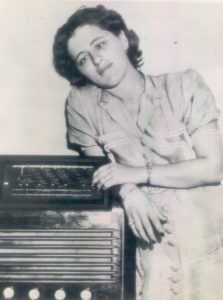
While the show’s format was almost identical to Gillars’s, Zucca’s broadcasts used intelligence provided by the German embassy in Rome in an attempt to deceive and confuse the advancing troops. For instance, it was Rita Zucca who addressed the Allied troops on July 8, 1943, the night before the invasion of Sicily. Speaking to “the wonderful boys of the 504th Parachute Regiment,” she told them, “Colonel Willis Mitchell’s playboys [the 61st Troop Carrier Group] are going to carry you to certain death. We know where and when you are jumping and you will be wiped out.” The value of this particular revelation backfired when Sally announced to the men that their regiment had been decimated—a full hour before the first plane took off.
In Berlin, Mildred Gillars was incensed when she discovered there was another woman broadcasting as Axis Sally, and threatened to quit. “I felt that I could be responsible for anything that I said and I didn’t want any confusion after the end of the war as to what I said,” she recalled. “It caused a great deal of trouble.” Her threats were empty ones, however, and both Sallys continued their broadcasts until the war’s bitter end.
As the Allies advanced on Rome in May 1944, Rita Zucca traveled north with the retreating Germans and resumed broadcasting from Milan. On September 15, 1944, the cast and crew of Jerry’s Front fled to the sliver of northern Italy known as the Italian Social Republic. The program was now attached to a German military propaganda unit called the Liberty Station. In a castle in Fino Mornasco, near Como, Axis Sally was the guest of honor at a party broadcast live on that station. The GIs who tuned in heard the sounds of merriment, clinking glasses, and laughter. Other radio personalities, including English fascist John Amery (later hanged by the British for treason), took part in the festivities.
The broadcast accentuated the desperation of those final days. It was then the familiar, sweet voice of an American girl floated over the radio to troops on the front lines. “Hello boys…how are you tonight?” Zucca asked the GIs. “A lousy night it sure is…Axis Sally is talking to you…you poor, silly dumb lambs, well on your way to be slaughtered!”
By then the seductive-sounding Zucca was heavily pregnant; her son was born on December 15, 1944. She returned to the microphone 40 days later and continued until her final broadcast on April 25, 1945. With Italian partisans in pursuit she boarded a train to Milan, where she was met by one of her cousins. Zucca took refuge at her uncle’s home in Turin, where she was captured on June 5, 1945.
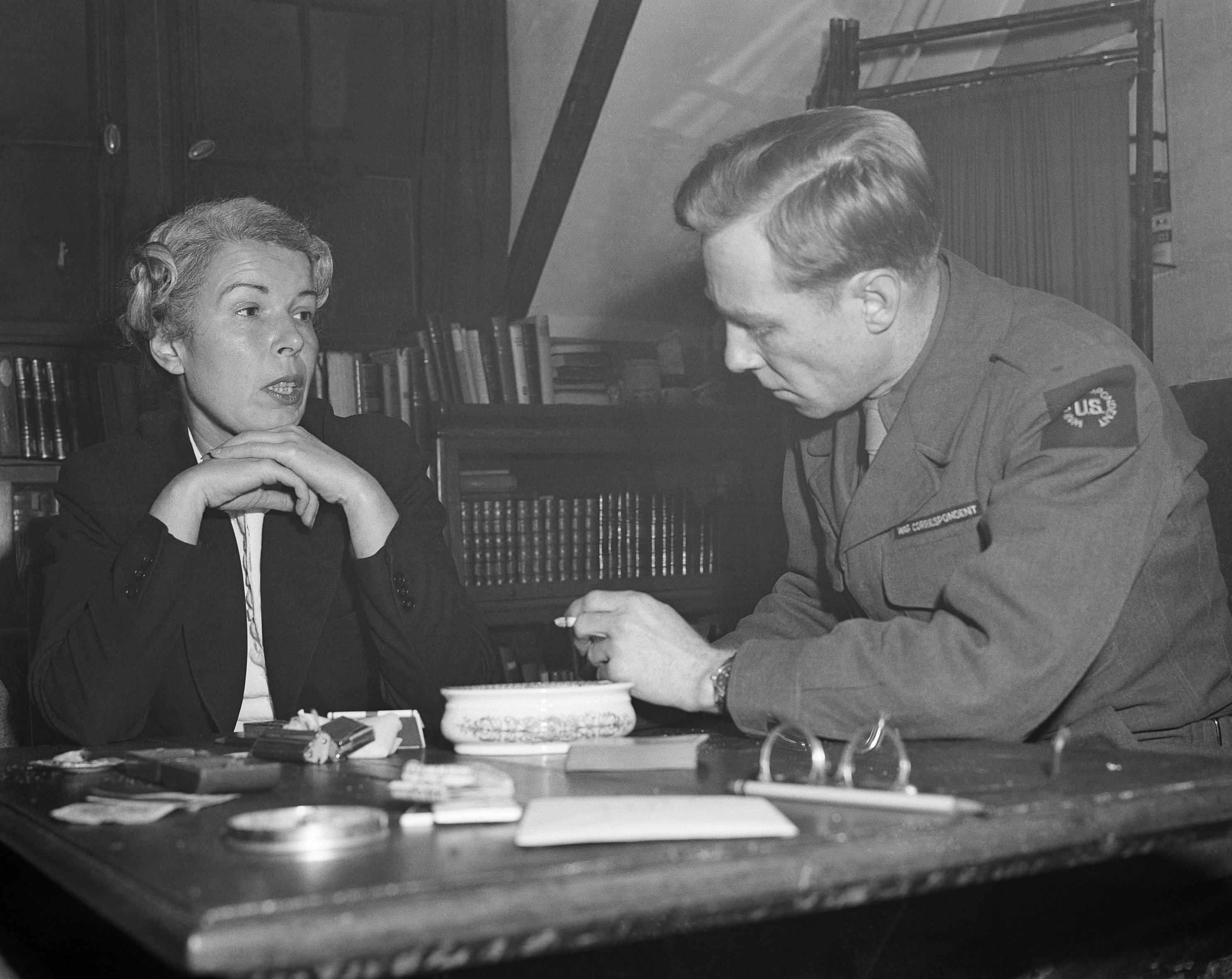
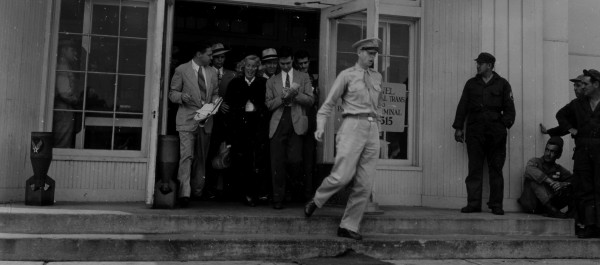
“When I saw her coming through the door, I said to myself, ‘What the hell is this, another rape case?’” an officer of the IV Corps military police later told Stars and Stripes’ European edition about being one of the first Allied men to lay eyes on the legendary Axis Sally. She was dressed in an American field jacket, a blue print dress, and sandals. As the arresting officers loaded Zucca and her son into a jeep for the overnight drive to Rome, they handed her eight blankets for protection against the cool night air. Although Stars and Stripes was not allowed to interview the prisoner, the correspondent breathlessly described her feminine charms: “True, her left eye is inclined to wander—but that cooey, sexy voice really has something to back it up.”
Stateside newspapers took a more bitter tone and tried to demolish the Axis Sally mystique. “Soft-Voiced ‘Sally from Berlin’ Found to Be Ugly Ex–N.Y. Girl” was a typical headline, with descriptions of the young mother as “[as] ugly and unattractive in person as her voice was appealing.” Another journalist called her “cross-eyed, bow-legged and sallow-skinned.”
Though the press touted her arrest, it soon became clear to the U.S. Justice Department that the Rome Axis Sally could not be prosecuted for treason. When the FBI discovered documentation of her 1941 renunciation of citizenship, J. Edgar Hoover wrote to the Justice Department, “In view of the fact that she has lost her American citizenship, no efforts are being made at the present time to develop a treason case against her.”
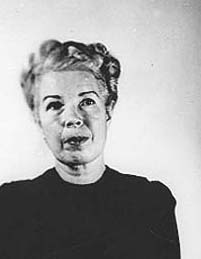
As the U.S. government’s effort to try Rita Zucca fizzled, it stepped up efforts to track down Mildred Gillars, who had continued to broadcast in Berlin until just before the German surrender. The U.S. attorney general dispatched prosecutor Victor C. Woerheide to Berlin in the summer of 1945; by August, he and Counter Intelligence Corps (CIC) special agent Hans Wintzen had only one solid lead: Raymond Kurtz, a B-17 pilot shot down by the Germans, recalled that a woman who had visited his prison camp seeking interviews was the broadcaster who called herself “Midge at the mike.” Kurtz remembered that the woman had used the alias Barbara Mome. That detail became the key to tracking her down.
Wanted posters went up throughout occupied Berlin, adorned with a dour photograph of Gillars, in which she looked more like a schoolmarm than a legendary woman of glamour and deceit. Wintzen discovered that “Barbara Mome” was selling her property on consignment at various Berlin antique shops to obtain hard currency. The investigation hit pay dirt when the agents found a small table that had belonged to Gillars in an antique shop tucked away on an isolated side street. The shop owner gave the CIC the name of the friend who sold the table to the shop. Under “intensive interrogation,” the man eventually admitted selling the item for Gillars and revealed her address.
On the evening of March 15, 1946, Gillars returned home to a boarding house in the British sector to find a pale, nervous U.S. Army soldier pointing a revolver in her direction. CIC special agent Robert Abeles announced, “Miss Gillars, you are under arrest.” With a surprised “Oh…” she surrendered, and asked to take one possession with her: a photo of Max Otto Koischwitz, the man who had led her down the path to treachery. He had died of tuberculosis in September 1944.
Mildred Gillars spent two and a half years in the Allied prison camp at Frankfurt-am-Main without charges before being returned to the United States in August 1948 to await trial. She was found guilty in March 1949 after a three-month trial and sentenced to 10 to 30 years imprisonment with a $10,000 fine. She served 12 years at the Alderson Reformatory for Women in West Virginia, was paroled in 1961, and became a teacher at a Roman Catholic convent school near Columbus, Ohio.
Gillars’s counterpart in Rome also served time, though far less. In September 1945 an Italian court found Rita Zucca guilty of collaboration. She was sentenced to four years and five months in jail, but was released after serving only nine months. Zucca remained in Italy, and faded into obscurity. The woman who came to replace her as the embodiment of Axis Sally in the memory of the American public died in Columbus of colon cancer in 1988, at the age of 87. Mildred Gillars was buried in an unmarked grave, surrounded by World War II veterans.
This article originally appeared in the January/February 2010 issue of World War II magazine.