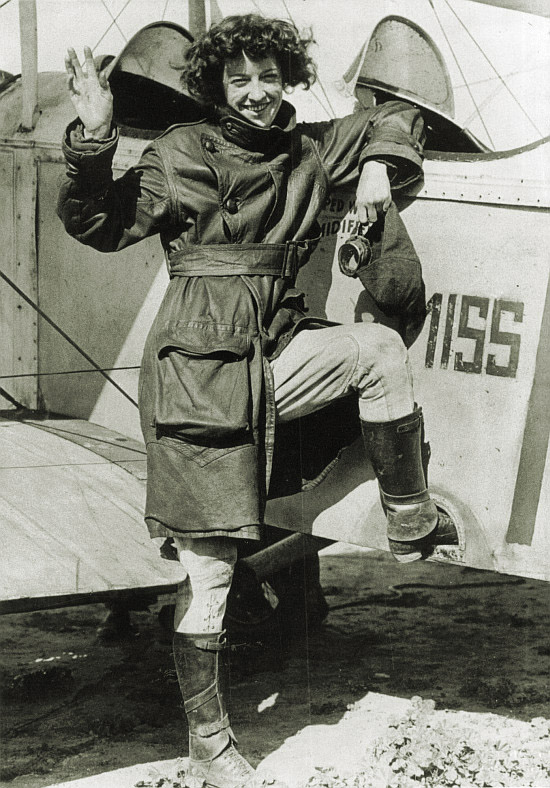
Anita “Neta” Snook achieved a long list of firsts: first woman aviator in Iowa, first woman student accepted at the Curtiss Flying School in Virginia, first woman to run her own aviation business and first woman to run a commercial airfield. Yet it is for her connection with another pioneering woman pilot that Snook remains best known.
“I’ll never forget the day she and her father came to the field,” Snook wrote of the time in December 1920 when they first met, in her book I Taught Amelia to Fly. “I liked the way she stated her objective. ‘I want to fly. Will you teach me?’” The Amelia of the title was, of course, Amelia Earhart. When Snook was in her 70s, she wrote the story of her life and of getting to know her famous pupil. That project got its start in a creative writing class.
As the title of her book indicates, Snook knew what her place in history would be. But before the two women became acquainted, Snook had already packed a book’s worth of adventure and achievement into her young life.
Born in Mount Carroll, Ill., on February 14, 1896, Snook became fascinated with machinery and flight at an early age. “I’d always wanted to fly as far back as I could remember,” she recalled, crediting the family doctor with igniting her interest when he took her on farm calls in his Ford Model T: “He’d race to the top of each [hill] and down the other side. We called it flying.”
“When she was little, Neta made toy automobiles that would run and boats that would sail in preference to playing with dolls,” her mother told an Iowa newspaper reporter. Neta’s dad bought a secondhand automobile when she was 9, and together they studied the instruction manual and learned about auto maintenance—a useful skill in 1905, since mechanics were a rare breed.
After Snook graduated from high school in 1915, her family moved to Iowa, where she attended Iowa State College (now Iowa State University) in Ames. Largely an agricultural college, it had a home economics department added to accommodate female students. After completing the 17 hours required for the home economics course, Snook was finally able to “choose courses that I really wanted—mechanical drawing, combustion engines, and a course in the repair, maintenance and overhaul of farm tractors.”
When not in class, Snook spent much of her time in the college library, reading about the government’s lighter-than-air and heavier-than-air craft divisions. During her second year of college, she heard about a flying school started by Glenn Curtiss that was part of the Atlantic Coast Aeronautical Station in Newport News, Va. She applied to the school but was disappointed when her application received a curt reply: “No females allowed.” The following year she spotted a newspaper advertisement for the Davenport Aviation School, close to her home in Iowa. Snook applied and was immediately accepted, becoming the first woman to attend the school.
“Finally the day came—my first flight,” Snook recalled in her autobiography. “We raced down the field, the engine roaring and all eight cylinders firing in perfect time. I felt the tail lift but scarcely knew when we left the ground…. I had no feeling of height, only of complete security with those long, sleek wings on either side which seemed almost a part of me.”
Beginning in June 1917, “Curly,” as her classmates were now calling her, helped to build and maintain the planes that were used for lessons. But when one of those planes crashed on September 9, killing the school’s new president and seriously injuring its instructor, the school closed. Some of the students were heading for the Curtiss Flying School in Newport News and promised Snook that they would make the case for admitting her.
Snook received news at the end of September that she finally had been accepted. When she reached the school on October 5, her pals from the Davenport Aviation School showed her around and introduced her to flight instructors Carl Batts and Eddie Stinson, who flew for the Wright brothers and would eventually own the Stinson Aircraft Company. Snook later noted that she was always nervous in the presence of Batts because of his stern demeanor, but she felt that Stinson was “effervescent and projected camaraderie.”
Just a few months later, however, after Snook had logged many hours in the air but before she had managed to solo, a notice from the government’s Security Division effectively stopped all flying in and out of the school. The United States had entered World War I on the Allied side, and there was fear that German spies would gain admittance to the school in an effort to take aerial photographs of the surrounding embarkation camps. The school’s aircraft were dismantled in early 1918 and sent — along with many of the students, including Snook—to another of Curtiss’ aviation schools in Miami, Fla.
But only months later, in March 1918, Snook’s training was interrupted once more—again before she’d been able to solo. President Woodrow Wilson issued an order prohibiting all private flying in the United States for the war’s duration. Having secured a letter of reference from the school’s manager, Snook packed her bags. Her frustration is still evident in her recollection of the event more than five decades later: “After parting farewells with all my Newport News friends, I went home—back to Iowa—with nothing to show for the past year except a ‘To Whom it May Concern’ scrap of paper.”
Snook had been home only briefly when she received an invitation from the British Air Ministry to work as an expediter. A friend from the Davenport Aviation School had recommended her for the position. Snook’s job was to improve delivery of airplane parts and engines that were being built in North America and shipped to England for the Royal Air Force. This move put her in Elmira, N.Y., where she tested metals and inspected Curtiss OX-5 training plane engines and Sunbeam engine parts at the Willys-Morrow plant. At war’s end in November 1918, she received a certificate of appreciation from the British War Mission. Once again she was free to pursue flying.
Before leaving Elmira, Snook bought a wrecked Canuck, a Canadian version of a Curtiss JN-4 “Jenny,” and had it shipped home to Ames. There, in between taking more classes at Iowa State, she rebuilt the airplane in her parents’ backyard. She recalled: “People came to see it and asked, ‘How will you get it out of this small yard? Can you fly straight up? Which is the front end?’ There were few people in the middle west who had ever seen a plane, most of the flying being limited to the east.”
When she had finished the Canuck, she dismantled the plane and had the fuselage towed to a nearby pasture, where she reassembled it. “I was so concerned about the airworthiness of my rebuilt plane that I didn’t think about myself,” she recalled. “I knew I could fly.” Indeed she could, finally soloing in the spring of 1920.
Snook barnstormed across the Midwest, offering 15-minute rides for $15. She had a U.S. license for flying civilian aircraft that had established the number of passengers she was allowed to carry as “none,” but Snook boldly erased the “n,” making it read “one.” A license she had more respect for was that of the Aero Club of America, and with it recognition as a pilot from the Fédération Aéronautique Internationale. During the summer of 1920 she passed the test for that license. “That, I think, was the climax of my aviation career,” she declared. “Now I was a recognized pilot before all the world.”
Flying was tough during Iowa winters. Eager to get more time in the air, Snook dismantled the Canuck and shipped it to Los Angeles. There, she heard about Winfield “Bert” Kinner and his airfield near Huntington Park, where he built his Kinner Airsters. She made a deal with Kinner to test-fly his planes in return for full commercial use of his airfield and set up a business there flying passengers and aerial advertising stunts and teaching flying.
one sunday in December 1920, Amelia Earhart appeared at Kinner Field with her father and requested lessons. Earhart’s first lesson, which lasted 20 minutes on January 3, 1921, marked the start of a legendary career as well as a firm friendship between the two women.
Snook tutored Earhart for five hours in the Canuck. She then spent 15 more hours—unpaid—teaching her new pupil in a Kinner Airster that Amelia had bought after Snook tested the plane in early January. In July Earhart, with Snook accompanying her, crashed the Airster at nearby Goodyear Field. The Airster had proved too slow to gain sufficient altitude to clear a eucalyptus grove on takeoff. Neither woman was hurt, but the plane needed a new propeller and repairs to the landing gear. When Snook turned around to check on Earhart, she found the future media star fully composed and powdering her nose to prepare for the reporters.
Although Snook said she would have made the same move as Earhart on that occasion, pulling the plane up rather than nosing down, she did express some reservations about her student’s talent, remarking later, “Perhaps I had misjudged her abilities.”
But she seems to have kept her concerns largely to herself. Although Snook was still only in her early 20s, she was doing what she could to advance the idea that women could make a strong contribution to the fledgling field of aviation. “Women are really more adventurous in their hearts than men are,” she told a Los Angeles Evening Herald reporter. “This spirit of adventure has been suppressed all these centuries and now it’s coming out in the 1921 woman.” When Snook became the only woman entered in an race against 40 men held at the Los Angeles Speedway in February 1921, she told the press, “I have to fly for the whole sex, as it were, and I’m going to show the world that a woman can fly as cleverly, as audaciously, as thrillingly as any man aviator in the world.” She finished in fifth place.
By the spring of 1922, however, Snook’s life had taken a different turn. She was by then married to Bill Southern and expecting a baby. “I wanted that baby above everything, and I made a vow that if I could just have a healthy baby, I would give up flying forever,” she wrote. She got her healthy baby—named William Curtiss Southern after his father and Glenn Curtiss—and kept her bargain, selling her business and retiring from aviation. A few years later, when Earhart invited her to join the group of women pilots she was organizing, later named the Ninety-Nines, Neta declined.
Around that time, Earhart had sent another letter to Snook, which concluded with the line “Sometime our paths may cross again, and we may be able to have a few words about the old days.” But Snook never saw her again. In 1937, after Earhart famously disappeared during a flight over the Pacific, Snook renewed contact with Earhart’s family. She subsequently became a popular lecturer, speaking about her own career as well as Earhart’s. Her autobiography, I Taught Amelia to Fly, was published by Vantage Press in 1974. On March 23, 1991, she died at the age of 95. One year later, Neta Snook Southern was inducted into the Iowa Aviation Hall of Fame.
This article was written by Patti Marshall and originally published in the January 2007 issue of Aviation History magazine. For more great articles subscribe to Aviation History magazine today!