
President Andrew Jackson was irate, convinced that he was the victim of ‘one of the most base and wicked conspiracies.’ For him, the scandal known as ‘the petticoat affair” was a social matter that his enemies had exploited and blown out of proportion. It was true that the situation had taken on a life of its own. ‘It is odd enough,’ Senator Daniel Webster wrote to a friend in January 1830, ‘that the consequence of this dispute in the social . . . world, is producing great political effects, and may very probably determine who shall be successor to the present chief magistrate.’
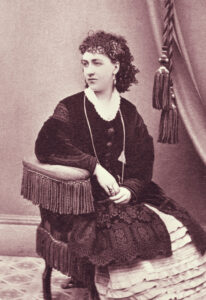
Always eloquent, in this case Webster also proved prophetic. For the imbroglio to which he referred–involving the young wife of the secretary of war, a woman much favored by Jackson but snubbed by Washington’s gentility for her outspokenness and allegedly sordid past–did ultimately help decide the fortunes of two powerful rivals eager to follow ‘Old Hickory’ into the White House. the cause of the turmoil was the young and vivacious Margaret ‘Peggy’ Eaton, although she was still Margaret Timberlake when Jackson initially made her acquaintance. She was the daughter of William O’Neale, an Irish immigrant and owner of a commodious Washington, D.C., boardinghouse and tavern, the Franklin House on I Street. The tavern was especially popular with congressmen, senators, and politicians from all over the growing United States. Margaret, the name she apparently preferred over ‘Peggy,’ was born at those lodgings in 1799, the oldest of six O’Neale children. She grew up amidst post-prandial political clashes and discussions of history, international battles, and arcane legislative tactics. Margaret observed the nation’s lawmakers at their best and at their worst, and the experience taught her that politicians were as flawed and fallible as anybody else. Far from home and family, these gents were easily charmed by the precocious and beautiful girl and did their best to spoil her rotten. ‘I was always a pet,’ she later remarked.
It was a curious upbringing for a girl in those days, when women were expected to be submissive and demure, domestic and irreproachably virtuous, and utterly uninterested in politics, much less able to argue governmental issues with anything approaching insight. Margaret’s parents could only try to balance her exposure to the often coarse world of men by sending her to one of the best schools in the capital, where she learned everything from English and French grammar to needlework and music. When she showed a talent for dance, Margaret took private lessons, becoming skilled enough by the age of 12 to perform for First Lady Dolley Madison. Moreover, many a guest at the Franklin House remarked on Margaret’s piano-playing prowess. Jackson once wrote to his wife, Rachel, at home in Nashville, Tennessee, that ‘every Sunday evening [she] entertains her pious mother with sacred music to which we are invited.’
Jackson met Margaret in December 1823, when he traveled to Washington as the new junior senator from Tennessee and boarded at the Franklin House. Like so many others in federal service, Jackson had had no intention of relocating to the capital. At that time it was a scattered, muddy, and manifestly Southern town that had recovered from the British invasion of 1814 but remained short of municipal conveniences. Furthermore, the wickedly humid weather in the spring and summer prompted lawmakers to complete their sessions by early April, then escape to cooler climes.
The Franklin had been recommended to Jackson by John Henry Eaton, Tennessee’s senior senator and the author of a biography that affirmed Jackson’s heroism as the general who vanquished the British army at New Orleans in 1815. Jackson had taken a liking to hotelier O’Neale and his ‘agreeable and worthy family.’ He was especially fond of Margaret, the 23-year-old wife of navy purser John Bowie Timberlake, with whom she bore three children (one of them dying in infancy). She was, Jackson said, ‘the smartest little woman in America.’ Rachel Jackson was equally impressed by Margaret when she accompanied her husband to Washington in 1824.
It was Old Hickory’s friend Senator Eaton, however, who appeared most thoroughly bewitched by the dark-headed, blue-eyed, and fine-featured tavern-keeper’s daughter. A handsome and wealthy widower nine years older than Margaret, Eaton had known her ever since he began staying at the Franklin House as a newly appointed senator in 1818. That was long enough for him to have heard all the rumors about Margaret’s premarital teenage romances. The gossip included tales of how one suitor swallowed poison after she refused to reciprocate his affections; how she had briefly been linked with the son of President Jefferson’s treasury secretary; and how her elopement with a young aide to General Winfield Scott had gone seriously awry when she had kicked over a flowerpot during her climb from a bedroom window, awakening her father, who dragged her back inside.
Such stories–coupled with the fact that Margaret Timberlake tended toward flirtatiousness, enjoyed serving men in her family’s tavern, and shared her opinions and jokes too loudly and liberally–led others in the capital to presume that she was a wanton woman. Eaton, though, saw her quite differently. He had become a confidant of John Timberlake and even fought, though unsuccessfully, to have his Senate colleagues reimburse the often financially troubled purser for losses Timberlake sustained while at sea. Moreover, when Timberlake was away, Eaton was glad to escort his wife on drives and to parties, enjoying both her humor and intelligence.
Margaret called Eaton ‘my husband’s friend . . . he was a pure, honest, and faithful gentleman.’ Rumormongers, however, credited the relationship between the Timberlakes and Eaton with far less innocence. They slandered John Timberlake as a drunk and ne’er-do-well and claimed that the real reason he kept sailing away from home was because he couldn’t face either his financial woes or his wife’s patent philanderings.
This talk grew uglier when, in April 1828, Timberlake died of ‘pulmonary disease’ while serving in Europe aboard the USS Constitution. Amidst the widow’s grieving, rumors spread that the purser had not perished naturally at all but had committed suicide in despair over his wife’s behavior. The situation caused distress not only to Margaret and Eaton, but also to Jackson, whose recent memories of defending his own wife against malicious murmurs made him all the more sympathetic to Margaret’s plight.
Jackson’s first campaign for the White House in 1824 ended with his winning the bulk of the national popular vote but losing the presidency when his failure to gain a majority in the Electoral College threw the race to the House of Representatives, which preferred John Quincy Adams. It was a particularly dirty contest, as Adams’ backers strove to undercut Jackson’s appeal in any way possible. Their tactics included ridiculing his lack of education and accusing him of everything from blasphemy to land frauds and murder. They even resurrected allegations that Rachel Jackson had been a bigamist and adulteress.
Those last charges stemmed from Rachel’s first marriage to a rabidly jealous Kentucky businessman named Lewis Robards. The pair had wed in 1785, but Robards believed that his wife was unfaithful and sought a divorce in 1790. A year later, assuming that she was once more a free woman, Rachel married Andrew Jackson, an ambitious, red-headed young attorney whom she’d met when he boarded at her mother’s home in Nashville. Not until 1793 did the Jacksons learn that Robards had only just been granted a divorce and that they’d been living very publicly in sin for more than two years.
To quash further scandal, the Jacksons promptly retook their vows. Yet claims of Rachel’s immorality haunted the couple. Early in the 1828 presidential race, rumors arose again in pro-Adams newspapers, one of which asked in an editorial, ‘Ought a convicted adulteress and her paramour husband to be placed in the highest offices of this free and Christian land?’ Jackson went on to win that election, becoming the first president from the emerging West and creating what is today the Democratic Party. Yet when Rachel died of a heart attack less than three months before his inauguration, Jackson blamed the political defamers for hastening her demise. ‘May God forgive her murderers,’ the president-elect said at his wife’s funeral, ‘as I know she forgave them. I never can.’
Even if Rachel had survived, Jackson would likely have supported Margaret Timberlake against character assaults; he had a long record of precipitant gallantry. Following Rachel’s death, however, Jackson became still more stubborn in championing the hotelier’s daughter, equating her with his late mate as a woman unjustly scorned. When John Eaton told Jackson of his wish to do what was ‘right & proper’ by marrying Mrs. Timberlake, the president counseled swift action. Damn the gossipers, he insisted, ‘if you love Margaret Timberlake go and marry her at once and shut their mouths.’
Unfortunately, the candle-lit nuptials held at the O’Neale residence on January 1, 1829, only incited fresh criticism of the couple. Louis McLane, an eminent Maryland politician (who would hold the positions of secretary of the treasury and state in Jackson’s second cabinet), sniped that the 39-year-old Eaton had ‘just married his mistress–and the mistress of 11-doz. others!’ Margaret Bayard Smith, a Washington society maven whose husband was president of the local branch of the Bank of the United States, proclaimed Eaton’s reputation ‘totally destroyed’ by this union with a woman who hadn’t even waited a respectful period of time before marrying again.
Floride Calhoun, wife of John C. Calhoun–the South Carolinian who had served John Quincy Adams as vice president and would hold the same office under Jackson–accepted a social call from the Eatons after their wedding. Nevertheless, she steadfastly refused to pay a return visit, which in the protocol-bound world of Washington could only be interpreted as a calculated snub. This left John Calhoun to ponder ‘the difficulties in which [such a rebuffing] would probably involve me.’
Worried that fallout from this fracas might wound the president-elect, some of Jackson’s partisans tried to dissuade him from naming Eaton to his cabinet. It was the wrong approach. Jackson had said many times, ‘when I mature my course I am immovable.’ Since Rachel’s death, he had found greater need of his friend Eaton’s advice, and he wasn’t apt to abandon the man simply because of attacks by ‘malcontents’ on Margaret’s propriety. Jackson reportedly thundered at one Eaton detractor: ‘Do you suppose that I have been sent here by the people to consult the ladies of Washington as to the proper persons to compose my cabinet?’ Jackson soon announced the appointment of Eaton as his secretary of war.
Hopes that this prestigious position might help to rehabilitate Margaret’s reputation were dashed as early as Jackson’s inauguration in March 1829, when the spouses of other cabinet members and politicos obviously slighted the seventh president’s ‘little friend Peg.’
According to modern Jackson biographer Robert V. Remini, at a grand ball on inauguration night, ‘the other ladies in the official family tried not to notice as Peggy Eaton swept into the room and startled everyone with her presence and beauty.’ Even Emily Donelson, Jackson’s beloved niece and his choice as the new mistress of the White House, turned a chilly shoulder to Margaret. She claimed that Eaton’s elevation to the cabinet had given his wife airs that made her’society too disagreeable to be endured.’
During his early months in office, Jackson had intended to concentrate on replacing corrupt bureaucrats. Instead he was plagued by what Secretary of State Martin Van Buren dubbed the ‘Eaton Malaria.’ Jackson decided to delay his formal post-inaugural cabinet dinner, fearing bad blood between Mrs. Eaton and the rest of the political wives. The president was continually distracted from the nation’s business by having to defend Margaret–despite her protestations that she did ‘not want endorsements [of virtue] any more than any other lady in the land.’
On the evening of September 10, 1829, Jackson concluded that if this flap was to end, he must take decisive action. With Vice President Calhoun at home in South Carolina and John Eaton not invited, the president summoned the balance of his cabinet, plus Reverends John N. Campbell and Ezra Stiles Ely who had recently criticized Margaret’s morals. Though ailing from dropsy, chest pains, and recurring headaches, the 62-year-old president proceeded to proffer evidence–affidavits from people who had known Mrs. Eaton–that he said absolved her of misconduct. When one minister dared to disagree, Jackson somehow forgot that Margaret was the mother of two surviving children from her marriage to John Timberlake as he shot back: ‘She is as chaste as a virgin!’
Thinking the matter was settled, Jackson finally held his overdue cabinet dinner in November 1829. While it provoked ‘no very marked exhibitions of bad feeling in any quarter,’ recalled Van Buren, the event was nonetheless awkward and tense. Guests rushed through their meals in order to avoid discussion of or with the Eatons, who had found places of honor near Jackson. The next party, hosted by Van Buren (who had neither daughters nor a living spouse to inhibit his societal intercourse), drew every member of the cabinet–but their wives contrived excuses for staying away.
By the spring of 1830, Jackson had come to believe that the situation did not result merely from connivances among the gentry, but from scheming by his political foes. Initially he imagined the plot was led by his renowned Kentucky rival Henry Clay, who would doubtless benefit from his administration’s ‘troubles, vexations and difficulties.’ As the president watched his cabinet split over this petticoat affair, however, he couldn’t help noticing that those advisors most opposed to the Eatons were also the strongest followers of John Calhoun–a man he was coming to distrust.
Tall, wiry, and earnest, Calhoun had helped elect Jackson to the White House, and many assumed that he’d be Old Hickory’s successor. Nevertheless, the vice president eschewed the capital during most of the Jackson administration’s tumultuous first year, and what the president remembered from Calhoun’s brief time there–notably, his wife Floride’s refusal to reciprocate Margaret Eaton’s social call–rubbed him the wrong way. One historian, J.H. Eckenrode, argued a century later that it was Calhoun’s ‘vain and silly wife’ who, by spurning Margaret, ruined her husband’s career ‘at its zenith.’ Certainly Floride Calhoun’s obstinacy, when combined with policy differences between her husband and Jackson–especially on the question of whether states should be allowed to nullify federal laws–drove a deep wedge between the nation’s two highest-ranking officials.
At the same time that Calhoun was falling from grace with the president, Secretary of State Martin Van Buren’s fortunes were rising. The former governor of New York, charming in person and a skilled behind-the-scenes strategist (allies and enemies alike called him ‘the Little Magician’), Van Buren had won the president’s regard by showing respect for John and Margaret Eaton. He became Jackson’s ‘dear friend,’ someone the president felt was ‘well qualified’ to one day fill his shoes. Calhoun’s backers realized that Jackson’s dwindling faith in the vice president played to Van Buren’s advantage. Daniel Webster wrote that since Jackson had become so dependent on his secretary of state, ‘the Vice President has great difficulty to separate his opposition to Van Buren from opposition to the President.’ Calhoun could only pray that his public approval or a Van Buren slip-up would still propel him into the presidency.
For two years the press and pundits savaged the administration over Jackson’s support for the Eatons. The nastiest rumors about the couple spread with impunity. One even averred that the war secretary had fathered a child with a ‘colored female servant.’ Van Buren saw as well as anybody how Margaret Eaton had become a liability for the Democrats and a personal burden to Jackson. The president had even sent his nephew and private secretary, Andrew Jackson Donelson, and his wife, Emily, back to Tennessee when they refused to associate with the Eatons. Andrew Donelson expressed his sadness in parting from his uncle, ‘to whom I have stood from my infancy in the relation of son to father.’ Harmony needed to be restored within the administration. Yet if the president discharged the anti-Eaton minority from his cabinet, he risked alienating Calhoun’s contingent of the party, and if he dumped his secretary of war after all this time, he would seem to have caved in to his critics.
The solution was presented to Jackson in April 1831 by Van Buren, when he offered to resign and suggested that John Eaton do likewise. This would permit the president to ask the remainder of the cabinet to do the same and allow for a reorganization. Though a few members resisted, later protesting their departures in print, they all relinquished their seats.
The capital reeled at this turn of events, and some people predicted that it portended governmental collapse. Newspapers were quick to trace the cause of the cabinet’s fall to Margaret Eaton. One publication likened the event to ‘the reign of Louis XV when Ministers were appointed and dismissed at a woman’s nod, and the interests of the nation were tied to her apron string.’ Henry Clay figured Calhoun could now ‘take bolder and firmer ground against the president,’ dooming Jackson’s chances of reelection in 1832 and maybe improving Clay’s own chances of winning the White House. Others hoped that John Eaton’s resignation would finally end talk of his blackballed wife, giving rise to that season’s most popular toast: ‘To the next cabinet–may they all be bachelors–or leave their wives at home.’
Elected to a second term, Jackson was eager to end the debate that had threatened to bring down his first administration. He hustled John Eaton and his wife off to the Florida Territory, where John became governor. Two years later Jackson appointed Eaton as the United States’ minister to Spain, and Margaret and John enjoyed life in Madrid for four years.
Bitter over the decline of his political fortunes, Vice President Calhoun sought revenge against Martin Van Buren. In 1832, Calhoun cast the tie-breaking vote against the New Yorker’s confirmation as U.S. minister to Great Britain. This rejection, Calhoun told a colleague, ‘will kill him, sir, kill him dead.’ On the contrary, it won Van Buren sympathy with the American public. In 1832 Van Buren became Jackson’s running mate for the upcoming presidential election, and in 1836 he was voted into the White House himself. Calhoun, meanwhile, resigned the vice presidency in 1832 to return to the Senate.
Amazingly, despite their history, Eaton eventually turned on Jackson. In 1840, when President Van Buren recalled Eaton from Spain for failing to fulfill his diplomatic duties, Eaton announced his support for Van Buren’s presidential rival, William Henry Harrison. Jackson was infuriated by Eaton’s political disloyalty, claiming that ‘He comes out against all the political principles he ever professed and against those on which he was supported and elected senator.’ The two men didn’t reconcile until a year before Jackson’s death in 1845.
John Eaton died in 1856, leaving a small fortune to his wife. Margaret lived in Washington and, after her two daughters married into high society, finally received some of the respect she craved. She didn’t enjoy it for long. At age 59, the once-vivacious and now wealthy tavern-keeper’s daughter married her granddaughter Emily’s 19-year-old dance tutor, Antonio Buchignani. Five years later, Buchignani ran off to Italy with both Emily and his wife’s money.
Margaret died in poverty in 1879 at Lochiel House, a home for destitute women. She was buried in the capital’s Oak Hill Cemetery next to John Eaton. A newspaper commenting on her death and on the irony of the situation editorialized: ‘Doubtless among the dead populating the terraces [of the cemetery] are some of her assailants [from the cabinet days] and cordially as they may have hated her, they are now her neighbors.’
This article was written by J. Kingston Pierce and originally appeared in the June 1999 issue of American History magazine. For more great articles, subscribe to American History magazine today!