For 9-year-old Willy Sherman, a carefree visit to the battlefield brought him a fatal illness.
Despite being shot in the leg by a Confederate sharpshooter, 12-year-old Fred Grant thoroughly enjoyed visiting his father, Major General Ulysses S. Grant, at Vicksburg, Mississippi, during the spring and summer of 1863. But for the son of another famous Union general, William Tecumseh Sherman, a carefree visit to the front ended suddenly and tragically.
Nine-year-old Willy Sherman was his father’s favorite child. Not only did he closely resemble General Sherman in looks, but he also shared his fondness for military life and his fearless disregard of danger. Sherman confidently expected Willy to carry on the family name and tradition of military service. “You and my other children will feel and know that I am always good to them,” he told Willy, “for they are growing up to fill stations higher and better than any I now fill.” Away from his family, Sherman avidly gathered Minié bullets and other wartime mementos for Willy and his younger brother, Tommy.
During a lull in fighting after the capture of Vicksburg in the summer of 1863, Sherman invited Willy to join him in camp on the Big Black River, 20 miles east of Vicksburg. His mother, Ellen, his older sisters Minnie and Lizzie, and 6-year-old Tommy accompanied him to the battlefront.
At first, the visit went famously. Members of Sherman’s headquarters detachment, the 13th U.S. Infantry Regiment, made Willy an honorary sergeant, taught him the manual of arms, and included him in their guard details and formal parades. Sherman took him along on frequent inspection tours of the army. “I have a healthy camp,” Sherman reported to his foster father, Thomas Ewing, “and have no fear of yellow or other fevers.”
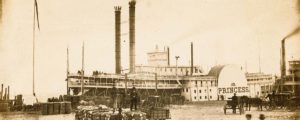
But Sherman spoke too soon. In late September, following the Battle of Chickamauga, he was ordered to reinforce Maj. Gen. William Rosecrans at Chattanooga. Commandeering a riverboat to Memphis, he quickly assembled his family for the voyage. Willy arrived proudly carrying a double-barreled shotgun, a gift from Maj. Gen. James B. McPherson. Once on board, however, the boy complained of diarrhea. His mother put him to bed at once and summoned the regimental surgeon, who quickly diagnosed the problem as typhoid fever.
Willy’s condition worsened rapidly, and when they reached Memphis, he was carried semiconscious into the Gayoso Hotel. Every available medical treatment was attempted, but nothing helped. Finally, Catholic chaplain J.C. Carrier was summoned to administer the last rites of the church. Willy proved as fearless in death as he was in life. He told the priest that he was quite willing to die if it was God’s will, but that he did not want to leave his father and mother. When his mother began to cry, he reached out and caressed her face. He died at 5 p.m. on October 3, 1863.
For General Sherman, the death of his beloved son was unbearable. He blamed himself for bringing the young boy to Mississippi and exposing him to a camp fever. “Why, oh why, should that child be taken from us, leaving us full of trembling and reproaches?” he asked his wife. “I will always deplore my want of judgment in taking my family to so fatal a climate at so critical a period of life.”
The night Willy died, Sherman addressed a letter to Captain C.C. Smith, the commanding officer of the 13th Infantry. “I cannot sleep tonight till I record an expression of the deep feelings of my heart to you, and to the officers and soldiers of the battalion, for their kind behavior to my poor child,” Sherman wrote. “I realize that you all feel for my family the attachment of kindred, and I assure you of full reciprocity….
“Please convey to the battalion my heart-felt thanks, and assure each and all that if in after-years they call on me or mine, and mention that they were of the Thirteenth Regulars when Willie was a sergeant, they will have a key to the affections of my family that will open all it has; that we will share with them our last blanket, our last crust!”
Sherman continued to mourn Willy for the rest of his life. On the March to the Sea, a year after Willy’s death, Sherman paused long enough to write his wife that “to see [Willy’s] full eyes dilate and brighten when he learned that his Papa was a great general would be to me now more grateful than the clamor of the millions. He seemed to know me better than anybody else, and realized the truth that if I labored it was his. He knew that all I had was for him, whether of money or property or fame.”
One year before his own death in February 1891, Sherman left detailed instructions for his eventual burial. He wanted to be buried in Calvary Cemetery in St. Louis, he declared, “alongside my faithful wife and idolized ‘SOLDIER BOY.'” In death, General Sherman and his “little sergeant” were united again.
Roy Morris, Jr., Editor, America’s Civil War