
The Civil War came early to Missouri and Kansas, stayed late, and was characterized at all times by unremitting and unparalleled brutality. More than anywhere else, it was truly a civil war.
The first formal military action in Missouri took place less than a month after the April 1861 Confederate bombardment of Fort Sumter, S.C. On May 10, Federal troops led by hotheaded Captain Nathaniel Lyon took over at gunpoint the arsenal at Camp Jackson, near St. Louis. Lyon’s soldiers brutally fired into a riotous mob of Southern sympathizers, leaving 20 people dead. It was an ominous beginning to official hostilities.
Three years later, Confederate Maj. Gen. Sterling ‘Pap’ Price led a last-gasp raid across the state. Forced to bypass St. Louis because of overwhelming Federal strength there, Price’s troops struggled past Hermann, Boonville, Glasgow, Lexington and Independence before losing an engagement at Westport, now part of Kansas City, and retiring, exhausted, into Arkansas. Westport was the last major Civil War battle west of the Mississippi River, yet it was but one of the 1,162 battles and skirmishes fought in Missouri during the conflict.
Usually subordinated to events east of the Mississippi, these and other western battles became slender chapters in the history of the war. But it is in the footnotes, so to speak, that the true character of the war in Missouri and Kansas is revealed. This dark soul is epitomized by two words: Bushwhackers and Jayhawkers.
As a bird, the Jayhawk does not exist; it is as fabulous as the mythological roc. But Jayhawkers were very real, indeed, in the days leading up to the Civil War. A Jayhawker was one of a band of anti-slavery, pro-Union guerrillas coursing about Kansas and Missouri, impelled by substantially more malice than charity. Jayhawkers were undisciplined, unprincipled, occasionally murderous, and always thieving. Indeed, Jayhawking became a widely used synonym for stealing.
For all this, Jayhawking carried no social stigma. Some prominent, influential and highly respected leaders were associated with Jayhawking. Among them was James Henry Lane, the self-styled ‘Grim Chieftain,’ a lanky Hoosier demagogue whose biography included terms in the United States House of Representatives and Senate, a penchant for fiery oratory, and a tendency not to repay his debts. Another was New England-born Dan Anthony, an ardent abolitionist and the brother of suffragette Susan B. Anthony, who was commemorated a century later by a poorly planned and short lived dollar coin.
Probably the most overt Jayhawker of all was Charles R. ‘Doc’ Jennison. In truth, Jennison was unique. A runty, consumptive dandy, originally from New York, he practiced medicine briefly in Wisconsin before coming to Kansas to practice the more lucrative trade of horse stealing. For years, the lineage of many good horses in Iowa and Illinois was said to be ‘out of Missouri by Jennison.’
While Jennison’s skill at stealing horses was apocryphal, his abolitionist sympathies were clear. He demonstrated this in 1860 by heading a posse that hanged two unfortunate Missourians caught trying to return fugitive slaves to their masters.
Bushwhackers were cut from much the same cloth, but that cloth was butternut instead of blue. Bushwhackers favored the Confederacy. Some Bushwhackers were semi-legitimate soldiers, even grudgingly acknowledged as such by the Confederate Army. Such men as William Quantrill, ‘Bloody Bill’ Anderson, John Thrailkill, David Pool, Jo Shelby and Jeff Thompson were in this category. Others were simply banditti with a quasi-military excuse for vengeful ambush, robbery, murder, arson and plunder.
It was excellent training, as well, for the postwar careers of some survivors. Was there a shortage of money to live on, or to buy horses or food? Horses and food could always be stolen. But cash was in banks, stagecoaches and railroad trains. It did not take the guerrillas long to figure out how it could be liberated for their use. Frank James and his kid brother Jesse, tagging along with Quantrill’s men, turned the knowledge to good account after 1865. So did their cousins, Coleman and Jim Younger. It was a fertile training ground for bandits of all stripes.
Price and Lyon, Lane and Jennison, Quantrill and Shelby are among the best-remembered names of the conflict. Myriad others, however–slaughtered men, women and children–were the forgotten victims of the undeclared Kansas-Missouri border war that raged in the 1850s. The perpetrators on both sides were labeled ‘border ruffians’ by a young newspaper correspondent named James Redpath, and New York Tribune editor Horace Greeley publicized the epithet widely. But ruffians was too kind a term–murderers would have been more accurate.
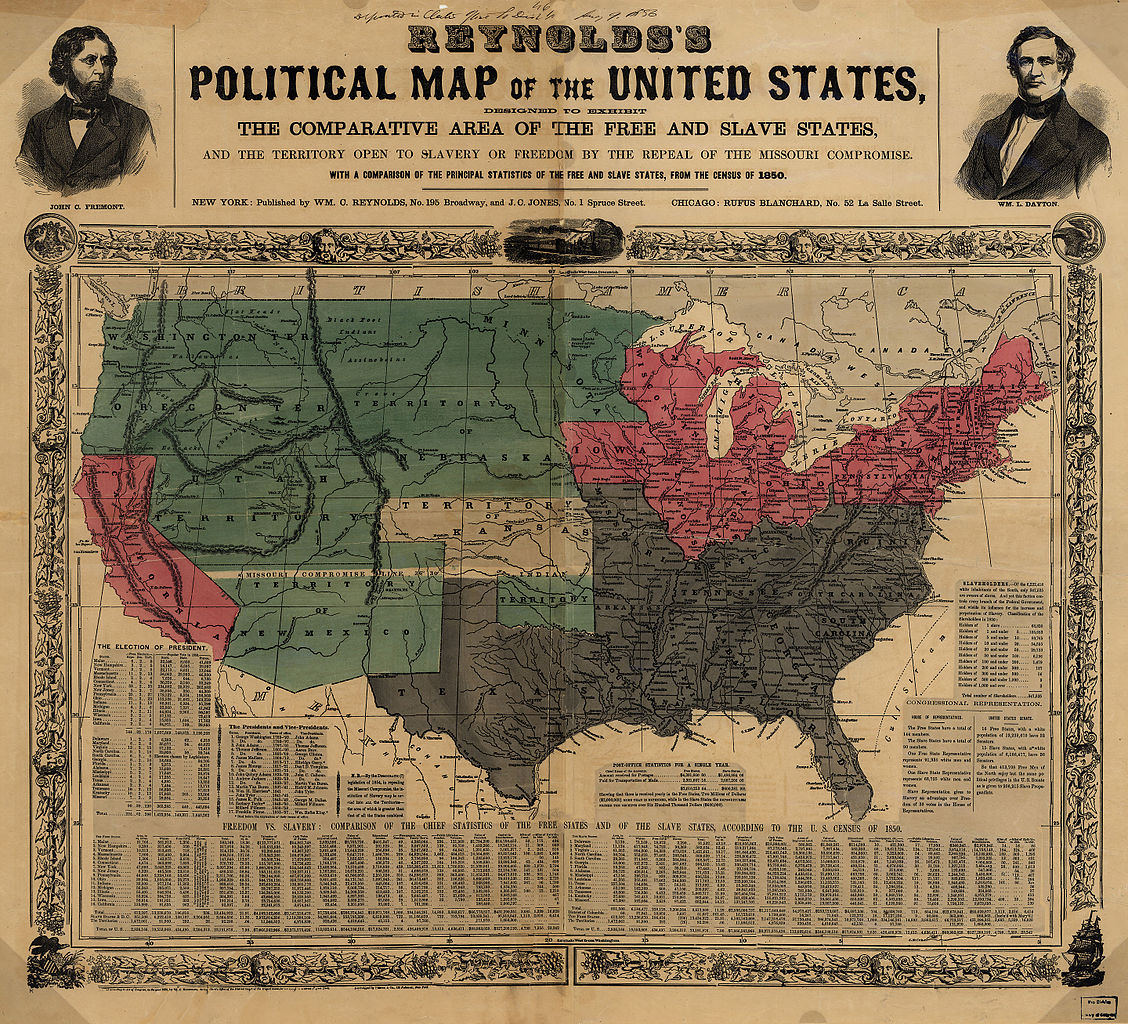
Kansas was the catalyst for the spiraling violence. In 1854, Kansas was a territory, sparsely settled but a strong candidate for statehood under provisions of the Kansas-Nebraska Act of 1854, which left the decision of slavery up to the residents of the territory. At polar political extremes were the abolitionists and pro-slavery Southerners. The former, very strong in New England, detested slavery and wanted Kansas admitted to the Union as a Free State. The Southerners, for their part, feared Yankee domination of Kansas; if its settlers voted it in as a non-slave state, their grip on congressional power would be eroded. They saw a free Kansas as a dire threat to their political, economic and cultural existence. Representatives of both viewpoints rushed to stake property claims and establish voting rights in the contested territory.
From slaveholding Missouri came scores, then hundreds of’settlers’ to vote on the vital statehood issue. Slave or Free? Votes were taken and tallied. The answer: Slave. And the voters? Gone, most of them, back to their homes in Missouri. ‘Foul!’ screamed the Free Staters.
As tempers rose, common people began to die uncommonly violent deaths. Near Lawrence, Kan., on November 21, 1855, Franklin Coleman, a pro-slavery claim-jumper from Missouri, gunned down Charles Dow, a neighboring Free Stater from Ohio, shooting him in the back. Pro-slavery Sheriff Samuel Jones of Westport cynically used the murder as a pretext to arrest Dow’s companion Jacob Branson and gather 1,500 pro-slavers from Missouri for an attack on Lawrence.
The ensuing ‘War of the Wakarusa’ consisted more of diplomatic maneuvering than bloodshed, but it did cement the polarization and inflame passions in the area. It also spurred the gathering of armed Free Staters in Lawrence under the command of Dr. Charles Robinson. Second in command was ‘Colonel’ James H. Lane.
Two weeks later, Thomas W. Barber, a Free Stater, was murdered near Lawrence by pro-slaver George Clark, and during election violence in January 1856, E.P. Brown of Leavenworth was killed in a skirmish as a member of a Free State company attempting to drive ruffians from Leavenworth County. Another unlucky Brown, R.P., was brutally hatcheted in the head the same year.
On April 23, Sheriff Jones, still harassing Free Staters under a tenuous guise of legality, was shot and severely wounded, as was Free Stater J.N. Mace five days later. Seeking vengeance, a posse led by Federal Marshal Israel B. Donaldson murdered a Free State boy named Jones and a friend of his near Lawrence on May 19. The youth had been returning home to care for his widowed mother. Free Staters were infuriated by the senseless killing.
Violence grew in scale three days later when a band of about 800 ruffians assaulted Lawrence. Among their leaders was fire-breathing Missouri Senator David Rice Atchison, dubbed ‘Staggering Davy’ by some for his alleged fondness for hard drink. The mob destroyed two local Free State newspaper offices, looted the town of more than $150,000 in merchandise, and burned the home of Governor Charles Robinson. A particular target was the Free State Hotel, a bastion for Free Staters. Its architecture included exceptionally thick walls and loopholes through which guns could be fired. A 12-pound howitzer was trundled to the hotel. The first shot at the three-story, 80-foot-wide building was reportedly aimed by Staggering Davy Atchison; it sailed over the hotel to a distant hill. The hotel withstood more than 50 rounds of more accurate fire and an attempt to blow it up with gunpowder placed within, but the structure was finally gutted by fire. Amazingly, the raid produced only two fatalities: a raider who accidentally shot himself, and another ruffian killed by a brick falling from the hotel.
Claiming revenge for the raid on Lawrence, fanatic abolitionist John Brown and seven followers shot and hacked five settlers to death near Dutch Henry’s Crossing of Pottawatomie Creek, west of Osawatomie. Brown’s motives may have extended beyond righteous fury at the ruffians’ actions; there is some evidence they included horse theft to redeem his failing financial fortunes.
On May 19, 1858, a pro-slavery band led by Charles Hamelton executed unarmed Free State men near Marais des Cygnes on the Kansas-Missouri border. A native Georgian who had been forced from Kansas into Missouri, Hamelton assembled about 30 followers and returned to the territory. Along the way, the band captured 11 Free Staters, some of whom were former neighbors of Hamelton’s and expected no harm from him. The captives were herded into a ravine and shot, first from horseback and then by the dismounted raiders. Five of the 11 victims died, and Hamelton and his men immediately returned to Missouri. The massacre was chronicled by abolitionist writer John Greenleaf Whittier in a poem that appeared in the the September 1858 issue of the Atlantic Monthly and further inflamed abolitionist sentiment, as Whittier had intended.
Such incidents were by no means isolated. Two hundred people died in the border dispute between November 1855 and December 1856 alone. The Civil War was not merely a seamless extension of the agony of ‘Bleeding Kansas,’ it was a direct result of it.
One of the most notorious individual units operating in Kansas was the 7th Kansas Volunteer Cavalry Regiment. Doc Jennison started it, although he was not around at the end. Ubiquitous Dan Anthony led it for a while. To both friends and foes, it was better known as ‘Jennison’s Jayhawkers’ and was proclaimed as the ‘Independent Kansas Jay-Hawkers’ on Jennison’s original recruiting poster of August 1861.
Political ambition fed Jennison’s military ardor, as it did Anthony’s and Lane’s. On October 28, 1861, the 7th Kansas was mustered into U.S. service with Jennison as colonel and Anthony as lieutenant colonel. The regiment, comprising volunteers from Kansas and nearby states, became part of Jim Lane’s Kansas brigade. Birds of a feather were now flying in formation. Or, more accurately, Jayhawking in cahoots. Jennison referred to his regiment as’self-sustaining,’ which meant simply that every foray into Missouri liberated more supplies than were carried into the state. Contraband seized from Southern sympathizers inevitably included horses, livestock and wagonloads of agricultural products–a minuscule fraction of which found their way to the Federal commissary. Slaves, too, gleefully trooped westward to freedom in Kansas. If other items found their way into the Jayhawkers’ possession–items such as civilian furniture, silverware and money–such was the bitter price of secession. And if a few Secesh homes caught fire along the way, that, too, was the price their owners paid for rebellion.
Perhaps the pinnacle of Jennison’s pointless depredation was achieved at Harrisonburg, Mo., where another outfit had looted the depository of the American Bible Society before Doc’s men arrived, leaving only the stock of Bibles. The 7th took the Bibles. Webster Moses, a member of the regiment, wrote to his Illinois sweetheart Nancy about a typical foray near Lone Jack: ‘About 10 of us went out jayhawking…before breakfast…caught their horses and took the best ones…found some silver ware…I got the cupps, two silver Ladles and two sets spoons….I gave Downing one ladle and the other to Capt Merriman…some of the boys got in some places about $100.00 worth of silver and…considerable money.’
Although such behavior continued for less than five months, it left an indelible mark on Missouri and the historical reputation of the 7th. Missouri was technically in the Union, and many of the citizens despoiled by the Jayhawkers were loyal Unionists. Wild with anxiety that the Jayhawkers would create more Rebels than they conquered, Federal authorities determined to put them where they could do no further harm. Originally they were to be transferred to New Mexico, but in May 1862 they were sent to Kentucky, then to Tennessee, and were seen no more in Kansas until their mustering out in September 1865.
Jennison, who was seldom with the regiment in the field, departed in April 1862, and Anthony resigned his commission four months later. Both pursued successful postwar commercial and political careers in Leavenworth, and the regiment, under new and more capable military leadership, performed well in subsequent campaigns, Jayhawking less but pursued to the end by a bad reputation richly earned in a short but boisterous period.
Jennison’s closest Southern counterpart, William Clarke Quantrill, was a puzzle, seemingly a study in contradictions. Assertive at times, at other times moody and reclusive, he was a leader who earned both loyalty and contempt. He was undeniably intelligent; he had once been a schoolteacher in Fort Wayne, Ind. That he was also a coldblooded killer was discernible in his heavy-ridded, pale-blue eyes and the almost effeminate lips that smiled wanly beneath his sweeping moustache. He was 26 years old when he destroyed Lawrence, Kan., and entered the history books alongside Tamerlane and Attila the Hun.
Quantrill and his followers sacked Lawrence on August 21, 1863. The deed was so dramatic, so bestial, and of such magnitude that it caught the imagination of the public and, in the end, made more of Quantrill than was really there. Other guerrilla leaders such as Bill Anderson and Jo Shelby accomplished more militarily. Quantrill’s raid, conversely, symbolized the senseless violence that characterized Bushwhacking at its worst, and perhaps for that reason more than any other has been granted a permanent niche in American folklore.
Revenge for Union atrocities, real or imagined, was one stimulus for the Lawrence raid. A three-story brick building in Kansas City was used by the Federals as a prison for women alleged to have aided Bushwhackers. On August 14, the building collapsed; among the five women who died were the sisters of Bushwhackers Bill Anderson and John McCorkle. Quantrill used this incident to fire up support for an attack on Lawrence, plans for which until then had drawn a cool reception even from his hard-bitten associates.
There were other motives for the raid, as well. Loot, of course, was always a motivation among Bushwhackers. To some extent, there was also the desire to show the Federals that they could operate with impunity in Union territory. Quantrill’s need to invigorate his flagging support was another. And information that Jim Lane was in Lawrence whetted Quantrill’s appetite. He wanted Lane’s scalp–figuratively or literally–very badly. If it were to be literally, teenager Archie Clement would be delighted to please his leader. Archie’skelpt’ more than one dead Union cavalryman and beheaded another.
Quantrill, Bill Anderson and George Todd led 450 men into Lawrence at 7 a.m. on August 21. They carried lists of specific targets for assassination, but they also heeded Quantrill’s final instructions to ‘kill every man big enough to carry a gun.’
The first Kansan to die was the Reverend S.S. Snyder, shot in his yard as he milked his cow. At 9 a.m. the Bushwhackers rode out, saddlebags laden with booty, many of the raiders swaying from the effects of newly liberated spirits. In 120 minutes, they had devastated the dusty town of 2,000 inhabitants and killed 150 of its male citizens. Many were gunned down before their wives and children; others died trapped in their flaming homes. Then the raiders torched the entire community, burning $2 million worth of property.
Jim Lane was, indeed, at Lawrence that day. The gaunt spellbinder heard the raiders coming and accurately guessed they would be looking very particularly for him. In his nightshirt, he ran from his house and hid in a corn patch. He survived then, as he did so often through his bizarre political career, on quick wit and quicker action, with no compunctions about his public appearance. Better a live coward than a dead hero, he reasoned.
Ironically, Quantrill’s well-known and senseless raid on Lawrence was followed six weeks later by an almost forgotten but militarily more significant encounter. Leading his men southward to winter in Indian Territory (now Oklahoma), Quantrill was drawn to the Union outpost at Baxter Springs, Kan., just west of Joplin, Mo. Here, on October 6, his forces captured the small fort and a wagon train of Union Maj. Gen. James Blunt’s headquarters entourage. Blunt escaped to nearby Fort Scott, but 90 of his soldiers were captured and massacred, and Blunt was relieved of command. A drunken Quantrill boasted that he had accomplished in one day what Confederate Colonel Jo Shelby and Maj. Gen. John Marmaduke had failed for years to do: whip Blunt. The assertion was true, but it also emphasized Quantrill’s increasingly desperate need to counter through acclaim the growing apathy and disgust of many of his own followers.
By the third year of the war, a vast area of Missouri had been burned and depopulated. The western counties closest to Kansas were the hardest hit. Many former residents were either dead, had fled before torch and ambuscade, or had been evicted as a result of Union Brig. Gen. Thomas Ewing’s notorious Order Number 11 of August 1863, which mandated the removal of all western counties inhabitants and the burning of their homes so that they could not harbor Confederate guerrillas.
Typical of the towns affected by Ewing’s order was Nevada, about 25 miles east of Fort Scott. So many guerrillas lived in and around the little community that it had become known to Unionists as the ‘Bushwhacker capital.’ On May 24, 1863, it was the site of an attack on a Federal militia party by Bushwhackers led by Captain William Marchbanks and ‘Pony’ Hill. Two days later, reinforced Union militia returned to Nevada and burned it. In some ways, Order Number 11 simply confirmed what had already been happening.
For all its infamy, Order Number 11 did achieve one goal: it deprived Bushwhackers of the protection, nurture and victims that fed their depredations. They simply took their business elsewhere. Elsewhere was ‘Little Dixie,’ the area flanking the rich valley of the Missouri River. Little Dixie’s presence in the northern half of Missouri derived from a topographic peculiarity. As settlers, mostly Southerners, moved north and west into Missouri, the Scottish-Irish ‘hillbillies’ from the upper South naturally gravitated toward the mountainous area of southern Missouri and northern Arkansas. Lowland planters from the deep South crossed the path of the highlanders, settled in the fertile river basin, and financed pillared mansions with the income from slave-raised hemp and cotton.
Despite desperate Union efforts to suppress Confederate Bushwhackers, Little Dixie witnessed almost daily–even into the war’s last year–the savagery of guerrilla warfare. Take, for example, the three months from mid-July to mid-October 1864. By then, moody Bill Quantrill’s behavior had become too bizarre for many of his own men. Some adopted Bill Anderson as their leader; others followed George Todd and John Thrailkill. Quantrill was left to wander at the head of a small band of loyalists.
Bill Anderson had grown up in Huntsville. Hometown allegiance, however, apparently did not deter Bill from raiding the place on July 15, robbing merchants and a bank of $45,000 and shooting down a passerby imprudent enough to try to stop the raiders. Anderson did, at least, make his boys return money stolen from people with whom he had gone to school.
Two days later, Anderson led 35 followers into nearby Rocheport, savaging the town and terrifying its inhabitants. On July 23, 100 of his raiders gutted the railroad station in Renick. The next day, the Bushwhackers ambushed and dispersed a pursuing company of the 17th Illinois Cavalry. Two slain Federals were found scalped. Attached to the collar of one was a note: ‘You come to hunt bush whackers. Now you are skelpt. Clemyent Skept you.’ Eighteen-year-old Archie had left his mad calling card.
Following the engagement, Anderson’s men moved north into Shelby County, where they destroyed the Salt River railroad bridge and torched depots at Shelbina and Lakenan. Then, in August, Anderson attacked the riverboat Omaha near Glasgow and raided Rocheport again, shooting up more boats and snarling all river traffic.
Todd and Thrailkill, for their part, moved to Keytesville on September 20, capturing the Union garrison and burning the courthouse. During the same month, Anderson’s men robbed 13 stagecoaches in Howard County. On September 23, Todd joined Anderson. The 300 guerrillas thus mustered together wiped out a 12-wagon Federal train near Rocheport, capturing 18,000 rounds of ammunition and killing 15 Union troops. The combined forces, briefly joined by Quantrill, then attacked Fayette, where they were repulsed by Federal soldiers barricaded in the courthouse.
Seeking revenge for this setback, Anderson’s guerrillas raided Centralia on September 27. They prowled the village for three hours, looting stores and terrorizing citizens. Drunken Bushwhackers burned the depot, and the arrival of a stagecoach from Columbia gave them an opportunity for more plunder. A westbound train from St. Charles provided unexpected bounty: 25 unarmed Union soldiers. The helpless Federals were lined up on the platform and stripped of their uniforms. Anderson ordered Clement to ‘muster out’ the naked and half-naked prisoners. Little Archie, a pistol in each hand, gleefully began to shoot them, and the fusillade was joined by the other guerrillas. The event became known as the Centralia Massacre.
A Union detachment chased the fleeing guerrillas, who turned at bay outside Centralia and killed 114 of their pursuers. David Pool proved that Archie Clement was not the only barbaric Bushwhacker. Pool chose to enumerate fallen enemies by jumping from one body to another. ‘If they are dead, I can’t hurt them, ‘he asserted. ‘I cannot count ’em good without stepping on ’em.’
On October 11, Anderson’s Bushwhackers sacked Boonville, while their leader joined Quantrill to capture Glasgow. Todd, riding with Jo Shelby’s cavalry division, was killed in battle near Independence on October 21, and Anderson fell five days later in a skirmish near Orrick.
Everywhere, Bushwhacker leaders were dying. On January 10, 1863, Joe Porter had been killed in a skirmish with Federal troops near Marshfield. Quantrill fled to Kentucky with a few loyal followers. On May 10, 1865, they were surprised by Federal rangers in Spencer County. Quantrill was shot in the back and lay in agony for nearly a month, paralyzed, before he died.
Archie Clement surrendered to Federal authorities at the end of the war, but he was shot from his horse in Lexington on December 13, 1866, while attempting to flee arrest by state militiamen. Jim Lane, too, died a violent death. Despondent over his failing political fortunes, Lane shot himself while in Lawrence on July 1, 1866, dying 10 days later.
Jesse James lasted longer–he was murdered in 1882, shot down in his own home by ‘the dirty little coward’ Robert Ford, who was himself killed by a James supporter a few years later.
The Jayhawkers and Bushwhackers died off, some violently, some in the peace and prosperity of old age. But the wounds of the bitter struggles in Kansas and Missouri, which presaged the Civil War and epitomized its brutality, lasted. Understandably, the first years after the war saw emotions still running high on both sides, and a number of acts of violence and revenge, some by individuals, others by groups, continued to darken the public mind.
In one typical postwar incident, in the western hamlet of Haynesville, Mo., a pro-Union townsman named Loft Easton drank heavily and accused a former guerrilla captain named Jim Green (whom he had run into at a local grocery store) of being part of a company of Bushwhackers that had burned out Easton’s father during the war. Green attempted to reason with Easton, pleading with him ‘not to get in a fuss,’ but the drunken man continued berating Green and all other Southern guerrillas he could bring to mind. Green, to his credit, attempted to walk away from the fight, pulling a pistol and telling Easton not to follow him. Easton kept coming, however, and a grocery clerk, perhaps attempting to keep the peace–or else a fellow Union sympathizer of Easton’s–tried to knock Green’s gun out of his hand. Instead, for his troubles, the clerk found himself on the fatal end of a stray shot from Easton.
Green dove for his pistol while Easton continued firing wildly. Getting up, he shot his assailant once, knocking him over, then coolly walked up and killed Easton with two more shots to the head. A local diarist, Sarah Harlan, herself a pro-Union resident of Haynesville, noted fairly, ‘I believe that everybody that seen it justifies Jim.’ Green surrendered to the local sheriff and was placed on bond awaiting trial; he eventually was exonerated of all charges against him.
Another, less lethal, encounter between old enemies took place in Chariton County in October 1866. As noted by Southern sympathizer William Hill, the fight consisted in its entirety of the following exchange: ‘Old Dave came down here last week & told Jube West he came down to straighten out the damn Rebels. Jube immediately knocked him down twice & beat him vere [sic] severly [sic] in the face. Dave left immediately on the stage. Everyone was glad and said it was the best thing ever happened here.’
Not even ministers were exempt from the postwar violence. Unionists still nursed a grudge against Baptist and Methodist ministers who had supported the South during the war–or, on some occasions, had merely counseled Christian charity to a defeated foe. One such victim was a Reverend Hadlee of Webster County, in south central Missouri. Reputed to have been a ‘bitter Rebel’ by the pro-Union sheriff at Springfield, Hadlee had fled the state during the war and had only recently returned. One Sabbath day in August 1866, Hadlee attempted to resume preaching at his old church, but he was refused entry by Union loyalists who told him that he was ‘obnoxious’ and that because of his ‘rebellious acts’ they did not want him to preach to or teach them.
Enraged, Hadlee pulled down the American flag flying outside the church and started down the road toward his own land, where he intended to preach to a group of pro-Southern followers. He did not make it that far. A conveniently unidentified gunman rode alongside the minister and shot him dead; no one was willing to identify the killer, either from fear of reprisal or in support of his decidedly unchristian act.
Such acts, whether comparatively harmless fisticuffs or coldblooded murder, were the natural fruit of a decade-long planting of bitter, mean-spirited seeds. For everyone in the war-torn states of Missouri and Kansas, the scars of both civil war and Civil War were a long time in healing. Talk to many residents of the area today, and you will find that they have never totally healed, even now.
This article was written by Bowen Kerrihard and originally appeared in the March 1999 issue of America’s Civil War.
For more great articles be sure to pick up your copy of America’s Civil War.