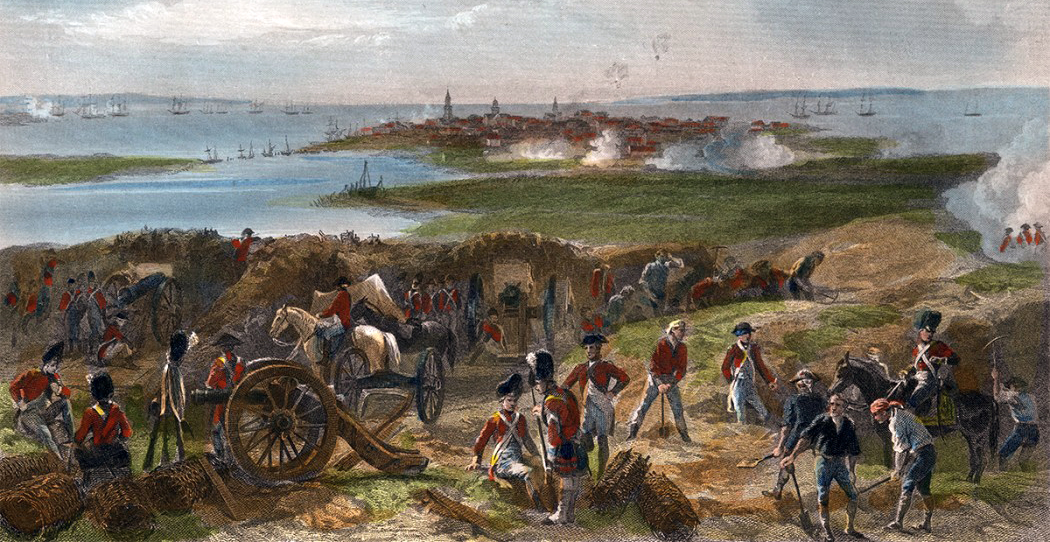
Before Union forces could capture Charleston, South Carolina, they first had to take Fort Wagner, a Confederate stronghold guarding the harbor’s entrance. So shortly after 6:30 p.m. on July 18, 1863, Union Colonel Robert Gould Shaw readied 600 men of the 54th Massachusetts Regiment for an assault on the fort. Shaw, the 25-year-old son of Boston abolitionists, was white, as were all his officers. The regiment’s men were black.
The 54th would spearhead a three-pronged attack aimed at capturing the necklace of heavily fortified islands that dotted Charleston harbor. If they could take Fort Wagner, the Federals would launch a major assault on nearby Fort Sumter. From there, it would only be a matter of time before Charleston fell. But capturing Fort Wagner would be no easy task.
At first glance, the fort appeared to be little more than a series of irregular, low sand hills. In fact, it was much more formidable than that. A timber and sandbag foundation beneath the sand-covered hills allowed the structure to absorb artillery fire without any significant damage. The fort had 11 heavy guns mounted in fixed positions behind the parapets, while smaller wheeled cannon could be quickly repositioned where needed. Defending it were 1,300 men from the 51st and 31st North Carolina Regiments as well as several companies of South Carolina artillerymen.
Fort Wagner sat in the middle of Morris Island’s northern sandy peninsula. Four batteries at the island’s northern tip guarded the entrance to Charleston harbor. The largest of these batteries was Battery Gregg, whose guns faced the ocean and covered the harbor mouth. South of the batteries, a deep moat with a sluice gate and three guns bounded Fort Wagner along its northern sea face. To the east lay the Atlantic Ocean, and on its western boundary were the impassable marshes of Vincent’s Creek. On its southern side the fort had guns and mortars for direct and flanking fire on any advancing troops. The only possible assault approach was east of the fort, along a slim stretch of sand, narrow even at low tide. Shaw and his troops would have to launch their attack on the seemingly impregnable fort from there.
Colonel Shaw readied his men on the beach. Tightly wedged together, elbow to elbow, the soldiers of the 54th began their gallant rush, determined to disprove the popular belief among whites that Negroes were an inferior race, lacking the courage and intelligence of combat-ready soldiers.
The onset of the Civil War set off a rush by free black men to enlist in the U.S. military, but a 1792 law barred ‘persons of color from serving in the militia.’ Also, strong opposition in the North as well as a widespread prejudice that blacks were intellectually and socially inferior limited their involvement in the war to driving supply wagons, burying the battle dead, and building railroads.
Yet public opinion slowly began changing. Northern morale faltered after Union forces suffered a series of military defeats, and fewer white men were willing to join the army. Pressured by this turn of events, on July 17, 1862, Congress passed a Confiscation Act that declared all slaves of rebel masters free as soon as they came into Union lines, and a Militia Act that empowered the president to ’employ as many persons of African descent’ in ‘any military or naval service for which they may be found competent.’ Congress also repealed the 1792 law.
On August 25, 1862, the War Department authorized Brigadier General Rufus Saxton, military governor of the Union-controlled South Carolina Sea Islands, to raise five regiments of black troops for Federal service, with white men as officers. Volunteers came forward slowly at first, but by November 7 the regiment had reached its quota and was mustered in as the 1st South Carolina Volunteer Regiment under the command of Massachusetts abolitionist Colonel Thomas Wentworth Higginson. A second regiment followed, led by Colonel James Montgomery.
Still, President Abraham Lincoln refused to raise a large black army on political grounds. ‘To arm the Negroes would turn 50,000 bayonets from the loyal Border States against us that were for us,’ he told his abolitionist critics. Black leaders continued to urge the necessity of enlisting black troops, realizing that if the black man proved his patriotism and courage on the battlefield, the nation would be morally obligated to grant him first-class citizenship. No one expressed those sentiments more eloquently than Frederick Douglass, a former slave and the nation’s most prominent black abolitionist. He insisted that ‘once the black man gets upon his person the brass letters ‘U.S.’, a musket on his shoulder and bullets in his pocket, there is no power on earth which can deny that he has earned the right to citizenship in the United States.’
Debate continued within the Union command until January 1, 1863, when President Lincoln signed the Emancipation Proclamation. Having freed, by executive order, those slaves in the South, Lincoln could no longer deny the black man the opportunity to fight. Now the Civil War was being fought not only to preserve the Union, but for the freedom of all the American people, white and black. The success of the 1st and 2nd Carolina Colored Troops only reinforced that position. Higginson and Montgomery had already led their black troops on several successful raids into the interior of Georgia and Florida, and in March 1863 they captured and occupied Jacksonville.
On February 13, 1863, Senator Charles Sumner of Massachusetts introduced a bill proposing the ‘enlistment of 300,000 colored troops.’ Although the bill was defeated, abolitionist governor John A. Andrew of Massachusetts requested and received authorization from Secretary of War Edwin M. Stanton to organize a colored regiment of volunteers to serve for three years.
Massachusetts had a small black population, and only 100 men volunteered during the first six weeks of recruitment. Disillusioned by the turnout, Andrew organized a committee of prominent citizens and Negro leaders to supervise the recruitment effort. Within two months the committee collected $5,000 and established a line of recruiting posts from Boston to St. Louis, resulting in the recruitment of 1,000 black men from throughout the Union who became part of the 54th Regiment Massachusetts Volunteer Infantry, Colored, the first black regiment raised in the free states. Toward the end of the second recruiting month, volunteers arrived at the rate of 30 to 40 each day, and Andrew soon had enough men to form a second black regiment, the 55th Massachusetts.
For the 54th’s commander, Governor Andrew turned to Robert Gould Shaw, captain of the Massachusetts 2nd Infantry. Charming and handsome, Shaw came from a wealthy and socially prominent Boston abolitionist family. His parents Francis and Sarah had joined the American Anti-Slavery Society in 1838, and by 1842 Francis was working with the Boston Vigilance Committee to help runaway slaves gain their freedom. Robert entered Harvard University in 1856 but abandoned his studies during his third year and moved to New York to work in his uncle’s mercantile office. Shaw joined an exclusive militia regiment, the 7th New York National Guard, where he talked about what he would do if the South made trouble. Shaw did not possess the strong anti-slavery calling of his parents, but he was fiercely patriotic. When the Civil War began, he was primed to take revenge on the South. To Shaw, the South was the transgressor, and if it took the end of slavery to redeem the honor of America, then he was willing to fight for that. When the 7th disbanded, Shaw accepted a commission in the 2nd Massachusetts Infantry. During his 20 months there, Captain Shaw received a minor wound at Antietam, during the single bloodiest day of the war.
When Governor Andrew asked the young captain to lead a black volunteer infantry, Shaw was hesitant. The prospect of heading a regiment of armed blacks would not be popular among the white ranks. Nor did he want to abandon the men of the 2nd Infantry. Shaw initially refused the position but changed his mind after much discussion with his parents. In a February 1863 letter to his future wife, Annie Haggerty, Shaw wrote, ‘You know how many eminent men consider a negro army of the greatest importance to our country at this time. If it turns out to be so, how fully repaid the pioneers in the movement will be, for what they may have to go through….I feel convinced I shall never regret having taken this step, as far as I myself am concerned; for while I was undecided I felt ashamed of myself, as if I were cowardly.’ Shaw received a promotion to major on April 11, 1863, and attained the rank of colonel the following month. Colonel Shaw would now have to navigate the turbulent forces of discrimination that existed within the Union Army.
The men of the 54th trained near Boston at Readville, under the constant scrutiny of white soldiers, many of whom believed black soldiers lacked the stomach for combat. Yet the negative perceptions seemed only to inspire a sense of unity within the ranks of the regiment and their white officers.
Contrary to recruitment promises, the soldiers of the 54th were paid only $10.00 per month, $3.00 less than the white troops. Shaw had become so committed to his men that he wrote to Governor Andrew, insisting that his entire regiment, including white officers, would refuse pay until his soldiers were ‘given the same payment as all the other Massachusetts troops.’ Yet Congress did not enact legislation granting equal pay to black soldiers until June 15, 1864.
Shortly after the 54th was mustered into service, the Confederate Congress passed an act stating its intention to ‘put to death,’ if captured, ‘any Negro’ as well as ‘white commissioned officer [who] shall command, prepare or aid Negroes in arms against the Confederate States.’ The directive only served to strengthen the resolve of the black soldiers.
On May 18 Governor Andrew traveled to the camp to present Shaw with the regimental flags. He made the trip with 3,000 other visitors, including such prominent abolitionists as Frederick Douglass, William Lloyd Garrison, and Wendell Phillips. Douglass had a strong personal link with the 54th—two of his sons, Lewis and Charles, had joined the unit. Andrew presented the flags to Shaw. ‘I know not, Mr. Commander, in all human history, to any given thousand men in arms, has there been committed a work at once so proud, so precious, so full of hope and glory as the work committed to you,’ the governor said.
Ten days later the 54th Regiment of Massachusetts Volunteer Infantry marched through the streets of downtown Boston, greeted by the cheers of thousands who assembled to see them off at Battery Wharf. It was an impressive spectacle. Shaw, atop his chestnut brown horse, led the way. Close behind marched the color bearers, followed by young black soldiers, handsomely clad in their sharp, new uniforms.
The dress parade gradually made its way to the wharf and boarded the De Molay bound for Port Royal Island, South Carolina. There the regiment reported to the Department of the South. Once the men arrived, however, reality set in when they were relegated to manual labor. Not until June 8, when Shaw and his men joined Colonel James Montgomery and the black troops of his 2nd South Carolina Colored Volunteers on an ‘expedition’ to Georgia, did they see any action, and that was during a pointless raid on the small town of Darien. After plundering the 100 or so residences, three churches, the market-house, courthouse, and an academy, Montgomery ordered Darien set afire. Begrudgingly, Shaw directed one of his companies to torch the town. Fanned by a high wind, the flames eventually destroyed everything but a church and a few houses.
Afterward, Shaw wrote to Lieutenant Colonel Charles G. Halpine, the acting adjutant general of the department, to condemn this ‘barbarous sort of warfare.’ Shaw knew his complaint could result in his arrest or even court-martial, but he felt compelled to express his feelings. He later learned that Montgomery had acted in accordance with the orders of his superior officer, General David Hunter. Soon after the Darien raid, President Lincoln relieved Hunter of his command.
The sacking of Darien and the manual labor his troops were compelled to do disheartened Shaw. ‘Our whole experience, so far, has been in loading and discharging vessels,’ he wrote to Brigadier General George C. Strong, commander of Montgomery’s brigade. ‘Colored soldiers should be associated as much as possible with the white troops, in order that they may have other witnesses besides their own officers to what they are capable of doing.’ That opportunity finally arrived on the morning of July 16, 1863. Fighting alongside white troops on James Island, Shaw’s men acquitted themselves well in a sharp skirmish. That same night they ferried to Morris Island, where battle lines had already been drawn for the anticipated attack on Fort Wagner. Despite their exhaustion, hunger, and wet clothes, the men of the 54th were determined to fight on.
When General Strong, now Shaw’s brigade commander, heard of the bravery of the 54th on James Island, he asked the colonel if he and his regiment would lead the attack on Fort Wagner. Shaw and his men readily agreed and prepared to lead the charge across a narrow beach obstructed by felled branches, crisscrossed wire, and a deep moat—all of which were constructed to slow the attackers, making them vulnerable to enemy fire. Eight all-white units were to follow. All day long, Union artillery bombarded Fort Wagner in an effort to soften the Confederate defense and minimize the bloodshed that would inevitably follow. Late in the day Shaw arranged the 600 able-bodied men of his regiment into two wings of five companies each and moved them slowly up the beach. He assigned Company B to the right flank, using the surf as its guide. The other companies lined up on its left.
At dusk, General Strong addressed Shaw and his men. Pointing to the flag bearer, he said: ‘If this man should fall, who will pick up the flag?’ Shaw stepped forward. ‘I will,’ he said. Addressing his troops with final words of inspiration, Shaw reminded them: ‘The eyes of thousands will look on what you do tonight.’ Then, drawing his sword, the young Boston Brahmin barked: ‘Move in quick time until within a hundred yards of the fort, then, double-quick and charge!’ Quickstep became double-quick, and then a full run, as Confederate riflemen on the ramparts of the fort let loose a torrent of fire upon the Union soldiers. Men fell on all sides, but those who were able continued the charge with Shaw in the lead.
Company B passed through the moat to the base of the fort where canister, grenades, and small arms fire rained down on them. Surrounded by bloodshed, the 54th’s commander realized that he could not retreat, and he ordered the final assault on the fort. Shaw somehow managed to reach the parapet before a Confederate bullet pierced his heart.
‘Men fell all around me,’ Lewis Douglass later wrote. ‘A shell would explode and clear a space of twenty feet, our men would close up again, but it was no use we had to retreat, which was a very hazardous undertaking. How I got out of that fight alive I cannot tell, but I am here.’
The intense fire mowed down the color bearers. Sergeant William Carney, a barrel-chested 23-year-old, seized the national flag and planted it upon the fort’s parapet. The men of the 54th fought gallantly for about an hour until Confederate guns forced them to abandon their position. Before retreating, Carney once again grasped the flag, and despite bullets in the head, chest, right arm, and leg, he returned it to Union lines. His heroism earned him the distinction of being the first of 21 black men during the war to earn the Medal of Honor.
Subsequent waves of Federal troops tried for two hours to take the fort but failed, and casualties mounted by the hundreds. At the end of the assault, the Union had lost 1,515 killed, wounded or missing. Of that number, 256 were black soldiers from the 54th Massachusetts.
The following morning revealed a grisly scene. The dead lay in contorted positions along the beach, their fingers and legs stiffened from rigor mortis. The soft but painful cries and moans of the dying could be heard, begging for help.
A few days after the siege, a Union party under a flag of truce requested the return of Shaw’s body. Brigadier General Johnson Hagood, Fort Wagner’s new commander, reportedly answered, ‘We buried him in the trench with his n——s.’ Learning of Hagood’s reply, Colonel Shaw’s father declared, ‘I can imagine no holier place than that in which he is, among his brave and devoted followers, nor wish for him better company.’
From a military standpoint, the assault on Fort Wagner proved to be a costly failure. The blame rested on the shoulders of commanding general Quincy A. Gillmore and his commander in the field, Brigadier General Truman Seymour, who had not ordered the usual preparations for such an assault—no one sent out guides to check the terrain in advance or dispatched lines of skirmishers to soften the enemy. Nor had the 54th ever practiced storming a fort. Nevertheless, the assault proved to be a turning point for black soldiers, serving to dismiss any lingering skepticism among whites about the combat readiness of African Americans. ‘I have given the subject of arming the Negro my hearty support,’ General Ulysses S. Grant wrote to President Lincoln in August. ‘They will make good soldiers and taking them from the enemy weakens him in the same proportion they strengthen us.’
When other Union generals remained recalcitrant, Lincoln responded swiftly. ‘You say you will not fight to free Negroes,’ he said. ‘Some of them seem to be willing to fight for you. When victory is won, there will be some black men who can remember that, with silent tongue and clenched teeth, and steady eye and well-poised bayonet, they have helped mankind on to this great consummation. I fear, however, that there will also be some white ones, unable to forget that with malignant heart and deceitful speech, they strove to hinder it.’