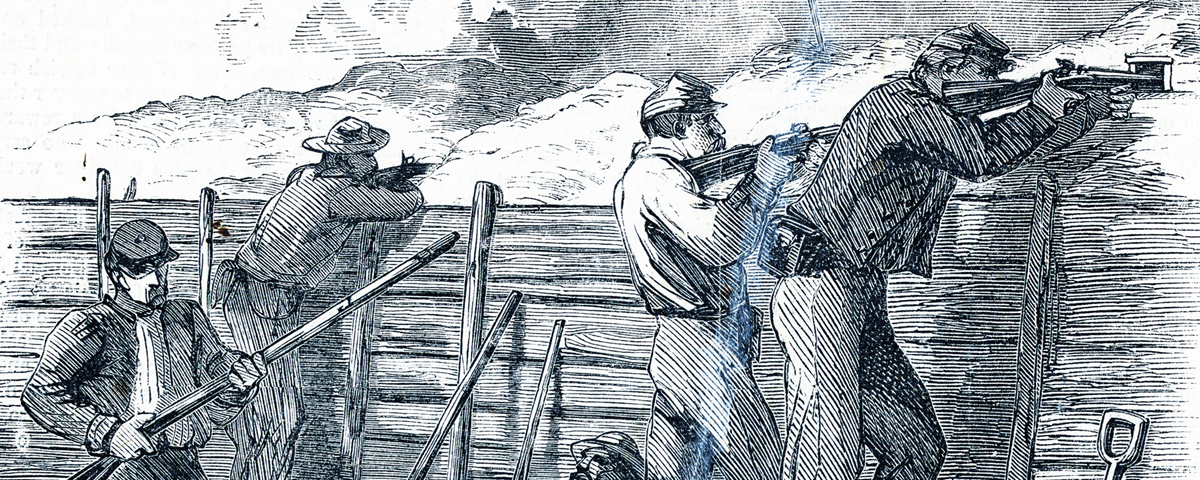
Lieutenant Freeman S. Bowley was fighting for his life in the man-made hellhole that was the Petersburg Crater when he noticed that the former slaves in his company of the 30th United States Colored Troops were not the only men of color wearing Union blue and dodging Confederate Minié balls on the stifling hot morning of July 30, 1864. “Among our troops was a company of Indians, belonging to the 1st Michigan S.S. [Sharpshooters],” recalled Bowley many years later. “They did splendid work, crawling to the very top of the bank, and rising up, they would take a quick and fatal aim, then drop quickly down again.”
More than 20,000 American Indians fought in the Civil War for both the Union and the Confederacy. Probably the best known were the Cherokee soldiers of General Stand Watie, who sided with the South in the Trans-Mississippi West. But the men Bowley saw were mostly Chippewas and Ottawas from Company K of the 1st Michigan Sharpshooters, the largest unit of American Indians serving with the Union armies east of the Mississippi River.
Why did these men, who were neither citizens nor subject to the draft, leave the primeval pine forests and sparkling lakes where their people had lived for thousands of years to fight and die on the killing fields of Virginia? What motivated a people accustomed to white racism and government duplicity to send its fathers, sons and brothers to fight in a war to free black slaves while they themselves were not completely free? How could men, characterized by Michigan newspapers as “demi-savages” and “a poor, ignorant, and dependent race” resolutely stand their ground on the blood-slicked red clay slopes of the Crater while many other soldiers fled in terror?
The warriors of Company K were in the trenches before Petersburg because, by late 1863, the Union armies desperately needed men. President Abraham Lincoln had imposed a federal draft and assigned numerical quotas to be filled by each state’s governor. Two years earlier, however, the Michigan Legislature had rejected an offer by George Copway, a Chippewa and well-known Methodist minister, to raise a regiment of Great Lakes-area Indians who were, as he put it, “inured to hardships, fleet as deer, shrewd, and cautious.”
But the blood of Michigan boys soaking battlefields from Shiloh to Gettysburg gradually opened the lawmakers’ eyes to the possibility of affording their American Indian population the benefits of citizenship, at least as far as it affected their ability to be soldiers. By late 1862, the supervisors of Oceana County, along the eastern shore of Lake Michigan, informed authorities that “thirty-four Indians whom we regard as citizens of said county” had enlisted. The good fathers of Oceana County seemed to have put prejudice aside—and not coincidently spared 34 white males and potential voters from the draft.
While the Michigan lawmakers were congratulating themselves on their newly discovered sense of equality, Colonel Charles V. DeLand, a veteran of the 9th Michigan Infantry, and a troop of energetic recruiters were scouring the Michigan hinterlands looking for men to join a regiment of sharpshooters—men who could move with stealth and kill with a single shot. American Indians, with a reputation for marksmanship and a tradition of living off the land, seemed ideal candidates if they could be convinced to join up.
Laurence Hauptman’s seminal study of Indians in the Civil War, Between Two Fires, argues that extreme economic necessity and the hopes of negotiating a more favorable treaty to protect their traditional homelands from white incursion were the primary reasons driving Michigan Indians into Union uniforms. But Saginaw Chippewa Chief Nock-ke-chick-faw-me, in a speech to the young warriors of his tribe gathered at Detroit, used a more sensational form of motivation. “If the South conquers you will be slave dogs,” he warned. “There will be no protection for us; we shall be driven from our homes, our lands, and the graves of our friends.”
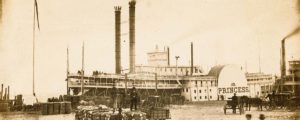
A similar oration given by Ottawa Chief Paw-baw-me on July 4, 1863, at the reservation in Oceana County caused 25 men to join the colors. Almost the entire tribe turned out to see them depart by steamer from the dock at Pentwater for mustering at Detroit. Among them was 23-year-old Antoine Scott, who was to be recommended for the Medal of Honor for his actions in the Crater. More recruits came from Bear River, Little Traverse, Charlevoix and La Croix. Some Ottawa-Ojibwas came from the Isabella Reservation on the Lower Peninsula near Saginaw. One of the first to sign up was Thomas Ke-chi-ti-go, a tall, muscular man known as “Big Tom.” He had been refused enlistment in 1861 but became a sergeant in Company K.
Second Lieutenant Garrett A. Graveraet led one of the most successful recruiting drives. His father was a Franco-Ottawa merchant-fur trader, and his mother, Sophie Bailey, was recorded as “Chippewayan.” Only 23, Graveraet was well known, well educated and spoke fluent Chippewa. He even signed up his own father, 55-year old Henry, who claimed to be only 45. The elder Graveraet became a sergeant in Company K and its only non-Indian enlisted man.
Along with Captain Edwin V. Andress and 1st Lt. William Driggs, Graveraet drilled the new recruits of Company K while Colonel DeLand and part of the regiment chased Confederate General John Hunt Morgan and his raiders through southern Indiana. When DeLand returned, he found 80 well-drilled men whom Lt. Col. John R. Smith, the mustering officer, characterized as “the stuff, no doubt, of which good sharpshooters can easily be made.” In all, about 150 American Indians served in Company K during the war.
Colonel DeLand had made it clear to his recruiters that “great care will be taken in enlisting Indians to give them all necessary and correct information upon all subjects….” They were to receive the same benefits as white soldiers. This included a $50 state bounty, $25 federal bounty and $13 per month in pay. In comparison, when African Americans first enlisted in USCT regiments, they received only $10 per month until a July 1864 act of Congress mandated equal pay.
But like their black brethren, the men of Company K began their Civil War service far from the front lines, protecting arsenals and guarding prisoners of war. In August 1863, seven companies of the 1st Michigan were ordered to Camp Douglas outside Chicago to guard Confederate prisoners. The routine of camp life quickly descended into boredom and its handmaidens: desertion and disease. There were few amenities or diversions for the men, and Charles Bibbins of Company E recalled after the war that the Indians “never associated with the other soldiers, always keeping strictly to themselves from the time they joined the regiment until the time they were mustered out.” Nevertheless, the warriors of Company K were a popular curiosity with the civilians of Chicago, who came out in droves to see them.
Orders finally came through on March 8, 1864, for the regiment to report to Annapolis, Md., the rendezvous point for units joining Maj. Gen. Ambrose Burnside’s IX Corps of the Army of the Potomac. The men of Company K arrived just as Lt. Gen. Ulysses S. Grant began his Overland campaign, and they remained in the thick of the fighting for more than a year until General Robert E. Lee surrendered the Army of Northern Virginia at Appomattox Court House.
Company K’s first encounter with the enemy came in the confused fighting known as the Battle of the Wilderness on May 6, 1864, north of the Chewing farm almost halfway between Parker’s Store and Wilderness Tavern. Skilled at skirmishing as well as sharpshooting, the Indians first rolled in the brush and mud to camouflage their blue uniforms. The rest of the regiment soon adopted the practice before every engagement.
Sergeant Charles Allen was severely wounded in the fighting that followed and died a week later in Fredericksburg. He was the first from Company K to die in battle. But on the afternoon of May 12 in the tangled woods and swamps around Spotsylvania Court House, the company faced an attack by Brig. Gen. James H. Lane’s North Carolinians, and the toll was much higher. Eight men, including Sergeant Graveraet, were killed, and two more died later from their wounds.
The Army of the Potomac moved south of the James River, and on June 17 Company K and the rest of the 1st Michigan were part of an attack by Brig. Gen. Orlando Willcox’s 3rd Division against a Confederate salient in front of the Shand house along the defenses around Petersburg, Va. The ferocious attack was poorly led. The sharpshooters soon found themselves in possession of some Rebel breastworks, but also isolated and surrounded.
Around 10 p.m., under the cover of an artillery barrage, remnants of five North Carolina regiments from Brig. Gen. Matthew Ransom’s Brigade swarmed over the defensive position of the severely depleted sharpshooters. After fighting that was often hand to hand, the Rebels forced the surrender of the defenders—who had covered the retreat of their comrades. Men of the 56th North Carolina confiscated many of the Indians’ prized rifles, with their uniquely carved stocks.
Company K had only two casualties in the action. Oliver Ar-pe-targe-zhik succumbed to his wounds in Washington, D.C., on July 9 and was buried in Arlington National Cemetery. Lieutenant Garrett Graveraet also died of his wounds in Washington the next day. He is buried next to his father on Mackinac Island, deep beneath the soil of the land of the Great Hare, which was sacred to his family and his ancestors. But the 1st Michigan’s greatest loss from that day was not understood until after the war. More than 80 soldiers, including 14 from Company K, were captured and sent to Andersonville Prison; 37, including eight from Company K, never returned.
For the next month the men of Company K fell into the routine of siege warfare, picketing, sniping and digging. Mud, flies and stifling heat were their constant companions. Both sides engaged in regular sniping, and Lieutenant Bowley recalled that an inordinate number of casualties near his unit indicated a well-placed Confederate sharpshooter was at work. The Indians were called in to stop him.
“Nearly a mile away stood a high chimney,” Bowley recalled. “All day the Indians watched that chimney and never fired a shot. The sun had gone down and the twilight was deepening, when one of the Indians fired. A man was seen to fall from the chimney…he had incautiously exposed a portion of his body, and the Indian sharpshooter had instantly dropped him.” Bowley didn’t know it at the time, but his life and the lives of the men of Company K were soon to be inextricably linked below a Confederate redoubt called Elliott’s Salient in a place that would come to be known as the Crater.
To break the stalemate between the two armies in front of Petersburg, Burnside devised a plan to dig a tunnel 510 feet long under the Confederate defenses and detonate 8,000 pounds of gunpowder. Four brigades of his IX Corps, led by Brig. Gen. Edward Ferrero’s “Colored Division,” were supposed to swarm into the abyss, sweep the dazed defenders aside and pour into the Confederate trenches. They were to move swiftly to occupy some high ground about 500 yards away known as Cemetery Hill and then roll into Petersburg.
Reluctantly, both Grant and Maj. Gen. George G. Meade approved the plan—but insisted that the Colored Division not lead the attack, fearing that if it failed, Northern abolitionists would rail about needlessly sacrificing mostly untested black soldiers. Burnside had the commanders of his three white divisions draw straws, and Brig. Gen. James F. Ledlie, the most incompetent among them, got the short one. The 2nd Brigade from Willcox’s division, including the 1st Michigan, was to be the third unit in, and the Colored Division, with Bowley and the 30th USCT, would follow them.
The mine detonated about 90 minutes late. Bowley, roughly a quarter mile behind the front lines, vividly recalled, “From the earth there burst a red glare of flame, followed by the black smoke; with it came a terrible rumbling, that lengthened into a muffled roar. High into the air rose the cloud of smoke and dust, and with it great blocks of clay and many dark objects that might have been men or cannon. Back to earth the mess fell again, with another shock almost equal to the first.”
After the blast, nothing went according to plan. By the time Company K entered the pit, it encountered a leaderless, roiling mass of humanity, some wounded, some dazed, all unsure of what to do or where to go. Those who managed to reach the Rebel lines found a bewildering labyrinth of pits, trenches, dugouts and covered walkways. Worst of all, the Confederates were regrouping and fighting back.
The sharpshooters, on the far left of the disorganized Union forces, were joined by the 2nd and 20th Michigan. They had gained a foothold on the Rebel works, and it is uncertain whether they could see the gallant but ineffectual charge made by the untested black troops on the right. Unit cohesion was impossible, and it is doubtful orders could have been heard, much less followed. Men clawed into the sides of the crater in a vain attempt to evade Confederate fire raining down on them. Under a pitiless sun, the corpses soon bloated and became breastworks for those who were still alive.
Through it all, the Indians kept their composure. Lieutenant William H. Randall of Company I, captured during the fight, remembered that “the Indians showed great coolness. They would fire at a Johnny and then drop down. Would then peek over the works and try to see the effect of their shot.” Lieutenant Bowley claimed to have seen that “some of them were mortally wounded, and clustering together, covered their heads with their blouses, chanted a death song, and died—four of them in a group.”
Official reports describing the actions of the 1st Michigan in the Crater are scant. Colonel DeLand was stunned by an exploding shell almost immediately upon entering the fight and went to the rear. Captain Elmer C. Dicey, who assumed command, was captured and did not file an after-action report.
Nevertheless, Raymond Herek, the regiment’s modern-day historian, has pieced together an account of their last moments in the Crater. “Some of the Sharpshooters,” Herek wrote, “among them Pvts. Sidney Haight, Antoine Scott, and Charles Thatcher, covered the retreat as best they could before they pulled out. Scott (Co. K) was one of the last to leave the fort….Thatcher, Haight, Scott and [Charles H.] DePuy all were cited for the Medal of Honor for their exploits that day.” Thatcher, Haight and DePuy, all white, received their medals in 1896. Scott, the Pentwater Chippewa, died in 1878—probably never knowing that his exceptional bravery had been recognized.
Herek lists only three men of Company K as killed, one wounded and six captured in the Crater. All the captured sharpshooters were sent to an old tobacco warehouse in Danville, Va. Overall, the 1st Michigan lost 62 men in the ill-fated assault.
The Crater was the last major action for the Indian sharpshooters, though Company K did some fighting at Ream’s Station, Peebles Farm, Hatcher’s Run and the final assault on Petersburg in April 1865. The 1st Michigan was the first Union regiment to enter the evacuated city. The men marched in the Grand Review of the armies in Washington, D.C., on May 23, 1865, and were mustered out of service on July 28.
Of the 1,300 men who served in the 1st Michigan Sharpshooters, only 23 officers and 386 enlisted men were on the steamer that brought the regiment home. For the widows and mothers of those who were disabled or had died, meager pensions were all the government offered as consolation. Sophie Graveraet, who lost both her husband and only son fighting in another man’s war, received $15 per month until she died.
For additional reading, see Laurence Hauptman’s Between Two Fires and These Men Have Seen Hard Service: The First Michigan Sharpshooters in the Civil War, by Raymond J. Herek.
This article by Gordon Berg was originally published in the June 2007 issue of Civil War Times Magazine. For more great articles, subscribe to Civil War Times magazine today!