 Task Force 38.0 was alive with activity as it prepared to strike a strategic Japanese target. All day on July 23, 1945, the task force rearmed and refueled. Toward evening, when all the fuel bunkers had been topped off, the force cut loose from the oilers and jockeyed into position. Aircraft carriers and battleships took stations in the center, ringed by cruisers shielded by an outer screen of destroyers. Blinker messages flashed from ship to ship. The course was set for 340 degrees, and at 7 p.m. the task force began its run toward its July 24 strike position.
A total of four U.S. Navy task groups constituted Task Force 38.0, under the command of Admiral William F. ‘Bull’ Halsey. Task Group 38.3 was a part of that force and included the carriers Ticonderoga, Essex, Randolph, Monterey and Bataan, the battleships North Carolina and Alabama, four light cruisers, two anti-aircraft cruisers and a screen of destroyers.
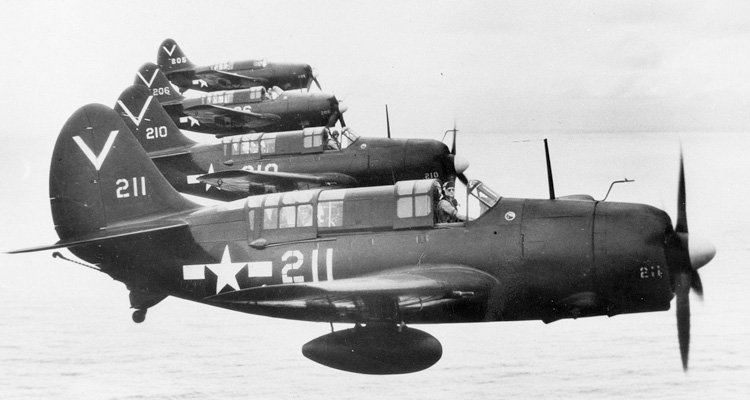
I was a Navy lieutenant and a dive-bomber pilot with Air Group 87, stationed aboard USS Ticonderoga (CV-14) with a complement of Grumman F6F Hellcat fighters, Grumman TBF torpedo planes and Curtiss SB2C Helldiver dive bombers. During the 9 p.m. briefing in our bombing squadron’s ready room, tension and speculation began to build as strike information came over the 2JG talker (the communications circuit) from flag plot, the tactical and navigational center.
The code names of the ships were established. Ticonderoga was to be Ginger Base. Then came the various frequencies for the strike leaders, the picket destroyers and air-sea rescue. Noting the information, we waited for the formal briefing by Lieutenant Lyndon McKee, the squadron’s air combat officer. He had so far remained in the background, not saying much.
‘Gentlemen,’ McKee finally said, clearing his throat, ‘Bombing 87’s target for tomorrow’s strike is the Japanese battleship-carrier Hyuga.’ He handed each of us packets of target overlay maps. He continued: ‘For your information, the Hyuga is one of the Ise-class ships, which has been converted to a combination battleship-carrier by the addition of a flight deck on her stern. As you study your overlays, you will note that this is a formidable target by reason of her own firepower as well as the fact that her position off the small island of Nasake Shima, just south of Kure, [Japan,] places her un-der the protection of numerous shore batteries on the coast. Also, there are guns on the hills to the east, north and west of her. So on your run-in, dive and retirement, expect to come under heavy anti-aircraft fire.’
Looking at the overlays, I recalled my 58 combat missions against airfield installations, supply depots and more gun emplacements than I wanted to remember. But this would be my first opportunity in my naval career to dive on a capital ship, and it would also be an excellent opportunity to become a casualty of war.
The bombing squadron’s skipper, Lt. Cmdr. Franz Kanaga, would lead the squadron in the first strike. I was designated as his section leader. My call sign was 3-307 Ginger. After the briefing, I went back to my stateroom, wrote a few letters and went to bed. But sleep was elusive.
At 4 a.m. the call, ‘General quarters, general quarters. All hands man your battle stations,’ came as a relief after the sleepless hours spent lying in the smothering darkness. The ready room was in chaos as everyone on the first strike got into flight gear, asked questions, made notations on their plotting boards and got last-minute weather data.
Conditions were not ideal. The weather was reported as marginal, and the task force had not reached its prearranged launch position. We were more than 100 miles short of the original proposed launch position, but the mission was going forward.
Finally the bomb-loading information came in from flag plot. Each Helldiver would be carrying a 1,000-pound, general-purpose bomb in the bomb bay, plus a 260-pound fragmentation bomb on one wing to partially compensate for the droppable wing tank (weighing about 680 pounds) on the other wing. We were cautioned that this unequal load might cause problems during takeoff. Then came the call over the 2JG talker, ‘Pilots, man your planes.’
Waddling out of the ready room in all my bulky gear, I paused on the walkway and looked down. I could see the blue-green water flashing by the hull and hear the sound of tractors on the deck as they rearranged the planes. The air was warm, and the sun was shining through patches of light, fluffy clouds.
Threading my way through the planes, I tried to find mine, No. 206. As usual the planes were mixed up, and we were not going to be able to take off in formation sequence. We would just have to reposition after join-up. The carrier’s stack blew out a shower of smoky cinders. The air was acid-tasting, stinging my eyes and burning my tongue.
My gunner, William ‘Tommy’ Thompson, met me at the plane. Together we checked the bombload, fuel tanks and armament. I climbed onto the wing, put my plotting board in its slot, threw a leg over the edge of the cockpit and climbed into my seat. I adjusted the seat height and moved the rudder pedals closer, so that I could really stand on them in a vertical dive. I cinched my shoulder straps one more time as the bull horn announced: ‘Stand by to start engine. Stand clear of propellers. Start the fighters on the catapults.’
The ship began to turn into the wind, the semaphore on the bridge went from red to green, and the order boomed out, ‘Launch aircraft.’ I looked at my watch. It was 7:24 a.m. The first of the fighters shot off the catapults and climbed up toward the sun. Launches continued at 15-second intervals.
My plane captain gave me the’start engine’ signal. I activated the starter switch and turned on the ignition, and the blades of the propeller slowly began to turn. There was a cough of white smoke, and the engine died. I tried it again. Ahead of me, the first of the Helldivers was moving into takeoff position.
A troubleshooter came back, jumped on the wing and yelled, ‘Hit her again!’ This time, with him pumping the throttle and me holding the starter switch down, the engine began to run–raggedly at first, then settling down to smooth revolutions. I throttled back to let the troubleshooter off the wing and then pushed the throttle up to 800 rpms to let the engine warm up.
The plane in front of me began to move forward. The deck handler turned to me next, motioning, with his hands over his head, for me to taxi forward. I came out of my slot, unfolded the wings at his signal, shoved the wing locking handle into the ‘lock’ position and set the flaps down 20 degrees.
Lieutenant Al Matteson was the first off. His plane got to the bow, but his wing loading was unbalanced. He started going into a tight right turn and the cameras began rolling. Momentarily flight operations were secured; the semaphore on the bridge went to red.
Matteson’s plane hit the water hard, and the Helldiver just disintegrated. I saw only one person getting out of the crash debris. The plane-guard destroyer was ordered to pick up the survivor. The semaphore on the bridge went back to green, and the order of ‘launch aircraft’ proceeded as if nothing had happened. No more than 25 seconds had elapsed. All I thought was, ‘Hell, we’ve lost our first plane for today’s strike, and we haven’t even completed the launch.’
The next plane, following Matteson, got a little more deck run, but he, too, dropped off the bow, turning in a right arc. But moments later, he was climbing skyward.
I was next in line for takeoff, and Fly One, the officer in charge of launching the planes, looked at me. I nodded my head, indicating that I was ready for takeoff. He looked forward to see that the deck was clear and started winding up his checkered flag. I gave the engine full throttle. Pointing forward, he dropped to the deck on one knee. I was cleared for takeoff.
Releasing the brakes, I started lumbering down the deck. The controls were sluggish. I passed the forward gun turrets and then there was no more deck, just air and water. I went straight off, not trying to make the usual turn to clear my slipstream from the deck for the next plane.
The plane began to tilt hard to starboard (the side that had the external wing tank), and it took both hands on the stick to keep the Helldiver close to level. The plane kept dropping lower, and as much as I wanted to pull up my wheels, it was as if I were frozen in time. I could not take the pressure off the stick.
The plane settled toward the water, but the air nearer the water had a little more compression, and the prop finally began to bite its way through the air. The pressure on the stick eased, and I jerked up the wheels, throttled back, reduced pitch and rpms, switched to the auxiliary wing tank and started buckling on my chute. I was airborne.
I cut inside the traffic pattern and joined up with Lieutenant Kanaga, who had taken off and was trying to slow down his plane while he waited for the others to take off. Lieutenant Vaughn was on his starboard, and I had Lieutenant Pucci on my port side as our section closed in. Our four-plane section was soon joined by Lieutenant Johnson’s four planes and Lieutenant Hearn’s three-plane section. Hearn was short one plane in his section, Lieutenant Matteson’s.
Our formation was strung out loosely as we headed toward the target area, and we were continually dodging in and out of the clouds. Everywhere I looked I could see planes. The attack today was an all-out effort against any target of opportunity, whether on land, in the air or on the sea.
Our flight was cruising at about 16,000 feet, passing over the island of Shikoku, when the first ‘OK, here we go!’ came over the radio. I could see planes in the distance starting to slant down into their dive-bombing runs and the black puffs of smoke as anti-aircraft shells started exploding. I remembered the gun count on Hyuga and scrunched down in my seat a little more.
Closing formation, I watched as the torpedo squadron slid off and started down. The plan was for the bombers to dive-bomb the battleship-carrier–taking out her guns and possibly sinking her–while the torpedo planes made glide-bombing runs, since the water was too shallow for a torpedo attack. The fighters were to give us cover during the run-in and departure from the target area.
Crossing over the Hiihama airfield, the skipper started a swinging turn to the northwest so that we could break off after the attack and retire to the southwest. After pulling out, we still had a lot of land and anti-aircraft batteries to fly over. The actual attack on Hyuga was just one of the hazards to be faced during this mission.
An anti-aircraft shell exploded off my port wing with a thunderlike clap. The round was a little wide of our position, but it was evident that the gunners had our range.
I split off from the skipper, Pucci closing in tight on me. I didn’t want to be bunched up with other planes in case of a direct hit on anyone in our section. With our bombloads, one hit could blow us all out of the air. I still had not sighted the target, even when I saw the skipper nose over and Black, his gunner, open the hatch.
I felt a blast of air as Tommy opened our hatch. I opened my bomb-bay doors, checked the bomb-arming switch one more time, turned on my cannon switches and loaded the first shell into the chamber. I waited for the signal to dive.
The air was now crackling with bursts of anti-aircraft fire. The gunners were zeroing in on our altitude. The skipper wagged his wings, and I saw a flash of red as his dive flaps began to open. ‘Step on it, damn it!’ I muttered as Vaughn hesitated before cracking his flaps. Flak was now bursting all around us.
Vaughn started down. I popped my flaps and rammed the stick forward, hard. The plane stood on its nose, throwing me against my seat belt. I held onto the instrument cowl with my left hand to give me more leverage to hold the stick forward.
Now, for the first time, I got a good look at the target. The skipper had put us right on top of Hyuga. We were diving bow to stern, but I could hardly see the ship. She was wreathed in a mass of smoke from all her guns firing at our diving planes.
I could see muzzle flashes from every part of the ship and watched the tracers from the shells as they arced up. The heavy guns’ projectiles looked like fiery red baseballs. It appeared to me as if every one of them was headed directly at me.
‘This is ridiculous,’ I told myself. At that instant I closed my dive flaps, deciding not only to dive clean but to add throttle besides. Anything to get this difficult dive over with, to give the anti-aircraft gunners as fast and as small a target as possible.
The altimeter was unwinding furiously. The entire ship filled my gunsight. I kept diving down, wanting to be sure that there was no way my bomb could miss making a direct hit on Hyuga.
Suddenly, coming out from under me, I saw Vaughn. His plane kept going straight down and crashed alongside Hyuga, disappearing into a geyser of white sea foam. One minute the plane was intact, the next moment it was gone. His bomb did not go off, if it was still aboard.
I jabbed my bomb release button and felt the bomb leave the bomb bay. I snapped the stick back. The windshield fogged over. I momentarily blacked out, and I felt the kick from my bomb blast; I had pulled out of the dive very low. Closing my bomb bay doors I called to Tommy: ‘My God, did you see that? Mr. Vaughn went straight in. He didn’t even try to pull out!’
‘No, sir, I didn’t see it,’ he replied.
Something made me aware of the sound of my engine. Looking at the gauges, I could see that the propeller rpms were dropping–1,900, then 1,800, now 1,700. Something was wrong. ‘Tommy, did we take a hit somewhere?’ I asked. ‘We’re losing rpms.’
‘No, I don’t see anything, and I didn’t feel us take a hit,’ came the response.
Suddenly I thought to check the propeller circuit breakers. One had popped out, probably from the excessive G forces I had pulled during the dive. I punched it back in and saw the rpms climb back to 2,100.
Banking around and looking back, I could see what appeared to be multiple columns of smoke rising from the battleship-carrier. Our attack had hit her square on. Meanwhile, all around us, planes were streaking for the rendezvous position. Distress calls began coming in over the strike frequency.
The rendezvous point was in the general area to the east of Yashiro Jima, and there I found the remnants of our flight. I pulled up alongside the skipper and saw that his plane had a huge hole in the port wing and one in the fuselage. He was leaking hydraulic fluid, and his radio was gone. Fortunately, neither he nor Black had been seriously wounded. Tommy and Black started communicating with the blinker, and control was transferred to Lieutenant Johnson, the second division leader, who still had radio communication with the task force. Two other planes joined up, showing no battle damage. The rest of the squadron’s planes were not accounted for.
The flight back to the picket ships was a slow, torturous affair because the main elements were not able to go any faster than the slowest plane. When planes could no longer fly or when they ran out of fuel, they were simply ditched.
Those of us who were still airborne checked in with the picket ships and got our vector to the task force. Looking at my watch, I noted that I had been in the air for a little over four hours. When we arrived at the task force, I looked for Ticonderoga but could not locate her. In the meantime, the skipper and the other damaged planes made emergency landings on any of the ships that had ready decks.
To the southeast, I noticed another group of ships in a rain squall and went racing in that direction. After a 15-minute search, I found Task Force 38.3 and Ticonderoga. Getting into the landing pattern, I got a ‘Charlie’ (approval to land) just in time to see Lt. j.g. Wheeler catch a barrier, tear it up and chew up the plane in front of him, which had just landed. I circled twice more but got a wave off each time because of the ship’s fouled deck.
It was now raining hard, and visibility was poor. Planes were zooming around, crisscrossing the landing flight pattern in their frantic search for any ship with a ready deck.
With a growing sense of frustration, I picked up my mike and called Ticonderoga: ‘Ginger Base. This is 3-307 Ginger. Queen 10, Queen 10,’ indicating that I had only about 10 gallons of fuel left.
‘I will relay your message. Stand by Ginger 3-307,’ came the reassuring, calm voice from the ship.
I made another pass at the deck, but the barrier was still torn up, so I banked off to try to find another carrier with a ready deck that would take me aboard. I called Randolph for permission to land but was advised that the landing signal officer was not at the ramp and was not available.
Other ships had ready decks but would still not take me aboard. It was pouring rain now, and over the air came the terse message: ‘This is Ginger Base calling all Ginger planes. Circle above the ship. We are changing course, trying to get out of this rain.’
‘Well, that does it,’ I told Tommy over the intercom. ‘We don’t have enough gas to circle, and I’m not going down into that mess again. I’d rather take my chances on a water landing than take a chance on a midair collision.’ I radioed to Ticonderoga: ‘Ginger Base. This is 3-307 Ginger. I’m ditching.’
‘Roger, Ginger 3-307. You are ditching. I will relay your message,’ came the reply.
With my fuel gauges now reading zero, I picked out a destroyer in the outer screen and told Tommy, ‘Get out your Aldis lamp and send the destroyer an SOS, then get ready for ditching.’
I dipped my starboard wing so Tommy could get a clear message to the bridge of the destroyer and then called back to him, ‘This is it, get ready for landing.’
I cut the throttle and put down full landing flaps. I was paralleling the course of the destroyer, but I had too much speed. Instead of dropping down alongside the ship, I was almost three-quarters of a mile ahead of the ship when the plane slammed into the ocean. For a moment I was in a state of panic. The plane tilted up on its nose but still had forward momentum. Water was pouring into the cockpit as I struggled to release my safety belt.
Then, like a cork bobbing up out of the depths, the plane returned to the surface and floated on top of the water. Snapping off my safety belt and shoulder harness, I jumped out onto the wing.
Tommy, who was already out on the wing, asked if I wanted to inflate the life raft. ‘No,’ I answered, looking at the jagged edge of the landing flaps. ‘Let’s go out on the edge of the wing and wait until the plane sinks out from under us, and we’ll cast off from there so that we won’t inadvertently tear a hole in the raft.’
The plane was now settling low in the water. The blades of the propeller were bent back over the cowling. Tommy and I walked to the tip of the wing, inflated the raft and waited until the plane started to sink out from under us. Then, we simply stepped into the raft as the plane went under, nose first. The last thing I saw was the huge, rounded tail, the white triangle insignia and the number, 206.
A group of sailors at the destroyer’s bow threw us a line, but neither of us could hang onto it. We had better luck with a line thrown to us from amidships. Catching it, I was almost pulled out of the raft, but we finally managed to secure the line.
A cargo net was thrown over the side so that we could climb to the deck, but neither of us had the strength left to make the climb. Two sailors quickly climbed over the railing and down the net to help us on board. Then, with sailors quickly pulling up the cargo net, USS Chauncey (DD-667) resumed her position in the screen.
Aboard Chauncey, we met the skipper and then were taken below, where we were given a cursory examination and found to have suffered no injuries. My shoulders were hurting where the straps had cut into me when we hit the water. A radioman came to get our names and other information so he could notify the squadron and our ship that we had been rescued. Chauncey‘s log indicates that a total of 2 minutes 45 seconds had lapsed from the time we crashed until we were hauled aboard.
Two days later, Tommy and I were high-lined (transported between ships on a bowswain’s chair) to Ticonderoga for debriefing. It was then that we found out that Hyuga had indeed been sent to the bottom, although her decks were awash and she was still sitting upright because her anchorage was so shallow.
Later, a survey team inspected the bombed hulk and noted that, because of all of the holes, the battleship-carrier had ‘lost buoyancy…and sunk.’ Only five of the original 13 bomber and torpedo planes that went to the target made it back to Ticonderoga. Two pilots and one crewman were lost.
The cost had been high, but the results had been spectacular. The Navy Cross was awarded to each pilot who had made a confirmed direct hit on the ship. I had the honor to be among them.
This article was written by H. Paul Brehm and originally published in the July 1999 issue of Aviation History.
For more great articles subscribe to Aviation History magazine today!