
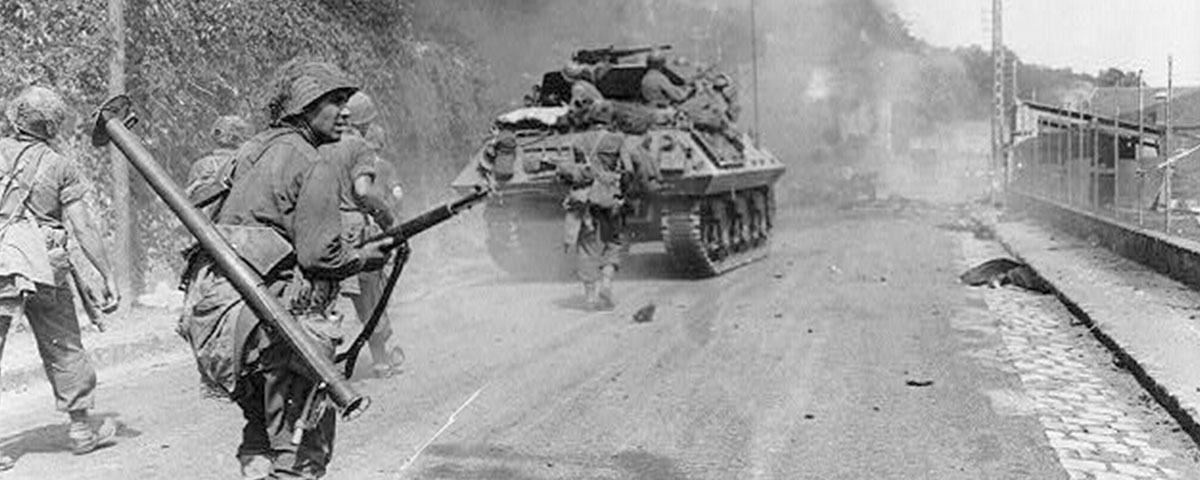
The American soldiers hemmed in on the east bank of the Rhine River were desperately protecting their tenuous Remagen bridgehead, resisting repeated German attempts to infiltrate their perimeter. Fighting throughout the night, sometimes hand to hand, the men doggedly held their position, firing flares, hurling grenades and shooting wildly at shadowy figures as the enemy counterattacked repeatedly up the deep-cut draws and forested ridges above the town of Erpel, directly across the Rhine from Remagen.
For the men of K Company, 394th Infantry Regiment, 99th Infantry Division, the situation was dire enough on the night of March 13, 1945, for them to call in friendly artillery on their positions in an effort to shake off their tormentors. Almost immediately, fire from American 155mm and 105mm batteries on the west bank of the river lit the blackened sky like distant lightning, the shells’ thunderous concussions reverberating up the steep ravines to the ridgeline where K Company was dug in.
The frantic barrage succeeded in driving the Germans back into the dark woods, their dead and wounded comrades left behind. For the weary Americans, though, the respite proved to be only temporary, as daylight soon brought renewed enemy artillery and sniper fire. The GIs knew that when the sun went down again they would face another terrifying night on the line.
In the late afternoon, however, the men heard a roar of gunfire, indicating that a sharp engagement was being fought on the wooded hillside below their position. When the firing finally died down, the Americans feared the worst, and the sound of men approaching only increased their apprehension. As a ragged line of soldiers began emerging from the woods, ducking under the low branches of the firs and hardwoods, the men of K Company hunkered down in their foxholes, gripping their weapons and straining to get a good look. To their relief, they could soon see that the advancing men were clad in olive drab and wore American pot-like helmets. However, as the approaching troops came closer, the GIs in K Company saw that their faces were brown and seemed to merge with the mud color of their helmets. Their relief was quickly displaced by shock.
What had sent such angst through the combat-weary men was something no American soldier had seen for more than 150 years. Coming to their aid were Black Americans, and—even more startling—these Black soldiers were there not simply to relieve them but to join them in battle.
The last time Blacks officially served shoulder to shoulder with whites in an American infantry unit, George Washington was in command of the Continental Army during the Revolutionary War.
Now, in 1945, on a ridge next to the Rhine, a line had been crossed that would have far-reaching implications in America’s long struggle with the pernicious racism that permeated its society.
The white GIs of Company K, most hailing from the Jim Crow South, experienced a transformation that day. No longer were these Black men to be objects of racial derision; rather, they were comrades putting their lives on the line just like any white soldier. With the arrival that month of platoons of Black GIs to all-white infantry and armored divisions all along the Western Front, thousands of white soldiers would similarly have their long-held racial prejudices challenged.
In World War II, the United States opposed governments that embraced fascism and all its deluded racial theories, yet when the conflict started the Army resisted the rising chorus of Black—and some white—citizens who were demanding that the military be integrated. Unfortunately for those advocates, many generals shared the bias of the majority of Americans and were adamant that it was not the Army’s duty to engage in a social experiment such as integration. Not only were they concerned about whether Blacks would make capable soldiers, but they also believed that forcing such a controversial policy down the throats of white recruits might severely cripple the effectiveness of the Army they were frantically trying to build.
As far as the average American was concerned, World War II was a white man’s war. In the hundreds of photographs, films and histories that have documented the conflict, Blacks are seldom depicted in heroic roles. Even the comics of the era leave out Blacks. Bill Mauldin’s famed cartoon characters Willie and Joe were white. Blacks, it seemed, were merely adjuncts to victory, primarily occupying the unglamorous jobs of truck driver and stevedore.
Prior to the Revolutionary War, militias in the colonies frequently included Black men in the ranks. During the French and Indian War, men of all ages and races banded together to protect their towns and villages against marauding Indians. As soon as the War for Independence began, Blacks rushed to the colors with as much devotion to the cause as their white brethren. As many as 5,000 Blacks fleshed out the ranks of the Continental Army. Black militiamen fought at Lexington and Concord. Blacks also served with Ethan Allen’s troops in capturing Fort Ticonderoga, and they served in Colonel John Glover’s Marblehead Regiment, which rescued Washington’s defeated army from Long Island in 1776 by ferrying the defeated Continentals across the East River from Brooklyn to Manhattan.
The presence of armed Blacks in the Continental Army, however, was troublesome for many in a new nation that still supported slavery. Even during the war, Washington passed orders that forced Blacks from the ranks. With independence won, their role in the Revolution was quickly forgotten.
During the Civil War, Blacks again flocked to recruiting stations to join Union regiments but were turned away. It wasn’t until 1863, as casualties were becoming increasingly difficult to replace, that they were permitted to serve in one of the 163 Black regiments raised. Some 178,985 African Americans donned Union blue during the war.
With the Union reunited in 1865, Congress authorized the creation of six Black regiments. Made up largely of Civil War veterans, the 9th and 10th Cavalry and 38th, 39th, 40th and 41st (later consolidated into the 24th and 25th Infantry regiments) were sent to the frontier, where they performed well. The men of these regiments were dubbed ‘buffalo soldiers. The Black units would also serve in the Spanish-American War.
Despite this impressive service record, the Army continued to enforce its strict segregationist policies. During World War I, the vast majority of the 367,410 Blacks drafted were assigned to service units or used as laborers. The few who saw action were in the all-Black 92nd and 93rd divisions. The 92nd served under American command and was reported to have performed poorly. Meanwhile the 93rd’s four regiments served separately under French commanders, who offered high praise for their contributions.
When the United States entered World War II, most Americans expected Blacks to perform the same auxiliary roles. Of an estimated 922,965 Blacks who donned olive drab, the majority toiled away in segregated service units where their work went largely unrecognized. These forgotten men built airfields, cleared mines, unloaded ships, maintained roads and rail lines, served as medics and drove the trucks that supplied the armies.
One of few accolades they received was for their work in providing the bulk of the drivers for the Red Ball Express, the famed military trucking line that was established in late August 1944 to rush critical materiel from supply bases in Normandy to the front. The only Blacks in the Army Air Forces, serving in the 332nd Fighter Group, were escorting bombers of the Fifteenth Air Force on missions over southern and eastern Europe.
As unbreachable as the color barrier seemed to be, however, the realities of combat in the ETO eventually produced the first cracks in the walls separating the races. In the months after D-Day, casualties mounted at a terrifying rate. Six months after the landings, losses among U.S. forces in Europe had risen to nearly 350,000 troops killed, wounded or missing. The Battle of the Bulge, which began on December 16, 1944, inflicted an additional 80,000 casualties. The problem that Allied Supreme Commander General Dwight D. Eisenhower faced in January 1945 as he planned for the final offensive into Germany was that he desperately needed riflemen—and he did not care where they came from or what color they were.
Back in the States, training time for recruits was shortened and noncombat units were culled for anyone who could be spared to hold a rifle. Next it was the turn of Army Specialized Training personnel and aviation cadets, who were wrenched from the comfort and security of their classrooms and taught the nomenclature of the M-1 rifle and the intricacies of drill. Even these measures were not enough, and when the demand for men could not be met, the Army sent out word that it would accept volunteers from Black units.
The original proposal came from Lt. Gen. John C.H. Lee. As the Service of Supply (SOS) commander in the European theater, he was in charge of many of the African-American units and was more familiar than most with the caliber of the men. Even with the pressing need for troops, however, Lee’s suggestion hit like a bombshell. Nothing could have been more drastic than making combat soldiers of substantial numbers of Black men, historian Russell Weigley would write years later.
Lee saw the hundreds of thousands of Black service troops under his command as an untapped resource, and his initial proposal called for the Army to take 2,000 African Americans and insert them individually into the ranks of white infantry units. Two thousand men represented the largest number that could be trained at one time at the Ground Forces Reinforcement Center (GFRC) in northern France. More could be trained later.
Old attitudes die hard, however, and despite the pressing need for manpower, the European high command rejected Lee’s proposal to treat Blacks as individual replacements, and as a half-measure instead opted to integrate by platoons.
Even this half-hearted breach of the color line was not enough to prevent some 2,000 Blacks—many of whom were long-serving NCOs willing to give up their stripes–to immediately volunteer for combat duty. With a stroke of the pen, Eisenhower soon had enough men to form 53 all-Black rifle platoons that after training would be assigned as the 5th Platoon to all-white infantry companies. By March, 37 of these platoons were ready for combat, and a number were formed into all-Black company-sized units and assigned to the 12th and 14th Armored divisions.
Even though many of the volunteers were soldiers of long service and considerable experience, they would still be led into combat by white officers. As was expected, many of these shavetails were unhappy with their new assignments. First Lieutenant Richard Ralston, a combat veteran with the 99th Division, was assigned to command the 5th Platoon of K Company, and he remembered the disdain of many white lieutenants upon learning they were to command Black troops.
Ralston didn’t mind his new assignment, but when he arrived at the GFRC, he immediately assessed that his men were not properly trained for combat. A combat veteran, Ralston also recognized the need to instill trust in the men. “There was a learning process on both sides,” he remembered, “They were pretty ginger about me because I was white, but once they were convinced that I was talking serious stuff and wasn’t racially prejudiced, they got down in the dirt and did what they had to do. They knew then I was talking survival.”
Each volunteer had his own impression of the infantry training. “It was a lot of run and jump in small unit tactics in the mud and snow,” recalled Waymon Ransom, a volunteer infantryman and a former engineer. “But it wasn’t any worse than doing construction work in the mud and snow back in the engineers.”
“We kept training in earnest,” Ralston remembered, “I exaggerated considerably about how many of them were going to die to try and scare them out of the unit. I only wanted the best and bravest. But nobody quit. They were pretty darned good.”
As the training progressed, the men impressed Ralston. “They were oddly superior to whites [as soldiers] in some respects,” he recalled. “They weren’t book smart; they were street smart, and they were cunning.”
Once training was complete, the 5th Platoon of K Company was assigned to the 394th Regiment, 99th Infantry Division. The men broke camp in France and, after a two-day trip by train and truck, they crossed the Rhine at Remagen on March 12, 1945. The next day they reinforced K Company and went into combat in the hills above the bridge around Erpel.
After some bitter fighting to expand the bridgehead, where the reinforcements suffered their first killed and wounded, they moved north with the rest of their outfit to join in the massive Allied envelopment of the Ruhr industrial area, which netted hundreds of thousands of German prisoners. Their next assignment was to join Lt. Gen. George S. Patton’s Third Army in its relentless march into southern Germany. The 5th wound up in Austria at war’s end.
Other 5th Platoons also were put to the test in combat and were praised for their performance. Brigadier General Edwin F. Parker, commander of the 78th Infantry Division, whose Black platoons also fought at Remagen, asked for more Black soldiers. In addition, the 104th Infantry Division filed glowing reports about these unique units. “Morale: Excellent. Manner of performance: Superior. Men are very eager to close with the enemy and to destroy him. Strict attention to duty, aggressiveness, common sense and judgment under fire has won the admiration of all the men in the country,” a division report stated.
The redoubtable 1st Infantry Division, the Big Red One, was also impressed with its Black riflemen. One of the division’s reports noted, “White platoons like to fight beside them because they laid a large volume of fire on the enemy positions.”
In the 99th Division, the 5th of K’s sister Black platoon in the 393rd Regiment was considered by its white commanders as one of the best platoons in the regiment.
Not surprisingly, the Black platoons had their share of heroes. One was Sergeant Edward A. Carter Jr. of Company D, 56th Armored Infantry Battalion, 12th Armored Division, who led a four-man assault group against a German position. Two of the men were killed and one wounded, but Carter continued on and was wounded five times. When a band of Germans tried to capture him, he killed six of them, captured two and returned them and his wounded comrade back to American lines. For his bravery, Carter received the Distinguished Service Cross. Five decades later, he was awarded a posthumous Medal of Honor, and was reinterred in Arlington National Cemetery.
By war’s end, Black platoons had served in 10 infantry and armored divisions in the ETO. The 1st, 8th, 9th, 69th, 78th, 99th, 104th and 106th Infantry divisions and the 12th and 14th Armored divisions had all benefited from the bravery and dedication of their African-American comrades in arms. They were veterans who could be proud of their Combat Infantryman Badges. Ralston’s praise for his men echoed among most commanders on the Western Front. Looking back on the performance of his platoon, the lieutenant remembered that the men of the 5th of K performed without fear and carried out instructions with zest and efficiency.
Curious to see how its experiment had been working, in the summer of 1945 the Army conducted a study of the Black platoons and interviewed some 250 officers and 1,700 enlisted men who had fought with or alongside the Black soldiers. A chief finding was that the colored soldiers performed well in combat (84 percent of the officers say the colored troops did “very well,” and the remainder says “fairly well.” In no instance was the performance rated as poor.)
“They were the best platoon in the regiment,” one company commander said. “I wish I could get a presidential citation for them. They are very aggressive as fighters–really good in woods and at close-quarters work.” Said another officer, “The only trouble is getting them to stop; they just keep pushing.”
The sterling performance of the Black volunteers in the ultimate test for any soldier—service in a rifle company in combat—did not end the reprehensible policy of segregation. Shamefully, the moment the shooting stopped, the Army sent the combat veterans back to their service units and anonymity.
Wilford Strange, sporting a Combat Infantryman Badge earned while serving with the 69th Division, found himself and his comrades denied entry to Army entertainment centers in occupied Germany. When members of his unit attempted to visit a recreation hall near Leipzig, they were told by a sentry, “No n——s allowed here.”
On hearing the news, their white company commander rushed out to the former country estate and demanded that his men be allowed to enter. “Know who I am?” the captain told the major in charge of the recreation center. “I’m Captain Herbert Pickett, commanding officer of K Company. We fought for this town 13 days ago. We took it and God damn it, if we have to we’ll take it again. When my men come in here, you treat them with respect.” Pickett then turned to his troops: “You men go in there. I’m a Southerner, but you are in the Army and I’ll go to hell with you.”
Such instances were few and far between. Soon after V-E Day, the Black platoons were ordered disbanded, and the members returned to their old units or to other all-Black service units for shipment home. Many of the men, who naturally believed they had earned the right to be treated as equals, rebelled and refused to follow orders. They demanded to be returned to the United States with their parent combat divisions.
James Strawder, who had served with the 99th Division, expressed the feeling of many of his fellow African-American combat vets, saying, “We expected to gain our dignity as human beings in this country when we put our blood on the line in combat.”
Strawder’s 5th Platoon was performing occupation duty in Germany. “All of a sudden we were told to pack up and they put us on trucks and started moving us out,” he said. “I thought the whole company was going, but I found out it was nobody but us Blacks. We were being separated out of the company. I cussed and raised Cain. I was having a rage, I was so upset. I said, I knew it. All this mess was for nothing. How could they be so indifferent as to kick us out of our infantry divisions?”
Believing that it was a misguided order coming out of the division, the men of the 5th of K, 394th, sent a delegation to Frankfurt hoping to speak directly to Eisenhower and ask that the separation orders be rescinded. Strange’s platoon members armed themselves, set up a perimeter around their barracks and threatened armed rebellion if MPs attempted to cross the line and force them to return to their segregated units. It was all to no avail. They eventually learned that the order had come directly from Supreme Headquarters Allied Expeditionary Forces (SHAEF) and applied to all the Black platoons.
Strawder and his platoon eventually found themselves in a cigarette camp in France, where several hundred separated Black veterans threatened open mutiny when they were ordered to take up picks and shovels and build barracks for white servicemen being processed for home. Somebody said, “We’re not doing anything,” Strawder recalled. So we didn’t do anything. They called in the MPs and they threatened to put us in the guardhouse, but they couldn’t discipline us. Strawder realized how serious the situation was, noting the number of pistols and knives his fellow volunteers had in their possession.
Having issued such an unjust order, SHAEF realized too late that it now faced a considerable problem. To placate these vets, the Army called in General Benjamin O. Davis, America’s first Black general, who calmed the situation and promised that the volunteers would return home with the 69th Division. But for many 5th Platoon men, the promise came too late and they were sent home with different units. Some speculated that the Army separated them from their parent divisions because most of these outfits were slated for duty in the Pacific, where integration of combat units had not yet been tested and the commanders there did not want racial strife to affect combat efficiency in the planned invasion of Japan.
With Black soldiers stripped from the white outfits, the remarkable combat achievements of thousands of brave Black infantrymen were left out of nearly every tale told of World War II. Although they had been forced back into the shadows, the men who volunteered at the sharp end did not forget.
It was not until 1948 that President Harry S. Truman forced the end of a shameful policy that was without merit, ordering all branches of the military desegregated. Volunteer Arthur Holmes believed the integration of the Black platoons was a turning point. The platoons had a lot to do with the later integration of the Army in 1948. “I never believed they would put us Black boys up there with white boys. And I didn’t believe it until we were actually being shot at. I thought they would put us back with the quartermaster working in supply.”
Even with Truman’s landmark legislation, it again took the exigencies of combat to complete the job. Most units were still segregated when the Korean War broke out in 1950, and it was not until the Army was again faced with a critical shortage of replacements that the president’s order went into full effect.
While the integration of the Black platoons in 1945 was a temporary measure that many in the Army believed had been forced on them, some saw great significance in the performance of those first Black platoons. General Davis recognized the importance of what had occurred, saying, “The decision from the High Command [to integrate the Black platoons] is the greatest since enactment of the Constitutional amendments following the emancipation.”
Bruce Wright, a volunteer infantryman who served with the 1st Infantry Division and later rose to become a justice on the New York Supreme Court, believed that the new policy opened a door that could never again be closed: “I was doing something for a dream. I was living to see partial integration coming to be a matter of fact.”