The last night of the year 1862 had been a restless one for the president. He went to bed after 12 and rose before dawn. At midnight all around the crowded city soldiers and civilians fired their guns over the grave of the departed year. The New Year was welcomed by the prayers and thanksgiving of preachers, the fanfare of bands, ‘the boisterous laugh of the gay and thoughtless,’ the whirl of dancers, ‘the flowing bumpers of worshippers at the shrine of Bacchus, and the rattle of musketry by ever hopeful and happy `Young America,” the Morning Chronicle observed. The merrymaking that flowed up Pennsylvania Avenue and 15th Street past the Willard Hotel, and down Vermont Avenue past St. John’s Church on Lafayette Square, went on in the light of the swelling moon. But it stopped at the gates of the president’s house.
The fireworks thundered all night. Then, as the sun rose, the streets around the White House began to fill with citizens who had come from far and wide to greet Mr. Lincoln at the president’s customary New Year’s levee.
Lincoln did not drink, and in any case this was not a night for him to celebrate. Military dispatches from Murfreesboro, Tenn., were appalling. On December 31 the Rebels, led by General Braxton Bragg, had attacked William Starke Rosecrans’ Army of the Cumberland. ‘Our entire line suffered terribly this morning,’ said telegraph superintendent Colonel Anson Stager’s telegram. ‘Four regiments of regulars lost half of their men, and all of their commanding officers….
Majors Rosengarten and Ward were killed, Generals Stanley, Rousseau and Palmer were wounded….The Fifteenth Wisconsin lost seven captains. General Negley’s artillery is still mowing the rebels in the center.’ In his third dispatch Stager admitted, ‘The greatest carnage of the war has occurred.’ Soon the president, and the country, would learn that there were 24,000 casualties at Murfreesboro. Two weeks earlier at Fredericksburg, 18,000 soldiers had been killed and wounded, and the president had said, ‘If there is a worse place than Hell, I am in it.’
Walt Whitman’s brother George, a first lieutenant under Maj. Gen. Ambrose Burnside’s command, survived the Union disaster at Fredericksburg in December, advancing over a narrow turf the Rebels had so perfectly enfiladed that one gunner remarked, ‘A chicken could not live in that field when we opened on it.’ Walt called Burnside’s charge ‘the most complete piece of mismanagement perhaps ever known in the earth’s wars.’ Public confidence in the commander in chief collapsed, and his cabinet was at loggerheads, so that he was able to hold it together only by the most ingenious diplomacy.
‘I am heartsick,’ lamented Senator William Pitt Fessendon of Maine, ‘when I think of the mismanagement of our army….There never was such a shambling, half-and-half set of incapables collected in one government before or since the world began.’ New York lawyer George Templeton Strong wrote in his famous diary: ‘Even Lincoln himself has gone down at last. Nobody believes in him any more.’
The tempest in the cabinet stirred by Secretary of the Treasury Salmon Chase’s jealousy and hatred of Secretary of State William H. Seward briefly distracted the public and the press from the slaughter at Fredericksburg. Radical Republican senators called for Seward to resign; as the president defended the secretary of state, Seward’s and Chase’s reciprocal resignations descended into comic opera. Lincoln’s ingenuity in resolving the conflict in his official family ‘to entire satisfaction’ — in his words — impressed the whole Republican Party, and bought him some time to win back the confidence of the American people.
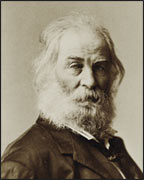 |
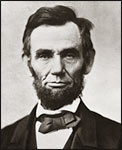
| Searching for his brother among the casualties of Fredericksburg, Walt Whitman (above, photographed in 1872) was moved to go to Washington and serve as a volunteer nurse. While there, he became captivated by the presence of Abraham Lincoln (Library of Congress). |
 |
But now there was the carnage at Murfreesboro, known at the moment only to the men fighting and dying there, to Secretary of War Edwin M. Stanton, to General-in-Chief Henry Halleck and to Lincoln. All evening, December 31, Lincoln had been working on the final draft of his Emancipation Proclamation, which had been the subject of a cabinet meeting that same morning at 10, when he presented the document for final approval. The changes suggested by Chase and others were slight. The major disagreements had been resolved by September 22, when Lincoln announced that the emancipation of slaves would be effective January 1, 1863. But the president had to write a fair copy of the document during the night and early morning of New Year’s Day.
Lincoln wrote slowly and painstakingly, with little facility in his fingers and wrist. An inkblot or a misspelled word caused him to discard the paper and begin again. The pistol cracks and rifle volleys outside his window mocked the shots fired in fury and terror a thousand miles away in Tennessee. And for every shot that hit its mark, a young soldier lost a life or a limb. It was not a night conducive to sleep or concentration. The very document under hand seemed to waver and tremble, disturbed by the sounds of gunfire.
Horace Greeley, Republican radicals and abolitionists had been begging Lincoln to free the slaves for as long as he had been in office. As much as he wished to oblige them and suit his own conscience, he had to wait for a military victory, an impression of superiority in the war, if the proclamation were not to seem an act of desperation. In September the Battle of Antietam — an ambiguous victory — had provided the occasion for Lincoln to act. But since then nothing had gone right. The London Times called emancipation ‘the wretched makeshift of a pettifogging lawyer’ who had stooped to ‘the execrable expedient of a servile insurrection.’ A bloody defeat in Tennessee would make freeing the slaves appear, more than ever, a desperate act rather than a conscientious change in policy.
Lincoln sat in a large armchair, his legs crossed, writing beneath the glass-globed jets of a chandelier, at a desk between two high windows in his office. The silk braid of a bell cord hung to the right of the desk. A fire was burning on the hearth with its high brass fender and andirons. The chamber Lincoln called his’shop’ took up the southeast corner of the second floor. It was large enough to accommodate, on one wall, a sofa flanked by matching button-and-roll armchairs, and across the room the long oak table where the cabinet met. Above the Victorian marble mantelpiece a portrait of Andrew Jackson overlooked the meeting table toward the military maps hanging on the opposite wall: Maryland, Virginia, Tennessee, Georgia. The table, desks, chairs, the slant-top escritoire with its pigeonholes and bookshelves in the southeast corner, all were as cluttered as in the Springfield office of Lincoln and Herndon, although here the maids swept and dusted. There was plenty of room to pace.
He could not stop thinking about the woman who had come to call on him the day before: ‘Yesterday, a piteous appeal was made to me by an old lady of genteel appearance, saying she had, with what she thought sufficient assurance she would not be disturbed by the government, fitted up the two South Divisions of the old `Duff Green’ building in order to take boarders….’ The woman might be the same age as his stepmother Sarah, the only member of that family he ever really loved after his sister died. He made a long pilgrimage from Springfield to Farmington to visit Sarah weeks before his inauguration, and the parting had been difficult, tearful.
Returning to the proclamation, the president wrote, ‘And upon this act, sincerely believed to be an act of justice, warranted by the Constitution, upon military necessity, I invoke the considerate judgment of mankind, and the gracious favor of Almighty God.’ He was finished. He pulled the bell cord next to his desk to summon a courier, who would carry the manuscript to the secretary of state’s office. There William Seward would review the document and have it copied for the press before midday, when both men would sign it. A clerk would pen the formal close, ‘In witness whereof, etc.,’ while Lincoln had his breakfast: one egg and a cup of coffee.
When he had dressed for the formal reception, Lincoln went to fetch Mary. She wore a black velvet dress with lozenge trimming at the waist, diamond earrings and necklace, and a black shawl around her head. This would be her first public reception since the burial of their 11-year-old son Willie, who had died of typhus in February 1862. The Lincolns were racked by guilt at the thought that the foul air of the canal that flowed behind the White House had killed the boy. Of all their sons (Robert, Edward, Willie and Tad) Willie had been the favorite, and Mary had not recovered from the shock. She took comfort in the company of spirit mediums, whose sances held in the darkened Red Room brought her in touch with Willie’s ghost. Lincoln was concerned about his wife this morning, doubting she could hold up under the pressure of receiving a thousand visitors, who began arriving at 9:30.
The gorgeous parade of the diplomats came first, ambassadors and their wives from India, Japan, Spain and elsewhere in their colorful costumes and headdresses: red and blue saris with gold thread, fiery kimonos, the fez, the veil, the mantilla. The distinguished representatives of foreign courts, in their carriages, drove rapidly up the semicircular drive, alighted and advanced through a screen of Ionic columns to the audience room, where they met the president and first lady standing together. Marshal Ward Hill Lamon, chief of protocol, made the introductions. Meanwhile the Army and Navy officers in full parade dress were gathering at the War Department. They marched to the White House at 10 o’clock, and the Lincolns, standing side by side, smiling and bowing, received them in the order of their rank.
At noon the gates were opened to the public, an overwhelming, if well-dressed and orderly crowd. Men wore formal black; women came in silks and lace, satins and feathers, but without bonnets. ‘With the stirring events of the times and our largely increased community,’ said the Washington Chronicle, ‘the desire this year was greater than ever to call on the patriotic Chief Magistrate….Aware of the public sentiment, and anticipating the extreme pressure on New Year’s morning, every arrangement was made at the mansion to facilitate the general movements of the people.’
The threat of assassination was constant. A detachment from a Pennsylvania regiment plus most of the metropolitan police were on hand to supervise the crowd. Officers stood guard under the portico, behind the semicircular projecting colonnade, forming a line up the two flights of steps, ushering people into the vestibule in installments. Canvas had been spread over the new carpeting in the East Room to protect it from muddy boots.
The crowd pressed forward in columns, first to the Red Room, where Mrs. Lincoln greeted them. The short, plump first lady stood under the full-length portrait of George Washington, which Dolly Madison had rescued from the English invaders in 1814 by clipping it from the frame with her sewing scissors. Mary knew the story. The White House still showed the scorch marks from the day British General Robert Ross had set it afire. The copper roof, lapped instead of grooved, leaked; yet Mrs. Lincoln had quickly spent more than $20,000 on carpets, damask curtains, gold-fringed tapestries for the Green Room, Limoges dining service, French wallpaper, drapes, ornately carved armchairs and sofas, and new gasoliers of brass and milk-glass globes.
From Mrs. Lincoln’s parlor the visitors passed into the Blue Room. There, the president stood smiling, his little boy Tad at his side, while Marshal Lamon performed the ceremony of introduction. Vigilant and protective, the burly, mustachioed marshal was almost as tall as Lincoln — they made an imposing pair. Noah Brooks, a columnist for the Sacramento Union, recalled a tumultuous scene as the crowd filled the reception rooms: ‘It required no little engineering to steer the throng, after it met and engaged the President, out of a great window from which a temporary bridge had been constructed for an exit.’
The president stood serenely, ‘availing himself of every opportunity to drop a pleasant word or remark,’ the Chronicle reported. Noah Brooks, who was also a friend of Lincoln’s, knew that after a couple of hours of handshaking the president’s fingers would be so swollen he could hardly write; the white kid glove on his busy right hand looked as if it had been dropped in the dust-bin. Brooks noticed that Lincoln ‘often looked over the heads of the multitudinous strangers who shook his hand with fervor and affection.’ His thoughts ‘were far away on the bloody and snowy field,’ in Tennessee, where men were dying to save the Union, or destroy it.
Walt Whitman had recently arrived in the Federal City from a battlefield in Virginia, where he had spent Christmas with the troops. He later wrote: ‘My place in Washington was a peculiar one; my reasons for being there; my doing there what I did do. I do not think I quite had my match….No one — at least no one I met — went just from my own reasons, from a profound conviction of necessity, affinity, coming into closest relations — relations O so close and dear! — with the whole strange welter of life gathered to that mad focus.’
On New Year’s Day, William O’Connor took Whitman from their rooming house on L Street on a stroll down Vermont Avenue toward Lafayette Square to see the hoi polloi jostling to shake Lincoln’s hand. The morning was brilliant, clear and not too cold. O’Connor was a writer — Thayer & Eldridge had published his antislavery novel Harrington. Slender and blue-eyed, he was famously good-looking, said to resemble a portrait of young Shakespeare. O’Connor first met Whitman in the Boston office of their bold new publisher. After the firm’s bankruptcy, both Charlie Eldridge and his novelist landed in the civil service: Eldridge in the Army paymaster’s office, and O’Connor as a clerk at the Light House board. Whitman liked the ‘gallant, handsome, fine-voiced, glowing-eyed man’ and his wife, Nellie, a wise woman whose austere features belied her generous nature. She adored the visitor even more than did her husband, who wrote of Whitman, ‘He is so large and strong — so pure, proud and tender, with such an ineffable bon-hommie and wholesome sweetness of presence; all the young men and women are in love with him.’
Whitman was lucky to find such friends in Washington. He had left New York after the Battle of Fredericksburg because the Tribune had listed his brother among the wounded. Walt had come hoping to find George in one of the hospitals and to take care of him. He arrived on December 16, 1862, flat broke, having had his pocket picked while changing trains in Philadelphia. When he couldn’t find George in Washington, he decided to continue the search in Virginia, but first he looked up his old friend O’Connor. The novelist loaned him money; Eldridge inquired at the paymaster’s office about a job for him; Nellie fed him and made him up a bed.
The next day, the 17th, Whitman took the boat down to Falmouth, Va. After reaching the front, near Falmouth Station, he came to the Lacy Mansion, a makeshift field hospital where Clara Barton was bandaging and feeding hundreds of soldiers. Whitman studied a heap of amputated arms, legs and feet piled under a tree in front of the building, wondering if any of these limbs had belonged to his brother. In a nearby garden he glimpsed a row of corpses, ‘each covered with its brown woolen blanket,’ and in the dooryard fresh graves, mostly of officers, each marked by a barrel stave with name and rank hastily carved.
George was not there. He had lost neither life nor limb. Two days later, when Walt finally located him in one of the scattered tents of New York’s 51st Regiment, George was recovering from a bullet wound in his cheek. He said you could push a stick all the way through it. George was hearty and cheerful, and was preparing to return to active duty as a newly promoted captain.
Walt spent Christmas with his brother and the Army of the Potomac in a campground near the Rappahannock. By the bivouac fires he heard stories of men at war, ‘more wonderful than all the romances ever written’; of bravery and cowardice, folly and suffering; ‘of a dead man sitting on the top rail of a fence…shot there at sundown, mortally wounded, clung with desperate nerves, and was found sitting there, dead, staring with fixed eyes in the morning.’
He shared a tent with George and three other men; ate their green corn, hard crackers, chicken, and potatoes; and drank their whiskey-spiked coffee. He watched the artillery drill to the sounds of a bugle, and heard the hooves of cavalry, the clatter of sabers. Once, under a flag of truce, he helped bury the dead still lying on the battlefield. He listened to the growling of the men in the ranks. ‘Even the good fellows would burst if they couldn’t grumble,’ he wrote. Whitman was amazed at how young they were. So many boys and youths were fighting — ‘and only a sprinkling of elderly men.’
Most of his time that week was spent with the sick and wounded in the drafty tents that had been pitched for ‘division hospitals.’ He wrote, ‘I go around from one case to another,’ soldiers lying on the frozen ground, their blankets spread on pine twigs. ‘I do not see that I do much good to these wounded and dying; but I cannot leave them. Once in a while some youngster holds on to me convulsively, and I do what I can for him; at any rate, stop with him and sit with him for hours, if he wishes it.’
He wrote to his old friend Fred Gray of a 19-year-old Mississippi captain who had lost his leg at Fredericksburg. He was taken as a prisoner to the Lacy Mansion hospital, where Whitman ‘cheered him up…our affection is quite an affair, quite romantic.’
The poet had found a new vocation — or rather, he renewed the passion that he had first discovered among the wounded stage drivers in New York Hospital. As Gay Wilson Allen wrote, ‘This work of bolstering the morale of the sick and discouraged was the one thing that Walt Whitman seemed especially created to do.’ At dawn on December 28, when Whitman left Falmouth, he found himself in charge of a trainload of sick and wounded men bound for the Federal City. One of these was the Rebel captain with whom he had developed such an intense bond. Federal soldiers and Rebels were not treated separately. They were all loaded on flatbed cars and hauled 10 miles to Aquia Creek, which flows into the Potomac; there, they boarded a steamer bound north. Walt moved from stretcher to stretcher, consoling and encouraging the men. There was no one else to do this, no one else to take messages assuring their wives and mothers that they were alive. As the boat steamed toward Washington, Whitman took dictation, ladled water and rearranged aching limbs and stumps, all the while gently talking to the soldiers. When the ship reached the Sixth Street wharves, where the ambulances were waiting, only one of Whitman’s patients had died.
George Whitman did not need his brother’s help, but there were many other men who did, especially in the Federal City. So he decided to stay a while and visit the hospitals there.
On that sunny New Year’s Day, Walt and his young friend William O’Connor stood across from the White House, a little removed from the surge of the crowd, the ‘welter of life gathered to that mad focus.’ The writers had no intention of getting in line under the colonnade. In his shabby country clothes, his open collar, Whitman was not properly attired to meet the president (he might in fact never be properly dressed for it). Besides, there would be plenty of time to meet Mr. Lincoln, years and years, and much better occasions than a New Year’s levee, when one had to wait in line with so many other people for the privilege of five seconds of the president’s attention.’A profound conviction of necessity, affinity,’ had drawn Whitman to the capital, focus of the Union’s administration and the nation’s suffering: ‘America, already brought to Hospital in her fair youth,’ is how he put it in a letter to Emerson.
Electricity was in the air, Whitman believed, quite literally; in the words of Justin Kaplan, ‘Whitman was a sort of storage battery or accumulator for charged particles of the contemporary.’ In his 30s the poet studied phrenology, the popular ‘Science of Mind,’ as practiced by his friend Orson Fowler in a studio in lower Manhattan. Fowler, a proponent of animal magnetism, imagined the universe as an enormous battery of ‘irradiating power’ or ‘nervous force’ whose workings resembled the magnetic telegraph. ‘Men and women, horses, cows…even rocks and puddles, were all part of a network of sending and receiving stations relaying an invisible electric fluid.’
Such notions were common at the time. Goethe popularized the idea of ‘elective affinities’ in his 1809 novel of that title. The term refers to a phenomenon that occurs when certain compounds meet: Their component elements ‘change partners,’ so to speak. Goethe’s fictional lovers are mysteriously in tune, and ‘magnetically’ drawn to each other. Animal magnetism, along with elective affinities, hydropathy and phrenology, were’sciences’ that informed Whitman’s actions. The poet believed in the force of his own animal magnetism, and many of his war letters speak of his healing others by this gift.
Years after the war, Whitman would recall the long hospital wards, ‘the clank of crutches on the pavements of the floors of Washington,’ the grand review of veterans bound for home, a dying Irish boy in the corner of a ward with a Catholic priest and a makeshift altar — these and a thousand other ‘first class pictures, tempests of life and death…and looking over all, in my remembrance, the tall form of President Lincoln, with his face of deep-cut lines, with the large, canny eyes, the complexion of dark brown, and the tinge of weird melancholy saturating all.’
In 1863, the poet rented rooms near the White House, took his walks in view of the mansion and learned the president’s schedule so well that he could watch him come and go daily in his carriage. It became clear that Lincoln himself had drawn the poet to the Federal City, as magnet to magnet. At first Walt told his family he would return in a week after checking up on some wounded Brooklyn soldiers, to make sure his friends from home were properly cared for. But he stayed, long after his Mississippi captain had gone. There were many hospitals from Falmouth to Manhattan where Whitman might have found more suffering soldiers than he could comfort, and cheaper rent. But he wanted to live in Washington because Lincoln was there. They were elective affinities — the poet as public servant, the president as dramatic poet. The compounds of the two personalities had ‘exchanged’ essential elements.
Whitman went to Washington to heal and console the men in the hospitals, but his actions during that year indicate he had other things in mind; more complex, inchoate and incommunicable urges and schemes. He wrote, ‘Lincoln is particularly my man — particularly belongs to me; yes, and by the same token, I am Lincoln’s man: I guess I particularly belong to him; we are afloat on the same stream — we are rooted in the same ground.’
In the years to come, a rich literature would spring from the connection between the president and the poet. But on this New Year’s Day, Lincoln had no idea of the poet’s proximity, and Whitman knew little of Lincoln. In a few hours the president would leave the crowd, slip upstairs to his office and, with his swollen, trembling fingers, sign a paper that would free slaves.
This article was written by Daniel Mark Epstein and originally published in the February 2006 issue of Civil War Times Magazine. Daniel Mark Epstein is the author of Lincoln and Whitman, from which this article is excerpted. Copyright 2005 by Daniel Mark Epstein. Published by arrangement with Ballantine Books, an imprint of Random House Publishing Group, a division of Random House, Inc.
For more great articles, be sure to subscribe to Civil War Times magazine today!