• Subscribe Now
  • Today In History
  • Wars & Events
    • The Russia–Ukraine War
    • American Revolution
    • The Civil War
    • World War I
    • World War II
    • Cold War
    • Korean War
    • Vietnam War
    • Global War on Terror
    • Movements
      • Women’s Rights
      • Civil Rights
      • Abolition of Slavery
  • Famous People
    • U.S. Presidents
    • World Leaders
    • Military Leaders
    • Outlaws & Lawmen
    • Activists
    • Artists & Writers
    • Celebrities
    • Scientists
    • Philosophers
  • Eras
    • Modern Era
      • 2000s
      • 1900s
      • 1800s
    • Early Modern
      • 1700s
      • 1600s
      • 1500s
    • The Middle Ages
    • Classical Era
    • Prehistory
  • Topics
    • Black History
    • Slavery
    • Women’s History
    • Prisoners of War
    • Firsthand Accounts
    • Technology & Weaponry
    • Aviation & Spaceflight
    • Naval & Maritime
    • Politics
    • Military History
    • Art & Literature
    • News
    • Entertainment & Culture
    • Historical Figures
    • Photography
    • Wild West
    • Social History
    • Native American History
  • Magazines
    • American History
    • America’s Civil War
    • Aviation History
    • Civil War Times
    • Military History
    • Military History Quarterly
    • Vietnam
    • Wild West
    • World War II
  • Newsletters
  • Podcasts
  • Privacy Policy
  • Terms of Service
  • Facebook
  • Twitter
  • Instagram
  • YouTube
Skip to content
  • Privacy Policy
  • Terms of Service
  • Facebook
  • Twitter
  • Instagram
  • YouTube
HistoryNet

HistoryNet

The most comprehensive and authoritative history site on the Internet.

  • Subscribe Now
  • Today In History
  • Wars & Events
    • The Russia–Ukraine War
    • American Revolution
    • The Civil War
    • World War I
    • World War II
    • Cold War
    • Korean War
    • Vietnam War
    • Global War on Terror
    • Movements
      • Women’s Rights
      • Civil Rights
      • Abolition of Slavery
  • Famous People
    • U.S. Presidents
    • World Leaders
    • Military Leaders
    • Outlaws & Lawmen
    • Activists
    • Artists & Writers
    • Celebrities
    • Scientists
    • Philosophers
  • Eras
    • Modern Era
      • 2000s
      • 1900s
      • 1800s
    • Early Modern
      • 1700s
      • 1600s
      • 1500s
    • The Middle Ages
    • Classical Era
    • Prehistory
  • Topics
    • Black History
    • Slavery
    • Women’s History
    • Prisoners of War
    • Firsthand Accounts
    • Technology & Weaponry
    • Aviation & Spaceflight
    • Naval & Maritime
    • Politics
    • Military History
    • Art & Literature
    • News
    • Entertainment & Culture
    • Historical Figures
    • Photography
    • Wild West
    • Social History
    • Native American History
  • Magazines
    • American History
    • America’s Civil War
    • Aviation History
    • Civil War Times
    • Military History
    • Military History Quarterly
    • Vietnam
    • Wild West
    • World War II
  • Newsletters
  • Podcasts
Posted inReview

Book Reviews: Four Dead in Ohio

by John Reichart11/17/201611/17/2016
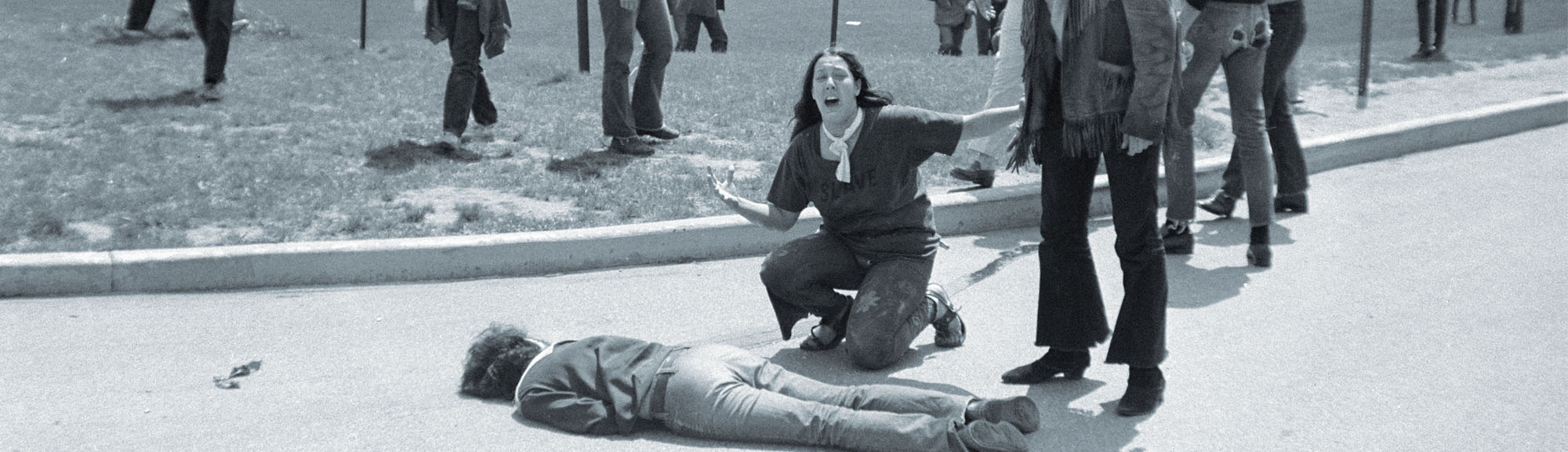
How Many More?: Mary Ann Vecchio, a 14-year-old runaway, keens over the body of slain student Jeffrey Miller. (Photo by John Filo/Getty Images)
Share This Article
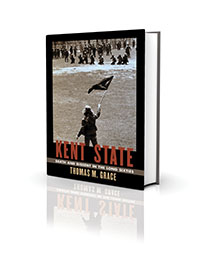
Kent State: Death and Dissent in the Long Sixties by Thomas M. Grace (University of Massachusetts, 2016, $29.95)

Society comes off the hinges. Fear and hatred swirl out of control. Violence erupts. Outbursts of aggressive behavior attempt to regain control or to restore justice.

We live in such times. Precedent offers a chance to reflect on how things turn violently wrong and how they might have gone differently. Three new books on events of May 1970 at Kent State University in Ohio examine the killing there of four young people by Ohio National Guardsmen. Compared to today’s mathematics of slaughter, that toll is puny, and the incident seems long ago. Yet all three volumes are gripping.

Kent State holds the imagination by posing so many unanswered questions. The shootings were so profane. In a country that sends its youth to fight and die for democracy, American soldiers killed American students exercising the rights of free speech and assembly on their campus. If our leaders truly hold those rights sacred, why not display more forbearance in the face of dissent—even if by foul-mouthed longhairs throwing rocks and human waste? Why did the guardsmen fire? Did outside agitators foment the violence?

In Death and Dissent, Thomas M. Grace excavates the deep roots of protest at the Ohio university. With admirable rigor, Grace chronicles a 15-year interplay ranging over civil rights, free speech, and Vietnam that enmeshed student radicals and patriotic frat men, student and town newspapers, administration and faculty, police and military, and local, state, and national politicians.

Out-of-town radicals did come to Kent, but Grace shows protest there to have been homegrown and enduring, tinged by the perspectives of blue-collar students and their union-member parents living in nearby Cleveland.

“The growth of the antiwar movement was a complex phenomenon, and at Kent State its development owed much to Old Left connections,” he writes.

The fusillade that helped swing opinion against the Vietnam War as never before came after days of campus protests nationwide reacting to President Richard Nixon’s April 30 announcement that he had sent American forces into Cambodia, enlarging the conflict.
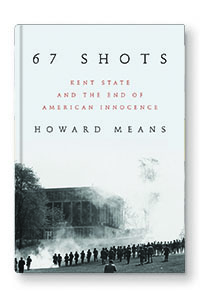
67 Shots: Kent State and the End of American Innocence by Howard Means (Da Capo, 2016, $25.99)

In downtown Kent, on May 1, rowdies smashed store windows. The next night, the campus ROTC building burned. On May 3, Ohio Governor James Rhodes, a U.S. Senate candidate in the coming week’s GOP primary who declared himself fed up with troublemakers he called “worse than brownshirts,” vowed he would “eradicate the problem” by having the National Guard drive protesters off campus.

Most students at Kent State that spring weren’t antiwar activists, but many were infuriated by the Guard’s occupation of campus—a showing “massive in men and machinery” that included helicopters and bayoneted rifles, writes Howard Means in 67 Shots, a taut account.

A rally was set for Monday, May 4. Despite the Guard’s presence, hundreds participated, with 2,000 other students passing nearby bound to and from class. Guardsmen let off tear gas, prompting some protesters to raise middle fingers, scream obscenities, hurl rocks, and throw back gas canisters. Within minutes, guardsmen opened up with M1 rifles. Their bullets killed Jeffrey Miller, 20; Allison Krause, 19; William Schroeder, 21, and Sandra Scheuer, 20. Nine other students were wounded, including Dean Kahler, 20, left paralyzed from the waist down.

Inquiries judged the shootings unwarranted. Probers rejected soldiers’ claims that rocks had imperiled them and that snipers had been shooting at them. Guardsmen, maneuveringing among hundreds of students, had orders to break up gatherings of more than two people. The men in uniform were fighting their own fear and fatigue—and anger. Some seemed to want to teach the punks a lesson.

The troops were serving a fraught municipality. Drawing on Kent State’s oral history archives, Craig Simpson and Gregory Wilson illuminate in Above the Shots the extent to which some townspeople had reached the breaking point.
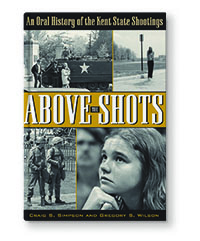
Above the Shots: An Oral History of the Kent State Shootings by Craig S. Simpson and Gregory S. Wilson (Kent State, 2016, $28.95)

Talk spread that students had cached rifles and dynamite. “We really thought kids were going to come down and burn us out,” said Kent resident Rosann Risland, then raising a toddler. “Not just the downtown. The people who owned businesses downtown really hated the students.” To many, the Guard was a godsend, bloody denouement or not. Town and state leaders failed in a fundamental democratic duty: to keep venues of dissent from becoming killing grounds.

Means, Simpson, Wilson, and Grace render comprehensible the blinkered outlooks of students, guardsmen, and townspeople. The real lapse, Means concludes, was mingling so many armed guardsmen with so many students and trying to keep the Kent State campus open.

“It didn’t require a Ph.D. in psychology to predict that prohibitions against peaceful assembly would be ignored,” he writes. “Increasingly forceful behavior on the part of the students and Guardsmen was all but certain to ensue.”

—John Reichard is a writer in Silver Spring, Maryland

Share This Article
by John Reichart

Dive deeper

  • American History
  • Vietnam

Citation information

John Reichart (12/3/2025) Book Reviews: Four Dead in Ohio. HistoryNet Retrieved from https://www.historynet.com/book-review-kent-state-death-dissent-long-sixties/.
"Book Reviews: Four Dead in Ohio."John Reichart - 12/3/2025, https://www.historynet.com/book-review-kent-state-death-dissent-long-sixties/
John Reichart 11/17/2016 Book Reviews: Four Dead in Ohio., viewed 12/3/2025,<https://www.historynet.com/book-review-kent-state-death-dissent-long-sixties/>
John Reichart - Book Reviews: Four Dead in Ohio. [Internet]. [Accessed 12/3/2025]. Available from: https://www.historynet.com/book-review-kent-state-death-dissent-long-sixties/
John Reichart. "Book Reviews: Four Dead in Ohio." John Reichart - Accessed 12/3/2025. https://www.historynet.com/book-review-kent-state-death-dissent-long-sixties/
"Book Reviews: Four Dead in Ohio." John Reichart [Online]. Available: https://www.historynet.com/book-review-kent-state-death-dissent-long-sixties/. [Accessed: 12/3/2025]

Related stories

Stories

Portfolio: Images of War as Landscape

Whether they produced battlefield images of the dead or daguerreotype portraits of common soldiers, […]

Stories

Jerrie Mock: Record-Breaking American Female Pilot

In 1964 an Ohio woman took up the challenge that had led to Amelia Earhart’s disappearance.

Stories

Celebrating the Legacy of the Office of Strategic Services 82 Years On

From the OSS to the CIA, how Wild Bill Donovan shaped the American intelligence community.

Review

Seminoles Taught American Soldiers a Thing or Two About Guerrilla Warfare

During the 1835–42 Second Seminole War and as Army scouts out West, these warriors from the South proved formidable.

HistoryNet
  • Facebook
  • Twitter
  • Instagram
  • YouTube

“History is a guide to navigation in perilous times. History is who we are and why we are the way we are.”

David McCullough, author of “1776”

HistoryNet.com is brought to you by HistoryNet LLC, the world’s largest publisher of history magazines. HistoryNet.com contains daily features, photo galleries and over 25,000 articles originally published in our nine magazines.

Our Magazines

  • American History
  • America’s Civil War
  • Aviation History
  • Civil War Times
  • Military History
  • Military History Quarterly
  • Vietnam
  • Wild West
  • World War II

About Us

  • What Is HistoryNet.com?
  • Advertise With Us
  • Careers
  • Meet Our Staff!

Stay Curious

Subscribe to receive our weekly newsletter with top stories from master historians.

sign me up!

© 2025 HistoryNet.
  • Privacy Policy
  • Terms of Service