
The battle for North Africa was a struggle for control of the Suez Canal and access to oil from the Middle East and raw materials from Asia. Oil in particular had become a critical strategic commodity due to the increased mechanization of modern armies. Britain, which was the first major nation to field a completely mechanized army, was particularly dependent on the Middle Eastern oil. The Suez Canal also provided Britain with a valuable link to her overseas dominions—part of a lifeline that ran through the Mediterranean Sea. Thus, the North African Campaign and the naval campaign for the Mediterranean were extensions of each other in a very real sense.
The struggle for control of North Africa began as early as October 1935, when Italy invaded Ethiopia from its colony Italian Somaliland. That move made Egypt very wary of Italy’s imperialistic aspirations. In reaction, the Egyptians granted Britain permission to station relatively large forces in their territory. Britain and France also agreed to divide the responsibility for maintaining naval control of the Mediterranean, with the main British base located at Alexandria, Egypt.
Italy was the wild card in the Mediterranean strategic equation at the outset of WWII. If the Italians remained neutral, British access to the vital sea lanes would remain almost assured. If Italy sided with Germany, the powerful Italian navy had the capability to close the Mediterranean. The navy’s main base was at Taranto in southern Italy, and operations from there would be supported by Italian air force units flying from bases in Sicily and Sardinia.

Italy did remain neutral when Germany invaded Poland in September 1939. When Germany invaded France in June 1940, however, Benito Mussolini could not resist the opportunity to grab his share of the spoils. On June 11, 1940, six days after the British evacuation at Dunkirk, France, Italy declared war on Britain and France. Britain and Italy were now at war in the Mediterranean.
On paper, at least, Italy enjoyed a considerable advantage over Britain in the Mediterranean theater of operations. In June 1939, Adm. Sir Andrew Cunningham‘s Mediterranean Fleet had only 45 combat ships against the Italian navy’s 183. The Italians held an especially large edge in submarines, with 108 against Cunningham’s 12. The French surrender on June 25, 1940, placed the entire burden of controlling of the Mediterranean sea lanes on the Royal Navy.
The Royal Air Force was in a slightly better position, with 205 aircraft against the Italian air force’s 313 planes. On the ground, Italian Marshal Rodolfo Graziani had some 250,000 troops in Libya, while Gen. Lord Archibald Percival Wavell, British commander in chief of the Middle East, had only 100,000 troops to defend Egypt, Sudan and Palestine. The British ground forces, however, were far better organized, trained and equipped and had superior leadership.
British, Italians meet in the Western Desert
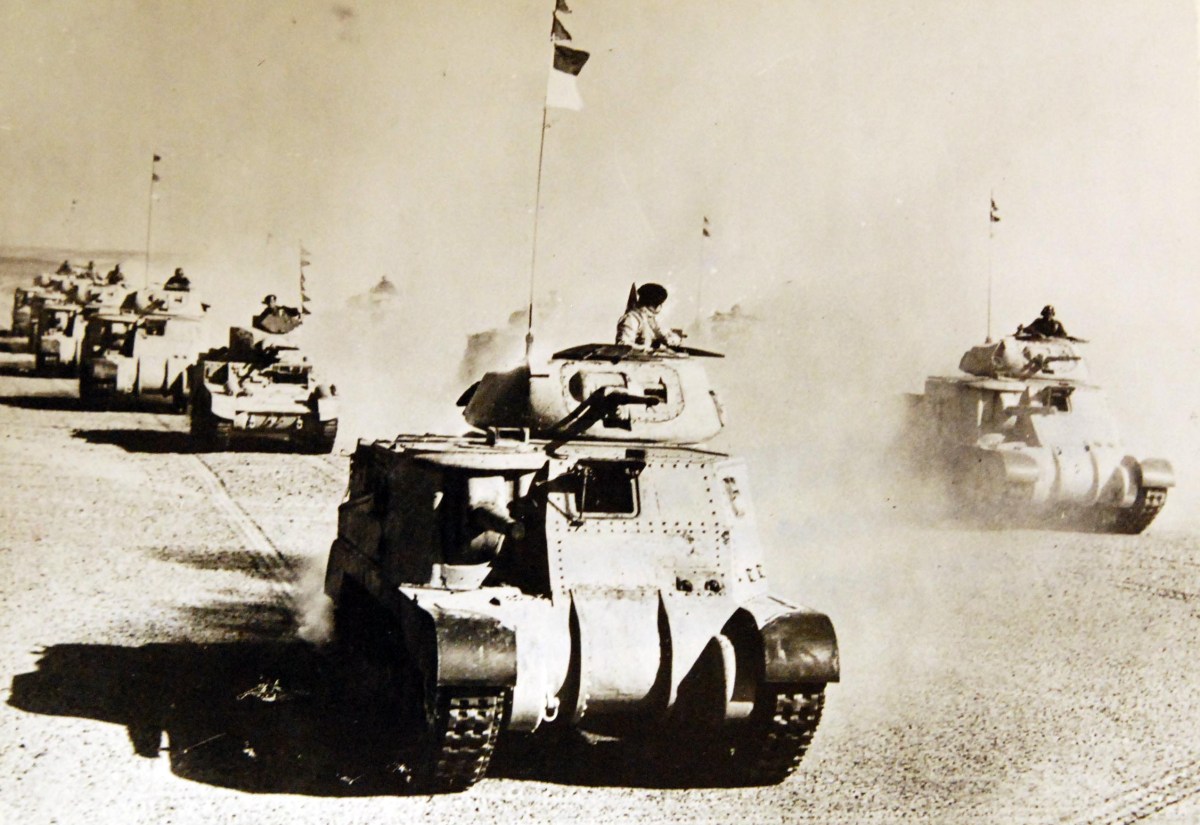
The British and Italian armies faced each other across the Libyan-Egyptian border in an area known as the Western Desert. It was an inhospitable region with no vegetation and virtually no water. From Mersa Matruh in western Egypt to El Agheila on the east side of Libya’s Gulf of Sidra, only one major road connected the region’s few towns and villages. A sandy coastal strip of varying width ran along the southern shore of the Mediterranean. Inland, a sharp escarpment rose to the 500-foot-high Libyan Plateau. There were only a few passes where wheeled or even tracked vehicles could ascend the escarpment. Once on the plateau, however, military vehicles had good cross-country mobility across limestone ground covered by a thin layer of sand. The commander of Germany’s 21st Panzer Division, Lt. Gen. Johann von Ravenstein, described the area as a tactician’s paradise and a logistician’s hell.

this article originally appeared in the March 1997 issue of World War II magazine
On September 13, 1940, Graziani reluctantly moved into Egypt, almost a month after he had been ordered to do so by Mussolini. Some six Italian divisions drove east, bypassing a small British covering force along the border, and halted at Sidi Barrani, just short of the main British positions at Mersa Matruh. Graziani apparently had no intention of going any deeper into Egypt. Italian control of the airfield at Sidi Barrani, however, seriously reduced the operational reach of British air power and posed a threat to the Royal Navy in Alexandria. With the Battle of Britain reaching its climax and Great Britain facing a possible German invasion, the British were in no immediate position to counter the Italian thrust.
By October 1940, the threat of a German invasion of the British Isles had eased, and the British began to reinforce Wavell. Through that December, an additional 126,000 Commonwealth troops arrived in Egypt from Britain, Australia, New Zealand and India. On November 11, British naval air power seriously damaged the Italian navy in a surprise attack against Taranto. On December 9, the Western Desert Force, under Lt. Gen. Sir Richard O’Connor, attacked the Italians at Sidi Barrani.
The British pushed the Italian Tenth Army out of Egypt and then, on January 3, 1941, scored a major victory at Bardia, just inside Libya. Driving into Cyrenaica (eastern Libya), the British took the vital port of Tobruk on January 22. O’Connor continued to pursue the Italians, trapping them at Beda Fomm on February 7, 1941. The Italian Tenth Army collapsed. In two months, a British force of about two divisions had advanced 500 miles, destroyed 10 Italian divisions, and captured 130,000 prisoners, 380 tanks and 845 guns. In the process, the British had suffered 555 dead and 1,400 wounded.
Following the British successes in North Africa, Prime Minister Winston Churchill decided on February 22 to commit British troops to defend Greece against the Axis. Most of those forces came out of Cyrenaica, which left Wavell only five brigades in Libya. Just a few weeks earlier, however, Adolf Hitler had decided to shore up the Italians in North Africa by committing German forces. On January 8, the Luftwaffe’s Fliegerkorps X arrived in Sicily from Norway and immediately began attacking Allied shipping destined for the Libyan port of Benghazi. That threat forced the British forward units in Libya to resupply through Tobruk, more than 450 miles away.
Two German divisions and two additional Italian divisions began crossing from Italy into Libya. On February 12, Brig. Gen. Erwin Rommel assumed command of the German units that later became the famed Afrika Korps. He lost no time in regaining the initiative. Rommel probed El Agheila on March 24. When he found that the British defenses were thin, he launched a general offensive despite Hitler’s orders to maintain an overall defensive posture.
Near the end of March, O’Connor was replaced by Lt. Gen. Sir Philip Neame as commander of the Western Desert Force. The magnitude of the German attack became apparent when the British were forced out of Benghazi on April 3. O’Connor was sent back to the front as an adviser to Neame. The Germans captured both British generals from their unescorted staff car on the night of April 6.

Rommel drove rapidly to the east, surrounding Tobruk on April 10. Unable to take the port on the run, he left a siege force of mostly Italian units there and continued his push for the Egyptian border. It was a decision Rommel later regretted. The Tobruk garrison, which held out against the siege for 240 days, remained a thorn in Rommel’s side—an annoying sideshow that tied down vital Axis manpower.
On April 14, Rommel’s main force reached Sollum on the Egyptian border, and his troops occupied the key terrain of the Halfaya Pass. The German high command, meanwhile, was concerned about the speed of Rommel’s advance and his failure to take Tobruk. They sent Gen. Friedrich von Paulus to North Africa to assess the situation and ‘bring Rommel under control. Paulus’ report back to Berlin described Rommel’s weak overall position and his critical shortages of fuel and ammunition. The report also reached Churchill via Ultra intercepts.
From this report, Churchill wrongly concluded that the Germans were ready to collapse with one strong push, and he started pressuring Wavell to mount an immediate counteroffensive. Meanwhile, a British supply convoy, code-named Tiger, made its way to North Africa carrying 295 tanks and 43 Hawker Hurricane fighters. Despite heavy air attacks, the Tiger convoy arrived on May 12 after losing only one transport that carried 57 tanks.
Operations at ‘Hellfire Pass’
Prior to launching his counterattack, Wavell wanted to gain control of Halfaya Pass. On May 15, he launched Operation Brevity, under the command of Brig. Gen. William Gott, to secure the pass and Fort Capuzzo beyond. Rommel skillfully parried the thrust, and the British withdrew from Fort Capuzzo the next day. By May 27 the Germans had recaptured Halfaya Pass. Unable to advance any farther because of supply shortages, they dug in and fortified their positions with 88mm anti-aircraft guns. The British troops began referring to the heavily fortified and fiercely defended Halfaya Pass as Hellfire Pass.
Under continuing pressure from Churchill, Wavell launched his major offensive on June 15. Operation Battleaxe began with a frontal attack on the Sollum-Halfaya Pass axis. Skillfully using the 88mm anti-aircraft guns as anti-tank weapons, the Germans blunted the British attack. Then Rommel counterattacked. Battleaxe was over by June 17, and Wavell had lost 91 of his new tanks. Churchill relieved Wavell on June 21 and replaced him with Gen. Sir Claude Auchinleck. Gen. Sir Alan Cunningham (the brother of Admiral Cunningham) was given command of the Western Desert Force, recently redesignated the British Eighth Army.
Auchinleck resisted Churchill’s constant pressure for an immediate British counterattack. When Hitler launched Operation Barbarossa against the Soviet Union on June 22, Rommel’s force in North Africa became even less a priority for Germany’s logistical support. Most of the Luftwaffe units in the Mediterranean were sent to Russia, which gave the British a freer hand in attacking Rommel’s supply convoys at sea and from the air. Rommel continued to grow weaker. By November, he had 414 tanks, 320 aircraft and nine divisions (three German), four of which were tied down in the siege of Tobruk. The British had some 700 tanks, 1,000 aircraft and eight divisions.
The British became increasingly obsessed with eliminating Rommel. On the night of November 17, 1941, a small commando force, led by 24-year-old Lt. Col. Geoffrey Keyes, tried to penetrate Rommel’s headquarters and assassinate the Desert Fox. The raid failed—Rommel was not even there—and Keyes died in the attempt. The Germans gave Keyes a funeral with full military honors, and the gallant Rommel sent his personal chaplain to conduct the services. The British later awarded Keyes, the son of Admiral of the Fleet Sir Roger Keyes, a posthumous Victoria Cross.
Operation Crusader opened on November 18, with the British XIII Corps advancing on Halfaya Pass and the XXX Corps attempting to sweep around Rommel’s southern flank to reach the besieged garrison at Tobruk. The XXX Corps reached Sidi Rezegh, 20 miles southeast of Tobruk. After a series of fierce tank battles on November 22 and 23, Rommel drove deep into the British rear with two panzer divisions. He attempted to relieve the Axis forces at Halfaya and at the same time cut off the Eighth Army.
With his tank losses mounting, Cunningham wanted to halt the operation. Auchinleck immediately relieved him and replaced him with Maj. Gen. Neil Ritchie. The British continued to press the attack, and on November 29 they broke through to Tobruk. By December 7, an overwhelmed Rommel was withdrawing his dangerously depleted forces. In order to avoid encirclement in the Benghazi bulge, Rommel retreated back across Cyrenaica, reaching El Agheila on January 6, 1942. Operation Crusader resulted in a clear victory for the British, but one they were unable to exploit due to a lack of reinforcements.
As Rommel withdrew to the east, the RAF continued to attack his supply convoys in the Mediterranean. Only 30 tons of Axis supplies were shipped to North Africa in November 1941, and 62 percent of them were lost en route. Hitler reacted by shifting Fliegerkorps II from Russia to Sicily and ordering the German navy to send 10 U-boats into the Mediterranean. Throughout December, Rommel’s resupply situation improved significantly, with shipping losses dropping to 18 percent. Meanwhile, the Japanese attack on Pearl Harbor caused the British to reroute forces from North Africa to India and Singapore. By mid-January 1942, Rommel was operating on shorter supply lines, and his shipping losses were below 1 percent. He now was ready to return to the offensive.
Rommel breaks out of the cauldron
On January 21, 1942, Rommel launched his second offensive and quickly drove the British back almost 300 miles. The aggressive German commander recaptured Benghazi on January 29 and continued to push east, reaching Gazala on February 4. There he halted along the Eighth Army’s defensive line between Gazala and Bir Hacheim. For most of the next four months, the adversaries sat on either side of the Gazala Line, building up strength.
On May 26, Rommel launched Operation Venezia—his attack against the Gazala Line. Both forces were roughly equal in strength, but Ritchie had his armored units widely dispersed, while Rommel kept his concentrated. Using his armor, Rommel swept around the Free French Brigade at Bir Hacheim and turned north, cutting across the Allied rear. An Axis secondary attack in the north pinned down the Allied forces there.
By May 28, the Axis armored units behind the Allied lines were in trouble. Rommel had lost more than one-third of his tanks, and the remainder were running short on fuel and ammunition. On May 29, the Italian Trieste Division cleared a path through the center of the Gazala Line. That opening became a lifeline to Rommel’s panzers. On the 30th, Rommel consolidated his armor in a defensive position that came to be known as the Cauldron.
On June 5-6, Rommel successfully beat off Ritchie’s series of piecemeal counterattacks. On June 10-11, the Axis finally drove the Free French forces out of Bir Hacheim, and on June 11 Rommel’s panzers broke out of the Cauldron. The Eighth Army once more started falling back to the Egyptian border. On June 15, German tanks reached the coast and Rommel shifted his attention to the Tobruk garrison. This time he would not make the same mistake of leaving the thorn in his side.
British fall back again
Tobruk fell on June 21, and the Axis forces captured 2.5 million gallons of much-needed fuel, as well as 2,000 wheeled vehicles. The fall of Tobruk, however, had unforeseen consequences for the Axis. Churchill heard the news during a meeting with President Franklin D. Roosevelt in the United States. The American president immediately offered help. The resulting 300 Sherman tanks and 100 self-propelled guns would later play a pivotal role at El Alamein.
The British fell back to defensive positions at Mersa Matruh, about 100 miles inside Egypt. Rommel, who had been promoted to field marshal for his success at Gazala, pursued. Auchinleck relieved Ritchie and personally assumed command of the Eighth Army. With only 60 operational tanks, Rommel attacked at Mersa Matruh on June 26 and routed four British divisions in three days of fighting. The British fell back again, this time to the vicinity of El Alamein, another 120 miles to the east.
Now less than 100 miles from Alexandria, Auchinleck was determined to hold near El Alamein. Under constant pressure from Rommel’s forces, Auchinleck improvised a fluid defensive line anchored on Ruweisat Ridge, a few miles south of the El Alamein defensive perimeter. Rommel attacked on July 1, attempting to sweep around El Alamein. For three weeks, Auchinleck skillfully battled Rommel to a standstill. Auchinleck launched a major counterattack on July 21-22, but gained no ground. Exhausted, both sides paused to regroup.
Despite the fact that Auchinleck had finally halted Rommel’s advance, Churchill relieved him in early August and named Gen. Sir Harold Alexander commander in chief of the Middle East. Sir William Gott was promoted to general and given command of the Eighth Army. On August 7, the day after his appointment, Gott was killed when his airplane was attacked by a German fighter during a flight to Cairo. The relatively unknown Lt. Gen. Sir Bernard L. Montgomery succeeded Gott as commander of the Eighth Army.
Although Churchill desperately wanted to win a clear victory for political purposes and to raise morale, neither Alexander nor Montgomery was inclined to take the offensive without first amassing an overwhelming advantage. On August 31, 1942, Rommel launched what he believed would be the final attack in the Axis drive to the Nile. The British, however, had made extensive preparations around El Alamein, based on a plan developed by Auchinleck and adopted by Montgomery. The British commander also had the advantage of knowing Rommel’s intentions through Ultra intercepts.
A turning point for the Allies
Rommel planned to sweep south around Ruweisat Ridge, then cut off El Alamein and take it from the rear. In preparation, the British laid extensive minefields and heavily fortified Alam el Halfa Ridge, which was located behind El Alamein to the southeast. By September 3, the Axis attack had run short of fuel and petered out. Montgomery counterattacked immediately, but broke off the operation as soon as the Axis forces were pushed back to the vicinity of their starting positions. Both sides again hunkered down to build up their strength. Taken together, the battles of Ruweisat Ridge and Alam el Halfa were the real strategic turning point of the war in North Africa.
Montgomery used the time after the Battle of Alam el Halfa to rest and train his troops, integrate the new American tanks he had received, and carefully plan his counterattack. Rommel, meanwhile, became ill and returned to Germany on sick leave. When Montgomery finally launched the attack, his forces and equipment were three times greater than his opponent’s.
The Battle of El Alamein began on October 23 with a massive artillery barrage fired by 900 British guns. Rommel immediately returned from Germany to resume command. The Allies tried for five days to break through the Axis positions, sustaining 10,000 casualties in the process. On October 30-31, Montgomery renewed the attack with strong support from the RAF. Critically short on fuel and ammunition, Rommel started to disengage on November 3. At first, Hitler insisted on his usual no-retreat orders. On the 4th, he grudgingly gave Rommel permission to withdraw, and the 1,400-mile pursuit to Tunisia began.

For the next three months, Montgomery followed Rommel across the northern coast of Africa. Despite constant urging from his German and Italian superiors, who wanted him to save Libya, Rommel was more interested in preserving his force to fight another day. He paused at El Agheila between November 23 and December 18, and again at Buerat and Wadi Zemzem, from December 26, 1942, to January 16, 1943. Rommel reached Tripoli on January 23 and the Tunisian border at the end of the month. By the time he got to Tunisia, however, another Allied force was there waiting for him.
British, Americans coordinate landings
On November 8, 1942, just four days after Rommel started his long withdrawal, the British and Americans had executed Operation Torch, the Northwest African landings. In a coordinated series of landings, the Western Task Force, under Maj. Gen. George S. Patton, Jr,. landed on the Atlantic coast near Casablanca, Morocco; the Center Task Force, under Maj. Gen. Lloyd Fredendall, landed just inside the Mediterranean around Oran, Algeria; and the Eastern Task Force, under Maj. Gen. Charles Ryder, landed near Algiers. Although all the landing sites were in Vichy French territory, the ultimate objectives of the operation were the Tunisian port and airfield complex of Bizerte and the capital city of Tunis. Command of those facilities would allow the Allies to bomb Sicily, protect the Malta convoys, and strike at Rommel’s supply lines.
While the Allies established themselves ashore and attempted to negotiate terms with the Vichy French, the Germans reacted swiftly, sending troops from Sicily to Tunisia on November 9. Hitler also gave the order for the German military in occupied France to take control of the remainder of Vichy France. The French fleet at Toulon, however, was scuttled before the Germans could seize it.
From the moment the Allies landed, the campaign in Northwest Africa and the race for Tunis was a logistical battle. The side that could mass forces the fastest would win. For the Germans, control of the Tunis complex was critical to prevent Rommel from being trapped between Montgomery in the east and the newly formed British First Army in the west. On November 28, the Allies reached Tebourba, only 12 miles from Tunis, but a well-conducted Axis counterattack drove them back 20 miles in seven days.
The Germans won the initial race for Tunis because they had shorter supply lines, and their aircraft, operating from closer bases, had greater time over the contested area. In January 1943, the winter rains and resulting mud brought mechanized operations to a halt in northern Tunisia. Waiting for better weather in the spring, the Allies continued to build up their forces. The British First Army, under Lt. Gen. Sir Kenneth Anderson, was organized into three corps—the British V Corps, the U.S. II Corps and the French XIX Corps. The Axis forces in northern Tunisia now consisted of Lt. Gen. Hans-Jürgen von Arnim’s 5th Panzer Army.
Once Rommel’s Panzerarmee Afrika crossed into southern Tunisia, it occupied positions in the old French fortifications of the Mareth Line. Rommel’s 10 divisions were well below half strength, with only 78,000 troops and 129 tanks. Before he had to face the rapidly closing Montgomery, Rommel intended to eliminate the threat of the British First Army to his north.
Axis, allies both regroup
On February 14, the Germans launched the first leg of a two-pronged offensive, with Arnim’s forces attacking that day through the Faid Pass toward Sidi Bou Zid. The following day, Rommel, in the south, attacked toward Gafsa. The bulk of Rommel’s forces, however, remained in the Mareth Line. By February 18, Kasserine Pass was in Axis hands, and U.S. ground forces had suffered their first major defeat of the war. Rommel tried to advance north toward Thala through Kasserine Pass on February 19, but the support he expected to receive from Arnim did not materialize. After several days of slow advances, he reached Thala on February 21 but could advance no farther. Hampered by a divided German command structure and rapidly massing Allied reinforcements, the attack stalled. The Allies pushed forward and recaptured Kasserine Pass on February 25. Rommel returned to the Mareth Line and prepared to face Montgomery.
When the Eighth Army reached Tunisia, the Allies modified their command structure to conform with decisions made at the Casablanca Conference in January. Gen. Dwight D. Eisenhower became supreme commander of all Allied forces in the Mediterranean west of Tripoli. Alexander became Eisenhower’s deputy and, at the same time, commander of the Eighteenth Army Group, which controlled the First and Eighth armies and the now separate U.S. II Corps. Air Chief Marshal Sir Arthur Tedder assumed command of the Allied air forces, and Admiral Cunningham retained command of the naval forces.
On February 24, the Axis also realigned its command structure. Rommel became commander of Armeegruppe Afrika, which included the Afrika Korps, Arnim’s 5th Panzer Army, and the Italian First Army under Gen. Giovanni Messe. The Axis forces finally had a unified command structure in Tunisia, but Rommel probably was not the best choice. By that point in the war, he had become frustrated and dispirited, the cumulative effect of the long seesaw campaign. To make matters worse, Arnim, who detested Rommel, continued to do pretty much as he pleased.
The Axis position in North Africa was hopeless, the final outcome clearly in the hands of the logisticians. As the Allies consolidated their control over the northwest African coast, the Axis pressure on Malta eased, which in turn enabled the Allies to further restrict the Axis supply convoys from Sicily. Without first coordinating with Rommel, on February 26 Arnim launched Operation Ochsenkopf, a drive toward Beja. By March 3, that offensive had stalled, at the cost of 71 precious tanks.
Rommel’s last offensive
Montgomery’s forces, which had crossed into Tunisia on February 4, had reached Medenine on the 16th and established defensive positions. Hoping to catch the British off-balance, Rommel attacked south from the Mareth Line on March 6. Spearheaded by 140 tanks, it was the most potent offensive Rommel mounted since arriving in Tunisia. It would also be the last. Warned by Ultra intercepts, Montgomery was waiting. The Germans ran into skillfully prepared anti-tank defenses and lost 52 tanks. Right after the failure of the Medenine attack, Rommel returned to Germany a sick man. Arnim assumed overall Axis command, and Messe took command in south Tunisia.
After the American debacle at Kasserine Pass, command of the U.S. II Corps passed to Patton. He wanted to mount an attack to drive to the coast, but Alexander would authorize only limited attacks designed to draw German forces away from the Mareth positions. At that point, Alexander simply did not trust American units. In fact, many among the British forces disparagingly referred to their American allies as our Italians. Patton’s limited attack between March 17 and 25 was successful, however, tying down the 10th Panzer Division near El Guettar.

On March 20, Montgomery attempted a night penetration of the center of the Mareth Line. The attack had failed by March 22. The next day, he shifted the weight of the main attack around the southwestern flank of the line, through the Matmata Hills. By March 26, his forces broke through the Tebaga Gap. The Italian First Army and the remainder of the Afrika Korps were forced back. Under continuous pressure from the Eighth Army on one side and the U.S. II Corps on the other, the Axis forces withdrew to Enfidaville.
By April 7, the Allied First and Eighth armies linked up, squeezing the Axis into a small pocket. On the east coast, the Eighth Army took Gabés on April 6, Sfax on April 10, Sousse on April 12, and Enfidaville on April 21. In the north, the U.S. II Corps, now under Lt. Gen. Omar N. Bradley, took Mateur on May 3 and Bizerte on May 7. Montgomery’s 7th Armoured Division captured Tunis on May 7. The remaining Axis forces in Tunisia were caught in two pockets, one between Bizerte and Tunis, and the other on isolated Cape Bon.
Arnim surrendered his forces on May 13, 1943. The Royal Navy, waiting in strength offshore, made sure that few Germans or Italians escaped to Sicily. Axis losses in Tunisia alone totaled 40,000 dead or wounded, 240,000 prisoners, 250 tanks, 2,330 aircraft and 232 ships. British and American casualties were 33,000 and 18,558 respectively. For the entire North African campaign, the British suffered 220,000 casualties. Total Axis losses came to 620,000, which included the loss of three field armies.
North Africa victory a watershed for Allies
On the strategic level, the North African campaign was a watershed for the Western Allies. For the first time in the war, they had decisively defeated the Axis, and especially the Germans, on the ground. The psychological value of the victory cannot be minimized. The U.S. Army, too, had finally gotten into the war and acquitted itself well after a shaky start at Kasserine Pass. The British and Americans perfected the combined command structure that would serve the Grand Alliance for the remainder of the war. The various Free French factions were finally united and organized under the Allied command. And perhaps most important, the British proved the value of Ultra intelligence and refined the system for getting the necessary information to the field commanders.
On the downside, the Allies were now out of position with a huge force of almost 1 million men and their equipment. With very limited means of transportation and no way for that force to strike directly at Germany, a follow-up campaign in Sicily was almost the only feasible next course of action for the Allies.
The loss was a stunning strategic setback for Germany. At first, North Africa had been a rather effective economy-of-force campaign. At the risk of only three German divisions and a number of Italian divisions of questionable quality, the Axis was able to tie down a proportionately larger force and at the same time pose a significant threat to one of Britain’s strategic lines of communication. But after the defeat at El Alamein, Hitler’s sense of pride once again overcame his meager grasp of strategy, and he committed a second field army to North Africa that he could neither sustain logistically nor afford to lose. The forces Hitler threw away in May 1943 just might have made some difference for the Germans fighting in Russia or Sicily.
On the tactical and operational levels, several factors conspired against the Axis despite the battlefield brilliance of Rommel and the superb fighting of the Afrika Korps. Although North Africa was a logistician’s hell, logistics was the deciding factor. In the end, the Allies triumphed with sheer mass. The Axis forces could not overcome Allied air and sea power—both of which enhanced Allied logistics and degraded Axis logistics.