
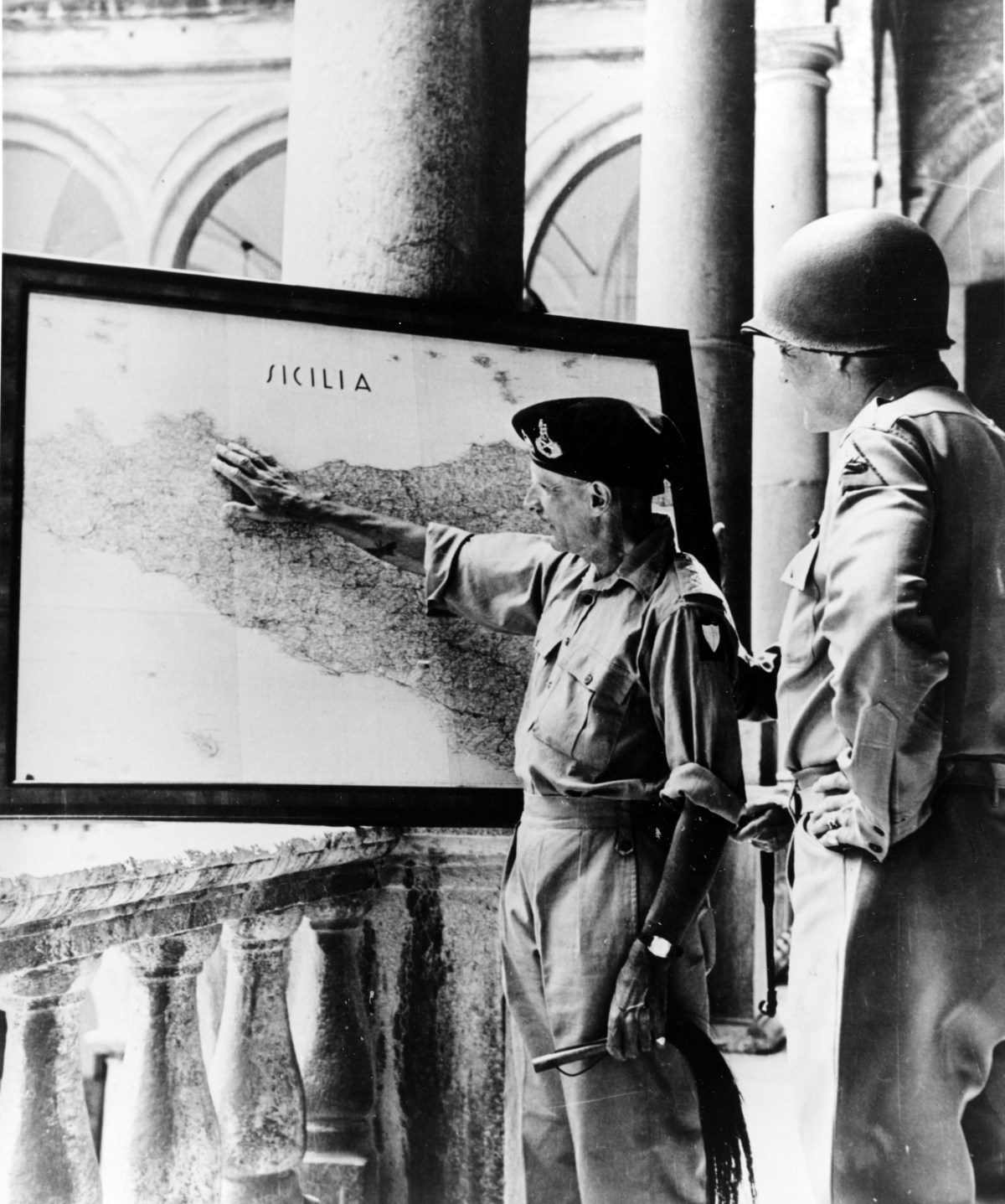
Inside Seventh Army headquarters on the southern coast of Sicily, a scowling Lieutenant General George S. Patton, Jr., greeted Lieutenant General Omar Bradley with bad news. ‘We’ve received a directive from Army Group, Brad,’ Patton said between puffs on a cigar. ‘Monty’s to get the Vizzini-Caltagirone road in his drive to flank Catania and Mount Etna by going up through Enna. This means you’ll have to side-slip to the west with your 45th Division.’
‘My God,’ Bradley replied angrily, ‘you can’t allow him to do that!’
But Patton had nothing else to say on the subject. ‘Sorry Brad,’ he said evenly, ‘but the changeover takes place immediately. Monty wants the road right away.’
To Patton, Bradley, and just about every other senior United States Army officer, British General Sir Bernard Montgomery got his way entirely too often. This time, just four days into Operation HUSKY (the code name for the Allied Invasion of Sicily), Montgomery had convinced 15th Army Group Commander General Sir Harold Alexander to grant his Eighth Army exclusive use of a highway previously promised to the Americans. Patton and Bradley considered the decision an insult to American military prestige.
On July 10, 1943, Allied ships had deposited Patton’s Seventh U.S. Army on the beaches along the Gulf of Gela, on Sicily’s southwest coast. Montgomery’s British Eighth Army went ashore to the east, south of Syracuse. The Allies targeted the city of Messina, at the northeast tip of the triangular island. Capturing Sicily would eliminate persistent Axis attacks on nearby Mediterranean supply routes, and if Messina could be taken quickly, the invaders would snare thousands of Axis prisoners and gain a convenient jump-off spot for the upcoming invasion of Italy.
By July 13, Bradley’s II Corps had advanced inland to within 1,000 yards of the Vizzini-Caltagirone road (Route 124)–a major transport route that cut east to west across the center of the island. Meanwhile, dug-in German troops had blunted Montgomery’s advance up the island’s east coast, hemming Eighth Army in on the plain of Catania between towering Mount Etna and the sea. In a sudden change of plan, Montgomery decided to send a flanking force west around Etna. To do so he needed Route 124, and Alexander, who had overall command of HUSKY’s ground forces, gave it to him. The Americans, one of Patton’s frustrated staff officers said, were left to’sit comfortably on our prats while Montgomery finishes the goddam war!’
The British generals thought little of American fighting ability. In February, German Field Marshal Erwin Rommel’s Afrika Korps had thrust across the hot sands of North Africa and smashed through inexperienced and poorly led U.S. troops at Tunisia’s Kasserine Pass. The unfortunate performance of the young Americans–many of whom had never before seen battle–distressed the British commanders. Alexander declared, ‘they lack the will to fight.’ Montgomery believed ‘they have no confidence in their Generals.’
In the wake of the disaster at Kasserine Pass, the Allied Commander in the Mediterranean, General Dwight D. Eisenhower, sent Patton to Tunisia to take over U.S. II Corps. Patton quickly injected discipline and his fighting spirit into the corps and led it to victories at Gafsa and El Guettar. In mid-April as the Tunisian Campaign neared its end, Patton left the corps in Bradley’s hands and returned to French Morocco to take part in planning for the Sicily operation.
Despite the Americans’ improvement on the battlefield, Alexander and Montgomery remained unimpressed. For their part, Patton and many of his colleagues resented British impertinence, especially on the part of Montgomery. Arrogant, self-centered, and pushy, the 56-year-old general in the natty black beret irked his colleagues with outlandish statements and demands. In many ways he was not unlike Patton. At the age of 58, Patton was deeply religious, swashbuckling, ‘human dynamo’ who strutted around in a polished steel helmet with a pair of ivory-handled revolvers strapped to his waist. ‘His vigor was always infectious, his wit barbed, his conversation a mixture of obscenity and good humor,’ Bradley wrote. ‘He was at once stimulating and overbearing. George was a magnificent soldier.’ By the time he waded ashore on Sicily, Patton’s antipathy toward his British counterparts had also come to affect his relationship with his boss, Eisenhower. Patton’s long-time friend had the difficult job of holding together the young Anglo-American alliance. But Patton felt that American interests and honor too often took a back seat to British demands. ‘God damn all British and all so-called Americans who have their legs pulled by them,’ Patton wrote in his diary in Tunisia. ‘Ike is more British than the British and is putty in their hands . . . .’
For the first invasion of the Axis’ home turf, Patton commanded the new Seventh U.S. Army, including Bradley’s II Corps. Patton welcomed the chance to assert U.S. military might. Initially scheduled to land on the island’s northern coast and capture Sicily’s capital Palermo, American troops expected to go on the offensive in Sicily. But Montgomery favored a less dispersed landing to the south and in the end, his plan won out. Patton still expected Seventh Army to make its mark. But to Alexander, it was clear that ‘Eighth Army would have the glory of capturing the more obviously attractive objectives of Syracuse, Catania, and Messina . . . .’
From the outset Eighth Army strategy left little room for Patton to operate, and Montgomery essentially imposed his will on Alexander. Montgomery reasoned that if the Americans could simply ‘hold firm against any action from the west I could then swing hard with my right with an easier mind. If they draw enemy attacks on them my swing north will cut off enemy completely.’ Two days later, Alexander transferred use of Highway 124 to Montgomery. ‘They gave us the future plan of operations,’ Patton wrote bitterly, ‘which cuts us off from any possibility of taking Messina.’
Patton considered himself, with good reason, ‘the best damn ass-kicker in the U.S. Army,’ but he accepted this outrageous decision without a protest. This was not the time to raise a fuss. For the moment he saved his invective for his diary. ‘Ike has never been subjected to air attack or any other form of death. However, he is such a straw man that his future is secure. The British will never let him go.’
Yet Patton did not simply give up Highway 124 with a smile. He slyly secured authorization to expand the American perimeter west. Patton had his eyes set on Palermo, and, ultimately, Messina. The next day Patton and Major General Lucien K. Truscott, who headed up the 3rd Infantry Division, discussed a westward reconnaissance in force toward Agrigento and Porto Empedocle. Truscott felt that Alexander would not object to such a move, and Patton, Truscott wrote, ‘with something of the air of the cat that had swallowed the canary, agreed . . . .’ Patton had his foot in the door and he meant to swing it open.
On July 16 Alexander issued another directive that positively infuriated Patton. The order stipulated that Montgomery’s Eighth Army would advance on Messina on three fronts. The Americans were officially left with the distasteful task of protecting Montgomery’s left flank. Alexander lamely authorized Seventh Army ‘to capture Agrigento and Porto Empedocle’–something Truscott had done that very day. Patton blamed Montgomery. ‘Monty is trying to steal the show,’ he wrote to his wife, Beatrice, ‘and with the assistance of Divine Destiny [Eisenhower] may do so . . . .’
Patton had had enough. Alexander clearly had no intention of assigning Seventh Army anything other than mop-up duty in Western Sicily, while Montgomery’s Eighth marched to Messina and glory in the east. Patton felt his superior lacked ‘any conception of the power or mobility of the Seventh Army.’ On July 17 he climbed aboard a B-25 and flew to 15th Army headquarters in Tunisia to confront Alexander. Patton told the army group commander in no uncertain terms that he wanted his army unleashed. He explained ‘it would be inexpedient politically for the Seventh Army not to have equal glory in the final stage of the campaign.’ Patton asked for authorization to drive north to split the Axis forces and to clear out remaining resistance in the west. Alexander agreed, providing Seventh Army hold a crucial road network near Caltanissetta in the center of the island. ‘If I do what I am going to do,’ Patton confided to his diary, ‘there is no need of holding anything, but ‘it’s a mean man who won’t promise,’ so I did.’
Patton wasted no time putting his new plan into action. He created a Provisional Corps under the command of Major General Geoffrey Keyes, his deputy commander, and sent it northwest towards Palermo while Bradley’s II Corps set out for the north coast, knifing across the island’s center through tough German defenders. Facing light resistance from largely dispirited Italian troops, Keyes’ troops ‘moved so fast that often the German and Italian 88s [88mm anti-tank guns], which they captured en route, had not been pointed around or set up to shoot against them.’ On July 22 Truscott’s Division entered Palermo after covering an astonishing 100 miles in just 72 hours. Wild celebrations and ebullient Sicilians greeted the Americans. Support for Italy’s Fascist Dictator Benito Mussolini was nowhere to be seen. The next day the 45th Division of Bradley’s II Corps reached the coast at Termini, 25 miles to the east. Until he took matters into his own hands, Patton wrote in his diary, ‘Monty was trying to command both armies and getting away with it.’ Now Seventh Army was making its mark.
Meanwhile, Patton pushed his personal competition with Montgomery to comical new heights. On July 25 he flew across the island to Syracuse for a meeting with Alexander and Montgomery. On seeing his erstwhile British rival, Patton noted, ‘I made the error of hurrying to meet him. He hurried a little too, but I started it.’ At the end of the conference, during which, Patton noted, he didn’t receive lunch, ‘Monty gave me a 5¢ cigar lighter. Some one must have sent him a box of them.’ When Montgomery visited Palermo a few days later, Patton sent an escort to meet him at the airport and greeted him at his headquarters with a full band. ‘I hope Monty realized that I did this to show him up for doing nothing for me on the 25th,’ Patton wrote. At Syracuse, Montgomery surprised Patton by suggesting that Seventh Army capture Messina. While Keyes and Bradley had raced across Sicily, Montgomery’s Eighth Army had become completely bogged down in the east. Dug-in German troops continued to hold Montgomery at Catania, while his circling movement west around Etna proceeded slowly. With Seventh Army now poised, cat-like, ready to strike east, Montgomery realized that Patton was best positioned to take the city. Besides, by attacking east Patton would relieve the pressure on Eighth Army and allow him to finally punch past Catania.
Patton doubted Montgomery’s motives, but he needed no further urging. ‘This is a horse race in which the prestige of the US Army is at stake,’ he wrote to 45th Infantry Division Commander Major General Troy Middleton. ‘We must take Messina before the British. Please use your best efforts to facilitate the success of our race.’ Montgomery made little of this ‘race,’ but to Patton it became a personal crusade to win acclaim and respect for his much-maligned troops. British soldiers and officers undoubtedly wanted to beat the Americans into Messina. But Patton definitely hyped the contest.
On July 25, 1943, King Victor Emmanuel III, supported by leading Italian political figures, deposed dictator Benito Mussolini, and Italy began to negotiate peace terms with the Allies. (Italy would pull out of the Axis in September.) As German commanders planned to evacuate Sicily, Patton and Montgomery began squeezing Axis defenders into the island’s northeast corner. Eighth Army continued to probe German defenses at Catania while Canadian and British troops drove in a ‘left hook’ around Etna’s western slope. To the north, the 1st and newly arrived 9th American Divisions advanced east from the island’s rugged center, while the 3rd Division attacked down the north coast road. ‘The mountains are the worst I have ever seen,’ Patton wrote on August 1. ‘It is a miracle that our men can get through them but we must keep up our steady pressure. The enemy simply can’t stand it, besides we must beat the Eighth Army to Messina.’
On August 3, Patton stopped by an army hospital outside Nicosia and chatted with several injured soldiers; ‘All were brave and cheerful,’ he noted. Then he encountered a 1st Division infantryman who seemed unhurt. Patton asked him what was wrong. ‘I guess I can’t take it,’ the soldier replied. Patton erupted. Cursing the soldier as a coward, he slapped him with his gloves and pushed him out of the tent. Such men, Patton wrote,’should be tried for cowardice and shot.’ A week later at another hospital Patton came across another ‘alleged nervous patient,’ a private in the 13th Field Artillery Brigade whose case was diagnosed as severe shell shock. Again Patton’s anger overcame him; again he slapped and cursed the soldier. ‘I can’t help it,’ he said, ‘but it makes my blood boil to think of a yellow bastard being babied.’ Patton didn’t realize the seriousness of what he had done, but the incidents would soon change his life and career.
Patton’s relentless push for Messina also took its toll on his relationship with Bradley, a straight-laced subordinate who deplored Patton’s use of profanity and flamboyant style of command. ‘He traveled in an entourage of command cars followed by a string of nattily uniformed staff officers,’ Bradley wrote. ‘His own vehicle was gaily decked with oversize stars and the insignia of his command. These exhibitions did not awe the troops as perhaps Patton believed. Instead, they offended the men as they trudged through the clouds of dust left in the wake of that procession.’ Where Patton was eager to outshine Montgomery, Bradley failed to see the point in capturing Palermo. ‘Certainly there was no glory in the capture of hills, docile peasants, and spiritless soldiers,’ he wrote. To Bradley, racing Montgomery to Messina was equally unnecessary, for ‘However rapidly we pushed into that city, we could not cut the enemy’s escape route across to Italy.’
Yet Patton wanted more than a cheap victory over Montgomery. Despite galling BBC reports (soldiers called them Badly Biased Comments) ‘that the Seventh Army has been lucky to be in western Sicily eating grapes,’ the capture of Palermo had been a publicity coup for Patton’s army. The troops’ morale soared. The Americans’ non-stop marching and ability to operate tanks and other armored vehicles in rough terrain began to open the eyes of their Eighth Army counterparts. Capturing Messina promised more of the same.
As the final phase of the Sicily Campaign heated up, Patton drove his officers to push as hard as they could. Troina fell on August 6. To the south, British forces captured Adrano and–finally–Catania. Fighting a brilliant rearguard action, German army units crept back from their narrowing front toward the beaches of the Straits of Messina. There, German and Italian ships waited to ferry troops and equipment across the two-mile passage to the Italian mainland.
In an effort to by-pass enemy positions and speed up his advance, Patton authorized two amphibious landings along the north coast. On the night of August 7-8 Americans swept ashore virtually unopposed behind German lines at St. Agata. At the same time, troops from Truscott’s 3rd Division launched an attack on the high ridges inland and took 1,500 prisoners, bringing Seventh Army 12 miles closer to Messina. The second landing nearly proved a disaster. Truscott felt he would not have time to get his infantry up in time to support it, and wanted to postpone the attack for one day. Bradley agreed. But Patton was having none of it. Messina lay around the corner, and this wasn’t the time to slow down. Early on August 11 elements of Truscott’s 30th Infantry regiment went ashore at Brolo, 12 miles behind a German front. The Americans were quickly pinned down on a hill just above town. Nearly 30 hours passed before the balance of Truscott’s troops could relieve them. Progress had again been made, but at a high price.
On August 13 American troops captured Randazzo. To the south, British and Canadian troops forced the Germans from the slopes of Mt. Etna. Axis forces flooded toward Messina. On the night of August 15-16 Montgomery tried an amphibious landing of his own, putting elements of his commando and armored units ashore at Scaletta, just eight miles from Messina.
Patton ordered a third ‘leap-frog’ operation for that same night, but by then American troops were moving so fast that they had already passed the scheduled landing site by the time the ship borne force arrived. Around 10:00 p.m. on August 16 elements of Truscott’s 3rd Division entered bomb-scarred Messina. Patton immediately notified Eisenhower and Alexander, and called Bradley to tell him ‘we would enter Messina in the morning at 1000 hours.’
Early the next morning as the last of the Axis troops slipped off the island, Patton met Truscott, Keyes, and a host of reporters on a hill outside town. ‘What in hell are you all standing around for?’ he bellowed. Bradley remained conspicuously absent. ‘This is a great disappointment to me,’ Patton later wrote, ‘as I had telephoned him, and he certainly deserved the pleasure of entering the town.’ But Bradley wanted no part of Patton’s pomp and ceremony. Minutes later, a procession of army vehicles led by Patton’s command car roared into Messina, chased all the way by exploding shells fired by Axis guns on the Italian mainland.
After fighting their way over mined roads and around blown-up bridges in the early-morning hours, Lieutenant Colonel J.M.T.F. Churchill’s British commandos reached the city only to find the Americans already there. At about 10:30 a.m., Patton pulled into the city square just as a squadron of Brigadier J.C. Currie’s British 4th Armored tanks rumbled into town. Both Churchill and Currie had brought along a set of bagpipes to celebrate beating the Americans into town. ‘I think the general was quite sore that we had got there first . . . .’ Patton wrote. Currie climbed out of his Sherman tank to shake hands with a glowing Patton. ‘It was a jolly good race,’ Currie said with a smile. ‘I congratulate you.’
Patton’s victorious, hell-for-leather drive on Messina restored some luster to an otherwise badly managed campaign. Rather than firmly coordinating the moves of Seventh and Eighth Armies, Alexander had vacillated, first backing down to Montgomery and then allowing, almost forcing, Patton to set his own course. Poor decisions, such as the reassignment of Highway 124 to Montgomery (and poor air cover over the Messina Straits), ultimately cost time, and allowed Axis ships and ferries to evacuate roughly 60,000 Italian soldiers, 40,000 Germans, 10,000 vehicles, and 17,000 tons of equipment from the island–all of which would soon be used against the Allies in Italy.
The race had significant, if less tangible, repercussions for Patton and American fighting men. The fast-moving Seventh Army had proved itself the equal of Eighth Army and set a new standard in mobile warfare. The Americans, Montgomery admitted after the war, had ‘proved themselves to be first-class troops. It took time; but they did it more quickly than we did.’
Patton was entirely satisfied with his own performance. ‘Of course, had I not been interfered with on the 13th of July by a full change of plan,’ he wrote to his wife, ‘I would have taken Messina in ten days, but then I would have had to turn back to get Palermo, so it all came out O.K.’ Although Alexander would continue to rate British troops above the Americans, Patton had effectively exorcised the demons of Kasserine Pass.
Yet the Sicilian campaign almost ended Patton’s 34-year army career. Reports of the two slapping incidents made their way to Eisenhower and, even worse, a small group of reporters. Eisenhower was furious. He ordered Patton to apologize to the soldiers involved and warned him that such behavior ‘will not be tolerated in this theater no matter who the offender may be.’ Meanwhile he asked the reporters to refrain from publishing the story for the good of the Allied cause. Patton was his best general and would be needed again. They agreed.
The story finally broke in November but Eisenhower refused to relieve his old friend. Still, the public furor over the slapping incidents doomed Patton to many months of glum idleness while the war passed him by. Eisenhower dropped him from consideration for command of American ground forces in the inevitable invasion of Europe–an honor that eventually went to Bradley. When Patton finally returned to action in France in command of Third Army in August 1944, he was subordinate to both Bradley and Montgomery. Yet to Patton, that was secondary. Destiny had beckoned him and he would soon become, as one German officer said, ‘the most feared general on all fronts.’
This article was written by Eric Ethier and originally published in the April 2001 issue of American History Magazine. For more great articles, subscribe to American History magazine today!