
In the evening of July 8, 1943, a group of transports and supporting warships was steaming eastward along the Tunisian coastline toward the next joint British-American operation of World War 11. Operation Husky, the invasion of Sicily, was only a few hours away, and elements of the 1st Infantry Division were on their way to their intended target, the coastal area of Gela.
Among the important objectives of the group was Gela proper, a quaint fishing town with a population of about 32,000. Its capture and defense were critical to the success of the whole operation, and the anticipated street fighting would require special handling. The task was therefore to be given to a new, elite group of the U.S. Army.
Colonel William O. Darby and his Rangers had already gained considerable renown in the North African campaign. The mission to take Gela would add even more luster to the Rangers’ reputation and greatly increase admiration for their leader. History has proved very kind to the Rangers’ efforts. Yet what most accounts fail to point out is that a full third of Darby’s command at Gela was neither Rangers nor infantry, but rather an untested battalion of combat engineers.
Headed for Sicily aboard the transport Joseph T. Dickman, the men of the 1st Battalion, 39th Combat Engineer Regiment, appeared ready for their mission, but they were actually a question mark. No one had more confidence in their abilities than Major Stanley Dziuban, the 1st Battalion’s commander. His men lacked any combat experience, however. There was not a single battle-hardened veteran among them. In fact, they had only been in the Mediterranean theater for five months, having arrived fresh from the States in Oran, Algeria, at the end of January. For the next 3 1/2 months they had remained close to the secured port of Oran, their only duties routine, noncombat engineering. But with the end of the North African campaign and preparations for Operation Husky, their role quickly changed.
The transformation had begun in the middle of May, when the engineers left Oran and moved some 100 miles south to an area in the Atlas Mountains, near Magenta, where they underwent a two-week period of intense training in infantry tactics. By early June the unit was again on the move, to the Fifth Army Invasion Training Center at Arzew. There the engineers were introduced to Colonel Darby and attached to his newly formed 1st and 4th Ranger battalions. For the next three weeks the three battalions rigorously trained together in realistic combat simulations, striving to reach a peak of combat efficiency.
Throughout this training period, the reason for relocating the engineers had remained secret, even to Dziuban. Secrecy was still the order of the day when, on July 5, the engineers, along with the Rangers (a union now designated Force X), were hauled to Algiers and fully combat loaded aboard joseph T. Dickman. It was not until the following day that Dziuban and his officers learned of their mission. Only then were they fully informed of their objectives and told that they were attached to General Terry Allen’s 1st Infantry Division for the invasion of Sicily.
Dziuban and his officers instantly focused their attention upon maps and models Of Gela, which showed the town sitting atop a 150-foot-high mound extending some three miles along the sea and some 4,000 yards inland. Obviously, the high ground would offer good defensive positions. Furthermore, they learned that the Italian 429th Coastal Battalion of the XVIII Coastal Brigade had established defenses in all directions around the community, extensively using concrete pillboxes and barbed wire.
The beach in front of the town was about 1,000 yards long and divided at its center by a 900-foot concrete pier. The beach to the left of the pier, designated Red Beach by the invasion force, was some 50 yards deep, while the beach to its right, designated Green Beach, was roughly 80 yards deep. Aerial photos had revealed several fishing boats beached on the shore, suggesting that mines were not likely to be a factor. What created the most immediate concern among the officers was the steeply rising ground behind the beach.
And there were other major concerns. On the north side of town lay a treeless, cultivated plain where the enemy had integrated several defensive measures. Poles installed as anti-glider obstacles were studded throughout the area, pillboxes were positioned to give machine-gunners maximum fields of fire and killing zones had been presighted for artillery
D-day was set for July 10, with H-hour scheduled for 2:45 a.m. The plan called for Colonel Darby’s Rangers to land in the first wave of the assault, the 1st Battalion on the western half of Red Beach and the 4th Battalion on the eastern half of Green Beach. Dziuban’s engineers were to land in the two following waves, with the critical center as their objective. Companies B and C made up the second wave. Company B, under Captain Theodore Arendale, was to land just left of the pier, while Company C, under Captain James C. Wilde, landed just right of the pier. In the third wave, Company A, under Captain Harold Hanson, was to land some 300 yards west of the pier and just to the left of Company B. A fourth wave made up of the 83rd Chemical Weapons Battalion would round out the initial assault as a supporting element.
The first phase of the on-shore operation required the Rangers and, engineers to reorganize at the base of the rising ground. Then, using existing footpaths and a central winding road, the three battalions were to simultaneously exit the beach and ascend the steep slope to town. Once up the slope, they would begin the second phase, amounting to a formation movement through town, eliminating resistance as they went. Ultimately, they were to move to their final objectives along the north edge of the community, establish defensive positions and await further orders.
Everyone knew, however, that the reality would never be as neat and clean as the words on paper made the plan sound. The weather was bad-it had been since the ships’ departure from Algiers, and it showed little sign of improvement. Rough seas constantly battered the convoy, and Joseph T. Dickman wallowed from side to side, making many men badly seasick. With H-hour approaching and the sea remaining rough, cancellation of the operation seemed inevitable. Then, at just before midnight on July 9, the weather suddenly began to improve. Although conditions remained far from perfect, it was decided to proceed as planned.
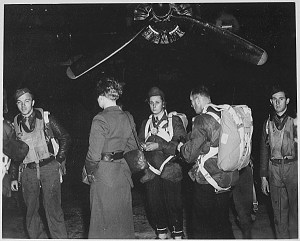
At around 12:45 a.m., the men were ordered topside. Wasting little time, the engineers quickly gathered their gear and began filing out onto the open deck and into the darkness. The men moved quietly to the transport’s side and descended rope ladders to the LCVPs (landing craft vehicles, personnel) that waited below.
Once loaded-an operation requiring careful coordination in the rough seas-the LCVPs moved to their assigned staging areas, where they were to circle until the order was given to proceed to shore. What followed was a grueling half-hour wait, just what many of the engineers had desperately hoped to avoid. Trapped aboard their small landing craft, some men were again suffering from severe seasickness, their stomachs churning as wildly as the sea around them. indeed, few men were immune to the turbulence, and all prayed for a quick escape from the ordeal.
Finally, the waiting ended and the journey to shore began. Rough seas had forced many of the landing craft out of position, causing considerable confusion among their operators. At this point there were no communications between LCVPs. Only through the leadership of Colonel Darby, who had strategically positioned himself aboard a guide boat with megaphone in hand, were the operators able to re-establish any semblance of order in their formation, although not before a searchlight from shore had switched on to illuminate the approaching boats for enemy gunners.
At 2:40 a.m., just seconds after the formation’s initial thrust toward the beaches, there was a sudden, huge explosion, and the engineers watched as a fireball momentarily lit up the beach where they were to land. The enemy had blown up a center section of the concrete pier with a series of preset charges. A special American team that landed earlier to defuse the charges had failed to complete its task in time. Immediately following the pier explosion a second searchlight switched on from shore, and a few artillery rounds began to splash into the sea ahead of the first wave of LCVPs.
The Navy had so far remained quiet, holding its fire until the last possible moment. At 3: 10 a.m., to the relief of the men heading for shore, the destroyer Shubrick was given permission to open fire, and its main batteries quickly knocked out both searchlights.
Intense gunfire suddenly erupted on both sides. The night sky and distant shoreline were instantly ablaze with tracers crisscrossing in wild patterns, punctuated by the flash and boom of ear-shattering explosions. The oncoming American invaders hunkered down within the semiprotection of their craft’s steel exterior. Safety had become a priority for the moment.
By 3:15 a.m., the gunfire had intensified. Machine-gun bullets were ricocheting off the landing craft, and mortar rounds were splashing the sea with greater regularity. The Rangers were just beginning to land. Several of their landing craft had already taken direct hits, and casualties were mounting for both battalions. For the engineers, however, progress so far remained unhampered. But as they drew near the beach, Dziuban and his men found their landing would not be made without some anxious moments.
Two hundred yards from the beach, one craft carrying members of Company B received a direct hit, quickly took on water and capsized with its full complement. Miraculously, no one was lost-thanks in part to the swimming skills of the company’s medical officer, Lieutenant Albert Thompson, who pulled to safety the only man who could not swim.
No other craft took such devastating hits, but there was another problem approximately 100 yards from shore, stretching the length of the beach, was a sandbar. Riding in one of the lead LCVPs, Lieutenant Arthur Dolan, executive officer for Company B and 1st Platoon commander, was standing up forward next to the ramp, ready to lead his men into combat. His landing craft was some distance from shore when it suddenly ground to a halt.
The boat had struck the sandbar, throwing all the men forward. Dolan’s medical officer, who had been perched upon the crafts platform at the rear, sailed through the air above them as a sudden burst of machine-gun fire snapped and crackled around the craft. One round perforated the high-flying medicat officer’s canteen that held his ‘personal medicinal alcohol. The Doc’s heartfelt expletive could be heard through the confusion, followed by, There goes my booze!
The ramp of Dolan’s craft flew open, and a rush of sea water flooded its interior and forced the men into a premature departure. Stepping out into deep water, Dolan ordered his men to activate their Mae West preservers and make for shore as best they could. Minutes later, exhausted and having discarded much of their equipment along the way, they reached the beach. Again, no one was killed.
The experience of Dolan and his men was not an isolated event. Several other landing craft also blundered into the sandbar. Yet, for the most part, the engineers landed unscathed.
After landing with Company C, Major Dziuban promptly established radio communications with Colonel Darby. He learned that the Rangers-especially the 4th Battalion-had run into stiff machine-gun fire, heavy concentrations of barbed wire and, somewhat unexpectedly, mines. The fishing boats had proved to be derelicts.
By the light of high-bursting flares Dziuban watched his men, many of whom were exhausted from their trek to shore, struggling across the beach to some safety at the edge of the rising ground. Machine-gun tracers laced the engineers’ way ahead, but the major had no immediate reason to be discouraged. Far from it. Aside from a few minor injuries, he had no reported losses. And while moving west along the beach to meet Captain Arendale, who had been mistakenly landed east of the pier, he learned that the center section of the beach was clear of barbed wire and anti-personnel mines. Anti-tank mines were present but posed no serious threat to the engineers. The enemy machine-gun fire was, for the most part, poorly aimed and lacking concentration. As a result, company commanders were able to reorganize so quickly that the engineers were actually ready to move into town ahead of the Rangers.
When the Rangers were in position, Dziuban ordered his men forward. They ran into trouble at once. Two active pillboxes combined their fire to completely pin down both Companies A and B.
The stalemate lasted for several minutes. Then Sergeant Harold Gilbert of Company B jumped up, ran to the nearest pillbox and tossed a grenade through its firing point. A dull thud was followed by silence from both pillboxes. Then a white flag appeared above the second. Gilbert finished his daring escapade by rounding up the humbled occupants, capturing eight Italians, including two officers.
The quick surrender of the pillbox crews typified the halfhearted resistance the Americans encountered throughout the occupation of Gela. For the most part, the Italian defense crumbled quickly. Two determined snipers, one in a church belfry and another behind a stone wall at the end of a dead-end side street, did cause the engineers a slight delay in their advance. Despite that, by 5:15 a.m.less than two hours into the ground campaign-the engineers and Rangers successfully reached their assigned objectives at the north edge of town. Every pillbox in the northern sector surrendered before firing a single shot. Mopping up continued for a time, but by 8 a.m. all resistance in Gela had ceased.
Indeed, the operation had progressed so well that back at the beach a platoon of engineers from Captain Hanson’s Company A was having difficulty accommodating the unexpected swell of POWs. At least 200 Italians had surrendered up to that point, and more were arriving with each passing hour.
So many prisoners showed up that soon the makeshift wire holding pen was filled to capacity, eventually requiring the compound to be opened up to allow the POWs some movement outside its barrier. Even so, the Italians required little attention. They made no attempt to escape their American captors.
A short distance from the POW compound, men of the 83rd Chemical Weapons Battalion had been hurriedly working to set up their 36 tubes of 4.2-inch mortars. Like the engineers, they too had had trouble with the sandbar, which hampered their getting to shore with the heavily laden two-wheel carts containing their equipment. Except for some Italian field guns captured by the Rangers, the 83rd’s mortars were the only heavy weapons momentarily ashore at Gela. With an enemy counterattack expected, it was time to get the mortars into position.
The counterattack came at 9:30 a.m., when a column of 13 Italian Renault R-35 tanks supported by infantry (elements of the reserve Mobile Group E, stationed at Niscimi) was spotted advancing toward town. Naval gunfire slowed the advancing armor, destroying several of the tanks and sending the infantry scurrying for cover, but at least seven of the tanks reached the streets of Gela.
Neither the Rangers nor the engineers were sufficiently armed for such a confrontation. Since 60mm mortars and .30- caliber machine guns were the heaviest weapons carried by the Rangers, they were at a distinct disadvantage against the tanks. The engineers were not equipped much better, with only .30-caliber machine guns, bazookas, some pole charges and a few borrowed anti-tank Teller mines, originally planted by the Italians, to augment their firepower. Nevertheless, into battle they went.
Colonel Darby anticipated the armor’s penetration and had taken his jeep back to the beach in search of some assistance. He was lucky enough to locate a 37mm anti-tank gun as it was being unloaded from a landing craft. Commandeering the weapon, he raced back to town, located the first of the advancing tanks and personally blasted a hole through its turret.
The colonel’s position would face no further challenge. Shortly after moving into town, the second tank had run into a determined squad of Dziuban’s engineers led by Lieutenant Dee Baker of Company B. Baker and his men concentrated their fire with rifle grenades and bazookas on the Renault’s wheel and tread assemblies until it was finally stopped. The engineers then continued their fire until the tank was totally destroyed.
A third tank was disabled under similar circumstances. The remaining four retreated under a torrent of harassing fire from both the engineers and the Rangers.
Meanwhile, at the west end of the engineer sector, Company C was busy helping the Rangers repel an attack by a battalion of Italian infantry (an element of the 4th Livorno Division) advancing from the direction of Butera. The enemy soldiers were approaching across open ground in an unusual close-order formation, fully exposed to the American gunners. It was a baffling move by the Italians, who seemed to have a death wish. Every weapon at the Americans’ disposal-captured field guns, the 83rd’s mortars and offshore naval gunnery-rained devastation upon the hapless Italians. As a result, not one enemy soldier reached Gela.
Six miles east of town and fighting his own battles was Lieutenant John Pacer, motor officer for Company B, who was trying to locate and bring forward the battalion’s heavier equipment. Due to the unexpected loss of the concrete pier, all LSTs (landing ships, tank) had been diverted to a beach in the 1st Infantry sector. It was there that Pacer’s nightmare began.
The beach was mass confusion-men, machinery and equipment everywhere and moving nowhere. Despite the chaos, Pacer managed to get aboard the only LST (388) that was unloading and was fortunate enough to locate some of what he was looking for, including desperately sought M2 halftracks needed back at Gela. At 10 a.m., just as the lieutenant was beginning to make progress with the unloading, three German Messerschmitt Me- 109 fighterbombers suddenly attacked the beach area, dropping two bombs that straddled the LST on which Pacer stood. The explosions sent a shower of deadly shrapnel throughout the immediate area without causing any serious damage or casualties.
Shaken but unharmed, Pacer checked himself and his equipment for damage and went back to work. His equipment retrieval effort was stymied by a friendly sentry. No sooner had the lieutenant gotten his equipment to shore than the sentry guided the vehicles into soft sand, where they sank up to their axles. Pacer had little choice but to return to Gela empty- handed, reporting his delay to a very disappointed Major Dziuban.
Pacer was not the only engineer with problems on the beach. Captain Hanson was deliberating his own unloading problem. LSTs loaded with medium tanks were beginning to reach shore, and they needed at least a mile of cleared area to unload. Teller mines as well as S anti-personnel mines were known to be all along the beach. The battalion’s mine detectors remained with the trucks and halftracks on the other beach, which left the captain but one option. His men would have to probe with their bayonets to locate each mine.
Hanson had to decide if the desperate need for the tanks ashore was worth putting his men at extra risk. The enemy’s armored counterattack quickly supplied the answer: The risks were indeed necessary. Sending a platoon down the beach, the captain had his engineers probe until the pattern in which the mines had been laid could be determined. Then, deliberately ignoring the very real threat posed by the S mines, Hanson ordered his men to step off the pattern to locate the rest of the Tellers. The procedure worked. Soon the mile of beach was clear and the tanks were rolling ashore. Remarkably, all was accomplished without a single casualty.
That afternoon and evening, the area around Gela became considerably quieter. Air attacks from both the Luftwaffe and Regia Aeronautica continued throughout the period, but most were against the offshore shipping. Still, the battle for the town was far from over.
As expected, at 7:30 on the following morning the counterattacks recommenced. On the east side of town a heavy- armored battalion of the reserve German Hermann Goring Division began advancing from the direction of the Ponte Olivo airfield toward the 1st Infantry sector. A little farther west, an infantry battalion of the Livorno Division was again advancing south toward the north edge of Gela.
Major Dziuban, who had established his headquarters in the cellar of a house on the north edge Of town, watched the advancing enemy. He had not gotten much rest during the night-an infestation of sand fleas had seen to that-but his spirits were high. One reason for his good frame of mind was the arrival of the battalion’s half, tracks. Lieutenant Pacer had finally gotten through. Dziuban was also aware of other additional strengths. The 531st Engineers had arrived ashore to assume the beach duties, allowing Hanson’s company to move up. Several medium tanks were now forward, and additional field batteries had arrived during the night. The engineers and Rangers were in a much better defensive posture than the day before.
Nevertheless, the Italians and Germans put the American defenses to a serious test. The attack from the north was strong and preceded by a heavy artillery bombardment. The engineers and Rangers, however, were unshaken by the enemy thrust and responded in fierce fashion.
Again, as on the previous day, they rained down a deadly concentration of fire upon the Italians. As a result, the enemy advance faltered, though it continued to within 800 yards of the town before being brought to a complete stop. What remained of the force dug in and put up a halfhearted and disorganized resistance. Soon, an engineer-led halftrack offensive overwhelmed the weakened opposition, resulting in the capture of an additional 300 Italians.
Meanwhile, a second attack developed on the northwest side of town. Another infantry battalion of the Livorno Division was again attempting an approach along the Butera Road. There, too, the Italians were greeted warmly. From their advantageous positions the Rangers unleashed an artillery bombardment on the advancing enemy, sending the Italians back their own ammunition courtesy of the previously captured field guns. The attack slowed. The 83rd Chemical Weapons Battalion added some of its firepower, and the attack slowed even more. When supporting fire from the cruiser Savannah contributed a shower of 6-inch high-explosive projectiles, the attack staggered to a complete stop.
From nearby positions, Captain Hanson and his men had a spectacular view of the decimation rained on the Italian column. It had been an awesome display of power. just arrived at Hanson’s position, Lt. Gen. George Patton, commander of American forces engaged, had also observed the scene. Patton was not as impressed as the others and ordered Hanson forward to personally reconnoiter what remained of the enemy’s strength.
Orders are orders. The captain grabbed four men, jumped into a halftrack and headed up the Butera Road, where his halftrack almost immediately came under fire. Moving off the road and into a meadow, Hanson and his men then got into a firefight with a group of Italians positioned in a nearby gully. Raking the area with the halftrack’s .50-caliber machine gun, Hanson continued forward. Finally, however, his transport sustained a minor hit from a hidden anti-tank gun, which forced him to call off the sortie and retreat.
Upon his return, Hanson reported his observations to Patton. The enemy appeared disorganized yet seemed to be digging in to hold their ground. Dziuban, who had also arrived on the scene, sent two additional halftracks, supported by two medium tanks, to circle behind the enemy positions. This time the results were surprisingly different.
The advancing halftracks located an Italian field hospital full of wounded. Then, as they sought information from the hospital’s staff and patients, the engineers were suddenly overwhelmed by a large body of enemy soldiers bearing white, flags. They had been badly mauled by the earlier bombardment, suffering casualties as high as 50 percent. They were finished and unwilling to fight on. When the halftracks returned, trailing behind them came a column of some 450 Italian POWs.
East of town, a battle with German armor continued, and it too was destined to end as another American victory. Throughout the nighttime hours, air attacks also continued. Although they were largely ineffectual, the air attacks indirectly led to the accidental shooting down of several incoming American transports, resulting in a number of casualties among the men of the 82nd Airborne. Despite this setback for the Americans, at 3 a.m. on July 12, the battle for Gela finally ended, and the push toward the strategically important city of Palermo began.
At Gela, the 1st Battalion, 39th Combat Engineers, had performed beyond expectation. Dziuban’s men had done all that was asked of them and more. Soon after, the rest of the regiment was to join them. The complete unit would proceed across Sicily, building 97 bypasses and shoveling rubble in seven cities along the way.
In Italy, too, the engineers of the 39th were destined to continue their valiant effort, taking part in both the Salerno and Anzio landings, the capture of Rome and the vicious battles for the Po Valley. During the Italian campaign the 39th would fight its way through enemy territory while building 77 bypasses, 123 culverts, 24 major roadblocks, seven airstrips and a floating footbridge. And that is only a partial listing of the engineers’ accomplishments.
On July 12, Major Dziuban was thrown from a halftrack when it struck a mine along the Butera Road. Under enemy fire and with a fractured wrist, he returned to the burning wreck to pull a wounded man to safety. Dziuban’s heroism was noted by all who served with him. Yet the battalion commander always shied away from attention and focused instead on his men. At the end of the Sicilian campaign, Dziuban would proudly say to those who had served him so well, We take our hats off to no one in the quality of our soldiering, combat ability and engineer work.
Certainly the 39th’s record, beginning with its support of Darby’s Rangers at Gela, was never to prove his proud statement false.
This article was written by Rex A. Knight and originally appeared in the September 2001 issue of World War II magazine. For more great articles subscribe to World War II magazine today!