
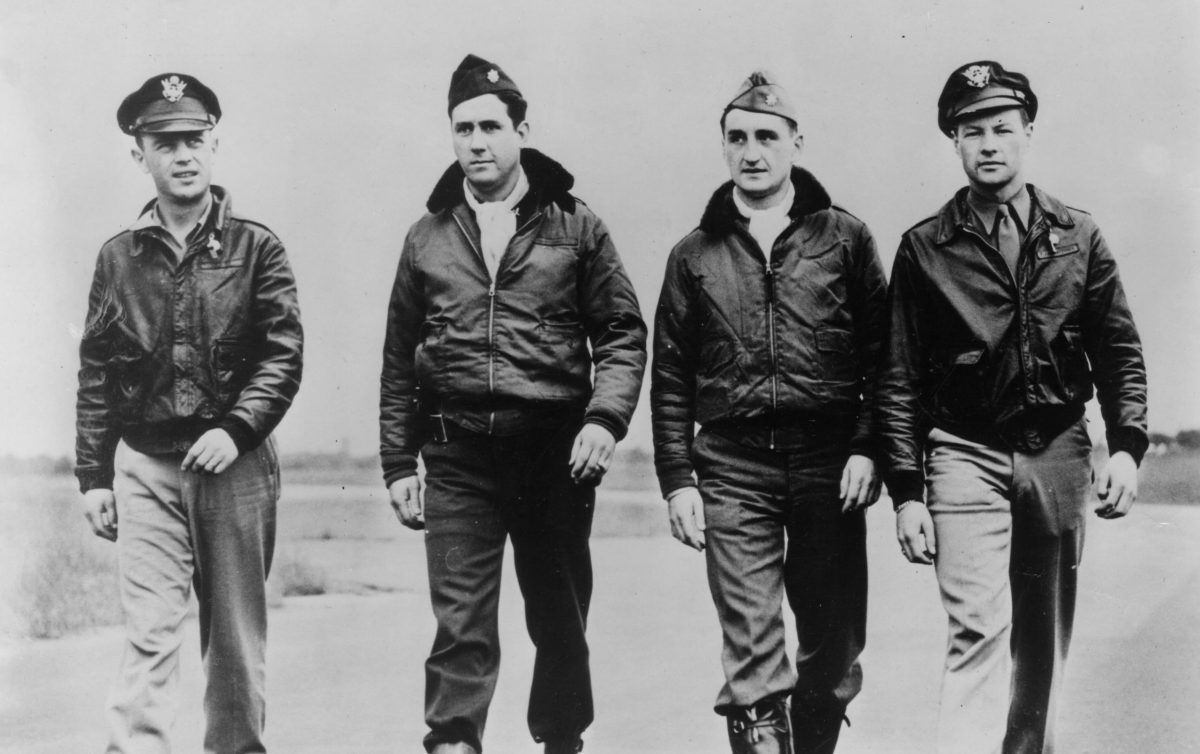
As the survivors of the 56th Fighter Group straggled back in over the British field, their commanding officer came down out of the control tower to meet them. Lieutenant Colonel Hubert “Hub” Zemke had listened in helplessly to the radio chatter as his men met the enemy over German-occupied Holland for the first time. It was April 1943, and the Luftwaffe was still a formidable fighting force; from the confused radio traffic Zemke could tell the combat had not gone well. Missing from the running commentary was the voice of Major Dave Schilling, the 62nd Squadron commander to whom Zemke had entrusted the mission. Now, as Schilling’s plane put down, Zemke took a jeep over to find out what had gone wrong.
The major’s fighter, Hairless Joe, had taken some hits. But the radio, Schilling explained, had gone out before the group ever reached the Dutch coast. Rather than abort, the dashing but impetuous Schilling had retained command and, upon sighting a pair of bandits, had led the 62nd’s attack. Scoreless, ambushed by Messerschmitt Bf-109s and Focke-Wulf Fw-190s, they and the group’s two remaining squadrons, the 61st and 63rd, belatedly escaped back over the English Channel. Many of the missing pilots, their aircraft running low on fuel, had simply set down at the first English airfields they came across, but two did not return. It had been, as Zemke later recalled, “an ignominious combat debut.”
Another commander might have taken it as an indictment of his own leadership skills. Zemke had joined the 56th only the previous year, a 28-year-old lieutenant with experience only as a combat observer in Great Britain and as a fighter pilot instructor in Russia. Zemke’s uncle had died flying for Germany in 1916, and two cousins were killed on the Russian Front while Zemke was in Moscow. In the rapidly expanding U.S. Army Air Forces, however, promotion came easily, and he had risen quickly to captain, then major, and ultimately, as a lieutenant colonel, was placed in command of the group. That the 56th had lost 18 men even before shipping for England he attributed to the combination of inexperienced, gung-ho flyboys and a brand-new, trouble prone fighter–Republic’s P-47B Thunderbolt, the “Jug.”
“The pilots were all eager young fellows who thought the Thunderbolt was a terrific fighter simply because they had flown nothing else,” said Zemke. Above 20,000 feet the P-47 was capable of speeds up to 400 mph and the quickest roll rate of any fighter in the U.S. inventory. But even with a turbosupercharged Pratt & Whitney R-2800 Double Wasp radial engine capable (in later models) of 2,800 hp, the plane required almost a half-mile run just to get 50 feet off the ground. Zemke noted that the aircraft “accelerated poorly and climbed not too much better from a slow airspeed” and that “overall the P-47 was a big disappointment.”
In England, the 56th took over an ex-RAF (Royal Air Force) grass strip at Horsham Saint Faith, Norfolk County. (When he was turning over the airstrip to Zemke, Schilling, and pilots Goldstein, Shiltz and Altschuler, the Royal Air Force station chief grinned, saying, “Sounds like I’m handing over to the Luftwaffe!”).
Equipped with new P-47Cs, they joined the 4th Fighter Group on a couple of “rodeos”–fighter sweeps intended to lure the Luftwaffe into combat, but Zemke had to abort because of an oxygen system malfunction. And on the group’s first “ramrod”–a bomber escort mission for which the P-47, with its blunt, high-drag nose and resultant short range, had never been designed–his own radio went out. (Because of faulty ignition systems, early model P-47s suffered from inordinate radio static.) His men bounced some bogeys over Walcheren Island and knocked one down–realizing too late the fighters were British.
In all fairness, the RAF had strayed from its assigned area, and in the heat of combat even experienced pilots sometimes failed at aircraft recognition. But in view of his group’s dismal record (and aware that his two aborts could be construed as a failure of nerve rather than equipment) Zemke, upon his promotion to bird (full) colonel, suspected he would be bumped upstairs to make room for a more capable group commander.
Finally, on June 12, the 56th flew another rodeo, 20,000 feet above Pas de Calais. German Jagdgeschwader (Fighter Wing) 26 had made these skies so much its own that its pilots were known to Allied airmen as “the Abbeville Boys,” named after the town where they were based. By flying 10,000 feet lower than usual, the group caught JG 26 by surprise. Over Ypres, Belgium, Schilling led the 62nd Squadron’s “Blue Flight” down after a Staffel (squadron) of Fw-190s, but as the Jerries scattered, a Schwarm (flight of four) moved around into kill position on Blue Flight’s tail.
Still “upsun,” Captain Walter Cook saw the trap and led “Yellow Flight” down to the rescue. He opened fire on the trailing Focke-Wulf from 300 yards. “Suddenly a big ball of fire appeared on his left wing and then black smoke poured out,” recalled Cook. “He rolled to the left, went over on his back in a gentle roll, and then went into a violent spin, with smoke pouring out from the fuselage and wing. At no time did the pilot take evasive action, and I believe he was killed.”
The next day, again over Ypres, Zemke led the 61st Squadron down behind a Schwarm of Focke-Wulfs, pulling to within 200 yards of the fourth aircraft. Zemke remembered that a split second after he fired at the plane, “the fuselage burst into flames and pieces of the right wing came off.” The third enemy plane twisted away with only minor hits on the starboard wingtip, but the number two plane “sat in the gunsight as one would imagine for the ideal shot. Again, when the trigger was pulled this aircraft exploded with a long sheet of flame and smoke.”

Meanwhile, the 61st’s Lieutenant Bob Johnson, an aggressive Oklahoman chafing in the “Tail-End Charlie” slot of his flight, left formation to make a solo attack–on no less than the enemy leader. “I didn’t think that this was a Focke-Wulf,” Johnson recalled, “or that the man inside was a German, or that if he managed to whirl that black-crossed airplane around, then four cannon and two heavy guns would be hurling steel and explosives at me.”
Johnson flamed the Fw-190 with his first burst. For abandoning formation, however, he was chewed out by his flight leader, Lieutenant Jerry Johnson (no relation), his squadron leader, Major Francis “Gabby” Gabreski, and finally by Zemke himself, whose leadership style had not been softened by his own double kill. “I doubt I endeared Bob to his group commander,” Zemke later reflected. “Privately, it was good to know I had pilots of such aggressive caliber.”
As it turned out, all four men were to race each other in downing German aircraft. For the time being, Bob Johnson swore, “The Krauts are going to have to shoot me out of formation.”
Two weeks later he made good on his promise. His P-47, Half Pint, was again bringing up the rear when Johnson spotted 16 more fighters above and behind– Focke-Wulfs, the Abbeville Boys, diving in for the kill. He called out a warning to the rest of the group, but for a fateful second nobody moved. Johnson held position, a perfect target, as the Germans raked him with fire–and then his P-47 was spinning downward, out of control, with the canopy jammed shut, trapping him in a cockpit full of fire.
The speed of his dive blew out the flames. Johnson managed to coast his crippled mount toward the Channel. Just when he thought he had made good his escape, a lone Fw-190 joined up behind him. Unable to dogfight but unwilling to just sit there and take it, Johnson used his lack of speed to force the Focke-Wulf into an overshoot so that he could turn the tables. Easily evading Johnson’s fire, the German circled back to shoot him up twice more. Still Half Pint refused to go down; finally, the German gave up, rocked his wings in grudging salute and turned back. With 21 cannon hits and more than 100 bullet holes in his Jug, Johnson made it across the Channel to a no-flaps, no-brakes landing at an RAF base near Dover, ground-looping to a stop between two parked Hawker Typhoons. That day the 56th scored two kills–including one by Kentucky quail hunter Jerry Johnson–but lost four of its own.
In July, when a bomber group took over Horsham Saint Faith, Zemke’s men relocated to a half-built base at Halesworth Suffolk. Upset with the second-rate treatment his command seemed to be experiencing, Zemke joined a group of Eighth Air Force bomber commanders in a gripe session. The 4th Bomb Wing’s Colonel Curtis LeMay (chief of the postwar Strategic Air Command) complained that the only fighters he had seen so far “all had black and white crosses on them,” but declared his bombers would carry on “with or without fighter escort.” Later, in the officers’ club, another bomber general stated he “wouldn’t pay a dime a dozen for any fighter pilots.” Zemke hurled his pocket change at the man’s feet: “Here, General, this is all I have handy at the moment,” he responded. “Any time you have a couple dozen fighter pilots handy send them my way. We can sure use them.” Then he jumped in his Jug and buzzed the place.
The bomber crews had good reason to be edgy. They were about to depart on one of their bloodiest missions, the first Schweinfurt-Regensburg raid. After escorting the B-17s part way to Schweinfurt, the 56th returned to Halesworth and took on 200-gallon, pressed-paper ferry tanks converted for combat use. These upset the Jugs’ handling and did not feed well in the low air pressure above 20,000 feet, but they gave the Thunderbolts enough range to meet the bombers over Germany.
The Thunderbolts proceeded to teach a Staffel of twin-engine Messerschmitt Bf-110 night fighters (Me-110s to American fighter pilots) not to venture out in daylight. “The 61st Squadron came screaming down from the front and caught an Me-110 right over the last box of bombers,” Zemke recalled. “Two P-47s shot at this guy at the same time–sixteen guns firing–and both of them hit him simultaneously. That Me-110 blew up as I’ve never seen anything blow up and fell, on fire, directly through the bomber formation…without hitting one of them.”
One of the Bf-110 shooters was Jerry Johnson, who downed two more Germans in quick succession–the 56th’s first triple kill, except that he had to split credit for the Messerschmitt. (Two days later, Johnson got a Bf-109, which could have made him the 56th’s first ace. Instead, his score stood at 4 1/2.)
Zemke, having gotten a Bf-110 himself, estimated the combat at no more than seven minutes long, but at that distance from base, fuel was already running low and he ordered a return home. From well to the north, however, Captain Bud Mahurin called back, “We’ve got ’em cornered. There’s plenty for everyone. Come on up this way.”
Soon after Zemke’s run-in with Bomber Command, Mahurin had gotten a little too close to one of the new Consolidated B-24 Liberators in formation and his Thunderbolt’s tail had been sucked into the bomber’s props; the four-engine B-24 had straggled home, but Mahurin had barely escaped from his falling Jug. Now he saw his chance to make amends–he had spotted a Focke-Wulf above the bombers, preparing to turn down into them. Mahurin recalled, “I sneaked up behind it and started to fire from about 300 yards, closing to 200 yards. It blew up.”
Mahurin and his wingman circled up through the bomber stream onto the tail of a second Fw-190. “We followed him until he started to make a turn into the front end of the bombers,” said Mahurin, “when I took a deflection [angled] shot at him and watched him blow up.”
Not one to hold a grudge, Zemke recommended Mahurin for the Distinguished Flying Cross. Later it turned out one of his kills was none other than the commander of II Gruppe JG 26, Oberstleutnant (Lt. Col.) Wilhelm “Wutz” Galland, brother of the famous Luftwaffe General of Fighters Adolf Galland and himself a 55-victory Experte (ace). His body was found in his aircraft two months later, driven by the force of impact 12 feet into the ground.
Bomber Command lost 60 of the 375 bombers on the mission. But the 56th, scoring 17 confirmed, one probable and nine damaged, prevented even more slaughter. “We had certainly broken up several German attacks,” Zemke said.

In August 1943, the 56th’s top guns began to distinguish themselves. Gabreski scored his first kill, Bob Johnson scored his second, and Zemke his fourth. In September, Zemke led the group on its longest mission yet, a 250-mile ramrod to Emden, Germany. (The P-47s had received new 75-gallon underwing tanks made of metal and pressurized to feed at all altitudes.) Spotting a lone Focke-Wulf stalking a straggling B-17 several thousand feet below, Zemke dived and fired from 500 yards: “Immediately strikes were registered all over the aircraft. Surprisingly, the Focke-Wulf flew on in a straight line. Another burst brought smoke and flame, and a third caused the left undercarriage leg to drop. Only then did the stricken plane fall away in a vertical dive. As no evasive action had been observed, I concluded the first burst had killed the pilot.”
That made Zemke the 56th’s first ace, by a narrow margin. Schilling, who had not scored a victory in 52 missions, got two that same day and three more by October 10, when Bob and Jerry Johnson each got their fifth. With four of the five American aces in the European Theater of Operations (ETO), the 56th never looked back, scoring its 100th kill, a Messerschmitt Me-210 (by now even Messerschmitt used the “Me” designation), on November 5 (at this time Major Eugene Roberts of the 78th Fighter Group claimed eight kills). On November 26, during a ramrod to Bremen, Zemke’s Wolfpack (the nickname given to the 56th) scored an ETO record: 23 confirmed, three probable and nine damaged, including two for Gabreski.
A second-generation Pole who had flown a Curtiss P-40 Tomahawk during the Pearl Harbor attack and a Supermarine Spitfire Mk. IX with the Free Poles in RAF service, Gabreski barreled down on a pair of Bf-110s that dived away–always a mistake against the fast-diving Jug. “I closed in rapidly behind them and opened fire on one at about 700 yards range…suddenly I was right on top of the 110. I just barely had time to push the control stick forward and duck below the burning German fighter.” Regaining height, Gabreski dived after a second Bf-110. “This time I slowed my approach slightly, though we were still traveling at about 420 mph when I opened fire from 600 yards. The 110 took solid hits in its wing root and rolled over into a death fall at 14,000 feet.”
Kills four and five were racked up by Gabreski; Schilling and Cook also scored doubles (Cook likewise achieving ace status), and Mahurin got three more Bf-110s to become the ETO’s first double ace. By March 1944, with 20 kills, he ranked as its highest scorer, with Bob and Jerry Johnson right behind him. The 61st Squadron became the first in the ETO with 100 victories to its credit; the group’s tally stood at 300. That month the Luftwaffe lost 22 percent of its pilots, a blow from which it never really recovered, and the 56th flew a ramrod all the way to Berlin and back without meeting a single enemy fighter.

Then, on March 27, while shooting down a Dornier Do-217 bomber south of Chartres, Mahurin was hit by its rear gunner: “I could see the shadow of my airplane with a great long trail of black smoke following me,” Mahurin recalled. He bailed out and was last seen running for a tree line. And Jerry Johnson, with 18 kills to his credit, was hit by groundfire while strafing a truck convoy and taken prisoner after bellying in. Mahurin made it back to England via the French underground and an RAF rescue plane, but he was not permitted to risk capture–which might mean having to reveal the secrets of his escape route–again. Transferred to the Pacific theater, Mahurin scored another kill before the war’s end, as well as 3 1/2 MiGs in the Korean War, before being shot down again and captured by the North Koreans.
So the mantle of high scorer passed to Bob Johnson. By early May 1944, near the end of his combat tour, Johnson led the ETO with 25 victories, just one less than World War I ace Eddie Rickenbacker. Returning from his last mission, an uneventful ramrod to Berlin on May 8, he rolled onto the tail of a passing Bf-109. The Jerry banked left, but Johnson rolled inside his turn. “We were real close,” Johnson recalled. “Close enough that I could see the pilot look back over his shoulder as I opened fire. He went into a dive but I kept right on his tail pouring fire into him. Suddenly his left wing came off and the fighter spun in. That made 26!” When his Numbers three and four chased a flight of Focke-Wulfs into a cloud, only to re-emerge with the Germans on their tails, Johnson scared off the lead Fw-190 with a few bursts. “I swung my nose to bear on the second plane. Hits! All over the wings and wing roots, and there it was. Number Twenty-seven…my last mission couldn’t have been more perfect.”
By now the Wolfpack, flying out of Boxted, Essex–and accounting for more than 400 kills–had developed P-47 tactics to a high art, diving to the attack and zooming back up to safety. From that strategy evolved group tactics: a lead squadron flying low, covered by the second at medium altitude, with the third high up in reserve. Spreading out ahead of the bombers to sweep the skies clean of German fighters–the “Zemke Fan”– the 66th Fighter Group presented an awesome array of aerial firepower.
On June 27 Gabreski downed a Bf-109 to match Bob Johnson’s score, and on July 5 he shot down another Messerschmitt near Evreaux. So Gabreski had 28 aerial kills (and 2 1/2 on the ground) and the ETO had a new high scorer. But like Johnson before him, “Gabby” was nearing the end of his tour. On his last day, July 20, he took time off from a ramrod to Frankfurt to strafe Bassinheim Airfield and set a parked Heinkel bomber afire. “At that time our policy was to make one pass on an airdrome and get out,” he recalled, “because the flak gunners were always ready and waiting if you tried to come back for more. But I figured the flak had been so light that I could get away with another pass.”
Coming back in right down on the deck, Gabreski saw his tracers pass over another He-111. Without thinking, he dropped the nose–and the P-47’s big paddle prop clipped the ground. With no hope of returning to England, Gabreski bellied into a wheat field and was captured. (He went on to fly North American F-86 Sabre jets over Korea–as Mahurin’s commanding officer–downing 6 1/2 MiGs.)
Of the 56th’s original aces, only Zemke and Schilling remained. Offered command of the 479th Fighter Group–P-38 Lightnings–Schilling refused (“Hell no, not P-38s”) and was stunned when Zemke took it instead. “There was only one group Dave wanted…and deserved to command,” said Zemke. “And for me there was need of a new challenge, a new purpose…[but]…behind me was the greatest command of my service life.” (By giving up his P-47, Zemke shortened his war. He scored two kills with the 479th, bringing his final aerial tally to 17 3/4, but on October 30, on escort duty over Germany, the North American P-51 Mustang he was flying that day came apart in a thunderstorm. Zemke got out safely, only to be captured.)
Zemke’s departure marked the Wolfpack’s darkest chapter. On September 17 the group was handed the dirtiest ground-attack work of all: anti-aircraft suppression in support of the ill-fated Allied airborne invasion of Holland (Operation Market Garden). In two days of dueling with flak sites, Schilling’s men took out 34 emplacements, but 17 P-47s were destroyed and a dozen damaged. Two pilots became prisoners-of-war and four were killed. The group’s old nemesis, JG 26, got through the dazed P-47 pilots the next day to knock down 17 helpless troop transports.
Fortunately, October 1944 was a quiet time for the Eighth Air Force. The Luftwaffe was saving its precious planes and fuel reserves for the grosse Schlag–the “Great Blow,” or Ardennes offensive, in which the Germans hoped to prevent the invasion of their fatherland. As they planned, foul weather initially curtailed Allied fighter cover. Not until December 23 could Schilling lead his men over the battleground, where he lost track of two consecutive enemy formations in the clouds. He angrily took his ground controllers to task, and they replied, “Don’t worry about it! There’s bigger game on this heading!”
There was. A large enemy formation was located below and 40-plus more were flying ahead, including new Focke-Wulf Fw-190D “long-nosed” high-altitude fighters. Sending the 61st and 63rd down to attack the Germans below, Schilling brought the 62nd around behind the group that was ahead. “I managed to hit the right rear Me-109 with about a 20-degree deflection shot at a range of about 700 yards,” Schilling recalled. As the Messerschmitt dropped off, Schilling moved up on the next in line, setting it afire. “I then picked another and fired at about 1,000 yards and missed as he broke right and started to dive for the deck. At about 17,000 feet I had closed to about 500 yards and fired, resulting in a heavy concentration of strikes, and the pilot bailed out.”
Now separated from his flight, Schilling spotted 35 to 40 Focke-Wulfs circling 1,000 feet below him. “I repeated the same tactics as before and attacked one from about 500 yards range.” As the Fw-190 went spinning downward, Schilling latched onto a fifth, which put up more of a fight: “He immediately took violent evasive action, and it took me several minutes of maneuvering to get in a position to fire. I fired from about 300 yards above and to the left, forcing me to pull through him and fire as he went out of sight over the cowling….The pilot immediately bailed out.”
Hooking up with a stray 63rd Squadron pilot, Schilling looked for a sixth kill, but when his wingman was attacked he broke off to help him out. Both escaped. When all the gun-camera film was sorted out later, the Wolfpack had chalked up its best day ever–34 enemy aircraft destroyed. Their tally now stood at more than 800–25 percent of the Eighth Air Force total. (Schilling, who was awarded the Distinguished Service Cross, soon moved up to join 65th Wing Headquarters, finishing the war as a full colonel with 22 1/2 aerial and 11 1/2 ground kills.)
After that, the 56th’s only real challengers in the air were the new Messerschmitt Me-262 jet fighters. The Wolfpack had downed jets before with lucky passing shots or by catching them over their runways. They had stuck with the Jug when all other groups went to P-51s, and were the sole recipients of the P-47M–upengined to produce 465 mph (more speed than a Mustang)–with which they could handle combat on the jets’ terms. On April 5, 1945, a Wolfpack pilot actually ran down a 262 in a shallow dive. Attempting to outturn the P-47, the German pilot was cut off and shot down.
On April 13, the second anniversary of its first combat mission, the Wolfpack celebrated by savaging Eggebeck Airdrome. Coming across the field at 400 to 450 mph, they fired more than 78,000 rounds of .50 caliber, destroying 91 enemy aircraft where they sat and becoming the first Eighth Air Force group to surpass the magic number–1,000 destroyed.
Later that score was reduced, but the 56th Fighter Group finished the war with 992 1/2 confirmed kills, including 664 1/2 in the air, more than any other Eighth Air Force fighter group. Furthermore, the 56th scored 58 probables and 543 damaged in the air and on the ground. At war’s end a P-47M was exhibited under the Eiffel Tower, its nose emblazoned with the legend: Zemke’s Wolfpack, 56th Fighter Group, 1,000 Enemy Aircraft Destroyed!
“A fighter pilot must possess an inner urge for combat,” Zemke said. “The will at all times to be offensive will develop into his own tactics. I stay with an enemy until either he’s destroyed, I’m out of ammunition, he evades into the clouds, or I’m too low on gasoline to continue the combat.”
For additional reading, Don Hollway recommends: Zemke’s Wolf Pack, by Hub Zemke and Roger Freeman; Gabby: A Fighter Pilot’s Life, by Francis Gabreski and Carl Molesworth; and Thunderbolt! by Robert Johnson and Martin Caidin. An article about U.S. bomber crews tangling with the Luftwaffe, “Twelve O’Clock High: Fact to Fiction,” by Chuck Dunning, can be found in the September 1999 issue of Aviation History.
This feature originally appeared in the September 1999 issue of Aviation History. To subscribe, click here!