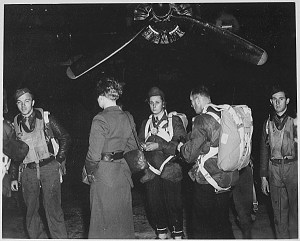

While the Boeing B-17 Flying Fortresses did their share in the air war against Germany, they were far from alone in their efforts. One-third of the U.S. Eighth Air Force’s total heavy-bomber strength was consolidated within the three combat bomb wings of the 2nd Air Division, the Consolidated B-24 Liberator division. Those three combat wings grew out of the 93rd Bombardment Group–the first B-24 group and the third U.S. Army Air Forces heavy-bomber group to see combat in the European Theater of Operations.
The 93rd Bomb Group was activated on March 1, 1942, under the command of Colonel Edward J. Timberlake at Barksdale Army Air Field in Louisiana. The initial cadre of personnel had been transferred from the 44th Bomb Group. Like the 44th, the fledgling 93rd was equipped with the four-engine B-24 Liberator heavy bomber. Built by Consolidated Aircraft, the B-24 featured the high-aspect ratio Davis wing, a new airfoil designed to reduce drag and increase lift, thus allowing heavier payloads, faster speeds and generally better performance than the older Boeing B-17. Although B-24 crews were often ribbed about the plane’s appearance by their peers flying B-17s, the Liberator was actually the more versatile airplane. Even though the slim wings made the airplane less stable than the B-17, the B-24 was a good 20 knots faster and could carry a larger bombload over a greater distance.
After initial training in the Liberator, the new 93rd moved to Fort Meyers, Fla., for advanced training prior to deployment overseas. While in Florida, group aircrews gained their first combat experience flying anti-submarine patrols over the Gulf of Mexico. The group was credited with destroying three U-boats, including one sunk by the crew commanded by Lieutenant John ‘The Jerk’ Jerstad, one of the group’s most popular pilots.
On September 5, 1942, the first flight of 93rd Liberators left for England from Grenier Field, N.H., but got only as far as Newfoundland, where they were forced to land because of bad weather. Four days later, 18 B-24s left Newfoundland and landed in Prestwick, Scotland, after flying through 8_ hours of thunderstorms, ice and strong winds. This flight by the 93rd was the first nonstop flight across the North Atlantic by American bombers. The trip was marred by the loss of one aircraft and crew at sea.
On October 8, one month after arriving in England, the 93rd flew its first mission–to the Lille-France Steelworks on the Franco-Belgian border. Colonel Timberlake and Major Addison Baker led in Teggie Ann, which was also the group’s lead ship on subsequent raids. Opposition en route and over the target was heavy; one B-24 was shot down and a second was forced to land at another base in England. Lieutenant John Stewart’s Boomerang came home with more than 200 holes, prompting the ground crew chief, Master Sgt. Charles A. Chambers, to explode, ‘Lieutenant! What the hell have you done to my ship!’ The severely damaged Liberator was earmarked for salvage, but Chambers and Stewart managed to save it. Boomerang went on to become the most famous Liberator in the Eighth Air Force.
In late October, the 330th Squadron was temporarily detached from the group for anti-submarine patrol duties over the Bay of Biscay with the Royal Air Force Coastal Command. Although no submarines were attacked during the 330th’s service with that group, Major Ramsay Potts’ crew was jumped by five German Junkers Ju-88s during one mission. The Liberator’s gunners managed to shoot down two of the enemy fighter-bombers and damage a third–the other two broke off their attack.
On November 14, the 93rd was honored by a visit from King George VI–his first visit to an American bomber base. By that time, the group had flown nine missions, including attacks on submarine pens at Saint-Nazaire and two missions to Lorient. In early December, General Ira Eaker, commander of the Eighth Air Force, ordered Colonel Timberlake to take the group to North Africa for a 10-day mission. On December 5, the 328th, 330th and 409th bomb squadrons left foggy England for the hot desert sands of North Africa, while the 329th remained behind for a special mission. The 10-day mission turned out to be a 90-day deployment, with the group operating first from Tafaroui, then moving to Gambut.
While the living conditions in Libya were atrocious, at least the crews encountered less fighter opposition there than over occupied Europe. On the other hand, the flak over the targets was intense. Missions were flown in support of Allied troops in North Africa. Then, after the Afrika Korps was pushed out of Africa, the B-24s were sent against Italian targets–Naples, Palermo and Messina. After a final mission against Cretone on February 22, 1943, the 93rd returned to England, this time to Hardwick, where the ground crew had moved while the aircrews were operating in North Africa.
The group’s operations officer, K.K. Compton, now a lieutenant colonel, remained in Africa to take command of a new B-24 group, the 376th Bomb Group. Many other 93rd staff officers and squadron commanders were given command of new B-24 groups in the European Theater of Operations.
The 329th squadron had remained in England, working with an experimental program. When that assignment ended, the squadron flew missions with the newly arrived 44th Bomb Group. Although the 44th was older than the 93rd, the newer group had been first in combat. The 93rd had thus far escaped severe damage from the enemy, but the 44th began taking heavy casualties from the onset of operations. The newly arrived Liberator group attained a reputation as a hard-luck outfit, and took to calling themselves the ‘Flying Eight Balls.’
While the 93rd was in Africa, the group public relations officer, Corporal Carroll Stewart, began issuing news releases describing the outfit’s exploits, dubbing the 93rd ‘the Traveling Circus.’ A newspaperman in civilian life, Stewart published The Liberator, the first overseas troop newspaper of the war. News releases mailed directly to U.S. newspapers made the group famous and caused great consternation among the B-17 groups. Stewart was told by a two-star general, ‘From now on you’ll work for the whole Eighth Air Force, or else.’ Stewart, along with another Eighth Air Force public relations man, James Dugan, would later write the definitive account of the most famous B-24 mission of the war, the raid on the Rumanian oil fields at Ploesti.
From Hardwick, the 93rd resumed flying missions over Europe. Several were diversions, missions flown against less important targets to draw fighters away from B-17 formations. On March 18, 1943, the 93rd bombed Vegesack, Germany. Over the target, the German fighters bypassed the accompanying B-17s to concentrate their attacks on the B-24s. One 93rd airplane was lost, but the 44th had its usual bad luck and took the most casualties. It became a joke in B-17 circles that crews were glad to see the B-24s on a mission because they knew the fighters would go after the Liberators and leave the Flying Fortresses alone.
Since there were more B-17 than B-24 groups in England, tactics in the Eighth Air Force were built around the Flying Fortress. Because the B-24s were so much faster, the Liberator pilots were forced to fly at reduced airspeeds and do a lot of jockeying to maintain the precise formations called for by Eighth Air Force policy. Consequently, the B-24 was underutilized in the strategic bombing role in Europe.
The 93rd became part of the 2nd Combat Bomb Wing in early 1943. After a short stand-down to train for night operations, the 93rd resumed daylight bombing. Missions were flown to Rotterdam, Antwerp, Brest and Bordeaux in the spring of 1943, along with several diversions for B-17 groups. The Traveling Circus crews worked with crews from newly arrived B-24 groups, teaching them the rudiments of combat flying.
In early June, the group was taken off combat operations and ordered to begin practicing low-level flying. The prospect of a low-altitude mission was frightening to the men of the Traveling Circus. They had good reason to be fearful. The 93rd was to be part of the mission code-named Tidal Wave, the disastrous attack on the oil fields in Ploesti, Rumania.
On June 25, 1943, after two weeks of low-level training over England, the 93rd departed for Benghazi, Libya, along with the 44th and 389th. The three groups made up the 201st Provisional Combat Wing, commanded by Timberlake. Command of the Traveling Circus itself had passed to Addison Baker, now a lieutenant colonel. From Libya, the three Eighth Air Force Liberator groups began flying missions against targets in Italy, where Allied ground forces were making their way toward Rome. News of ground successes in Italy made the B-24 crews think that perhaps the low-level mission they had trained for would not come off, but they were wrong.
In mid-July, the three Eighth Air Force groups began practicing for a low-level mission against the Ploesti oil refineries, along with the 376th and 98th groups from the Africa-based Ninth Air Force. Tidal Wave called for the 93rd to be the second group in the low-altitude formation, which would be led by K.K. Compton’s 376th Bomb Group.
According to the plan drawn up by Major John Jerstad, now with the 201st Provisional Combat Wing, the 93rd would strike in two sections. Section A, led by Colonel Baker, was to hit target White Two, the Concordia Vega refinery; Section B, led by Ramsay Potts, was to hit White Three, the Standard and Unirea Spearantza refining units. The Traveling Circus attacks were to be conducted simultaneously with the lead group’s attack on White One, the Romana Americana plant. Three other groups also would hit targets.
On August 1, 1943, a total of 177 Liberators took off from Libya for Ploesti–39 of them from the Traveling Circus. Extra fuel and a maximum load of bombs, ammunition and thermite sticks put each airplane well over the safe takeoff weight for a B-24. One B-24 crashed on takeoff when an engine failed after the wheels left the ground; there were only two survivors from the 10-man crew.
All went well as the formation, now down to 167 heavily laden bombers, flew onward. Brigadier General Uzal Ent and Colonel K.K. Compton led the formation in Teggie Ann, formerly the 93rd’s lead ship. Teggie Ann reached the first initial point, but four similar-looking valleys lay between it and the second initial point. As they approached Targoviste, Rumania, the 2nd initial point, 20 miles away from the 3rd initial point where the formation was to turn into a bomb run heading of 127 degrees, Compton led his formation in a turn. Unknowingly, he had taken up a heading that would miss Ploesti altogether–his group was headed for Bucharest.
Colonel Baker, with Major Jerstad in the co-pilot’s seat, saw Compton make the turn and recognized the mistake, as did others in the 167-plane formation. Several pilots broke radio silence in an attempt to warn Compton of his error. For a time, Baker followed the 376th, but halfway to Bucharest, seeing the smoke of the Ploesti refineries to his left, the 93rd commander made his decision. He turned Hell’s Wench 90 degrees to the left, away from the lead group, and headed for Ploesti–with all 38 Traveling Circus planes strung out behind.
Because of Compton’s error, the Traveling Circus targets were on the other side of town, so Baker took the 22 planes of his section toward an unfamiliar target. As they approached the refineries, the 93rd lead section encountered heavy flak. Pilots ordered the gunners to engage the flak towers while they hugged the ground to spoil the anti-aircraft gunners’ aim. Airplane after airplane was hit by the heavy fire and went down in flames. Hell’s Wench struck a balloon cable, then received a direct hit from an 88mm anti-aircraft gun. Other crews saw their leader take three more hits and burst into flames.
Even though there were flat fields in which he could have landed, Baker elected to continue leading his group toward the target he had selected. He and Jerstad jettisoned their bombs so that the mortally wounded B-24 would stay airborne just a few moments longer. Over the refineries, the ill-fated Liberator climbed to 300 feet so the crew could bail out, then fell off on one wing and crashed in a field. There were no survivors from Hell’s Wench. Baker and Jerstad were posthumously awarded the Medal of Honor for their actions over Ploesti.
As the bombs detonated on Ploesti’s refineries, gasoline tanks caught fire and began exploding, throwing debris high into the air, into the paths of approaching Liberators. Now the B-24 crews had a new threat to contend with, as if the deadly anti-aircraft fire and enemy fighters were not enough.
Ramsay Potts’ Section B bombed Astro Romania, the largest oil producer in Europe, a target originally assigned to the 98th. As the remnants of the 93rd’s two sections drew away from the target, they were attacked by fighters. Gunners aboard the Liberators managed to force them to break off the attack. As the German pilots regrouped, they caught a couple of B-24s that were flying at about 300 feet instead of hugging the ground, where the fighters could not safely attack. Both Liberators were shot down.
When the Tidal Wave survivors got back to their bases in Libya, 11 of the 93rd Liberators were missing–almost one-third of those dispatched from the group had failed to return. Lieutenant Colonel George S. Brown, who had been in the formation over Ploesti with Baker, was assigned as interim commander until Colonel Leland G. Fiegel could arrive from the United States to take command of the group. Colonel Brown later became chief of staff of the Air Force. Colonel Fiegel had been with the 93rd in the United States and remained in command of the Traveling Circus until after D-Day.
With the memories of Ploesti still fresh in their minds, the five B-24 groups in Libya were sent on another mission against a heavily defended target, the Messerschmitt factories at Weiner-Neustadt, Austria. Colonel Timberlake led 101 B-24s on one of the longest missions of the war. They damaged two of four assembly buildings so effectively that Me-109 fighter production at the plant was cut by more than one-third. Other missions were flown in support of the Allied advance in Sicily. Finally, the three Eighth Air Force B-24 groups were allowed to return to England. The 93rd reached its Hardwick base on August 27.
After a few days of rest for the pilots and repair for the planes, the Traveling Circus resumed operations on September 1. On September 6, the group flew a diversion for B-17s en route to Stuttgart. On the 15th, they were sent to Chartres, where the 93rd was the only group to bomb the primary target. The next day, the group was alerted for another deployment to Africa, this time to Tunis. The Traveling Circus was living up to its name.
Arriving at Tunis on September 18, the Traveling Circus began operations in support of the Fifth Army in Italy, as well as strategic bombing missions. Missions were flown against the Italian cities of Leghorn, Pisa and Lucca. On October 1, the Traveling Circus went back to Weiner-Neustadt on a mission again led by Timberlake. It was the longest B-24 mission of the war to that point. Unlike the earlier Weiner-Neustadt mission, when enemy resistance had been comparatively light, the Liberators were greeted by strong flak and a large force of fighters. Fourteen B-24s were lost on the mission, although none were from the 93rd. The next day the group returned to England.
For the remainder of the war, the 93rd was involved in Eighth Air Force operations flying out of England. The 93rd was now the lead group of the 20th Combat Bomb Wing, under the command of Ted Timberlake, who was now a brigadier general. The 20th Wing was one of three combat wings of B-24s that made up the Second Air Division, the only B-24 division of the Eighth Air Force.
On October 8, 1943, the 93rd went to Vegesack again. That was followed by a mission to Danzig on October 9 and a diversion for the famous B-17 mission against the ball bearing factories at Schweinfurt on October 14. Several 93rd aircraft were lost over Vegesack. On December 16, the 93rd went to Bremen, the 50th mission for Boomerang, the Liberator that had almost been condemned to the scrap pile after the group’s first mission. Boomerang flew 53 total missions, including Ploesti, and her gunners were credited with downing one Italian and 11 German fighters before she was sent to the United States on a war bond tour in the spring of 1944.
In late February 1944, after several weeks of bad weather, the Eighth Air Force launched an all-out assault on the German aircraft factories during what came to be known as the ‘Big Week.’ The 93rd went to Gotha on the 20th, then to Achmer on the 21st. After a day of bad weather, the Traveling Circus went to Gotha again on the 24th, followed by Furth on the 25th. The combined efforts of the Eighth Air Force B-17 and B-24 groups managed to severely cripple the German aircraft industry, cutting actual production to less than half of that planned for March.
After Big Week, the Eighth Air Force turned its attention toward the most important target in Germany: Berlin. A huge strike launched on March 3 was canceled after the bombers were airborne, but one B-17 group failed to get the word and continued on to become the first American bombers to hit the German capital, doing little damage but creating great material for the press. Three days later, a 730-plane force of B-17s and B-24s went to Berlin, escorted by 796 fighters. Sixty-nine bombers (including 16 B-24s) did not come back from the Eighth’s most costly mission of the war. On March 8, Eighth Air Force bombers went back to Berlin a second time and met less opposition.
Throughout April, the 93rd flew deep penetration missions against targets in Germany, plus strikes at V-2 rocket bases in the Pas de Calais. In May, the group began operating in support of the upcoming invasion of occupied Europe, bombing targets in France and Belgium. On June 6, 1944, the Traveling Circus joined other Eighth Air Force bombers in pounding the beaches of Normandy in advance of the invasion.
After the invasion, some B-24 crews, including some from the 93rd, were put to work flying ‘trucking’ missions–the aerial resupply of ground forces. Dropmasters from the Ninth Air Force Troop Carrier Command replaced waist gunners on missions in which bundles of supplies rigged for parachute drop replaced the bombs normally carried. Airdrop missions called for low-altitude flying in the face of intense ground fire, bringing back memories of Ploesti for some 93rd personnel. Some of the most important trucking missions were flown in support of General George Patton’s Third Army during its breakout from Avranches and the subsequent dash across France.
The 93rd Bombardment Group continued performing its primary mission of bombing enemy targets right up to the end of the war. On April 25, 1945, the Traveling Circus flew its last mission of the war, the 391st time that 93rd crews had faced the enemy. The 93rd’s 391 missions were the most flown by any Eighth Air Force heavy-bomber group, making the Traveling Circus the Eighth’s most productive bomber group. The 93rd is also recognized as the most traveled group in the Eighth. Boomerang was the first B-24 to complete 50 missions. During the group’s combat tour, the 93rd earned two Presidential Unit Citations. After the end of the war in Europe, the 93rd returned to the United States to be re-equipped with Boeing B-29 Superfortresses. Before the Traveling Circus could be redeployed to the Pacific, World War II came to an end.
This article was written by Sam McGowan and originally appeared in the May 1997 issue of World War II magazine. For more great articles subscribe to World War II magazine today!