
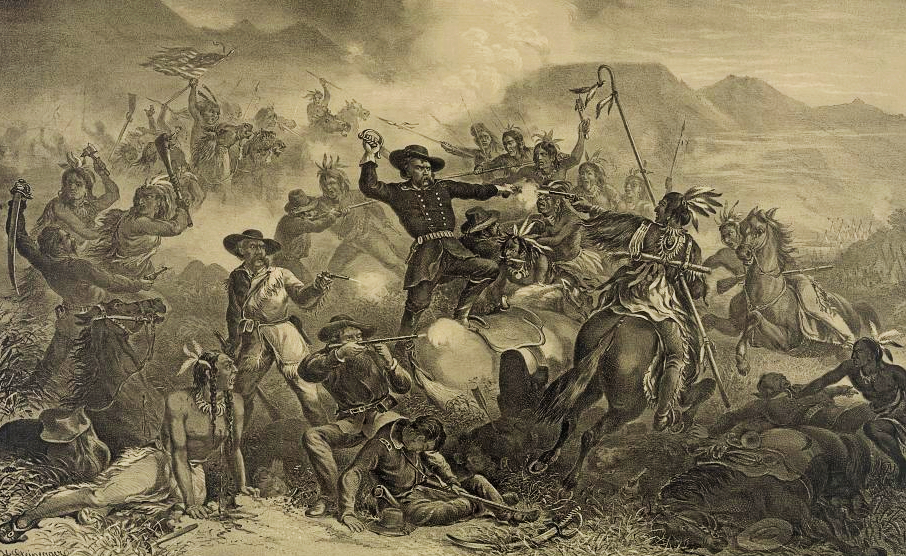
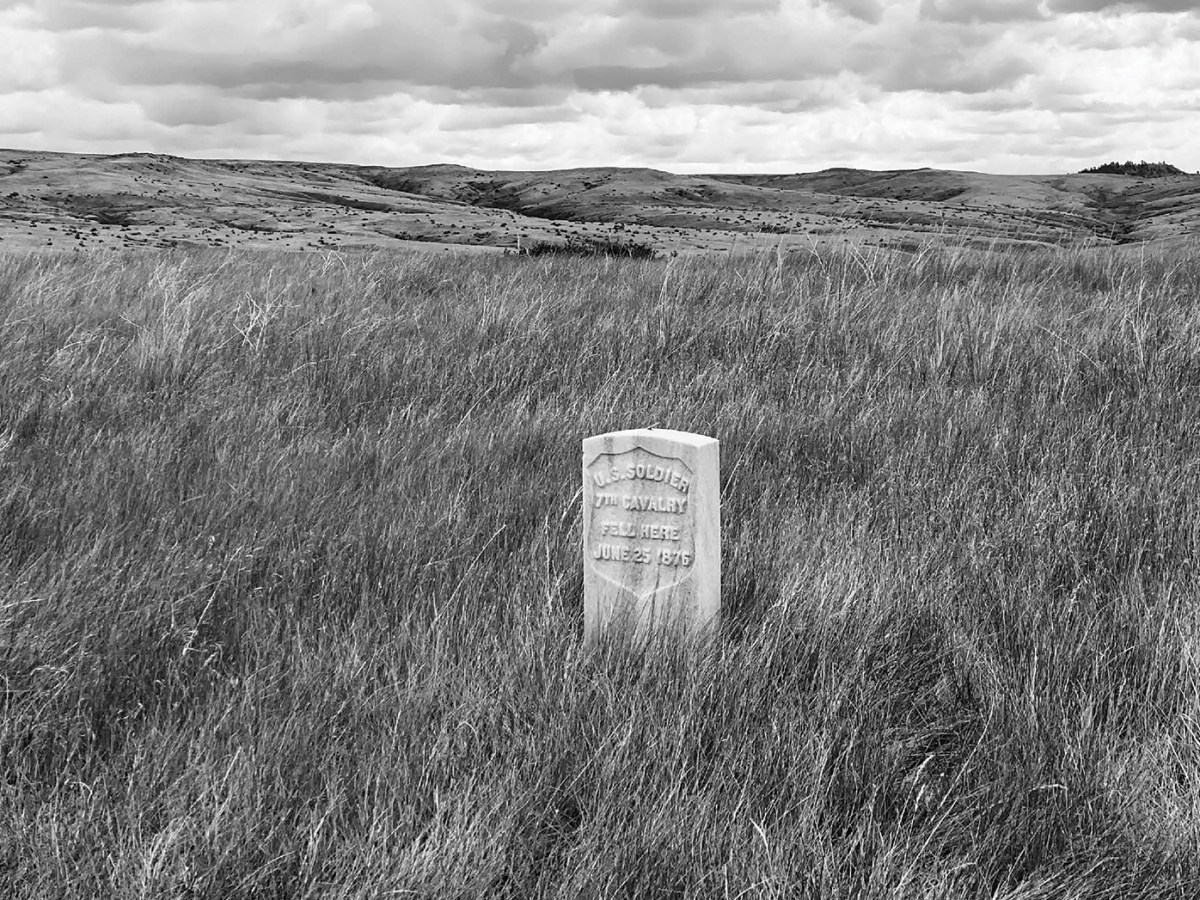
In the years between 1876 and the later 1920s, 70 grizzled galoots and geezers told amused journalists and historians that they were the lone survivors of the Battle of the Little Bighorn. Their stories fell into one of three predictable patterns: disguised themselves as Indians by wrapping up in blankets; hid inside a scooped-out horse or a scooped-out buffalo; rescued by the chief’s daughter, who found them irresistible.
Recommended for you
One man’s story was completely different—because he was actually telling the truth.
But before this article, the last few points of confirmation that clinch Frank Finkel as a survivor of Custer’s Last Stand were hidden in the National Archives, the U.S. Census Bureau and the records of the Columbia County Auditor’s Office in Dayton, Wash. After the discovery of the final pieces of the puzzle, with information from published books, it is clear that Finkel was what he claimed to be—the only known white survivor of the five companies that followed Lt. Col. George Armstrong Custer to the banks of the Little Bighorn River in Montana Territory on June 25, 1876.
Finkel Joins the Army
Frank Finkel was born in January 1854 in Washington County, Ohio, the third son of Peter and Magdalena Finckle, German immigrants who owned a farm valued at $500 in the 1860 U.S. census, about the average for that time and place. The census taker spelled the name “Finkle” in 1860, continuing the drift from the Germanic “Finckel” to the Americanized “Finkel” that occurred through Frank’s long life. Peter and Magdalena Finkle had six sons and a daughter, and while they spoke German at home, they sent their children to public schools, so that Frank Finkle grew up bilingual and fully literate in English. Peter Finkle died in 1868, and some of the older sons, including Frank, left a farm that was too small for six men and went to look for work.
Down on his luck in Chicago in January 1872, Frank Finkle did what a lot of young men did if they were “too proud to beg and too dumb to steal”—he enlisted. Joining the U.S. Army in 1872 was an admission of economic incompetence if you were a native-born American as Frank Finkle was, and a lot of young men signed up under assumed names, but Frank Finkle went the government one better: He assumed a name that could help him win prestige and promotions.
He Germanized his name still further by calling himself “August Finckle” and put down his birthplace as “Berlin, Prussia,” and his occupation as “clerk.” The year before “Finckle” enlisted, Prussia had scored a double-edged victory over Louis-Napoleon and over the new Republic of France. Prussian soldiers were in greater demand than they had been in the days of Baron von Steuben, and Frank cashed in. Keeping his own birth date on January 23, he updated his age from 18 to 27 and was shortly telling gullible troopers of the 5th and later the 7th Cavalry, like his German-born buddy Charles Windolph, that he had been an officer in the Prussian army. Frank’s imposing height (a shade over 6 feet), dark hair, gray eyes and language skills helped him make sergeant in two years.
By 1876, Finkle was the second sergeant of C Company, 7th Cavalry, commanded by Captain Tom Custer, a high-morale unit whose soldiers, like the officers, were Custer partisans in the heavily polarized 7th Cavalry. When the soldiers were issued huge, floppy Andrews hats that made them look like buccaneers, C Company was one of five companies where the men chipped in their own money to buy snappier hats from a Chicago retailer. The incident touched off fireworks when George Custer received a slap on the wrist from the designated post trader, who warned him against shopping off-post. Post traderships were a scandalous monopoly; investors who never saw an Army post hired the actual traders to deal with soldiers and random Indians and expected a 50 percent kickback. The soldiers at the frontier posts paid outrageously inflated prices for everything from whiskey to canned peaches, while supplies meant for the Indians simply disappeared. The one thing that the Indians could depend on was a steady flow of 1866 16-shot Henry repeating rifles, now rendered surplus because of the later-model Winchester 1873 but still worth $75 on the day when the Indians received their cash annuities. Government policy kept the Indians hungry and better armed than the troopers sent to keep an eye on them, whose rifles were single-shot Springfields.

this article first appeared in wild west magazine


The powder keg of graft blew up when the Sioux refused to sell the Black Hills in 1875 and many of the younger men left the agencies to join “the Sitting Bull Sioux”—Hunkpapas and other so-called hostiles whom Army officers called “self-supporters.” George Custer, who had gotten himself in trouble in Washington testifying about the potentially lethal post trader swindle, had to do some fast talking to win back a role in the campaign to force the Sioux back to their agencies. The 7th Cavalry, including Tom Custer’s C Company and 2nd Sgt. Frank Finkle, set out from Fort Abraham Lincoln in Dakota Territory as one of three swords swung against the hostiles.
George Custer refused three Gatling guns and a 3-inch Rodman cannon for his column, as well as two companies of the 2nd Cavalry, his first Civil War outfit. He had few doubts. C Company appeared less confident. Tom Custer was said to have been nervous before the battle, and his second-in-command, Lieutenant H.M. Harrington, was having recurrent nightmares about being tied to a tree and tortured by Indians. First Sergeant Edwin Bobo had bought a spare .22-caliber pistol by mail order—but forgot to bring it. As they drew near the Little Bighorn, C Company found a white man’s scalp on a stick. Third Sergeant Jeremiah Finley—Irish-born, Civil War veteran, Custer admirer and Finkle buddy—stowed the scalp in his saddlebag, perhaps with the idea of giving it a decent burial. The men were jittery. The sight of the biggest Indian village they’d ever seen on June 25 did nothing to calm them down.
finkel’s horse falls behind
C Company led the charge down to the Little Bighorn—such as it was. Finkle had trouble keeping up, probably because his height and weight imposed a heavy burden on his horse; he was the tallest enlisted man in the 7th Cavalry and one of the heaviest.
“I was riding close to Sergeant Finkle,” Sergeant Daniel Kanipe remembered in 1924. “We were both close to Capt. Tom Custer. Finkle hollered at me that he couldn’t make it, his horse was giving out. I answered back, “Come on, Finkle, if you can.” He dropped back a bit….If Sergeant Finkle had not dropped back a few minutes before, he would have got the orders [to bring up the ammunition pack train]—and I would not be telling this story.”
Sergeant Kanipe, the next to last man to see the Custer brothers alive, was sent back with orders to speed the pack mules and their 24,000 rounds of Springfield ammunition forward, leaving his buddy Finkle and his struggling horse to follow the Custer brothers down to the river. At least four C Company troopers dropped out with “horse troubles”—two with blown horses, two probably from cowardice—but Sergeant Finkle was with C Company when the company reached the stream.
What happened then is the source of endless debate.
last stand and finkel’s escape
The archaeology of Richard Allan Fox Jr. suggests that George Custer stopped at the river and moved back into three defensive positions. C Company, with Tom Custer and Sergeant Finkle, was one of two companies on what came to be called Calhoun Hill, overlooking the Hunkpapa village. The Indians had been sleeping off an all-night courtship dance the night before, but two green troopers rode into their village and started shooting whatever moved until they were unhorsed and killed. Major Marcus Reno hit the huge encampment on the other side. The unseen warriors exploded out of their tepees—armed with all those repeating rifles the post traders had sold them. The 7th Cavalry was outgunned 10-to-1 by the Indians they came to encircle. Finkle told reporters that the men were ordered to mount, and that as he was firing, an Indian bullet struck the butt of his Springfield carbine and slammed the bare steel barrel into his forehead. He was hit twice more—once in the leg, once in the side—a bullet slashed his horse’s bridle, and another grazed his horse’s flank.
Bolting into the oncoming Indians along with those C Company men who hadn’t already been killed or unhorsed, Finkle was carried through the angry Indians charging uphill to protect their families and down Calhoun Hill, beyond the Hunkpapa camp at the foot of the hill and out onto the plains.
“One long sword escaped,” Rain-in-the-Face told W. Kent Thomas in 1894. “His pony ran off with him and went past our lodges [at the foot of Calhoun Hill]….I remembered hearing the squaws tell about it after the fight.”
Finkle wasn’t the only one to get past the Indians momentarily. Lieutenant Harrington’s body was never found, though a skeleton found years later and miles from Calhoun Hill might have been his. Corporal John Foley of C Company also broke through the cordon and was chased for miles by three teenage Indians armed only with bows. The three boys were out of arrows when Foley panicked and shot himself in the head with his own Colt .45. As many as eight men from C Company might have gotten through the Indians, only to be ridden down and killed far from the battlefield—the pro-Custer Crow Indians found six skeletons with 7th Cavalry equipment years later, and nobody from the Army even bothered to go out and look. Trooper Nathan Short made it as far as the Rosebud River—more than 20 miles—before he and his horse both collapsed and died.
GET HISTORY’S GREATEST TALES—RIGHT IN YOUR INBOX
Subscribe to our HistoryNet Now! newsletter for the best of the past, delivered every Wednesday.
Back inside the circle of desperation and death, Sergeant Finley had been unhorsed and wounded or killed. First Sergeant Bobo, his horse dead, walked back grimly toward Custer Hill for the Last Stand while other, less courageous troopers panicked and frantically tried to escape or—according to the Indians—shot themselves. Bobo died in the so-called Keogh Sector. Tom Custer died with his brothers George and Boston, nephew Autie Reed, and their brother-in-law, Lieutenant James Calhoun.
Finkle kept riding, dazed and hurting, on his frantic sorrel. Somewhere in the next day and night, he crossed the three branches of Tullock’s Creek, later reporting—correctly, according to the 20th-century topography of Dr. Charles Kuhlman—that the two southern branches were polluted with alkali, but the northernmost branch was fresh and sweet.
Days after the disaster, Finkle reached the confluence of the Rosebud and Yellowstone rivers and put his dying horse out of its misery with a single pistol shot to the head. Lieutenant Edward Godfrey of the 7th Cavalry found the horse in August and realized that there had been a survivor. Godfrey reported the dead 7th Cavalry horse in 1892 but—significantly—didn’t mention that it had been a C Company sorrel or light bay until 1921, in an account unpublished until the 1950s. (The other four companies in the color-coded, or “blooded,” 7th Cavalry rode dark bays or gray horses down to the river.)
Back at the battlefield, Sergeant Kanipe found Finley’s body with a dozen arrows in it and found Finley’s horse, Carlo.
“I looked over the dead and recognized here and there a buddy and a sergeant that I knew,” he said. “I recognized Sergeants Finkle and Finley. Sergeant Finley lay at his horse’s head, he had 12 arrows through him. They had been lying there for two days in the sun, bloody and the wounded mutilated….The squaws would always, after taking the clothes off the men, shoot them full of arrows or chop them in the faces with tomahawks.” Kanipe never found Finkle’s horse, and while he said he saw Finkle, he provided no plausible explanation of how he identified a butchered corpse after two days of 100-degree weather. Sergeant Charles Windolph, Finkle’s best friend and a survivor of the fighting on Reno Hill, ventured back to the field of slaughter expressly to find Finkle’s body—and said he couldn”t find it.
Cabin in the wilderness
Wandering the wilderness, Finkle discovered a white man cutting wood outside a shack in the middle of the uncharted territory. The man started at the sight of his uniform and ordered him away at gunpoint. Finkle collapsed, and the man relented and helped him to his feet. Inside the shack, another white man was sprawled on a crude bed, his face gaunt and pallid, clearly dying of tuberculosis. The two men—the healthier one was known only as Bill—took turns doctoring Finkle. They probed the wound in his leg with a pine splinter, then poured hot pitch on it. Finkle passed out.
When he came to, he found that the bleeding had finally stopped and that the wound in his side, treated with bear grease, had also closed. For the next few weeks, Bill took care of Finkle, and Finkle helped Bill take care of his dying friend. The man finally died, and Finkle and Bill buried him under a simple marker. Then they split up. The men had told Finkle they were “trappers” but more likely they were gunrunners or whiskey traders; he said later that he never saw any traps at the cabin.
Perhaps leery of his status as a “deserter”—Custer had ordered some deserters shot in 1867, leading to his own court-martial conviction and a year’s suspension—Finkle discovered that his entire company had been wiped out at the Little Bighorn. His own name appeared, fourth from the bottom on the front page of the Bismarck Tribune. Now officially dead, he may have decided that he’d had enough of the Army. He later told his second wife that he tried to claim a discharge but was unable to prove he’d been a soldier without two witnesses—which sounds like a cover-up for the fact that his successful escape could also be construed as desertion in the face of the enemy.
He knocked around St. Louis for about a year working in the dairy business, then visited California and discovered Dayton, Wash. Finkle used his sparse money and his skills in carpentry and farming to speculate in land, building thriving farms, then selling some of them and buying more vacant land. In 1886—near his birthday—he married Delia Rainwater, the daughter of Jacob Rainwater, one of the most prosperous farmers and civic leaders in Dayton. Finkle signed the marriage certificate book “Finckle” but the marriage license “Finkle.” On his wedding night, Finkle’s teenage bride asked about the old gunshot wound on his left side. He told her he’d been shot in a fight with some Indians. He didn’t say where the fight took place. The slug eventually worked its way to the surface, and Frank had a surgeon take it out.
Finkel’s story comes out
Through the 1890s, Finkle continued to buy and sell farms—and his signed name gradually shifted from “Finkle” to “Finkel.” The lot numbers and Delia’s name indicate he was the same person. By 1920, Frank and Delia had four children—three lived to grow up, including Ben, who served several terms in the Idaho Legislature—and they were moderately wealthy and respected citizens of Dayton. In April 1920, at a game of horseshoes perhaps lubricated by beer, Frank unexpectedly went public with his status as a Custer survivor. Another farmer made some remarks about poor old Custer being ambushed by Indians.
“You don’t know what the hell you’re talking about,” Frank said bluntly.
“How do you know so much about it,” his crusty neighbor shot back.
“I was there….”
Somebody asked Frank to talk about the Battle of the Little Bighorn at the Dayton Kiwanis meeting, and after his neighbors hired a relief carpenter to finish a porch Frank was working on, he obliged. The article appeared in the April 8 issue of the local newspaper:
Dayton, April 8. — Frank Finkle, a pioneer resident of Columbia county, was the chief speaker at the Thursday luncheon of the Dayton Kiwanis Club this week. He was eyewitness to the Custer Massacre and gave to the club the account of his thrilling escape and the circumstances that prevented the knowledge of his survival from reaching the government at the time. Congressman John W. Summers of Walla Walla was a guest at the luncheon and he will make an effort to get government recognition of Mr. Finkle’s story.
In giving the account of the battle in which General Custer’s command was pocketed by the Indian forces Mr. Finkle said his horse became “kettler” and bolted through the Indian lines carrying him to a territory beyond the fighting. He had two serious bullet wounds and after many days of wandering he found a cabin in the wilderness where he was months recovering from his injuries.
Nobody who knew him doubted he’d been there. The journalist obviously didn’t understand when Finkel used the term “skedaddled” and wrote “kettler,” but the Civil War slang term for a panicked flight brands Finkel as a veteran of the Old Army.
But Finkel told one more whopper that compromised his story for future generations. Frank had joined the Army in 1872, a year after the Franco-Prussian War, and lived and worked in Dayton through the later 19th century, when the hard-working, music-loving Germans were the best-loved minority in America. World War I changed all that, and in 1920 the Germans were blamed for everything from “German measles” to the influenza epidemic. Finkel originally said that his name was on the roster, and made no bones about it when the story first broke. He also claimed to have had papers that were lost in a house fire that provided further confirmation.
Later, when somebody found “August Finckle” on the casualty list, his second wife appears to have fudged and denied that he’d ever been August Finckle—whose bogus birthplace was recorded as “Berlin, Prussia.” When his second wife attempted to pursue the pension he could have won, she claimed that he’d enlisted under the name “Frank Hall.” Frank Hall, 5-foot-6, brown eyes and 14 years older than Finkel, had deserted the 7th Cavalry in May of 1875, a year before the battle.
On June 25, 1921, the 45th anniversary of the battle was marked with ceremonies, and the newspapers spoke to Frank Finkel again. Finkel told one reporter:
The battle opened with an attack on an Indian village. General Custer led one set of troops while Major [Marcus] Reno headed another.
Custer’s forces rode on to the attack until suddenly there was a thunder of yells as the Indians sprang from behind every bush and poured over the hilltops.
Men and horses went down all around me. A bullet hit my rifle stock and a splinter of steel started blood flowing between my eyes. My horse bolted and carried me, half blinded, through the Indian lines.
Then came a stinging sensation in my shoulder, and I lost consciousness, falling forward on my horse. When I came to, it was dark. Early next morning I reached the mountains.
For five days I rode, eating raw rabbits in fear of attracting the Indians if I build a fire.
On the sixth day I met some trappers and stayed with them until September….
Delia Finkel died in August 1921 after a brief illness. “Her husband, who survived her, was the only soldier who escaped the Custer massacre,” one obituary blandly noted. Frank Finkel’s signature on the probate to Delia’s will, written 49 years after he joined the Army in Chicago, is in the same handscript as his signature on the enlistment form. Ben Finkel, one of Frank and Delia’s two surviving sons, had already moved to Idaho and was involved in state politics, which might have been another good reason to keep “Berlin, Prussia,” out of the public prints.
second wife eyes pension
In 1926, Frank Finkel married his second wife, Hermie, an Anglo-Saxon born in Canada who adored him and knew something about his status as a Custer survivor—but nothing about the Old Army or the Indians. Frank himself died at 76, wealthy and in no need of a pension, in August 1930.
Hermie subsequently remarried and became Hermie Billmeyer, the wife of an apparently unsuccessful mom-and-pop grocer in Oshkosh, Wis. With the onset of the Depression, Hermie needed that pension—and perhaps, also, the collateral fame of being the widow of the only Custer survivor. For the next 20 years, until her own death in 1951, she relentlessly contacted every government official and Custer historian in the United States trying to establish a status that Frank and his neighbors in Dayton had taken for granted. Hermie, unfortunately, was locked into the story that Frank had enlisted under the name of Frank Hall—and somewhere picked up the idea that he had enlisted at Council Bluffs, Iowa, in 1874 and had served as a private and acting corporal.
She tended to mess things up. One of the last newspaper stories, written a dozen years after Frank was dead, describes him playing dead the night after the Little Bighorn and then shooting an Indian who came to investigate—something Frank never said when he was alive. Ostensibly honest, Hermie purposefully denied that Finkel and Finckle were the same person—the tallest enlisted man in the 7th Cavalry at just over 6 feet tall, with light eyes, and dark hair, as established by Hermie’s own memories of Frank and by the “Finckle” enlistment form from Chicago. She was obviously more afraid of “Berlin, Prussia,” than he had been, since he appears to have mentioned his name on the 1876 casualty list quite freely before his son Ben got into politics in Idaho.
Hermie also appears to have been jealous of the late Delia, obviously the true love of Frank Finkel’s life, because Hermie claimed that Delia never knew anything about Frank’s military service—when in fact Delia as a teenage bride had seen the gunshot wound and had known for at least 18 months before her death that Frank was an acknowledged Little Bighorn survivor, as mentioned in her obituary. Hermie did find out that Sergeant Charles Windolph, who was awarded the Medal of Honor for his actions on Reno Hill, remembered Finkel, went back to find his body, and couldn’t locate it—an excellent confirmation. (After Frank, Windolph and Hermie were all dead, the last two in 1950 and 1951, critics of the “August Finckle” story circulated reports that Frank Finkel had been offered the chance to meet Windolph and had backed out—but that wasn’t true. Windolph didn’t learn of Finkel’s purported survival until long after the man was dead, and said he would have loved to meet his old friend: “He was a gallant soldier.”)
Hermie probably never knew about the dead sorrel horse Godfrey found in August 1876—color-keyed to C Company. “Here was the one chance I knew of where a man may have escaped the fate of his comrades,” Godfrey wrote in a letter not mailed until 1921, after Finkel went public, and not published by E.A. Brininstool until after Finkel, Hermie and Windolph had all died. “I have met several who claim to have escaped, and have heard of many others, but never one who identified himself by this incident.”
Hermie certainly never knew that only C Company could have been a plausible source of survivors, because the C Company breakup and breakout wasn’t well-documented before Richard Allan Fox’s groundbreaking study of the Little Bighorn in the 1980s. Something of the kind had certainly been suggested by Rain-in-the-Face in the 1894 interview, where he described a lone white survivor escaping past the Hunkpapa camp at the base of Calhoun Hill before the circle closed.
“We were better armed than the long swords,” Rain-in-the-Face said. “Their guns wouldn’t shoot but once—the thing [ejector] wouldn’t throw out the empty cartridge shells….It was just like killing sheep. Some of them got on their knees and begged; we spared none.” Instead of expanding from the Rain-in-the-Face account, Hermie tried to peg Finkel to a white horse in a dubious Indian account—and overlooked the factual escape account of Rain-in-the-Face, a genuine and undoubted Little Bighorn warrior, who even claimed he had later seen Finkel in Chicago.
Finkel correctly insisted that his horse had been a roan—a C Company sorrel. He knew the terrain well enough to satisfy the compulsive topographer Charles Kuhlman, who calibrated distances with three different odometers. Finkel used Old Army slang correctly, had gunshot wounds and a military bearing, and was a perfect forensic match for a man known to have fought at the Little Bighorn, who was supposedly buried there but who was never properly identified among the dead. Above all, Finkel described the battle not as romanticized in the 1880s through the 1940s, but as described by the 7th Cavalry survivors like Captain Frederick Benteen and the Indians in the 1870s, and clinched by the cartridge-case and slug analysis of Dr. Fox in the 1980s—a rout where C Company broke up and fled, scattering corpses (and one fugitive) all over the landscape before most resistance in the other four companies collapsed. Hermie Finkel fooled the people who tried to follow Frank’s trail with her name game, but Frank Finkel really was a Custer survivor. The world that justified expansion, shrugged off graft, glorified Custer and defamed the Indians just wasn’t ready for one.
New Jersey journalist John P. Koster, who with Robert Burnette wrote The Road to Wounded Knee (1974), says that InHye Lee contributed significant archival and editorial research to his story. Suggested for further reading: Archaeology, History, and Custer’s Last Battle, by Richard Allen Fox; The Custer Myth, by Col. W.A. Graham; and Custer in ’76, by Kenneth Hammer.
This article was written by John P. Koster and originally published in the June 2007 issue of Wild West magazine.
historynet magazines
Our 9 best-selling history titles feature in-depth storytelling and iconic imagery to engage and inform on the people, the wars, and the events that shaped America and the world.