
It was a classic setting for international intrigue, a tile-roofed villa secluded among fog-swirled trees, ivy clinging to building wings clustered around a stunted steeple-like tower. The first group of conspirators landed at a French airfield outside Paris and reached the wall-enclosed villa in an unmarked car during the wee hours of October 22, 1956. Later that Monday morning, French Foreign Minister Christian Pineau visited his office in Paris, then was chauffeured home to switch to his personal car. He soon was at the villa shaking hands with Israel’s 70-year-old Prime Minister David Ben-Gurion, eye-patched Chief of Staff Moshe Dayan and Defense Ministry Director-General Shimon Peres. British Foreign Minister Selwyn Lloyd, a key member of the third group of plotters, called his office in London to say he was staying home with a cold. He left England shortly after, to arrive at the villa that afternoon.
By the time the tense clandestine discussions–which also included French Premier Guy Mollet and British Prime Minister Anthony Eden–ended two days later in France and England, a secret accord had been reached. Champagne glasses were raised to celebrate a tripartite pledge to pursue what one chronicler called ‘the shortest and possibly silliest war in history.’ The target was Gamal Abdel Nasser’s Egypt, which had become the symbol of Arab nationalism.
Israel, still territorially insecure after 8 1/2 years of existence among hostile Arab neighbors and cut off from access to the Red Sea by a blockade, had agreed to launch a pre-emptive invasion of Egypt’s 24,000-square-mile Sinai Peninsula on October 29. In response to that ‘threat’ to the strategically important Suez Canal, Britain and France would step in the next day to give the belligerents 12 hours to stop fighting, pull back from the strategic waterway and accept temporary occupation of ‘key positions on the Canal’ to ‘guarantee freedom of passage.’ That ultimatum, so obviously favorable to Israel, was designed to be rejected by Nasser. Then, on October 31–following a ‘decent interval’ for Egypt’s rejection of the ultimatum–Britain and France would launch airstrikes against the Egyptians. Invasion forces would then land long enough afterward to lend plausibility to the scenario.
The British had been stunned when Nasser legally nationalized the Suez Canal on July 26, 1956. The takeover gave Egypt oversight of the principal oil flow between Middle Eastern wells and Western Europe, as well as Britain’s easy access to its interests east and south of Suez. Outwardly the paragon of unruffled British dignity, handsome Anthony Eden actually was nervous and short-tempered, refusing to accept his country’s declining world role. The prime minister also was suffering the chronic aftereffects of less-than-successful bile duct operations, and was taking amphetamines and other drugs that probably affected his judgment. France, which had initiated the secret meetings with Israel in June 1956, was motivated by the belief that Nasser was behind the nationalist-inspired war that was then agitating Algeria, her North African possession. One thing the three conspirator nations had in common was the conviction that Nasser, who was upsetting the Mideast balance of power by accepting Soviet military and economic assistance, had to go.
The trio did not expect the United States, which had clashed politically with Nasser over his recognition of Communist China and acceptance of Soviet Bloc arms, to pose a major problem. Furthermore, 66-year-old President Dwight D. Eisenhower had his hands full with an election campaign sure to be influenced by the strong Jewish vote. The plotter nations ignored the fact that as much as Eisenhower wanted Nasser out, he was dead set against the use of direct force. The Soviet Union, meanwhile, was busy putting out fires in its satellite states. Poland had ousted its Soviet defense minister on October 19 and installed its own choice in the premiership. By October 24, Soviet tanks were in Budapest, trying to suppress a Hungarian uprising.
As the three conspiring nations formulated their plot at Sèvres, they also set in motion military preparations. The Anglo-French buildup was a tortoise compared to Israel’s hare, which would be able to mobilize 100,000 troops almost overnight and even make a feint eastward toward Jordan. Although Britain had 750,000 men under arms, many were committed to operations in the Far East, Africa and Cyprus. Shipping and aircraft needed for a major operation were in short supply. On August 2, an emergency mobilization proclamation for 25,000 men had been rushed to Queen Elizabeth II at the Goodwood races; wags insisted she signed her approval ‘on the rump of a horse.’ The French, somewhat more battle-ready after their Indochina war, nevertheless would have to borrow troops from their Algerian force. The nearest post suitable for gathering an invasion force was Valetta, on British-controlled Malta, nearly 1,000 miles northwest of the projected landing beaches.
At first dubbed Hamilcar, the operation was soon renamed Musketeer, presumably in honor of Alexandre Dumas’ three musketeers. Although the three-country scenario was essentially a French brainchild, Britain, as the major contributor to the invasion, assumed command of the Anglo-French portion of the military operation. General Sir Charles Keightley was named Musketeer commander, with heavyset French Vice Adm. Pierre Barjot as his deputy. The landing force chief was British General Sir Hugh Stockwell, seconded by French Maj. Gen. André Beaufre, a testy veteran of Indochina and Algeria. Air Marshal Dennis Barnett and Admiral Robin Durnford-Slater were placed in charge of the air and naval units, respectively.
The bipartite air-sea-ground force consisted of approximately 45,000 Britons and 34,000 Frenchmen; 200 British and 30 French warships, including seven aircraft carriers; more than 70 merchant vessels (‘It is tragic having to requisition liners at the height of the tourist season,’ wrote one British official); hundreds of landing craft; and 12,000 British and 9,000 French vehicles. Counting base and support units as far away as the British Isles, more than 100,000 uniformed Anglo-French personnel were committed to the operation. Musketeer called for landing at Alexandria, in the Nile River delta, and advancing to the capital of Cairo, while Israel took care of Egypt’s right flank. In keeping with the ambivalence that clouded the entire operation, the landing site was shifted eastward–to Port Said, the target originally selected during earlier planning. Musketeer now became Musketeer Revise. In the meantime, responding to the military buildup, Nasser moved half of his Sinai forces west of the canal, although he was still unwilling to believe an invasion would ever occur.
Murphy’s Law was a constant companion to the scattergun imprecision of the operation. There were postponements, endless meetings, detail changes, logistical and other problems, and both internal and external dissension. For example, it took weeks, using a commercial moving company, to cart 93 tanks to their English Channel embarkation port. There, the materiel most urgently needed upon landing was inconveniently stowed at the bottom of transport holds. An episode during the Franco-Israeli plotting stage before the Sèvres accord graphically illustrated the convoluted conspiracy’s shortcomings. In a watch-this-hand-so-you-don’t-see-what-the-other’s-doing act, Ben-Gurion triggered a large armored foray into neighboring Jordan, the base for many Arab raids into Israel. Jordan invoked its defense treaty with Britain against a full-scale Israeli invasion. The too-clever deception ploy nearly precipitated an implausible, unwelcome war that could have seen Britain fighting against Israel in the east and with Israel in the west. In any case, the Protocol of Sèvres marked the point of no return. Invasion orders flashed to the military chiefs.
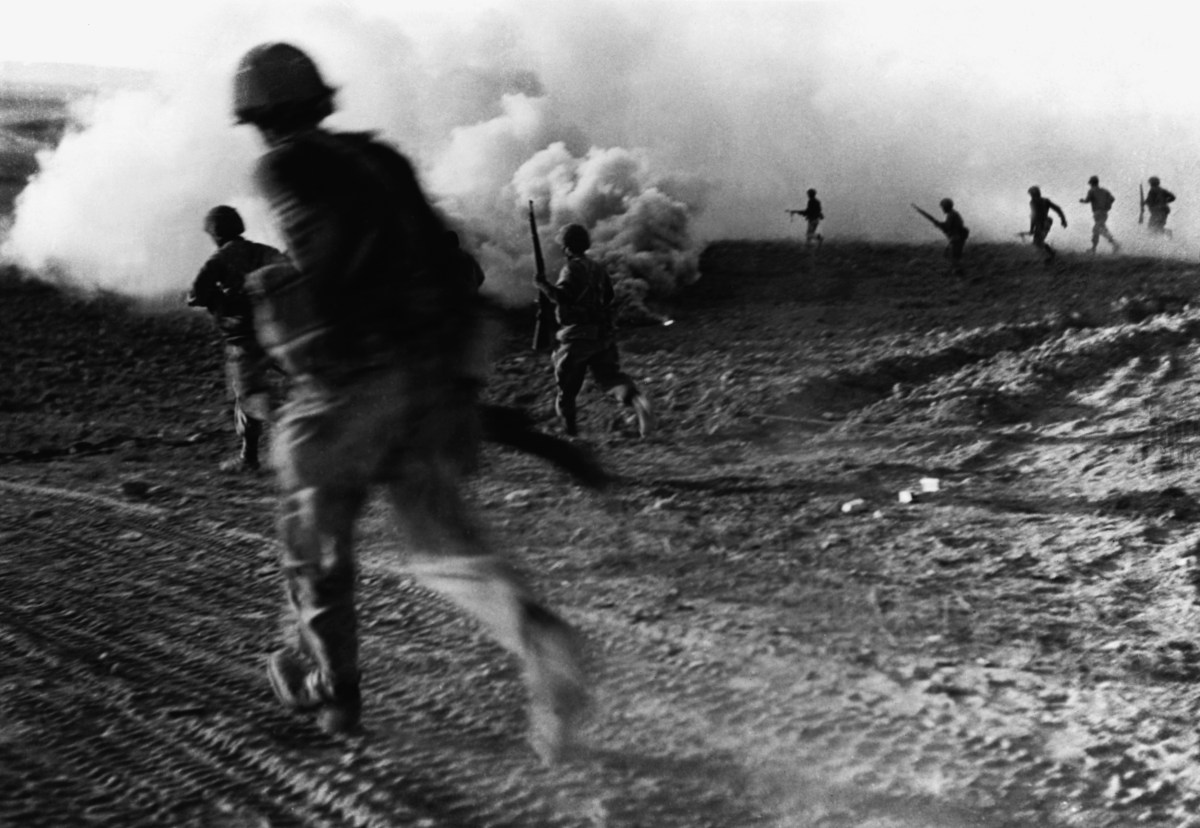
Israel went into action at between 2:15 and 2:35 p.m. on October 29, 1956. Two pairs of piston-engine North American F-51 Mustang fighters raced westward over the parched wasteland of the triangular Sinai Peninsula. Swooping to a dozen feet over the desert, the American-built planes used propellers and wingtips to sever overhead telephone lines linking the 30,000 men of the Egyptian 3rd Infantry and Palestinian 8th divisions and their subordinate units. It was the modest beginning of Kadesh, Israel’s operation to threaten the Suez Canal, open the Gulf of Aqaba to its shipping into the Red Sea and destroy Egyptian military capabilities in the Sinai.
About an hour later, two battalions of Colonel Ariel Sharon’s 202nd Parachute Brigade–roughly 3,000 men riding M3 half-tracks, French-made AMX-13 tanks and 100 trucks received from France only three days earlier–stormed into Egyptian territory. Sixteen low-flying Israeli Douglas C-47 Dakota transports and their escort of 10 British-built Gloster Meteor jets rumbled overhead. Having evaded radar detection, the camouflaged Dakotas rose to 1,500 feet about 18 miles east of the canal. At 4:59 p.m., the first of 395 paratroopers of the 202nd Brigade’s 1st Battalion leaped into space to land unopposed just east of the strategic Mitla Pass. The invaders dug in at the granite-flanked eastern entrance to the pass to await the arrival of Sharon’s column, churning across more than 105 miles of sun-baked desert toward them. The linkup came at 10:30 p.m. the following day. Behind Sharon’s brigade, other Israeli units swung into action. During the ensuing week, they swarmed west and south–along the 134-mile-long Sinai Mediterranean coastline, across the heart of the peninsula, down the eastern side along the Gulf of Aqaba toward the southern tip on the Red Sea, and finally down the western perimeter along the Gulf of Suez. Israel had surprised Egypt and given its co-conspirators their ‘justification’ for intervention.
Nearly a week before Operation Kadesh was launched in defiance of a no-war appeal from Eisenhower to Ben-Gurion, three squadrons of French aircraft had discreetly landed in Israel. All were marked with the distinctive yellow and black stripes that would identify allied planes during the campaign. One squadron, composed of Dassault Mystère IVA jet fighters, was tasked with preventing air raids on Israeli cities. A second, equipped with American-built Republic F-84F Thunderstreaks, would support the Mystères and provide ground support. The third, made up of twin-boom Nord Aviation Noratlas transports, went into action only four hours after the parachute landing at Mitla Pass. The French aircraft roared overhead to parachute down eight jeeps, weapons and other supplies. To ice the cake, three French destroyers protected the approaches to the Israeli ports of Tel Aviv and Haifa.
Although President Eisenhower later insisted that he first learned of the outbreak of hostilities by ‘reading it in the newspapers,’ he knew that aircraft of the Central Intelligence Agency (CIA) were taking high-altitude photos of the allied activities. Further information came from human sources in London, Paris and Tel Aviv. U.S. spy chief Allen Dulles later claimed that ‘intelligence was well alerted as to what Israel and then Britain and France were likely to do….In fact, United States intelligence had kept the government informed.’ At an October 27 State Department meeting, CIA Deputy Director Robert Amory said, ‘I’m positive the Israelis will attack shortly after midnight tomorrow….I’m prepared to lay my job on the line that there’s a war coming tomorrow or the day after.’ It was no accident that a Lockheed U-2 spy plane was 70,000 feet above the Sinai on October 29. Its CIA pilot, Francis Gary Powers of the top secret Detachment 10-10, based in Turkey, ‘looked down and spotted something. Black puffs of smoke–that must have been the first shots fired in…the Sinai campaign.’ Powers himself would make headlines in 1960, when his U-2 was shot down over the Soviet Union.
Late on October 30, the Anglo-French appeal-cum-ultimatum was handed to Egypt and Israel–cease fire and withdraw to positions 10 miles from the Suez Canal. The ultimatum expired at 4:30 a.m. the next day. Israel, still miles from the canal and with no intention of halting its offensive, played out the charade by accepting. As expected, Egypt rejected it. Hours passed as the Israelis, facing reinforced Egyptian resistance, wondered what had happened to the promised British strikes against enemy airfields. A flu-stricken Ben-Gurion, long distrustful of Britain’s pro-Arabism, prepared to recall his forces. His allies hadn’t told him that they had postponed the air raids until dark for a number of military and political reasons. Far to the west, during the night of October 31-November 1, the Anglo-French invasion armada sailed from Malta and Algeria. A day later, a smaller contingent loaded at closer-by Cyprus.
Even before the 12-hour ultimatum expired, the war at sea began. The Egyptian frigate Ibrahim al-Awal, lobbing 4.5-inch shells at Haifa, was fired upon by a French destroyer and Israeli air and sea units. Captured, the frigate was towed in and later became part of the Israeli navy. The following night, the British cruiser Newfoundland sank the Egyptian corvette Damietta at the southern end of the canal. On November 3, four Israeli jets mistakenly attacked the British frigate Crane in the Gulf of Suez. The damaged warship shot down one attacker. The French cruiser Georges Leygues steamed off the Gaza Strip to bombard Arab positions on the Mediterranean shoreline.
On the evening of October 31, Royal Air Force (RAF) English Electric Canberra and Vickers Valiant bombers from Cyprus and Malta dropped explosives on Egyptian airfields. The Halloween raid shocked Nasser into ordering his Sinai forces to speed west of the canal to defend the country’s heartland. Early the next morning, a U-2 sailed over Cairo West Airport, its film recording undisturbed parked aircraft. The CIA plane made a sweeping turn to pass over the field once more. The second set of photos, snapped 10 minutes later, showed planes and buildings on fire. Telephotoed a set of pictures, the RAF responded with, ‘Warm thanks for the pix. It’s the quickest bomb damage assessment we’ve ever had.’
De Havilland Venoms of the RAF and Armée de l’Air Thunder streaks from Cyprus pounced on canal zone airfields. Royal Navy Hawker Sea Hawks and de Havilland Sea Venoms from the carriers Eagle, Bulwark and Albion swooped on three fields in the Cairo area. The flak was light, and all the attackers returned. By early afternoon, the carriers were 50 miles offshore and launching a fresh sortie every few minutes. On Cyprus, planes were taking off or landing at the rate of one a minute. The jets were joined by turboprop Westland Wyverns from the British flattops and propeller-driven Vought F4U Corsairs from the French carrier Arromanches, which was accompanied by Lafayette, carrying Grumman TBM Avengers and helicopters. Corsairs sank an Egyptian torpedo boat and damaged a destroyer off Alexandria. The vessel Akka was attacked by Sea Hawks as it was being towed into the main channel midway down the canal and sunk. The 347-foot-long ship, filled with cement and debris for the purpose, was the first of numerous vessels scuttled to cause the canal’s first major blockage in its 87-year history. British bombs also tumbled the key Firdan Bridge into the shipping lane. Nasser and the British had thus deprived the conspirator nations of their stated purpose–keeping the waterway open.
Egypt accepted the United Nations call for a cease-fire on November 2. Israel, assuming it could achieve its objectives before one went into effect, accepted the next day. But persuaded by his co-conspirators that this would nullify the Anglo-French intervention, Ben-Gurion withdrew Israel’s acceptance by setting impossible conditions. Allied airstrikes continued. The Arabs had evacuated most of their newer Soviet-built aircraft–Mikoyan-Gurevich MiG-15 fighters to Syria and Saudi Arabia, and Ilyushin Il-28 jet bombers far up the Nile River to historic Luxor. French Thunderstreaks from Cyprus paused to refuel at Tel Aviv’s Lydda Airport, then sped south to savage all 18 Il-28s. Israel’s two antiquated Boeing B-17 Flying Fortresses flew nuisance raids against Cairo while its other planes kept the skies clear over Sinai. Since Egyptian aerial opposition was virtually nonexistent, the allied losses of seven aircraft and three pilots were due to anti-aircraft fire and accidents. Interestingly, it took 44 allied squadrons, dropping 1,962 bombs in 18 attacks on 13 targets, most of two days to destroy 260 planes, compared to the three hours it would take Israel’s air arm alone to demolish some 300 Egyptian aircraft during the Six-Day War of June 1967. The air activity, blending into an elaborate but error-ridden allied propaganda blitz, merely strengthened the defiance of Egypt’s civilian population, which was issued weapons to carry out Nasser’s radio appeal to ‘fight bitterly, oh compatriots.’
The next phase of Musketeer (the Revise had been dropped), originally to consist of simultaneous parachute and amphibious landings, was revised again when the French insisted on speeding things up. Now, paratroopers would land ahead of seaborne forces. In the early darkness of November 5, the 3rd Battalion of the British 16th Independent Parachute Brigade Group, the ‘Red Devils’–more than 600 men with recoilless anti-tank guns, mortars, machine guns and jeeps–boarded obsolete Handley Page Hastings and Vickers Valetta transports on Cyprus. Its drop zone was Gamil airfield, located on a narrow strip of water-flanked land three miles west of Port Said. The paras were to push into the city for a linkup with amphibious forces the following day.
At another Cyprus airfield, 487 men of the Coloniale of General Jacques Massu’s crack 10th Division Parachutiste and 100 men of Brig. Gen. Jean Gilles’ 11th Demi-Brigade Parachutiste de Choc (Shock Demi-Brigade), supplemented by a British company, boarded 17 transports. The French troops were battle-hardened veterans of Indochina and Algeria. Gilles was to coordinate tactical communications between battlefield, warships, support aircraft and General Keightley’s Cyprus headquarters from an airborne command post circling overhead. The French had two drop zones. One was a sandy neck between the Suez Canal and a dead-end canal on the south side of two bridges spanning the Raswa Channel below Port Said. The second zone lay on the east side of the Suez Canal atop a water-flanked golf course south of Said’s twin city of Port Fuad.
While the land battle for the canal was about to begin, the war between the ‘belligerents’ (Israel and Egypt) was ending 265 miles to the southeast at the tip of the Sinai Peninsula. The first major airborne assault of the postwar period began with airstrikes. The paratroop-laden transports droned above the convoy carrying men scheduled to land the next day. At 7:15 a.m., the first stick of parachutists stepped into the bright, nearly windless air 600 feet above Gamil air base. The drop was completed within 15 minutes. Replacing their drop helmets with red berets, the Britons mopped up a defending national guard battalion and a company of reservists in 30 to 45 minutes.
At 7:30 a.m., two lines of Noratlas transports, only 75-90 feet apart, buzzed 300-400 feet above white-sailed fishing dhows on Lake Manzala. They dropped four lines of men onto the first French landing zone in precisely four minutes. The French paras were firing as they touched down in an Egyptian position. After a brisk action, they secured the main Raswa road-and-railroad bridge, Port Said’s only land link to the south, by 9 a.m. The second Raswa bridge, a smaller pontoon structure, had been blown up by the defenders a half hour earlier. Within an hour or so, Said was cut off from Egyptian reinforcements. The city’s defense, led by Brig. Gen. Salah ed-Din Moguy, consisted of three reservist battalions and 600 riflemen formed into national guard battalions. A trainload of arms also was there for distribution to the inhabitants. Moguy centered his defense on the Manakh native section of town, using four Soviet SU-100 100mm self-propelled guns as mobile points of resistance. The second French airdrop, 506 men of the 10th Paras, landed in mid-afternoon at Port Fuad across the canal and swiftly eliminated virtually all resistance.
A second British drop at Gamil reinforced the Red Devils with 100 men and equipment. The French, with their objectives attained, sent a patrol motoring six miles southward preparatory to the next day’s expected drive toward Qantara and Suez. A parley requested by General Moguy resulted in a temporary cease-fire, but fighting resumed at 10:30 p.m.
Although the Soviet Union’s position in the Suez crisis was as helpless as was the United States’ regarding Hungary’s uprising, Premier Nikolai Bulganin sent written thunderbolts from the Kremlin to London, Paris and Tel Aviv. The Red leader’s notes used threatening phrases like ‘rocket weapons,’ ‘third world war,’ ‘use of force’ and a threat to ‘the very existence of Israel,’ all open enough to interpretation to be an effective bluff. The Soviets had been apprised of the tripartite conspiracy by their agents in France, Egypt and Israel. Most important among those agents were army reserve Colonel Israel Beer, who became Ben-Gurion’s personal secretary, and Ze’ev Goldstein, an Israeli Ministry of Foreign Affairs official and veteran of the Red Orchestra spy network of World War II fame. The Soviets also had an Egyptian spy, Sami Sharif, Nasser’s future chief secretary. Yet, unlike Washington, Moscow did not try to head off the crisis. The Anglo-French intervention gave the Soviet Union a stronger Mideastern role as a friend of the Arabs and diverted world attention from its brutal suppression of the Hungarian uprising. In any case, the United States promised to join Britain and France if the Soviets intervened.
Even as the invasion armada loomed on Port Said’s horizon, plan changes were radioed from London. First, ‘no gun of greater caliber than 4.5 inches will be fired.’ This eliminated the devastating firepower of the cruisers and the 15-inch guns of the French battleship Jean Bart, which was doubling as a transport, carrying most of two divisions from Algeria. A second order canceled pre-landing air and naval bombardments entirely. The on-the-scene commanders wisely decided to differentiate between ‘bombardment’ and ‘gunfire support.’ Musketeer’s amphibious phase began on November 6 with a 10-minute air sweep of the landing beaches and a 45-minute barrage by destroyers. The landing craft churned landward from ships lined up five miles offshore–Numbers 40 and 42 Commandos of the Royal Marine 3rd Commando Brigade and C Squadron of the 6th Royal Tank Regiment toward Said’s casino pier; the French Foreign Legion’s 1st Regiment Étranger de Parachutistes with a squadron of AMX-10 tanks, complemented by three regiments of the 7th Division Méchanique Rapide (Mobile Mechanized Division), toward Fuad.
Fifteen amphibious tracked vehicles, each carrying 30 men, wobbled like angry metal bugs from gaping British tank-carrier doors into the choppy sea at 4:30 a.m. as mine sweepers moved aside. Other landing craft deposited their loads at the surf line. Fourteen waterproofed Centurion tanks ground ashore alongside the canal’s western breakwater. The Commandos landed on both sides of the casino pier to advance into Said behind the tracked vehicles against harassing sniper fire. During an improbable duel between a destroyer and an SU-100, slum buildings in Fuad burst into flame. By early afternoon, the 16th Parachute Brigade’s 1st and 2nd battalions and the tank regiment’s A Squadron had disembarked in the main harbor. The French, meanwhile, landed unopposed on the other side of the canal’s eastern breakwater. The minimal resistance they encountered in Fuad was partly due to the thorough savaging the paratroopers had given the Egyptians the day before.
Aboard the British carriers Theseus and Ocean, the Royal Marines of No. 45 Commando prepared for the first helicopter-borne assault landing in history. An hour after the initial landings, No. 45 Commando’s Lt. Col. Norman Tailyour lifted off Theseus‘ flight deck to reconnoiter his unit’s touchdown site. The chopper descended into smoke-blanketed Port Said to set down in a sports stadium. Tailyour had barely made it back aboard when a hail of Egyptian gunfire peppered the helicopter. Back in the air, he designated the canal entrance by the western breakwater as a safer landing zone. Minutes after 8 a.m., the first wave of Westland Whirlwind Mark 2s, each carrying five green-bereted marines, moved away from Ocean. It was shortly followed by a flight of smaller helicopters, each with three soldiers aboard. Whirlwinds from Theseus joined them. The aircraft passed the beckoning arm of a giant statue of canal builder Ferdinand de Lesseps in successive waves to hover nearby just above the ground as the troops leaped out. Within 83 minutes, 22 choppers put ashore 415 marines and 23 tons of stores. The whirly-birds then brought in reinforcements and supplies, and ferried out the wounded, including 18 marines who had been strafed in error by a Fleet Air Arm fighter-bomber.
The British were frequently fighting house-to-house battles. General Moguy’s capture made little difference to either side as the Egyptian resistance became increasingly vicious and disorganized. The 3rd Battalion paras made a tenuous linkup with No. 45 Commando in the evening. Had they been less impulsive, the Egyptians could have captured many of the invasion force high command. Misinformed that the enemy was ready to surrender at the Canal Company building in Port Said, Generals Stockwell and Beaufre, Admiral Durnford-Slater and Air Marshal Barnett chugged in a motor launch past the de Lesseps statue inside the canal. The small boat was only 100 yards from the Canal Company building when Egyptian gunners fired on them from the imposing, three-domed structure. Bullets hit the launch as it swerved away. As a spent slug dropped between them, Durnford-Slater said to Stockwell, ‘I don’t think, general, that they are quite ready to receive us yet.’ An SU-100 supported Egyptian assault on the captured waterworks was broken up by French aircraft. Two nearby oil tank farm containers erupted into flames, sending up columns of greasy black smoke that lingered for days. Soon afterward, the French paras and No. 42 Commando linked up at the Raswa bridge. As the fighting raged in Egypt, thousands of miles to the west, Americans began casting 57 percent of their votes for Eisenhower, who was applying intense political and economic pressure on London and Paris to stop fighting and pull out.
Eden, ill and rattled by the growing pressure at home and abroad, finally caved in. The French, still eager to finish the campaign, were told of the British decision by phone. The ‘cease fire at midnight’ order reached General Stockwell after 7:30 p.m. Aghast at being ‘thwarted in the midst of success,’ he reasoned that midnight in London was 2 a.m. in his war zone. The general ordered Brig. Gen. M.A.H. Butler, the wiry Irish commander of the Red Devil brigade, to ‘get as far down the canal as possible.’ Butler led his tank-supported 2nd Parachute Battalion speeding down the 300-yard-wide tarmac causeway between the canal and Lake Manzala. Musketeer, intended to topple the ‘Moslem Mussolini’ Nasser and control the entire Suez waterway, came to a premature end after less than 43 hours of ground war. At 2:20 a.m. on No vember 7, Butler’s force abruptly halted at Al Cap, about a fourth of the way down the canal and a mere 23 miles south of Port Said. Allied military reaction to the political meddling was summed up in a cable Stockwell sent to London: ‘We’ve now achieved the impossible. We’re going both ways at once.’
In mid-November, the first elements of a newly created, blue-helmeted United Nations Emergency Force, soldiers from half a dozen neutral states, reached the canal zone. A day earlier, the Soviets had completed their suppression of the Hungarian uprising. The last of the Anglo-French forces steamed out of Port Said just before Christmas. Israel tried to hold out, but also finally gave in to irresistible military and economic pressures to evacuate the last of its conquered ground in early March 1957. The following month, the Suez Canal was reopened after the removal of 51 obstructions ranging from scuttled ships to demolished bridges. During the two-front war, Egypt fielded about 150,000 men, some 50,000 of whom were committed against Israel. It lost an estimated 1,650 dead, 4,900 wounded and 6,185 captured or missing, most in the Sinai clashes. Israel, with about 45,000 of its 100,000 ground troops engaged in just over 100 hours of combat, lost 189 dead, 899 wounded and four captured. Britain’s ground fighting forces numbered about 13,500, France’s some 8,500. In all, they lost between 23 and 33 killed (some sources disagree on the number), and 129 wounded.
Britain, using 19th-century gunboat diplomacy in vain hopes of retaining imperial prestige with American consent but without offending other Arab nations, was the big loser in the Suez fiasco. The crisis marked the century’s lowest point in U.S. British relations, the Commonwealth was shaken and British assets in Egypt were confiscated. In January 1957, sick and embittered, Eden resigned. Suez proved to be a slow-burning fuse for France. Its soldiers returned to the Algerian war angry over ‘political betrayal.’ In 1958, seeing another successful war being lost by politicians, they joined the European Algerians in toppling France’s Fourth Republic and bringing Charles de Gaulle to power. The loss of Algeria followed. Suez also convinced France to become militarily and politically independent.
Musketeer proved to the world that the British and French were no longer superpowers. The result was a Middle Eastern power vacuum that could only be filled by the United States and the Soviet Union. Israel, besides demonstrating its growing military prowess, gained access to the Red Sea, enabling the gradual development of the port of Eilat. With the insertion of a U.N. force on its southwestern border, Israel also won a respite from Egypt-based guerrilla raids. Ironically, it was only after Suez that the Arabs of Israel showed the first clear signs of unrest, a portent of the violence to come in later years. Nasser remained in power, and a crack appeared in the North Atlantic Treaty Organization, accompanied by Anglo-French animosity and suspicion.
The war’s ultimate victors were Egypt and the Soviet Union. Nasser, who left to himself might never have gained the stature he did, emerged a hero of the Muslim world. Egypt’s ownership of the Suez Canal was affirmed. The Soviet Union, after long peering through the keyhole of a closed door on what it considered a Western sphere of influence, now found itself invited over the threshold as a friend of the Arabs. Shortly after it reopened, the canal was traversed by the first Soviet warships since World War I. The Soviets’ burgeoning influence in the Middle East, although it was not to last, included acquiring Mediterranean bases, introducing multipurpose projects, supporting the budding Palestinian liberation movement and penetrating the Arab countries.
Perhaps the most dramatic demonstration of both the end of European supremacy over the canal and the angry zeal of Arab nationalism came on Christmas Eve 1956. Egyptians surrounded the 40-foot-high de Lesseps statue at Port Said. They put up a ladder and placed explosives between the stone pedestal and the bronze figure of the canal builder. As crowds cheered, an eruption of fire and smoke toppled the 57-year-old symbol of colonial domination.
This article was written by Wilfred P. Deac and originally published in the April 2001 issue of Military History magazine.
For more great articles be sure to subscribe to Military History magazine today!